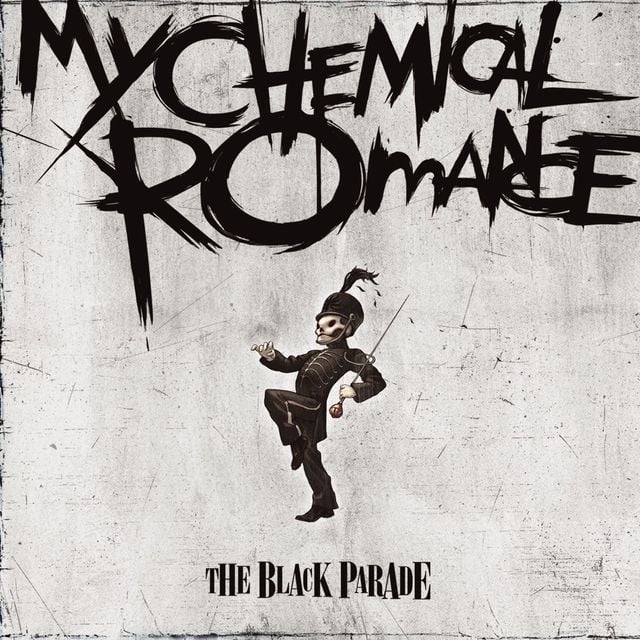

In October 2006, My Chemical Romance's The Black Parade sold 240,000 copies in its first week and still finished second. The Hannah Montana soundtrack beat it to No. 1. Twenty years later, on the Billboard 200 dated November 7, 2026, The Black Parade finally reached the top.
It was the New Jersey band's third album, a full rock opera about a dying man known only as The Patient. They wrote much of it in a Los Angeles mansion they believed was haunted. Their bassist left partway through to get help for depression and drinking.
The album turned a cult emo band into one of the biggest rock acts in the world. Its 20th-anniversary reissue sent it from No. 139 to No. 1 in the US. No album has ever waited longer for its first week at the top.
“The Black Parade… is the best mid-Seventies record of 2006, a rabid, ingenious paraphrasing of echoes and kitsch from rock's golden age of bombast.”
A Punk Band Chasing Queen and Ziggy
By 2006, My Chemical Romance had two albums behind them: I Brought You My Bullets, You Brought Me Your Love (2002) and Three Cheers for Sweet Revenge (2004). The band was Gerard Way on vocals, his brother Mikey on bass, Ray Toro and Frank Iero on guitars, and Bob Bryar on drums. They led the emo and post-punk scene, but were still, in Louder's phrase, one of “the biggest little cult bands in the world.”
The band itself began with a disaster. Way watched the Twin Towers fall from New York on September 11, 2001, and the first song he wrote for the group, “Skylines and Turnstiles,” came out of that day. Fricke called them “very much a band of their time — post-9/11,” and noticed how much fire and rubble runs through the new songs.
Their first two albums told a horror-movie story about two outlaw lovers, vampires and a deal with the devil. Way described them as “a meditation on immortality.” The new album, he said, was “a meditation on mortality.”
For album three, they looked back to 1970s rock. Way named two concept albums as models: David Bowie's Ziggy Stardust and Pink Floyd's The Wall.
“It's almost as if we're trying to spearhead some kind of neo-classic rock movement,” he told Kerrang! soon after release. “Bringing the pageantry and the theatre back. Paying tribute to those old songs – not ripping them off, but a total tribute. We wanted to capture that glory, that over-the-top-ness and that essence of classic rock in the ’70s.”
Queen was the other obvious influence, and Way cited the band in interviews. To produce, they hired Rob Cavallo, who had made Green Day's 2004 concept album American Idiot. NME pointed out that the two records shared a label, a producer, a video director and an A&R department. Cavallo has said the Green Day album was built to resist iTunes chopping records into 99-cent songs: “we wanted to combat this and make an album that had to be heard as a whole.”
The comparison stuck. Ray Toro later linked the album's centerpiece to Green Day's “Jesus of Suburbia.” “That song had about five or six different movements,” he said of “Welcome to the Black Parade.” “The closest thing I could relate it to is Green Day's Jesus Of Suburbia where you have all these different parts of a song which all work together.”
Ghosts in the Paramour Mansion
Much of the album was written at the Paramour Mansion in Silver Lake, Los Angeles, a house with a reputation for being haunted. “I think environment is important in the writing and production, and the mansion was a cool, spooky place to go,” he told MusicRadar in 2026.
“It was absolutely haunted and freezing in there as there was no heat in the giant basketball sized living room.”
Cavallo set the band up to play live in that room. “We put a PA in, hung a couple of fancy mics in there to record them stereo live,” he said.
Gerard Way had vivid dreams and night terrors in the house, and some went straight onto the record. The spoken passage that opens “Sleep” was recorded when he woke up in a cold sweat and grabbed his voice recorder. Another passage in the song came from recurring dreams about “Joan of Arc and brimstone and damnation.”
Ray Toro told drummer Bob Bryar he had seen a ghost in his room.
The hardest time belonged to Mikey Way, who was struggling with serious depression and alcohol addiction. “The band had engulfed all of us and I found it overwhelming,” he told author Tom Bryant. “Recording Black Parade was the moment it all came to a head. I just had to go fix myself.” He left the band temporarily to get help, and later returned.
Gerard Way has described the mood plainly. “When we were at the Paramour in pre-production basically still writing, things got kind of dark,” he said on Apple Music 1. “The place, we liked it, but it had this weird energy that it was kind of haunted.” Once the songs were written, the band recorded them at Eldorado Recording Studios, and Chris Lord-Alge mixed the album.
The Patient and His Parade
The album tells one story. A young man, The Patient, is dying of cancer. The idea behind the title, as NME explained it in 2006, was that death arrives in the form of your most vivid memory. The Patient's is a childhood trip with his father to see a marching band, so death comes for him as a parade.
From there the songs move through his death, his afterlife and his memories. The album has its softer side too. NME called the ballad “I Don't Love You” “this album's ‘Boulevard Of Broken Dreams’,” and Tucker singled it out as one of the record's good power ballads. The bleakest moment is “Cancer,” which NME described as “just Gerard and a piano” delivering “a first-person account of death from cancer.”
“Teenagers” is the exception. Way wrote it, he said, as “a commentary on kids being viewed as meat; by the government and by society.” Cavallo says the story was always bigger than what reached the record. “Gerard is such a prolific writer, he has backstories for all his records, he just doesn't show you,” he said.
The band went further than a concept. For the album and its tour, they took on an alter ego, also called The Black Parade, with matching uniforms and a new look. NME saw the point: as The Black Parade, the group could adopt whatever style each chapter of the story needed. The musical style that ties it together, NME decided, was “of all things musical theatre.”
By then Way had white-blond hair. Ken Tucker, reviewing for NPR, described him as having “the upturned chin hauteur of a man who wears rock stardom like a uniform,” and read the band's tight black suits as “symbols of their bleak integrity.”
The lead single and the band's only UK No. 1, which topped the Official Singles Chart for two weeks in October 2006.
Essential Tracks
“Welcome to the Black Parade”
The album's signature song nearly didn't make it. It began years earlier as a punk song called “The Five of Us Are Dying.” “We just kind of had this punk song that was really cool and we liked it, but nothing about the song was speaking to me,” Way told Apple Music 1. Rather than drop it, the band took it apart and rebuilt it around the idea of the parade.
The fix started with a new opening. “It was around this time that I wrote the opening melody for piano that [producer] Rob [Cavallo] played,” Way said. That single piano note, then the slow march, then the explosion into punk, gave the song the multi-part shape Toro compared to “Jesus of Suburbia.” Louder calls the result “a sort of updated Bohemian Rhapsody,” the Queen epic from A Night at the Opera.
It became the band's biggest hit. In the UK it jumped 22 places to No. 1 with 34,000 sales and stayed there for two weeks, their only UK No. 1 single.
In the US it reached No. 9 on the Billboard Hot 100. Fricke heard in it the album's only real hope, “whenever Way hits the vocal hook.”
“Mama”
“Mama” is the strangest song on the record and the one critics talked about most. Way sings as a soldier covered in blood, raging at the mother who gave him life, over a lurching, cabaret-style rhythm.
Halfway through, Liza Minnelli appears. Fricke described her as belting “her two big lines only to have Way sing back at her with vicious obscenity.” He called it “brassy casting, as if Minnelli has been dropped into a Glenn Danzig production of Bertolt Brecht's Mother Courage and Her Children.”
NME called it “a vaudeville riot.” More than any other track, it shows how far the band had moved from the punk of Three Cheers for Sweet Revenge.
“Famous Last Words”
The album's closing song proper is partly about the band's own troubles that year, including Mikey Way's decision to step away. In the story, it is The Patient's last stand. Outside it, the band later pointed to its closing line as the real message of the whole album.
The video shoot was rough. The band filmed in front of real flames, and Louder reports that Gerard Way tore muscles in his leg and foot while Bob Bryar suffered third-degree burns to his hands and legs. Fricke was cool on the track, writing that the album's vintage sound “loses luster by Tracks Twelve and Thirteen,” meaning “Disenchanted” and this one.
Listeners disagreed. “Famous Last Words” became one of two further UK top-ten singles from the album, alongside “Teenagers.”
Shot in front of real fire; Bob Bryar was badly burned and Gerard Way injured his leg during filming.
Beaten to No. 1 by Hannah Montana
The Black Parade came out on Reprise on October 23, 2006, and a day later in the US. It sold 240,000 copies in its first American week. The soundtrack to the Disney Channel's Hannah Montana, starring Miley Cyrus, sold 281,000 and took No. 1.
The Hollywood Reporter called it “another TV-driven smash” for Walt Disney Records. In the UK, the album also peaked at No. 2, the first of a string of top-20 albums there.
Critics mostly approved, with reservations. Fricke praised the album's “glam-Godzilla guitars and spook-choir hurrahs” but complained that “the excess comes with diminishing returns.” NME predicted it was “about to turn the late MCR into the biggest band on the planet.”
Fricke heard 1970s rock everywhere. The opener, “The End,” “blows up like an outtake from Alice Cooper's Billion Dollar Babies.” “Dead!” was “like Queen's ‘Keep Yourself Alive’ in widow's weeds,” and “Teenagers” was “a tight fist of T. Rex-style crunch.” NME heard something newer: “a crisp, vast, and fiercely melodic kind of stadium punk that is barely emo in the slightest.”
On NPR's Fresh Air, Ken Tucker found it more enjoyable than its reputation. “My Chemical Romance has made a big, messy, pretentious album that turns out to be what the band probably did not intend, a lot of fun,” he said. He called the title track “My Chemical Romance's clearest homage to Queen.” His main complaint was the lyrics: “So much talk of death, isolation, pain, blood, betrayal, lies, infection, even cancer.”
The world tour that followed had the band performing as The Black Parade, in costume. It was hit by injuries and illness, including food poisoning, but by the end of it they were, as Louder put it, “true global superstars.”
Kasabian and the “Suicide Cult” Panic
Success brought attacks. In 2007, Kasabian singer Tom Meighan dismissed the band in the press. “It's like ventriloquists' music,” he said. “It's weird and dark. They don't have anything positive to say. The only good news is that it won't last.”
The Daily Mail went further, trying to cast My Chemical Romance as a “suicide cult” band. It claimed the title was “a nickname for the place where Emo fans believe they will go when they die.”
The band answered with a statement. “The message and theme of our album The Black Parade is hope and courage,” it read. “Our lyrics are about finding the strength to keep living through pain and hard times.” They pointed to the closing line of “Famous Last Words,” a refusal to be afraid of living.
Twenty Years Later, No. 1 at Last
My Chemical Romance made one more album, Danger Days: The True Lives of the Fabulous Killjoys (2010), which reached No. 14 in the UK. They split up in 2013. They reunited for a world tour that the pandemic pushed back to 2022. In July 2025 they began a tour built around The Black Parade, including two sold-out nights at London's Wembley Stadium, a hometown stadium show in New Jersey and five nights at the Hollywood Bowl.
The 20th-anniversary edition arrived on October 23, 2026, in more than 20 physical versions with bonus tracks. In the US it earned 78,000 units in its first week, 68,000 of them pure sales, and jumped from No. 139 to No. 1.
Vinyl accounted for 42,000 copies, the band's best week ever on the format, and the album's songs were streamed more than 10 million times that week.
Billboard called the wait of 20 years the longest ever for an album to reach the top, beating the previous record of 15 years and nine months set by Toby Keith's 35 Biggest Hits after his death. Counting from their first chart appearance in 2004, the band had waited 22 years and four months for a No. 1. They were the third act in 2026 to wait at least ten years for a first chart-topper, after Megadeth and Jhené Aiko.
It beat Olivia Rodrigo's new album, and Rodrigo had publicly cheered the band on after meeting them at their Citi Field show in New York. My Chemical Romance marked the news with an Instagram story set to Miley Cyrus's “Wrecking Ball,” which Rolling Stone read as a nod to the Hannah Montana loss in 2006. In the UK the same reissue gave them their first No. 1 album, with Amy Winehouse's Back to Black anniversary edition at No. 4 that week.
The anniversary was not the album's first second life. In 2021, the Official Charts Company tied a mainstream emo revival, led by Olivia Rodrigo and Willow, to bands like My Chemical Romance. By then “Welcome to the Black Parade” was still being streamed about 300,000 times a week in the UK alone.
Way has said the theme was there from the start. “The triumph of the human spirit over darkness was something that was kind of built into the DNA of the band from the beginning,” he told the My Turning Point podcast. “There's darkness in the world. And I think overcoming that darkness, that darkness externally and internally, is a beautiful thing.”
“We want this to be the album that My Chemical Romance is remembered for. We all have records that shaped our childhood and teen years. When you hear a song, it shoots you back to a moment in time. We want this album to do that for people.”