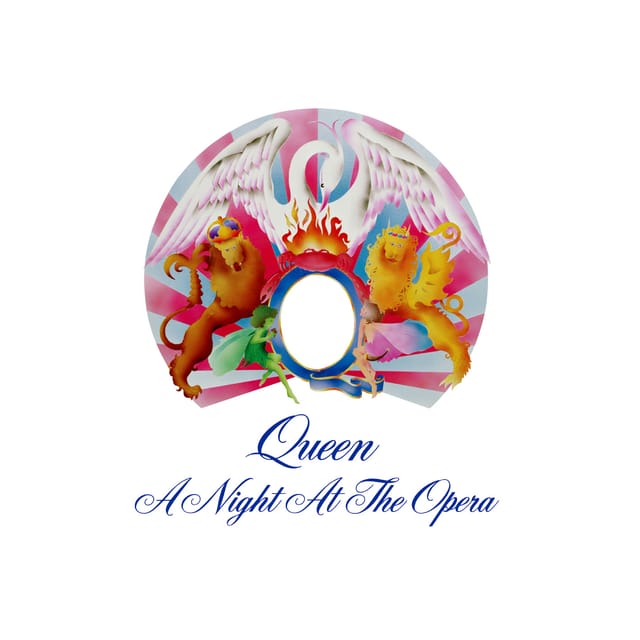

In the summer and fall of 1975, Queen moved between seven different studios across Britain. They spent £40,000 of borrowed money, an unprecedented sum, on an album built around one song that broke every rule of radio programming.
“Bohemian Rhapsody” was nearly six minutes long and had no chorus. It veered from ballad to opera to hard rock, with more vocal overdubs than anyone had tried before. EMI executives were convinced the band had lost their minds. Instead, Queen had made their masterpiece.
We were doing things that really hadn't been done before, so there was a degree of experimentation.
Fifty-one years after its release on November 21, 1975, "A Night at the Opera" stands as one of rock's most audacious artistic statements—an album where four working-class Brits transformed their medium into high art. With production costs that rivaled small films and ambitions that dwarfed their contemporaries, Queen created something unprecedented: a rock album that functioned as a complete artistic statement while delivering some of the genre's most enduring anthems.
The album's creation began in earnest at Rockfield Studios in Wales during the summer of 1975, where Queen had retreated to craft their fourth album. Unlike previous efforts, this time they came armed with a clear mandate: create something completely unprecedented. Each band member arrived with compositions that pushed boundaries—Freddie Mercury's operatic "Bohemian Rhapsody," Brian May's multi-layered guitar symphonies, Roger Taylor's aggressive rockers, and John Deacon's sophisticated pop arrangements.
The Alchemy of Ambition: Four Minds, One Vision
Producer Roy Thomas Baker, returning from their successful "Sheer Heart Attack," pushed the band's perfectionist tendencies further than on any previous record—the operatic middle section of "Bohemian Rhapsody" alone reportedly required well over 100 separate vocal overdubs. Financially, the stakes could not have been higher: the band was deep in debt to their management at the time. "We owed everybody money," Brian May later said. "We knew that if the next album didn't succeed, the ship would sink. But we were defiant."
The recording process resembled more a theatrical production than a traditional rock album. Mercury would arrive with operatic arias sketched out on napkins, May brought guitar arrangements that required mathematical precision to execute, and Taylor pushed his drum sounds into territory that bordered on orchestral percussion. Deacon, the band's most reserved member, contributed bass lines that served as the gravitational center holding these ambitious compositions together.
The album's most famous track, "Bohemian Rhapsody," required production techniques that had never been attempted in popular music. The operatic middle section alone took three weeks to record, with Mercury, May, and Taylor layering vocals to create a full choir sound. The 24-track tape machine at Sarm Studios was pushed beyond its limits, with some sections containing so many overdubs that the tape became transparent from repeated playback.
Studio as Concert Hall: The Revolutionary Production
Engineer Mike Stone worked alongside Baker to push the available 24-track tape technology well past what it was designed for—layering vocal and guitar overdubs until some reels reportedly grew thin from repeated use. The band's insistence on perfection meant that single guitar solos might take days to complete, with May layering multiple parts to create what he called "orchestral guitar" sounds.
The album's sonic ambition extended beyond individual tracks. Queen conceived the record as a journey through different musical worlds—from the vaudevillian charm of "Lazing on a Sunday Afternoon" to the gothic drama of "The Prophet's Song." Each song required its own sonic architecture, demanding recording techniques that Baker and Stone essentially invented during the sessions.
“Bohemian Rhapsody”
Perhaps no single song in rock history has generated more analysis, controversy, and pure wonder than "Bohemian Rhapsody." Mercury's operatic epic defied every convention of radio programming while delivering one of the medium's most emotionally devastating confessionals. The song's structure—ballad to opera to hard rock—mirrors the album's overall ambition to transcend genre limitations.
The technical achievement remains staggering: 180 separate overdubs creating a full operatic chorus from just three voices, guitar parts that required mathematical precision to synchronize, and a production that made a six-minute genre-hopping epic sound completely natural. Mercury's vocal performance ranges from intimate whispers to operatic bombast, showcasing a four-octave range that few rock singers could match.
The lyrics, shrouded in mystery for decades, represent Mercury's most personal statement—a coded confession wrapped in operatic grandeur. Lines like "Mama, just killed a man" and "Nothing really matters" suggested deeper autobiographical content, but Mercury never confirmed the song's meaning, preferring to let the music speak for itself.
The groundbreaking promotional video that helped establish MTV's visual language and proved rock could be cinematic art.
The Calculated Risk: Commercial Gamble as Artistic Statement
EMI's executives viewed "A Night at the Opera" with considerable alarm. The production costs exceeded those of most major films, and the lead single violated every rule of radio programming. At nearly six minutes, "Bohemian Rhapsody" was three times longer than the standard radio single, contained no conventional chorus, and switched genres multiple times within a single song.
The gamble paid off spectacularly. "Bohemian Rhapsody" became the UK's best-selling single of 1975, staying at number one for nine consecutive weeks—a feat that wouldn't be matched until the 1990s. The album itself reached number one in the UK and established Queen as major international stars, proving that audiences were hungry for music that challenged their expectations.
“You're My Best Friend”
Written and sung by bassist John Deacon, "You're My Best Friend" provided the album with its most straightforward pop moment while maintaining Queen's sophisticated musical approach. The song marked Deacon's emergence as a significant songwriter within the band, offering a lighter counterpoint to Mercury's operatic dramatics and May's guitar orchestrations.
The track's distinctive sound came from Mercury's use of the Wurlitzer electric piano, creating a warm, intimate texture that perfectly complemented Deacon's romantic lyrics written for his wife Veronica. The production showcased Roy Thomas Baker's ability to adapt Queen's layered approach to simpler material, with subtle harmonies and careful arrangement decisions that elevated what could have been a throwaway pop song into album-worthy material.
"You're My Best Friend" became the album's second major hit single, reaching #7 in the UK and #16 in the US, proving that Queen's appeal extended beyond their more theatrical material. The song's success demonstrated the band's versatility and helped establish them as hitmakers capable of balancing artistic ambition with commercial appeal—a skill that would define their career.
“Love of My Life”
If "Bohemian Rhapsody" showcased Queen's bombastic theatrical side, "Love of My Life" revealed their capacity for intimate beauty. Mercury's tender ballad, accompanied primarily by May's delicate acoustic guitar work, demonstrated the band's dynamic range and emotional sophistication. The song's simple structure belied its sophisticated harmonic content and Mercury's most vulnerable vocal performance.
The recording featured innovative use of the harp, played by Mercury himself, and showcased May's classical guitar training. The song's bridge section, with its unexpected modulations and baroque-influenced progression, revealed the formal music education that all four band members brought to their rock compositions. Live performances would later transform this intimate studio creation into massive sing-along moments, with audiences worldwide taking Mercury's vocal lines.
The song's enduring appeal lies in its perfect balance of sophistication and accessibility—complex enough to reward repeated listening, yet immediate enough to connect with casual listeners. It became a template for the power ballad format that would dominate arena rock throughout the 1980s.
A Night At The Opera was a hugely important album. It opened up the world for us.
The album's success transformed Queen from critical darlings into mainstream superstars, and more importantly, it proved that rock music could support the same artistic ambitions as classical music or opera—a record built on real financial desperation that ended up buying the band the creative freedom to keep taking risks for the rest of their career.
Though from a later album, this performance captures the joyous energy that made Queen's live shows legendary experiences.
Cultural Explosion: From Art Rock to Universal Language
The album's impact extended far beyond music charts. "Bohemian Rhapsody" became the first rock song to function as a complete short film, with its innovative promotional video helping establish the visual language that would define MTV. The clip's theatrical staging and rapid-fire editing influenced music video production for decades, proving that rock could be cinematic as well as musical art.
Queen's operatic ambitions inspired a generation of progressive rock bands to expand their compositional horizons. Groups like Rush, Yes, and Genesis all cited "A Night at the Opera" as proof that rock audiences would accept extended, complex compositions. The album's genre-blending approach became a template for art rock throughout the late 1970s and early 1980s.
The record's theatrical elements also influenced rock performance, with Queen's subsequent tours featuring increasingly elaborate stage productions. Their Live Aid performance in 1985, widely considered one of rock's greatest live moments, drew directly from the dramatic sensibilities developed during the "A Night at the Opera" sessions.
The Enduring Revolution: Legacy of Limitless Ambition
Fifty-one years later, "A Night at the Opera" stands as rock's most successful argument for treating popular music as high art. The album's influence extends from progressive metal bands like Dream Theater to pop artists like Lady Gaga, all of whom cite Queen's willingness to combine theatrical drama with rock power as inspirational. The record proved that audiences would reward artists who refused to limit their ambitions.
Modern production technology has made the album's technical innovations accessible to bedroom producers, but its artistic vision remains unmatched. Contemporary artists still struggle to match the album's perfect balance of complexity and accessibility, sophistication and emotion. It remains the template for how rock music can transcend its medium to become something approaching classical art.
The 2018 film "Bohemian Rhapsody" introduced Queen to a new generation, but the movie's commercial approach couldn't capture the artistic revolution that "A Night at the Opera" represented. The album remains the best argument for music as serious art form—a complete artistic statement that happens to rock incredibly hard.
In an era of diminishing attention spans and algorithm-driven playlists, "A Night at the Opera" stands as a monument to the power of complete artistic vision. It reminds us that the greatest art comes from artists willing to risk everything on their most audacious dreams—and sometimes, gloriously, those dreams come true.
Related Story
The £40,000 Gamble: How Queen Bet Everything on the Most Expensive Album Ever Made→The untold story of how Queen risked financial ruin to create their masterpiece.
Essential Tracks: "Bohemian Rhapsody," "Love of My Life," "You're My Best Friend"
For Fans Of: Led Zeppelin, Yes, The Who
MusicBrainz ID: 6b47c9a0-b9e1-3df9-a5e8-50a6ce0dbdbd