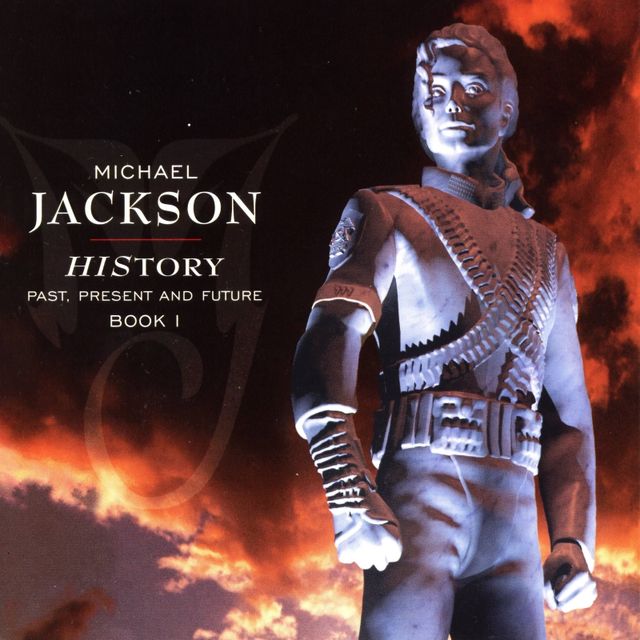

On June 15, 1995, The New York Times reported that a song on Michael Jackson's new album contained antisemitic slurs. The album, HIStory, was five days from American stores. That night, about 60 million people watched Jackson defend himself to Diane Sawyer on ABC's PrimeTime Live.
HIStory was Jackson's first album of new songs since a 1993 child molestation allegation, which ended in a reported settlement and no charges. It came as two discs. The first collected 15 of his biggest hits. The second held 15 new songs, many of them openly angry about the press and the accusations.
It debuted at No. 1 in the US and sold 391,000 copies in its first week. Its single “You Are Not Alone” became the first song ever to enter the Billboard Hot 100 at No. 1. It also gave Jackson the most expensive music video ever made, and a lyric he was pushed into re-recording.
“But then that's the story of this exhilarating, misconceived, often heartbreaking package.”
A Hits Album That Grew a Second Disc
A Jackson hits album had been planned before. Before Dangerous, the plan was a collection called Decade with four new songs. It was shelved when a whole new album began to take shape. After Dangerous, the idea came back: a single disc of hits with some new tracks.
Jackson resisted. “Greatest hits albums are boring to me,” he said, as quoted by PopMatters. “I wanted to keep creating.” Producer and mixer Bruce Swedien described how the plan changed as the new material piled up.
“We had gone through 36 or 37 different sequences for the album. But then, as we began to experiment with the new songs, it became evident that we had an awful lot of good new material to deal with, so Michael decided that we should make it a double and have the old stuff on a separate disc from the new material.”
The first disc, HIStory Begins, drew on Off the Wall, Thriller, Bad and Dangerous, including eight No. 1 singles. The second, HIStory Continues, was all new.
The new disc ran late. According to PopMatters, it was first scheduled for the 1994 holidays, then moved to Los Angeles that winter for more work. In the final week, Jackson told his team that sleep was no longer an option, and sessions ran until three or four in the morning. Bernie Grundman mastered the finished record.
Written Alone in a Moscow Hotel Room
In the summer of 1993, while Jackson was working on new material, a 13-year-old boy accused him of sexual abuse. Police searched his Neverland Ranch. No charges were filed, and Jackson reportedly reached a multi-million-dollar settlement with the boy's family.
The accusation hit while he was on the road with the Dangerous World Tour, and it shaped the new songs. Swedien said “Stranger in Moscow” was one of the first. “Michael was in Russia when he was having all the trouble,” he said. “He was literally alone in Moscow, sitting in his hotel room with the rain pounding down outside, and he wrote this incredible song.”
Swedien called it “one of the best things he has ever done,” and said it set the rest of the project in motion. “That's really what started the ball rolling on the album.”
Hunter heard the change in tone immediately. Instead of ignoring his troubles, he wrote, “Jackson obsesses on his woes, an eager participant in today's talk-show din of personal confession.”
Much of what followed was angry rather than reflective. “Scream” and “Tabloid Junkie” went after the media; “D.S.” and “Money” went after the people he blamed for his troubles. Robert Christgau, unimpressed, gave the album only an honorable mention, singling out “Smile” and “Tabloid Junkie.”
Jam & Lewis, Dallas Austin and R. Kelly
For the first time, Jackson had no single main collaborator. Rolling Stone's James Hunter counted four tracks with Jimmy Jam and Terry Lewis, the Minneapolis team behind his sister Janet's hits, including Rhythm Nation 1814. Atlanta producer Dallas Austin made “This Time Around.” David Foster produced a couple of tracks, including “Earth Song” with Bill Bottrell, who had co-produced “Black or White.”
The album's biggest hit came from outside. R. Kelly wrote and co-produced “You Are Not Alone,” a slow R&B ballad that Hunter called “first-rate.” Jackson also covered the Beatles' “Come Together,” from Abbey Road, and closed with Charlie Chaplin's “Smile,” which he often called one of his favorite songs.
Hunter thought the mix of producers was the problem. Without Quincy Jones, or a single partner like Teddy Riley, he wrote, “the new album really jerks you around.” He loved the Jam and Lewis tracks, which “work completely,” and called “This Time Around” “one dynamite jam.” He had no time for the orchestral ballads, calling “Childhood,” “Little Susie” and “Smile” “a Streisand-size mistake.”
Mark Romanek's $7 million video, listed by Guinness World Records as the most expensive music video ever made.
Essential Tracks
“Scream”
The first single paired Michael with Janet Jackson and her producers, Jam and Lewis. It was their only full duet. The song is a hard, distorted attack on the press, and near the end it cuts in a newscaster's report about a young Black man beaten to death by police after being misidentified as a robbery suspect. Hunter called it “excellent,” one of the few new songs that tied Jackson's own troubles to bigger themes of injustice.
Released as a double A-side with the ballad “Childhood,” it entered the Hot 100 at No. 5 on June 17, 1995. That was then the highest debut in the chart's history, though it was also the song's peak.
Its video is better remembered than its chart run. Mark Romanek shot it in black and white on seven sound stages, with flying electric guitars and morphing effects, for $7 million. Guinness World Records still lists it as the most expensive music video ever made. It won MTV's Video Music Award for best dance video in 1995 and the Grammy for best short-form music video in 1996.
“Stranger in Moscow”
This is the song Swedien credited with starting the album. Jackson wrote it during the Dangerous tour, stuck in a Moscow hotel room as the allegation broke at home. It opens with the sound of rain and a slow mechanical pulse before the guitar comes in.
Hunter, otherwise hard on the album's self-pity, made an exception for it. On this track, he wrote, Jackson “remembers the synth-pop ’80s” while building a portrait of danger and loneliness to rival any of the Seattle grunge bands of the time.
It was not a US hit. Released there as a single in 1997, it peaked at No. 91 on the Hot 100. Its reputation has grown since; PopMatters' 2025 retrospective called it a song that “never quite received the attention and recognition its brilliance deserved.”
“Earth Song”
“Earth Song” is the album's biggest statement: a slow, building lament about environmental destruction and war, produced by Jackson with Bill Bottrell and David Foster. Its video was filmed across four continents, with scenes of poaching, burning rainforest and war in Croatia, and ends with the destruction running in reverse.
American critics were unconvinced. Hunter wrote that “for all its noble sentiments,” it “sounds primarily like a showpiece.” It never appeared on the Hot 100.
In Britain it was a different story. “Earth Song” became the Christmas No. 1 of 1995. That success brought Jackson to the Brit Awards in February 1996, where his performance of it was remembered for reasons he did not plan.
Filmed across four continents; the song was the UK's Christmas No. 1 in 1995.
The Song He Was Made to Re-Record
Dan Beck, then a senior vice president at Epic Records, first heard the problem at a listening session at Sony's New York studios. “They Don't Care About Us” included antisemitic slurs. Beck warned his bosses, but Jackson's co-manager Sandy Gallin argued that the song was a protest against prejudice and that “to take two lines out of context is unfair.”
After the Times story, the Simon Wiesenthal Center objected, and the Anti-Defamation League called on Epic to speak out and on Jackson to attach a commentary to the album. Jackson apologized in a letter to the center's dean, Rabbi Marvin Hier. “My intention was for this song to say ‘no’ to racism, anti-Semitism and stereotyping,” he wrote. “I apologize to anyone who might have been hurt.”
He promised a statement in copies not yet shipped, “so that no one can listen to my music and misconstrue my intentions.” Hier accepted: “I know that Michael Jackson is not an anti-Semite or a racist.”
On PrimeTime Live, Jackson's answers made things worse. “It's not antisemitic because I'm not a racist person,” he told Sawyer, before naming his Jewish friends David Geffen, Jeffrey Katzenberg and Steven Spielberg. Geffen backed him: “There's not one iota of antisemitism in Michael. He's not a hater of any kind. At worst, sometimes he's naïve.”
In a written statement, Jackson explained what he had meant. “I am the voice of the accused and the attacked. I am the voice of everyone. I am the skinhead. I am the Jew. I am the black man, I am the white man. I am not the one who was attacking,” he said. “I am angry and outraged that I could be so misunderstood.”
Steven Spielberg, who had written liner notes for the album two years earlier, publicly said they were “by no means an endorsement of any new songs.” On calls with Epic, Beck recalls, Jackson kept repeating the same defense: “This is the media. I would never be racist or antisemitic.”
After weeks of pressure, Jackson agreed to replace the lines. Co-manager Jim Morey talked him round on a conference call, and Beck remembers the reply as “a soft, resigned, almost inaudible ‘Okay.’” “I actually felt bad for him,” Beck writes.
In his 2025 book, Beck describes the session at Sony's studio in New York shortly after July 4. Jackson sang the new words, then threw the music stand and a chair across the room between takes while a cameraman kept filming. The Christian Science Monitor reported in 1995 that all future copies of the album would carry the new lyrics. Beck now believes the revised vocal was only ever used on the single and the videos.
A Statue, an Army and a $6 Million Teaser
The marketing was as provocative as the music. The album's four-minute teaser film, which cost a reported $6 million, was shot in Budapest with the cooperation of the Hungarian army. It showed Jackson in uniform at the head of marching soldiers and ended with a 300-foot statue of him. The album cover shows a similar statue.
The ad campaign also drew on images of Nazi Germany, Cold War Russia and Tiananmen Square, according to the Christian Science Monitor.
Critics compared the film to Leni Riefenstahl's Nazi propaganda. “Is taking Nazi propaganda techniques and using them to sell records in bad taste?” asked Stanford communications professor Henry Breitrose. “Answer: Absolutely.” The Monitor concluded that “a lot of the controversy with HIStory was created on purpose by Jackson.”
Its reviewer, Ian Zander, still found plenty to enjoy. Once the uproar died down, he wrote, listeners could “begin to enjoy an entertaining and technically marvelous collection of music.” His complaint was that the “thumping and lyrical tunes” were all on the hits disc.
A Record Debut, Then Jarvis Cocker
The controversy did not stop the album at first. HIStory entered the Billboard 200 at No. 1 on the chart dated July 8, 1995, “no small feat for a pricey two-CD set,” as The Billboard Book of Number One Albums put it. It finished ahead of the Pocahontas soundtrack and Hootie & the Blowfish's Cracked Rear View that week. But it lasted only two weeks at the top, the shortest run of any of Jackson's four No. 1 albums.
The singles kept it going. “You Are Not Alone” entered the Hot 100 at No. 1 on September 2, 1995, the first song to do so in the chart's 37-year history. It went platinum, earned a Grammy nomination and was Jackson's last US No. 1. “They Don't Care About Us,” despite two official videos, reached only No. 30.
In Britain, Jackson was invited to the Brit Awards on February 19, 1996, to collect an “Artist of a Generation” award, which Rolling Stone UK says the show invented to get him to perform, and perform “Earth Song,” surrounded by children.
It was his first British TV appearance in 20 years. Pulp singer Jarvis Cocker had watched the rehearsal and found it “extremely distasteful.” During the live show, Cocker ran onto the stage and wiggled his backside at the crowd before he was led off. “Something in me just snapped,” Cocker said later. “He was obviously trying to exonerate himself from the child abuse allegations.”
Cocker was arrested that night on suspicion of assaulting children on the stage, which he said was news to him, and was released on bail at three in the morning. Jackson said he was “sickened, saddened, shocked, upset, cheated and angry.” His camp accused Cocker of harming three children; comedian Bob Mortimer, who had been in the audience, went to the police station to act as his legal counsel. NME responded by selling “Jarvis is Innocent” T-shirts.
His Most Personal Album
Hunter's 1995 verdict was mixed but not dismissive. A decade after Thriller, he wrote, Jackson “still wants to be the King of Pop and to be left alone.” He found the hits disc full of “miraculous recordings” and the new disc “odd” and “charmless” in places, the work of “someone with a bad case of Thriller nostalgia.” He saw the whole project as an attempt “to position Michael Jackson's music as a planet, a genre, a law, a marketing budget unto itself.”
Later writers have been kinder. PopMatters' Luka Neskovic, writing for the album's 30th anniversary in 2025, called it “without question, Michael Jackson's most personal album.” He argued that “without that pain, we wouldn't have songs like ‘Stranger in Moscow’ or ‘Scream.’”
HIStory also set the pattern for what followed. Jackson released only one more studio album. When Invincible arrived in 2001, retailers measured it against HIStory's 391,000 first-week sales, and it fell short. That album was also overshadowed by fights with the press and his record company.
“If stardom is your only subject, you might as well take it to the limit.”