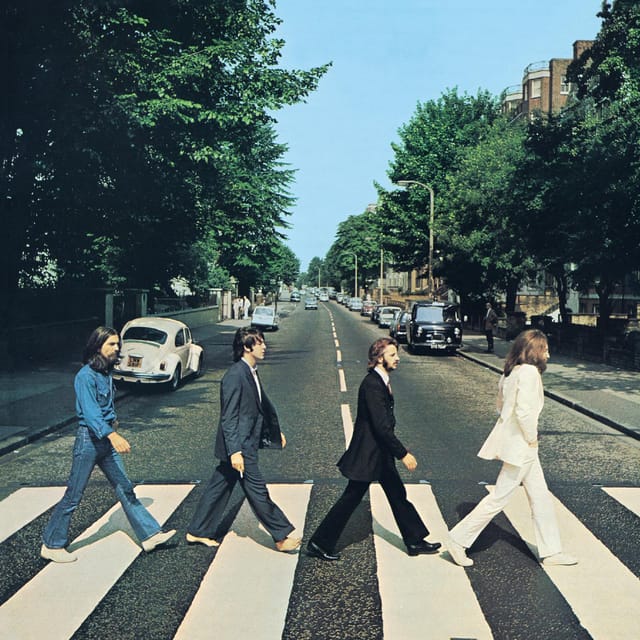

Fifty-six years after four young men from Liverpool crossed a London street and changed music history forever, Abbey Road remains The Beatles' definitive statement of artistic maturity. Released on September 26, 1969, this would be their final studio album—a bittersweet farewell that found the band reaching new creative heights even as personal tensions threatened to tear them apart. What makes Abbey Road extraordinary isn't just that it captures The Beatles at their most sophisticated, but that it does so with such effortless grace, creating something that felt both like the culmination of everything they'd learned and a glimpse of where rock music could go next.
Abbey Road is the Beatles at their most creative and collaborative. It's the sound of four musicians who had learned to communicate without words, channeling their individual genius into collective perfection.
The album emerged from what should have been impossible circumstances. The sessions began in February 1969, just months after the bitter Let It Be sessions that had left the band fractured and demoralized. Yet producer George Martin, returning after his absence from much of the White Album, helped orchestrate what would become their most cohesive statement since Revolver. Engineer Geoff Emerick's pioneering use of eight-track recording technology allowed for unprecedented sonic layering, while the band's collective experience had reached a level of intuitive musical communication that transcended their personal differences.
Abbey Road represented more than just musical evolution—it was a cultural watershed. The iconic cover photograph, taken by Iain Macmillan on August 8, 1969, would become one of the most recognizable images in popular culture, spawning countless imitations and conspiracy theories. The album's blend of individual songwriting brilliance and collective arrangement genius created a template for how rock bands could mature without losing their essential magic. Read: The Paul McCartney Death Hoax and Abbey Road →
Revolutionary Production: The Sound of Maturity
Abbey Road marked The Beatles' most sophisticated approach to studio craft, building on years of experimentation to create their most sonically cohesive work. George Martin's orchestral arrangements reached new heights of integration with the band's playing, never feeling like mere decoration but becoming essential to each song's emotional architecture. The album's use of synthesizers, particularly the Moog on "Maxwell's Silver Hammer" and "Here Comes the Sun," pointed toward rock's electronic future while maintaining the band's essential humanity.
Watch: Come Together - the album's infectious opening statement
The production's most revolutionary aspect was its seamless integration of diverse musical styles. From the swampy funk of "Come Together" to the delicate fingerpicking of "Here Comes the Sun," from Paul's music hall theatrical "Maxwell's Silver Hammer" to George's blues-rock "Something," each track maintained its individual character while contributing to an overarching sonic narrative. This wasn't the patchwork eclecticism of the White Album, but a carefully curated journey through the full spectrum of The Beatles' musical personalities.
Perhaps most importantly, the production served the songs rather than showcasing studio trickery for its own sake. Every effect, every orchestral flourish, every vocal harmony was deployed with surgical precision to enhance emotional impact. This restraint, learned through years of experimentation, marked Abbey Road as the work of artists who had finally mastered their medium completely.
Individual Brilliance: Four Songwriters at Their Peak
“Something”
George Harrison's 'Something' stands as perhaps the most beautiful love song The Beatles ever recorded, and Frank Sinatra's declaration of it as his favorite Lennon-McCartney composition (despite it being written by Harrison) speaks to its universal appeal. The song's sophisticated chord progressions, moving from C major through a series of unexpected modulations, demonstrate Harrison's growth as a songwriter who could rival his more famous bandmates. The orchestral arrangement, added later by George Martin, doesn't overwhelm the delicate guitar work but rather provides a lush foundation that enhances the song's emotional weight. Billy Preston's electric piano adds just the right touch of gospel-inflected soul, while Ringo's restrained drumming proves that sometimes the most powerful musical statements come from knowing exactly when not to play. The guitar solo, one of Harrison's most melodic and emotionally direct, builds from tentative single notes to a soaring climax that perfectly mirrors the song's lyrical journey from uncertainty to complete surrender to love.George Harrison finally came into his own as a songwriter on Abbey Road. 'Something' and 'Here Comes the Sun' proved he could write songs that were every bit as strong as anything John and Paul were doing.
The Medley: Rock's Greatest Extended Statement
The album's second side medley represents one of rock music's most ambitious and successful extended compositions, seamlessly weaving together eight song fragments into a 16-minute musical journey that feels both inevitable and surprising. Paul McCartney's concept of connecting unfinished songs into a coherent suite demonstrated a compositional sophistication that drew from classical music traditions while remaining thoroughly rooted in rock sensibilities. How those eight fragments were salvaged — and how the album's final seconds got there entirely by accident — is a story in itself: Twenty Seconds of Leader Tape: How the Abbey Road Medley Became the Beatles' Goodbye →
The medley's genius lies not just in its seamless transitions but in its emotional architecture. Beginning with the playful "You Never Give Me Your Money," it moves through themes of loss, love, and reconciliation before culminating in the triumphant "The End." Each transition feels organic rather than forced, with musical motifs and harmonic progressions linking disparate songs into a unified emotional journey. The way "Sun King" flows into "Mean Mr. Mustard," or how "Golden Slumbers" builds toward "Carry That Weight," demonstrates an understanding of musical narrative that few rock artists have ever achieved.
Experience the whimsical darkness of Paul's music hall masterpiece
“The End”
'The End' serves as both the climax of the medley and The Beatles' ultimate musical statement, featuring the only drum solo in their catalog and a three-way guitar conversation between McCartney, Harrison, and Lennon that sounds like a musical summit meeting. Ringo's drum solo, recorded in multiple takes and carefully edited, provides a rhythmic tour de force that builds inexorably toward the song's final section. The three-guitar interplay that follows represents each Beatles guitarist at their most distinctive: McCartney's melodic sensibility, Harrison's blues-rock authority, and Lennon's rhythmic drive combining in a conversation that feels like the musical equivalent of their entire career compressed into two minutes. The final piano chord, held for over 40 seconds, provides a sense of resolution that feels both final and eternal. The couplet 'And in the end / The love you take / Is equal to the love you make' distills The Beatles' entire philosophical worldview into two simple lines that achieve the universality they had been reaching for since 'All You Need Is Love.' The track's production showcases every aspect of The Beatles' mature studio craft. The drum solo was built from multiple takes, with Ringo playing various sections that were then edited together to create a cohesive narrative arc. The guitar solos that follow were recorded with each guitarist taking turns, creating an organic conversation rather than a competitive showcase. This collaborative approach extended to the mixing, where each instrument was given space to breathe while maintaining the track's driving momentum.“Here Comes the Sun”
Written during a break from tense Apple business meetings, George Harrison's 'Here Comes the Sun' emerged as one of The Beatles' most enduring expressions of optimism and renewal. The song's fingerpicked acoustic guitar pattern, played on a Maton MS-500, creates an intricate foundation that supports both delicate verses and soaring choruses. Harrison's use of unconventional time signatures—shifting between 4/4 and 2/4—creates a sense of musical breathing that perfectly matches the lyrics' themes of emergence and hope. The Moog synthesizer, one of the first uses of the instrument on a Beatles recording, adds ethereal textures that suggest sunrise and new beginnings without overwhelming the song's essential intimacy. George Martin's string arrangement builds gradually, beginning with single notes that echo the guitar melody before expanding into full orchestral support for the final chorus. The song's structure, with its patient build from whispered beginning to full-band celebration, mirrors the natural process of dawn breaking, making it one of The Beatles' most successful marriages of form and content. The recording process itself reflected the song's themes of renewal and hope. Harrison wrote the piece while taking a break from increasingly tense business meetings at Apple Corps, finding solace in Eric Clapton's garden where the opening guitar pattern first emerged. The song's technical innovations, including the use of artificial double tracking on the vocal harmonies and subtle phasing effects on the synthesizer parts, create a sense of musical space that enhances the lyrics' outdoor imagery.Legacy: The Final Word in Rock Evolution
Fifty-six years after its release, Abbey Road stands as The Beatles' most complete artistic statement, synthesizing everything they had learned about songwriting, arrangement, and studio craft into their most cohesive album. Its influence on subsequent rock music is immeasurable, from the progressive rock movement's embrace of extended compositions to punk rock's return to essential musical values, from the studio perfection of 1970s pop to the sample-based hip-hop that would mine Beatles recordings for generations.
The album's approach to balancing individual artistry with collective vision provided a template for band collaboration that continues to influence group creativity across all genres. The way each Beatles member's distinct musical personality contributed to a unified whole demonstrated that the most powerful artistic statements often emerge from creative tension rather than comfortable consensus. This lesson resonates particularly strongly in an era of individual artist brands and social media promotion, where the collaborative magic that created Abbey Road feels both timeless and increasingly rare.
Abbey Road's technical innovations continue to influence contemporary recording practice. Its use of the studio as a creative instrument, rather than mere documentation device, anticipated the sample-based production techniques that would dominate hip-hop and electronic music. The album's sonic clarity and instrumental separation remain reference points for mastering engineers and audiophile listeners, while its seamless integration of orchestral and rock elements provides a model for contemporary genre-blending artists from Radiohead to Arcade Fire.
Most importantly, Abbey Road proved that popular music could achieve genuine artistic depth without sacrificing accessibility or emotional immediacy. The album's commercial success—it spent 11 weeks at number one and remained on charts for years—demonstrated that audiences were hungry for sophisticated musical statements that respected their intelligence while still providing visceral pleasure. This balance between artistic ambition and popular appeal remains the gold standard for rock music achievement, a lesson that feels particularly relevant in today's streaming-dominated landscape where attention spans are measured in seconds rather than album sides.
Cultural Impact and Enduring Influence
The cultural impact of Abbey Road extends far beyond its musical innovations. The iconic cover photograph has become one of the most referenced images in popular culture, inspiring countless tributes, parodies, and artistic homages. The simple act of four men crossing a street captured something profound about The Beatles' journey—from the synchronized matching suits of their early years to the individual expressions of their final period, yet still moving forward together in harmony.
The album's influence on subsequent generations of musicians is evident everywhere from the orchestral arrangements of '70s prog rock to the experimental song structures of modern indie artists. Bands like Pink Floyd took the medley concept to its logical extreme on albums like "The Wall," while the sonic sophistication of Abbey Road can be heard in everything from Fleetwood Mac's "Rumours" to more recent works by artists like Tame Impala and The 1975. The way Abbey Road balanced experimental studio techniques with memorable songwriting became a template for how to push artistic boundaries without alienating audiences.
Essential Tracks
While every track on Abbey Road contributes to its unified vision, several songs stand as essential Beatles statements that capture the album's revolutionary spirit. "Come Together" opens the album with swampy funk that pointed toward rock's future while maintaining The Beatles' melodic sensibilities. "Something" and "Here Comes the Sun" showcase George Harrison's emergence as a songwriter capable of matching Lennon and McCartney's output. The medley suite from "You Never Give Me Your Money" through "The End" represents rock music's most successful extended composition, proving that popular music could support classical music's architectural ambitions.
Each essential track demonstrates different aspects of The Beatles' mature artistry: sophisticated harmonic progressions, innovative production techniques, and emotional depth that rewards repeated listening. Together, they create a listening experience that feels both complete and endlessly renewable, proving that great albums function as unified works of art rather than collections of individual songs.