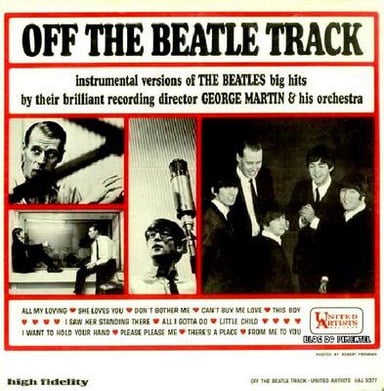

On the evening of February 10, 1967, forty of London's finest orchestral players arrived at Abbey Road's Studio One in formal evening dress and were handed party novelties — false noses, gorilla paws, balloons. The man giving the instructions wore a suit and spoke like a BBC announcer. He told them to begin on the lowest note their instruments could play and finish, twenty-four bars later, on the highest, and to make their own way between the two without listening to their neighbors. Trained session musicians sat in silence; nothing in their careers had prepared them for an instruction like it. The man was George Martin — Guildhall-trained oboist, head of EMI's Parlophone comedy label at 29 — and the avalanche of sound he conducted that night became the climax of “A Day in the Life.” This feature is about how a classical musician learned to score other people's imaginations.
“If anyone earned the title of the fifth Beatle it was George.”
The Method: The Translator
Martin's value was never a signature sound — it was a signature service. The Beatles could not read or write music; Martin could, fluently, and he spent a decade converting their hums, metaphors, and dares into arrangements an orchestra could play. When John Lennon said he wanted to “smell the sawdust” on “Being for the Benefit of Mr. Kite!,” Martin's job was to work out what that meant in terms of tape machines and steam-organ recordings. The band supplied appetite; the producer supplied vocabulary.
The vocabulary came from an unlikely apprenticeship. At Parlophone — EMI's unfashionable third label, which he took over in 1955 — Martin made comedy and novelty records with Peter Sellers, Spike Milligan, and Peter Ustinov. Comedy taught him what he called sound pictures: without an image, every scene had to be built from effects, edits, and trick tape work. Years before psychedelia, the straightest-looking man at EMI was already cutting tape into collages and bending machines away from their intended use.
Classical training supplied the other half. A war-service Fleet Air Arm pilot who entered the Guildhall School of Music at 21, Martin studied composition and oboe, and heard pop songs the way an arranger hears them — as structures with room in them. His scores never decorated; they answered. The string quartet on “Yesterday,” the piccolo trumpet on “Penny Lane,” the cellos on “I Am the Walrus” are all counter-voices placed where the song had space, which is why none of them have dated.
And underneath both sat an A&R man's nerve. Martin's first great production decision was a signing: hearing past a scrappy audition tape to something no other label in London could hear. Every technique in this feature exists because of that one act of judgment in the spring of 1962.
1962: Signing the Band Decca Refused
Every London label had passed on the Beatles, most famously Decca, whose verdict to Brian Epstein entered industry legend.
Guitar groups are on the way out.
Martin, whose comedy roster made him the one EMI executive with nothing to lose, signed them — by his own account less for the demos than for what happened in the room. At the first Abbey Road session on June 6, 1962, he delivered a long technical lecture on what needed improving, then asked if there was anything the band didn't like. George Harrison's reply — “Well, for a start, I don't like your tie” — broke the room up, and told Martin what he had actually signed: charisma. His first producer's decisions were blunt ones. Unconvinced by Pete Best, he booked session drummer Andy White for the “Love Me Do” remake, moving the newly hired Ringo Starr to tambourine — a slight Starr needed years to forgive.
The defining negotiation came over material. Martin wanted the band to record “How Do You Do It,” a professional songwriter's tune he considered a sure No. 1; the band wanted their own songs. Martin's condition was a producer's compromise: your song, then, but fixed. “Please Please Me” had arrived as a slow, Roy Orbison-style ballad; Martin had them double its tempo, add harmonica, and tighten the ending. At the end of the November 26, 1962 session he pressed the talkback and said: “Gentlemen, you have just made your first number one.” The trade papers proved him right within weeks. When the single hit, Martin booked one marathon day — February 11, 1963, less than ten hours — and recorded the entire Please Please Me album, closing with a shredded, one-take “Twist and Shout” because Lennon's voice had nothing left.
The postscript vindicated both sides of the argument. Martin handed the rejected “How Do You Do It” to another Liverpool act on his roster, Gerry and the Pacemakers, and it went straight to No. 1 — the producer's commercial ear proven right about the song, and the band's instinct proven right about themselves. A producer who could hear a hit in material his own artists refused was a producer worth arguing with, and the arguments stayed productive for eight years.
Listen for: the harmonica-and-harmony rush of the reworked “Please Please Me” — a ballad turned into a starting pistol by a producer's tempo call.
“Please Please Me” — the Orbison ballad Martin doubled in tempo.
1965: A String Quartet for “Yesterday”
When Paul McCartney brought in a melody so complete he feared he had plagiarized it, the recording posed a problem no one had faced before: it was a Beatles track that no other Beatle belonged on. Martin's solution — McCartney alone with an acoustic guitar, plus a string quartet — horrified a band that considered itself a rock group. Strings meant Mantovani, syrup, everything they had escaped. Martin's counter was practical: try it, and if it fails we drop it.
The scoring session became a template for their collaboration. Producer and songwriter sat together at the piano, Martin translating McCartney's instincts into notation, McCartney pushing back against anything that sounded lush — the players were instructed to go easy on vibrato, keeping the quartet dry and plain, and McCartney himself picked out the bluesy cello phrase under the middle eight that a trained arranger would never have dared. Released on Help! in 1965, “Yesterday” became one of the most recorded songs in history, with thousands of cover versions logged in the decades since.
The lesson it taught both parties was the one Martin repeated for the rest of the decade: the right arrangement is the one the song asks for, not the one the genre expects. A year later, “Eleanor Rigby” pushed the idea to its extreme — a Beatles record on which no Beatle plays an instrument. Martin scored it for double string quartet and, by his own account, borrowed the stabbing, close-miked aggression from Bernard Herrmann's film scores: strings used as percussion, chamber music with a knife in it. Within two years the same logic produced the piccolo trumpet solo on “Penny Lane” — written down note by note as David Mason played fragments McCartney sang at him — and a French horn on “For No One.” The band stopped asking whether something was rock and roll; the only question left was whether it worked.
Listen for: how dry the quartet is — no vibrato, no swell, chamber music sharing a room with a guitar rather than sweetening poured over it.
“Yesterday” — the arrangement that taught rock bands to use strings.
1967: Two Takes, Two Keys, One Song
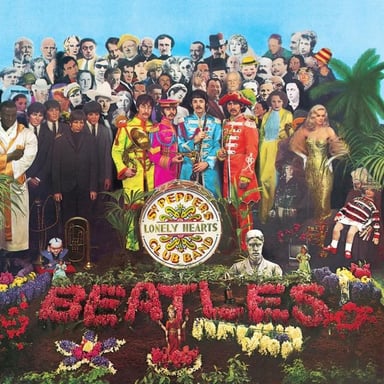
The psychedelic years turned Martin's comedy-record tricks into high art, and the clearest example is “Strawberry Fields Forever.” Lennon recorded the song twice — once as a gentle band arrangement, once as a heavy orchestral storm with scored trumpets and cellos — and then announced he liked the beginning of the first and the end of the second. Martin pointed out the two versions were in different keys and different tempos. Lennon's reply, as Martin retold it for decades, was serene: “You can fix it, George.”
Martin and engineer Geoff Emerick discovered that speeding one tape and slowing the other brought the keys almost into agreement, and joined the two performances with a single edit about a minute in — audible once you know, invisible for sixty years if you don't. The same willingness to abuse the machinery filled Sgt. Pepper's Lonely Hearts Club Band: for “Mr. Kite,” Martin had steam-organ recordings cut into pieces, flung into the air, and spliced back in random order until the fairground smelled right. All of it was done on four-track machines, bounced and re-bounced with a precision that modern engineers study like scripture.
“I told them to start on their lowest note and end on their highest, and to make their own way up between the two.”
The album closed with the orchestral instruction from this feature's opening scene — repeated, stacked, and resolved into the most famous final chord in popular music, three pianos struck simultaneously and held for forty seconds while Martin rode the faders up to catch the decay. Sgt. Pepper won the 1968 Grammy for Album of the Year, the first rock album to do so, and the citation might as well have named the producer's chair.
Listen for: the join in “Strawberry Fields Forever” around the one-minute mark — the moment the gentle song becomes the storm, hidden by a change of speed.
Two performances, two keys, two tempos — made one with varispeed and a razor blade.
1969: One Last Album, the Old Way
By 1969 the partnership had frayed. The Let It Be sessions had collapsed into acrimony with Martin sidelined, and when McCartney rang to ask him to produce one more record, Martin set a condition: only if the band worked the way it used to, with the producer actually producing. The result was Abbey Road, covered at length in our review — so what belongs here is Martin's fingerprint on it, which is the whole of side two.
The sixteen-minute medley was the closest Martin ever came to getting the Beatles to write a symphony. He and McCartney championed the continuous form — song fragments keyed, bridged, and reprised like movements — over Lennon's preference for a straight rock record, and the compromise gave each side of the vinyl its own philosophy. Around it sat the era's newest machine, a Moog synthesizer threaded into “Because” and “Maxwell's Silver Hammer” with an arranger's restraint, and Harrison's “Something” — the song Martin considered proof that his third songwriter had caught the other two.
Listen for: the strings under “Something” — Martin's last great Beatles chart, answering the guitar line without ever crowding it.
The final album's biggest single — and Martin's favorite Harrison song.
1973: The Demo That Was the Record
Martin's post-Beatles career began with a business decision that reshaped his profession. EMI had paid him a salary while his productions sold in the tens of millions; refused a royalty, he resigned in 1965 and co-founded AIR, an independent production company owned by producers themselves. It was the moment the record producer stopped being a staff employee and became a free agent — arguably as influential as anything he did at a console.
The signature production of the independent years reunited him with McCartney. Asked to score the Bond film Live and Let Die, Martin recorded the title song with Wings and delivered the finished track to producer Harry Saltzman. Saltzman listened politely, praised the “demo,” and asked who they should get to sing the real version — suggesting Thelma Houston. Martin had to explain that a recording by Paul McCartney was not raw material. The track stayed, reached No. 2 in America, won a Grammy for its arrangement, and made the first Beatle-scored Bond theme a template for every bombastic Bond song since.
The independent years were productive far beyond Bond. Martin spent the mid-seventies as America's producer, steering the soft-rock harmony trio through a run of hits that included the No. 1 “Sister Golden Hair,” and in 1975 he made Blow by Blow with Jeff Beck — a wordless, jazz-fusion guitar record, about as far from “Love Me Do” as the job allowed, and proof the translator worked in languages beyond pop. AIR's studios became the second act's other legacy: the Oxford Circus rooms opened in 1970, and in 1979 Martin built AIR Montserrat, the Caribbean retreat where the Police cut Synchronicity and Dire Straits Brothers in Arms before Hurricane Hugo destroyed it in 1989. A producer who had spent the sixties inventing studio technique spent the seventies and eighties building the rooms other producers invented in.
Listen for: the hard cut from McCartney's piano ballad into the orchestral chase — a Bond film's worth of scoring compressed into three minutes.
The finished record Harry Saltzman mistook for a demo.
The Job He Invented Twice
Martin was knighted in 1996, and his last No. 1 came the following year, at 71: Elton John's “Candle in the Wind 1997,” recorded in the wake of Princess Diana's death and produced with the same instincts as ever — a single live vocal take, a discreet string quartet, nothing the song didn't ask for. It became the best-selling single since charts began, a career bookended by “Please Please Me” and the biggest record in chart history. His hearing, the instrument underneath all of it, failed him in his final decades; his son Giles became his ears for the Love remix project in 2006. He died in March 2016, at 90.
His legacy operates at two levels. The audible one is in every pop record that books a string date, from the quartets on nineties Britpop ballads to the orchestral stems in modern film-scored pop — arrangements used as counter-voice, the “Yesterday” lesson. The structural one is the job itself: the producer as the artist's translator and equal partner rather than the label's supervisor, paid in royalties, working from independent rooms. Both of the modern producer's identities — studio auteur and free agent — trace to the same polite man in a tie the Beatles made fun of.
The measure of a translator is whether the voice still sounds like the author. Nothing Martin added to a Beatles record — the quartet, the piccolo trumpet, the 24-bar avalanche — ever sounded like George Martin; it sounded like the Beatles, only more so. That restraint, more than any splice or score, is what producers still study. Our review of Abbey Road covers the record he considered their shared farewell; the method described here is audible in every bar of it.
“I must emphasize that it was a team effort. Without my instruments and scoring, very many of the records would not have sounded as they do. Whether they would have been any better, I cannot say. They might have been.”