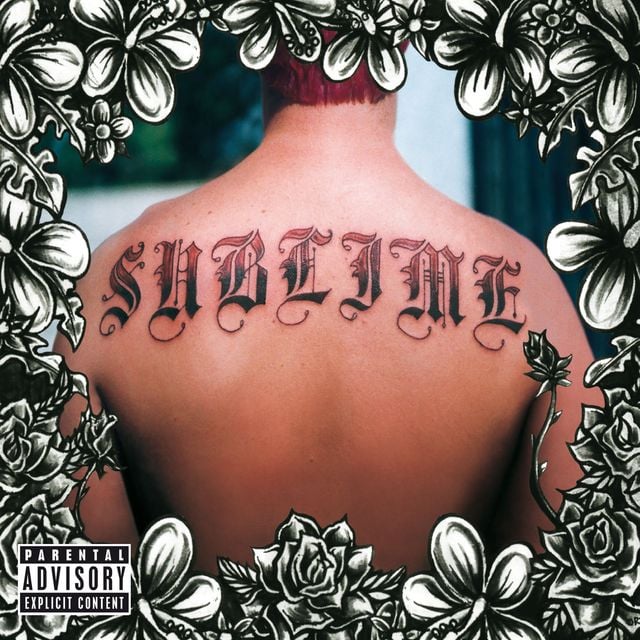

On May 18, 1996, Bradley Nowell married Troy Dendekker in Las Vegas. On May 25, in a San Francisco motel room the morning after a show, he died of a heroin overdose. He was 28.
On July 30, the album he had spent that spring recording at Willie Nelson's studio in the Texas hills arrived in stores. There was no band left to promote it: no tour, no interviews, no singer.
What happened next made no industry sense. Three singles crawled onto the radio and refused to leave, and the record eventually went Diamond. A ska-punk trio from Long Beach became one of the defining American bands of the 1990s after it had already ceased to exist. Sublime is a party and an elegy on the same disc.
“On their first and only major-label album of originals, Sublime coughed up a bleached beachfront creole, a seedy pawn-shop slop of punk, reggae, and hip-hop.”
Long Beach Before the World Arrived
Sublime formed in Long Beach, California, in 1988: Nowell on vocals and guitar, Eric Wilson on bass, Bud Gaugh on drums, and a dalmatian named Lou Dog with a standing invitation to wander the stage. They were a backyard-party band in the most literal sense, honing a hybrid of ska, punk, dub, and hip-hop at keggers the police usually ended.
Two self-made albums built the following. 40oz. to Freedom (1992) sold steadily out of car trunks and surf shops, and Robbin' the Hood (1994) — recorded partly in a drug dealer's living room — proved the songwriting was outgrowing the recording budgets. The turning point came when Los Angeles rock station KROQ put the three-year-old “Date Rape” into rotation in 1995 and the phones lit up. MCA signed the band that no major label had wanted, chaos and all.
The chaos was not a stage act. Nowell's heroin addiction had shadowed the band for years, and the label's advance bought better equipment and worse habits in equal measure. Still, by early 1996 the band had a catalog of new songs strong enough that MCA booked serious studio time in Texas and attached a producer with impeccable credentials in controlled noise: Paul Leary of the Butthole Surfers.
Margaritas at Nine in the Morning
The sessions at Pedernales Studio, Willie Nelson's ranch complex outside Austin, ran from February to May 1996 and have entered rock lore as a managed catastrophe. When the band complained they were already drunk by the noon start, Leary moved sessions to the morning; they arrived the next day with pitchers of margaritas. “It didn't matter what time you started, they were gonna be drunk,” he told the Austin Chronicle. The songs came fast and loose, cut live with the slop left in — and the slop was the style.
They were the sweetest bunch of guys, [but] it was chaos in the studio. There were times where someone had to go into the bathroom to see if Brad was still alive.
Behind the anecdotes sat real dysfunction. Nowell's use got so bad that Leary eventually sent him home to Long Beach before the record was finished; his father later said it took him three days to recover, the worst he had ever seen his son. Drummer Bud Gaugh, himself in and out of recovery, described trying to be everything at once: conscience, nurse, even drug buddy. The record was completed around its frontman — vocals comped from what existed, arrangements finished by the producer.
That a coherent album emerged at all is the production achievement. Leary kept the band's house-party looseness while quietly imposing structure, and label producer David Kahne later gave the key track its radio finish. The result sounds effortless, which is the oldest studio illusion there is: the loosest-sounding record of 1996 was assembled from sessions that barely held together.
Assembled after Nowell's death from archive footage — the video MTV played all through 1996 and 1997.
Twenty-Two Genres in Seventeen Tracks
What separates Sublime from every other 1996 alternative record is its total disregard for genre borders. Ska upstrokes slide into punk tempos; dub basslines carry hip-hop drum loops; an acoustic guitar shares a track list with hardcore. Nowell sang, toasted, and rapped in a voice that made all of it sound like one language — sunny on the surface, with the dread sitting just underneath.
The songwriting borrowed the way Long Beach traffic moves — constantly and from every lane. “Doin' Time” rebuilt George Gershwin's “Summertime” as a G-funk lament; “April 29, 1992 (Miami)” set a first-person account of the Los Angeles riots over a bass line Wilson seemed to have found in a police scanner's static. Covers, interpolations, and samples sat beside originals without apology, a collage aesthetic closer to hip-hop production than rock convention.
The lyrics kept a running ledger of the life that produced them: dealers, riots, stolen gear, the dog, and — repeatedly, in terms that read differently after May 25 — the needle. The record never romanticizes the addiction; it documents it with the casual precision of someone who did not expect to be quoted posthumously. That tension, sunshine over an undertow, is why retrospective critics have kept returning to the album as something more serious than its beach-party reputation.
Essential Tracks
“What I Got”
The song that carried the album started as a shuffle built on a borrowed melody — its chorus openly indebted to Half Pint's reggae standard “Loving” — with Nowell strumming a single acoustic riff under a half-sung, half-rapped inventory of a Long Beach life. David Kahne's single mix tightened the loop and pushed the vocal forward, turning a demo-loose groove into a radio record.
Musically it is almost nothing — two chords, a drum loop, a turntable scratch — which is exactly why it worked. The space left Nowell's voice to do the record's emotional arithmetic: “love is what I got” delivered by a man whose losses the listening public would soon learn in detail.
Released as the album's lead single, it reached No. 1 on Billboard's Modern Rock chart — the band's first and only chart-topper, achieved without a single live performance to support it. Three decades on, it remains the entry point: the simplest song on the record, and the heaviest once you know the story.
“Santeria”
The album's second signature reworked a guitar figure the band had kicked around since the Robbin' the Hood era into a jealous-lover revenge fantasy sung with a grin. It is the closest Nowell came to a classic pop structure: verses that build, a chorus that releases, and a guitar solo — melodic, unhurried, faintly Western — that has become one of the most recognizable of the decade.
The track shows the band's musicianship at its most disciplined. Wilson's bass walks the whole song on a leash, Gaugh plays the backbeat straight, and the reggae skank stays in the pocket rather than the foreground — proof the trio could play it clean when the song asked.
Released to radio in 1997, it climbed to No. 3 on the Modern Rock chart more than a year after Nowell's death, and it has never really left American radio since. Its video, with Wilson and Gaugh acting out a saloon showdown around their absent singer, doubled as the band's public goodbye.
“Doin' Time”
The boldest construction on the album turns Gershwin's “Summertime” — by way of the Herbie Mann flute recording the track samples — into a slow-rolling Long Beach groove about infidelity and imprisonment by relationship. It is the record's thesis in one track: seventy years of American songbook folded into G-funk without asking anyone's permission.
Producer credit matters here: the track's hip-hop architecture — loops, scratches, a sampled hook treated as raw material — shows how far the band's method sat from their rock contemporaries. No other Modern Rock playlist staple of 1997 was built like a rap record.
The song's afterlife proved the durability of the idea. When Lana Del Rey covered it in 2019 — faithfully, loops and all — it charted again for a new generation, and the cover was blessed by the surviving members. Twenty-three years after his death, Nowell's arrangement needed no updating.
Wilson and Gaugh's saloon showdown — the band's public goodbye to their singer.
May 25, 1996
The band played the Phoenix Theater in Petaluma on May 24. The next morning, in a San Francisco motel, Gaugh found his best friend dead. Nowell had been married for exactly one week; his son Jakob was eleven months old. The tour was over, the band was over, and an album by a suddenly nonexistent group was due in nine weeks.
His widow later put the failure in collective terms: the people around Nowell understood addiction so little, she told Rolling Stone, that their incomprehension “gave his addiction power” and left him more isolated. Miguel Happoldt, the band's longtime collaborator and label partner, was blunter still: Brad was great — unless there were drugs.
MCA released the album on schedule, retitled simply Sublime. There was no band to tour it, so the label did the only thing available: it worked the songs to radio, one at a time, for two years. The strategy — singles as the only messenger — turned out to be the purest possible test of the material. The material passed.
The Posthumous Radio Takeover
The album entered quietly and then refused to follow the usual decay curve. As “What I Got,” “Santeria,” and “Wrong Way” rolled out across 1996 and 1997, the record climbed rather than faded, cracking the Billboard top 20 by the spring of 1997 and peaking at No. 13 — nearly a year after release. The RIAA certified it triple platinum in November 1997 and five-times platinum by December 1999. On July 31, 2026, thirty years and a day after release, it was certified Diamond for 10 million units.
Radio programmers discovered what the band had known from the rough mixes: these songs did not wear out. Three decades later the album's singles remain among the most-spun 1990s tracks on American alternative and rock radio, a catalog annuity built in fourteen weeks of chaos. For a group that never performed a note of the album live, the numbers are without real precedent.
Long Beach Forever
The band's afterlife has been long and complicated — compilations, an acoustic set, the Sublime with Rome years — but the story bent toward home in 2024, when Jakob Nowell, the eleven-month-old from the obituaries, stepped in front of Wilson and Gaugh to sing his father's songs at Coachella. The circle the album left open finally closed on stage.
The influence is easier to hear than to credit, because it dissolved into the mainstream: every sun-bleached genre collage on modern playlists — pop-punk with dub basslines, acoustic beach rap, ska revivals — works ground this record cleared. Lana Del Rey's “Doin' Time” put a Sublime arrangement back in the charts in 2019, and the album keeps finding new listeners at a rate that embarrasses records with living promoters.
What lingers hardest is the double exposure. Sublime is simultaneously the best party record of its decade and a document of the disease that killed its author — both things at full volume, neither canceling the other. Thirty years on, that honesty is the reason the record still sounds current: it never pretended the sunshine and the undertow were different oceans.
“We were in an upward moment; we were just beginning to realize all the hard work we had done was going to start paying off. And all of a sudden, I don't have my best friend to share it with anymore.”