
On April 6, 1966, the first day of sessions for a new Beatles album, John Lennon gave the control room an impossible instruction. He wanted his voice to sound like the Dalai Lama chanting from a hilltop.
The song was a one-chord drone with lyrics adapted from a psychedelic reading of the Tibetan Book of the Dead. The man expected to solve the problem was Geoff Emerick, a newly promoted engineer barely out of his teens. He wired Lennon's vocal through the spinning speaker of a Hammond organ cabinet. It broke the studio's rules and opened an era.
Eleven weeks later the Beatles delivered Revolver: fourteen tracks they would never perform live. It moved popular music's center of gravity from the stage to the mixing desk.
“The biggest miracle of Revolver may be that the Beatles covered so much new stylistic ground and executed it perfectly on one record, or it may be that all of it holds together perfectly.”
The Band About to Leave the Stage
Revolver was made by a band in the final months of its life as a touring act. The screaming had long since drowned the music; the equipment of 1966 could not reproduce what the songs were becoming; and the year's tours would bring death threats in Tokyo, a violent exit from Manila, and the American furor over Lennon's “bigger than Jesus” remark. The studio was the one place the four could still hear themselves.
They used it accordingly. Freed from writing songs four boys could replicate on a ballpark stage, the band spent April through June at EMI's Abbey Road studios treating every track as a laboratory: backwards guitars, tape loops, brass bands, string octets, sitar. The album arrived on August 5, 1966; the Beatles played their last paying concert at San Francisco's Candlestick Park twenty-four days later. Not one Revolver song was on the setlist — or ever would be.
That timing is the key to the record. Revolver is the first Beatles album conceived entirely as a recording — a thing that exists only on tape, with no obligation to reality. Its producer, George Martin, whose translation of the band's imaginations we profile in depth, called the shift in ambition audible from the first session. The band no longer asked whether something could be played. Only whether it could be recorded.
Cut during the Revolver sessions — the promo films Harrison later joked had invented MTV.
Breaking EMI's Rules, One Microphone at a Time
The sessions began with a personnel change that proved as consequential as any song. Norman Smith, the band's engineer since 1962, had moved on, and Martin promoted Geoff Emerick — twenty years old, terrified, and willing to try anything. Emerick jammed microphones inside Ringo Starr's bass drum and draped the drum with a sweater, close-miked the string players until they complained, and ran vocals through equipment designed for organs — each a violation of EMI's written technical standards, each now a textbook technique.
The studio's own staff joined the arms race. Technical manager Ken Townsend, tired of watching the band grind through double-tracking their vocals, invented artificial double tracking — ADT — by delaying a copy of the vocal signal off a second tape machine. It debuted on Revolver and spread through the industry within a year. Varispeed, reversed tape, and compression pushed past its intended limits filled out the toolkit.
He wanted his voice to sound like the Dalai Lama chanting from a hilltop.
The point was never gadgetry for its own sake. Every trick served a songwriter's request that ordinary recording could not satisfy — Lennon's hilltop lama, McCartney's wish for a trumpet part higher than trumpets go, Harrison's demand that Indian instruments be treated as seriously as guitars. The engineering was translation, and the translators worked overtime.
How a 20-year-old engineer, a hacked organ speaker, and tape loops held taut with pencils got through the album's first session is its own story: Studio Three, April 6, 1966: How “Tomorrow Never Knows” Turned the Studio Into an Instrument →
Three Songwriters, Three Records in One
Revolver opens, for the first time on any Beatles album, with a George Harrison song — “Taxman,” a snarling complaint about Britain's 95 percent supertax bracket, driven by a guitar solo McCartney played because Harrison couldn't find the shape he wanted. Harrison landed three songs on the album, his best allocation yet, and “Love You To” became the first Beatles track built on Indian classical instrumentation from the ground up.
McCartney spent the album perfecting a classicist streak: “Eleanor Rigby” scored for double string quartet, the chamber ballad “For No One” with its French horn, and “Here, There and Everywhere,” the love song he has repeatedly named among his own favorites. Lennon, meanwhile, supplied the album's altered states — “I'm Only Sleeping” with its yawning backwards guitars, “She Said She Said” born of a bad Los Angeles acid trip, and the closing track that made the future audible.
The miracle Erlewine named is that none of it clashes. The sequencing alternates the three songwriters like panels of a triptych, Martin's production giving each idiom its own acoustic space while Starr — whose drumming on the album is repeatedly cited as his finest — stitches the styles into one rhythmic signature. Fourteen songs, no filler, thirty-five minutes.
No Beatle plays a note — a double string quartet, a lone voice, and a No. 1 single about loneliness.
Essential Tracks
“Tomorrow Never Knows”
Recorded first and sequenced last, the album's destination track is a single C chord sustained for three minutes under a swarm of tape loops — seagull screeches that are actually sped-up laughter, orchestral stabs, a distorted sitar — mixed live in one pass, with faders riding loops fed in from machines all over the building.
The loops were McCartney's contribution, made at home on a domestic tape recorder with the erase head removed; the drone and the Leslie-cabinet vocal were Lennon's séance; the thundering, compressed drum pattern was Starr's — one of the most sampled rhythm tracks in British music.
Nothing in pop had sounded like it, and everything from psychedelia to electronica has drawn on it since — the Chemical Brothers built an entire single, “Setting Sun,” as an open homage three decades later. It remains the clearest before-and-after line in the band's catalog.
“Eleanor Rigby”
A pop single about loneliness, death, and an unattended funeral, on which no Beatle plays an instrument: McCartney sings against a double string quartet scored by George Martin, its stabbing attack borrowed — by Martin's own account — from Bernard Herrmann's film writing.
Emerick's close miking put the listener inside the string section, an aggression classical engineers considered vandalism. The arrangement leaves no cushion: eight players, one voice, and subject matter pop radio had never been asked to carry.
Released as a double A-side with “Yellow Submarine” — children's singalong on one face, meditation on mortality on the other — it topped the UK singles chart. The pairing is the album's range compressed onto one seven-inch disc.
“Got to Get You into My Life”
McCartney's brass-driven Motown homage hides the album's slyest confession: he later confirmed the ecstatic love song was addressed to marijuana. The horns — trumpets and saxophones tracked close and hot, then compressed hard — gave British pop a punchier brass sound than anything cut in London before it.
As arrangement, it is the record's straightest dance track, which is its own kind of experiment: proof the same band chasing tape loops could out-Stax the imports on a three-minute soul number.
A decade later, released as a US single in 1976, it reached the American top ten — a hit twice, ten years apart, for a band that no longer existed. Earth, Wind & Fire's 1978 cover carried it back to soul radio, closing the loop on the homage.
Charts, a Grammy, and a Duel with Pet Sounds
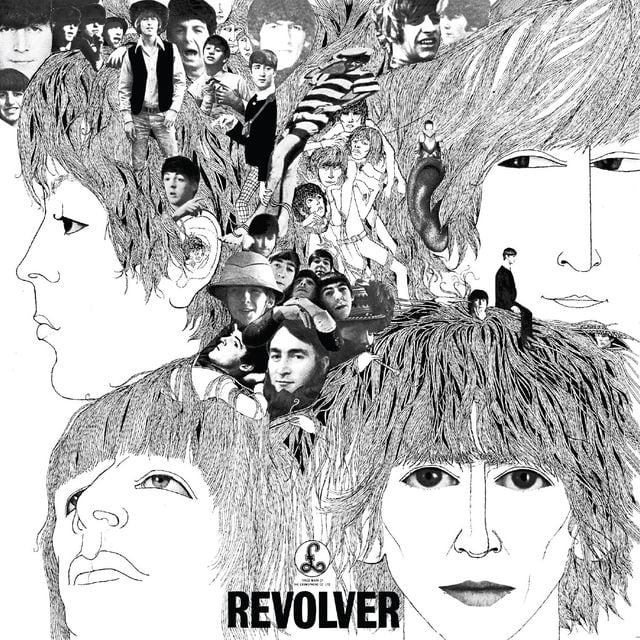
Commercially the experiment cost the band nothing. Revolver spent seven weeks at No. 1 in Britain and six atop the American chart, while the double A-side single led the UK listings the same month. Klaus Voormann's pen-and-ink collage cover — drawn by the band's Hamburg friend for a fee of £50 — won the Grammy for best album cover, the packaging as forward-looking as the tape inside it.
The album also sat at the center of the era's great creative rivalry. Brian Wilson had made Pet Sounds that spring in open response to Rubber Soul; McCartney absorbed Pet Sounds while finishing Revolver; and the readers of NME effectively declared the contest a draw in their 1966 year-end poll. The arms race the two albums ran — arrangement against arrangement, studio against studio — produced much of the next decade's ambition, including the Beatles' own next record.
The Album That Moved Music Indoors
Sgt. Pepper got the parades, but the modern critical consensus has steadily migrated to its predecessor: poll after poll now ranks Revolver as the band's peak, and its 2022 super-deluxe reissue — remixed by George Martin's son Giles with machine-learning source separation — renewed the argument for a new generation of listeners. What Pepper announced, Revolver had already done, in half the studio time and with tighter songs.
Its deepest legacy is a definition. After Revolver, a record could be a constructed object rather than a captured performance — the assumption underneath psychedelia, prog, disco, hip-hop production, and every bedroom producer working today. The band followed the logic to Abbey Road and beyond, and the industry followed the band. Sixty years on, every artist who builds a track no band could play is working inside the door Revolver opened — the one marked tomorrow.
“As they devoted more time to the studio, the Beatles' individual voices and confidence continued to grow, resulting in the sonic landmark Revolver.”