
On July 17, 1981, Journey released an album that rock critics dismissed on arrival and the American public has refused to put down for forty-five years.
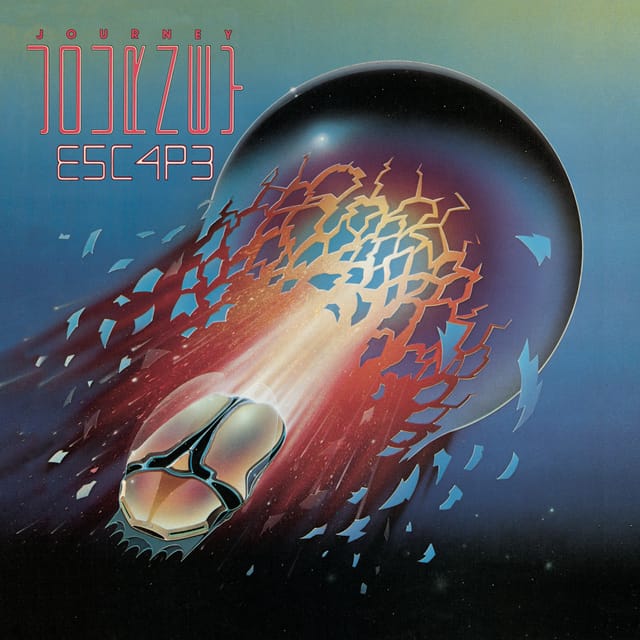
Escape, stylized E5C4P3 on Stanley Mouse's scarab-ship cover, sent four singles into the Billboard Hot 100. It gave the band its first and only No. 1 album. It was eventually certified Diamond by the RIAA, for more than ten million copies sold in the United States alone.
Its biggest achievement took a quarter of a century to show itself. An album track that peaked at a modest No. 9 in 1981 would, in the download era, become the best-selling digital track of any song released in the twentieth century. This is the story of a new keyboardist, a father's advice written in a notebook, and the most patient hit in rock history.
“I listen to it now and it's a great record, but it's all over the map. You've got a song like ‘Dead or Alive’ on it, which is like really musical punk.”
The Keyboardist Who Changed Everything
Escape began with a departure. In late 1980, Gregg Rolie — the founding keyboardist and original lead vocalist who had anchored Journey since its jazz-fusion beginnings — left the band. His replacement was Jonathan Cain of the Babys, a classically trained pianist from Chicago who arrived carrying something more valuable than technique: a spiral notebook full of song ideas gathered through a decade of lean years in Los Angeles.
The chemistry was immediate, and the band knew exactly what it had gained. “When Jon came in, he brought in a whole different thing,” Neal Schon recalled. “He's an accomplished songwriter … and an accomplished keyboardist, a classical keyboardist like on piano.” Steve Perry was even more direct about the album's creative engine: “I have to attribute that to Jonathan coming in and joining the writing team. Jon had so many creative ideas, and he and I did a lot of lyrics back then, too.”
The shift mattered because it resolved Journey's identity crisis. The band had spent the late seventies evolving from instrumental virtuosity toward radio-ready songcraft, and Cain completed the transformation. Where Rolie's Hammond organ pulled the band toward its San Francisco roots, Cain's grand piano and layered synthesizers pointed somewhere new: toward a widescreen, melodic rock built for arenas — and, though nobody knew it yet, for television finales and stadium singalongs decades in the future.
Spring 1981 at Fantasy Studios
The album came together quickly. Between April and June 1981, Journey recorded at Fantasy Studios in Berkeley, California, with a production team that balanced live-sound instincts against studio precision: Kevin Elson, who had cut his teeth mixing Lynyrd Skynyrd on the road, co-produced alongside Mike Stone, the English engineer whose credits included Queen's mid-seventies masterpieces. Stone brought the stacked-harmony discipline of those sessions to Journey's vocal arrangements, and the result was a record that sounded enormous on arena PAs and AM radios alike.
The material ranged wider than the band's ballad-heavy reputation suggests. “Stone in Love” and the title track ran on Schon's guitar heroics; “Mother, Father” gave Perry his most technically demanding vocal on record; “Dead or Alive” was the near-punk sprint Schon still singles out. The sequencing alternated muscle and melody so deliberately that the album played like a setlist — which, within weeks of release, it effectively became.
Even the packaging entered pop-culture history. Stanley Mouse's cover painting of a scarab-shaped ship bursting free of a cracked planet gave the album its visual identity, and the E5C4P3 stylization proved so recognizable that Atari licensed it for a 1982 video game — Journey Escape for the Atari 2600, one of the first games ever built around a rock band.
A Notebook, a Phone Call, and Ten Minutes at the Piano
The album's most famous song was nearly an afterthought. Deep into the writing sessions, Perry asked whether anyone had one more idea. Cain flipped to the back of the spiral notebook he had carried through his hardest years in Los Angeles and found a phrase he had written down after a phone call home — a moment when, broke and discouraged, he had asked his father whether he should give up music and return to Chicago. “The phrase came from my father,” Cain explained. “I had a tough time trying to get down the road in the music business, and he used to tell me that stuff: ‘Don't stop believing.’”
By Cain's account, the chorus arrived in about ten minutes at the piano, captured on a cassette recorder so it wouldn't escape. The verses that followed built a miniature world of small-town dreamers and midnight trains, anchored by one of rock's great geographical inventions. There is no South Detroit — the area south of downtown Detroit is Windsor, Ontario — but Perry chose the phrase by ear, not by map. “I ran the phonetics of east, west, and north, but nothing sounded as good or emotionally true to me as South Detroit,” he said. “The syntax just sounded right.”
Structurally, the song broke every rule of hit-writing: the title phrase doesn't arrive until the final minute, functioning less as a chorus than as a delayed revelation. In 1981 that made it a No. 9 hit — respectable, but the album's third-biggest single. The strange architecture that limited it on radio would later prove to be exactly what made it immortal.
“Don't Stop Believin'” — the No. 9 hit from 1981 that became the best-selling digital track of any twentieth-century song.
Four Singles and a Diamond
Commercially, Escape did what no Journey record had done before or has done since: it went all the way to No. 1 on the Billboard 200. The singles kept coming for a full year. “Who's Crying Now” reached No. 4 in the autumn of 1981; “Don't Stop Believin'” followed at No. 9; “Open Arms” spent six weeks parked at No. 2 in early 1982, the biggest hit of the band's career; and “Still They Ride” extended the run to four Hot 100 entries at No. 19.
The album's sales curve never really ended. Escape kept selling through the CD era, the download era, and the streaming era, until in July 2021 — forty years after release — the RIAA certified it Diamond, marking more than ten million copies sold in the United States. It remains the band's most successful studio album and one of the defining commercial documents of the arena-rock era.
The Escape Tour that followed filled arenas across America and was captured in the Live in Houston 1981 concert film — a snapshot of a band at the exact moment it became the biggest American rock act of the early eighties.
Essential Tracks
“Don't Stop Believin'”
Built on Cain's circling piano figure and one of the most recognizable bass-and-drum pockets in rock, the song is a masterclass in deferred gratification — verses and pre-choruses stacking anticipation until the title finally lands as the outro. Schon's solo enters like a train coming into view, a deliberate piece of scene-painting to match the lyric's midnight travelers.
The vocal is Perry at his most disciplined: conversational in the verses, soaring only when the story earns it. The band cut it live off the floor at Fantasy Studios with the confidence of players who had road-tested the arrangement's dynamics before tape ever rolled.
Its second life defies precedent. After anchoring the final scene of The Sopranos in 2007 — a use Perry approved only days before broadcast — downloads exploded; the Glee pilot cover in 2009 introduced it to another generation. By 2017 it had passed seven million downloads, and in January 2024 the RIAA certified it eighteen-times Platinum: the best-selling digital track of any song released in the twentieth century.
“Open Arms”
The power ballad that defined the form, “Open Arms” began as a melody Cain had sketched during his time in the Babys, where it went unused. Reworked with Perry, it initially met resistance within Journey's ranks — the band's harder edges pulling against something so nakedly romantic — before becoming the biggest chart hit of their career.
The arrangement is almost defiantly simple: piano, voice, and a slow orchestral build that gives Perry's tenor nowhere to hide. Its six weeks at No. 2 in early 1982 established the commercial blueprint that a decade of arena ballads would follow.
“Who's Crying Now”
The album's lead single and its highest-charting song of 1981, “Who's Crying Now” showcases the Perry–Cain partnership at its most economical: a moody minor-key verse resolving into a chorus of pure release, with Schon's extended outro solo — melodic, patient, never showy — often cited among his finest recorded moments.
Reaching No. 4 on the Hot 100, it announced within weeks of the album's release that the Cain-era Journey was a different, bigger band — one that could put craft and commerce in the same three and a half minutes.
“Open Arms” — six weeks at No. 2 and the template for a decade of arena ballads.
The Critics' Punching Bag
It is difficult to overstate how much the rock press disliked Journey in 1981. Rolling Stone's review dismissed the band as “heavy-metal light-weights” with “fluffbrained” musicianship — language typical of a critical establishment that treated polished, populist rock as a moral failing. Journey became the era's designated punching bag: too melodic for the metal press, too big for the tastemakers, too beloved by exactly the wrong people.
The audience never got the memo, and eventually the critics recanted. In 1988, Kerrang! readers voted Escape the greatest AOR album ever made. AllMusic's retrospective assessment awards it four and a half stars, praising songs that are “timeless” and built on “heartfelt songwriting” — a near-total reversal of the album's critical reception on release.
The gap between Escape's reviews and its reach is now a standard case study in how badly the critical consensus of an era can age. The qualities the 1981 press held against it — the gleaming production, the unembarrassed choruses, the emotional directness — are precisely the ones that carried it across four decades intact.
The Resurrection: Television, Streaming, and the Long Game
Escape's afterlife is unlike any album of its generation. When David Chase ended The Sopranos in June 2007 on a diner jukebox playing “Don't Stop Believin'” — cutting to black mid-lyric — the song re-entered the culture at a scale it had never reached in 1981. Downloads surged overnight. Two years later, Glee built its pilot around the song and made it the show's best-selling recording.
The Sopranos was only one of four accidents that revived the song, starting with a Baltimore hotel bar and the 2005 White Sox: The No. 9 Single: How “Don't Stop Believin'” Became Journey's Biggest Song Decades Later →
The numbers that followed rewrote the record books: best-selling digital track of the twentieth century, eighteen-times Platinum, a permanent fixture of stadium PA systems, wedding receptions, and karaoke rooms on every continent. A song written from a father's encouragement during a hard season had become, quite literally, the anthem people reach for when they need one.
Forty-five years on, Escape stands as the definitive document of American arena rock — an album whose craft outlasted its critics, whose biggest hit needed twenty-six years to finish arriving, and whose title turned out to be a promise about longevity rather than departure. For new listeners, it remains the rare classic that requires no historical translation: press play, and it still sounds like the biggest band in America.
“I had a tough time trying to get down the road in the music business, and he used to tell me that stuff: ‘Don't stop believing.’”