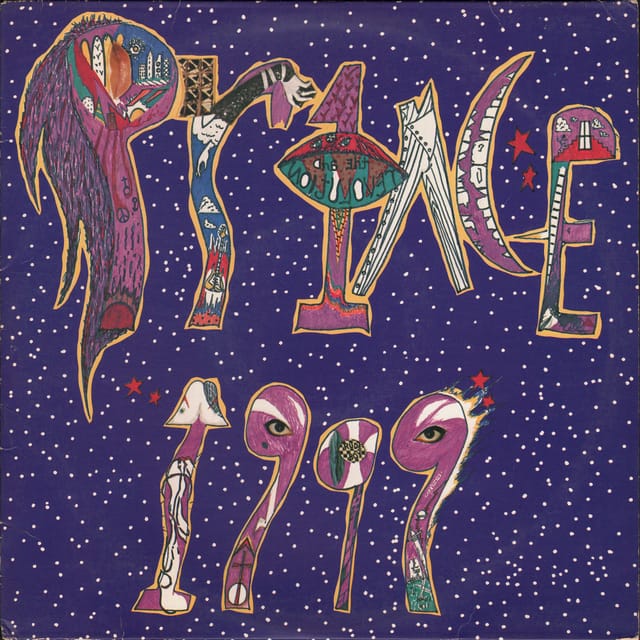
Prince: “1999” at 44
The album that taught the world to party like it's 1999 (1982)

Prince released 1999 just before Halloween in 1982. It was a double album, and the first time he set out to make hits. It reached the Top 10 and went platinum within a few months.
He made most of it at Sunset Sound in Los Angeles with one engineer, Peggy McCreary, playing nearly everything himself over a Linn LM-1 drum machine. “Little Red Corvette” and the title track crossed over to pop radio and set him up for Purple Rain two years later.
The Revolution Begins
By 1982, Prince had already established himself as a formidable talent with his first three albums, but "1999" represented a quantum leap in both artistic vision and commercial appeal. Working primarily at his home studio in Minneapolis, Prince created an album that was simultaneously futuristic and timeless, political and hedonistic, accessible and experimental. The result was a 70-minute statement that would reshape the landscape of popular music.
The album's central theme – the approaching millennium and what it might bring – gave Prince the perfect framework to explore his obsessions with technology, sexuality, spirituality, and social consciousness. Unlike many concept albums that feel forced or pretentious, "1999" wears its thematic unity lightly, allowing each song to function both as part of the larger narrative and as a standalone masterpiece.
What made "1999" so groundbreaking was Prince's integration of new technology with traditional funk and rock instrumentation. The Linn Drum machine, which would become synonymous with 80s production, was used not as a replacement for human rhythm but as an enhancement, creating mechanical precision that somehow felt more human than most live playing. Prince's use of synthesizers was equally revolutionary – rather than creating the cold, sterile sounds that characterized much early 80s music, he coaxed warm, organic tones that complemented rather than competed with his extraordinary guitar work. The revolutionary production techniques Prince pioneered on this album would come to define the entire Minneapolis Sound movement, influencing everyone from Janet Jackson to hip-hop pioneers.
The title track that gave voice to a generation's hopes and anxieties about the approaching millennium, featuring Prince's innovative use of drum machines and synthesizers alongside his incomparable vocals.
Musical Innovation and Production Mastery
The sonic palette of "1999" was unlike anything in popular music at the time. Prince's decision to handle nearly all instrumentation himself – with the notable exception of some backing vocals and Lisa Coleman's contributions – resulted in a cohesive vision that few multi-musician projects could match. His drum programming was particularly revolutionary, creating patterns that were both mechanically precise and rhythmically sophisticated, laying the groundwork for hip-hop production techniques that wouldn't emerge for several more years.
The guitar work on "1999" showcased Prince's incredible versatility. From the chunky, syncopated riffs of "1999" to the screaming solos on "Let's Pretend We're Married," Prince demonstrated that he could compete with any rock guitarist while maintaining his funk credentials. His use of effects and unconventional recording techniques – including his famous technique of recording guitar solos at half-speed and then playing them back at normal tempo – created sounds that seemed to come from the future.
1999
The album's opening statement is a masterclass in controlled chaos and organized rebellion. Beginning with the ominous synthesizer line that would become one of the most recognizable hooks in popular music, "1999" establishes the album's central conceit while delivering a message that was both celebration and warning. Prince's vocals, processed through the Vocoder to create an otherworldly effect, speak directly to the listener about the approaching millennium – not with fear, but with a kind of ecstatic fatalism.
The song's structure is deceptively complex, building from minimalist beginnings to a full-band assault that incorporates elements of funk, new wave, and rock without ever losing its essential groove. The interplay between the drum machine's relentless pulse and Prince's guitar work creates a tension that perfectly captures the anxiety and excitement of anticipating an uncertain future. Lisa Coleman and Dez Dickerson's backing vocals add a gospel dimension that elevates the track from party anthem to spiritual experience, while the extended outro showcases Prince's ability to create hypnotic, trance-like states through repetition and gradual dynamic shifts.
Cultural Impact and Social Commentary
"1999" arrived at a crucial moment in American cultural history. The Cold War was at its height, the nuclear threat felt very real, and the dawn of the computer age was beginning to change how people thought about the future. Prince channeled these anxieties and possibilities into music that was simultaneously escapist and confrontational. Songs like "Ronnie, Talk to Russia" addressed Cold War tensions with a directness that was unusual in pop music, while tracks like "Free" and "Lady Cab Driver" tackled issues of personal freedom and social justice.
The album's treatment of sexuality was equally groundbreaking. Prince had always been sexually provocative in his music, but "1999" presented sexuality as both liberation and spiritual experience. Tracks like "Little Red Corvette" and "Let's Pretend We're Married" used automotive and domestic metaphors to explore desire in ways that were both playful and profound, while "International Lover" pushed the boundaries of what was acceptable in mainstream pop music.
Prince tackled the record working like a colorblind technician who's studied both Devo and Afrika Bambaataa and the Soulsonic Force, keeping 1999's songs constantly kinetic with an inventive series of shocks and surprises.
Little Red Corvette
Perhaps the most commercially successful track on the album, "Little Red Corvette" demonstrates Prince's genius for wrapping complex emotions in irresistibly catchy melodies. The song's automotive metaphors work on multiple levels – as sexual innuendo, as commentary on American consumer culture, and as a meditation on the relationship between technology and human desire. The track's production is a marvel of restraint and precision, with each element given space to breathe while contributing to the overall groove.
Prince's guitar solo, recorded live in the studio, is a perfect balance of technical proficiency and emotional expression, while his vocal performance showcases his remarkable range and interpretive ability. The song's bridge, with its unexpected harmonic shifts and intricate vocal arrangements, reveals Prince's sophisticated understanding of pop song structure, proving that accessibility need not come at the expense of artistic complexity. The track became Prince's first Top 10 hit, introducing his music to audiences who might have been intimidated by his more experimental work, while never compromising his artistic vision.
The Revolution and Musical Collaboration
While Prince played most of the instruments on "1999," the contributions of his collaborators were crucial to the album's success. Lisa Coleman's keyboard work and backing vocals added harmonic sophistication and emotional depth, while Dez Dickerson's guitar provided a rock edge that complemented Prince's own playing. The backing vocals throughout the album, featuring Coleman, Dickerson, and Jill Jones, created a sense of community and celebration that balanced Prince's more introspective moments.
The album also marked the beginning of Prince's most creatively fertile period with his band, which would soon be rechristened The Revolution. The democratic spirit evident in the backing vocals and group arrangements on "1999" would come to full fruition on subsequent albums, but it's already apparent here in the way individual personalities shine through even within Prince's tightly controlled vision.
Delirious
One of the album's most infectious tracks, "Delirious" showcases Prince's ability to create irresistible dance music without sacrificing musical sophistication. The song's rockabilly-influenced guitar riff, processed through a haze of reverb and distortion, creates a sound that is both retro and futuristic. The track's lyrics, delivered with Prince's characteristic mix of vulnerability and bravado, explore themes of romantic obsession and emotional instability with a lightness that makes the darker implications all the more effective.
The production, with its prominent use of the Linn Drum and layered synthesizers, exemplifies the album's successful integration of electronic and organic elements. Prince's vocal performance, ranging from tender crooning to ecstatic shouts, demonstrates his incredible versatility as a singer, while the song's structure – with its unexpected tempo changes and dynamic shifts – keeps listeners engaged throughout. The track became a significant hit, further establishing Prince's ability to create music that worked equally well on the dance floor and in more intimate settings.
Lady Cab Driver
Perhaps the most politically charged track on "1999," "Lady Cab Driver" finds Prince channeling his anger and frustration into one of his most powerful musical statements. The song's sparse, menacing arrangement – built around a hypnotic bass line and stark drum programming – creates an atmosphere of urban tension that perfectly complements the lyrics' exploration of class, race, and economic inequality. Prince's vocal delivery is particularly striking, alternating between controlled rage and weary resignation as he addresses systemic injustice with a directness that was rare in mainstream pop music.
The track's structure is deliberately unsettling, with unexpected pauses and tempo shifts that mirror the chaotic urban landscape Prince describes. The repetitive nature of the groove creates a trance-like effect that draws listeners deeper into the song's world, while the gradual build of tension throughout the track showcases Prince's understanding of dynamics and musical narrative. "Lady Cab Driver" remains one of Prince's most underrated compositions, demonstrating his ability to address serious social issues without sacrificing musical integrity or emotional impact.
While from a later era, this performance captures the explosive energy and musical virtuosity that made Prince one of the greatest live performers of all time.
Legacy and Influence
The influence of "1999" on popular music cannot be overstated. The album's integration of electronic and traditional instruments became the template for much of the music that would dominate the 1980s, while Prince's approach to home recording and self-production inspired countless artists to take control of their own creative processes. The album's success also proved that music with real artistic ambition could achieve massive commercial success, paving the way for other genre-defying artists.
Hip-hop producers, in particular, found inspiration in Prince's drum programming and use of samples, while rock musicians were influenced by his fearless experimentation with guitar effects and recording techniques. The album's sexual frankness and social consciousness also set new standards for what popular music could address, inspiring artists across all genres to tackle more challenging subject matter.
Perhaps most importantly, "1999" established Prince as more than just a musician – he became a cultural icon whose influence extended far beyond music into fashion, film, and social consciousness. The album's success gave him the platform and credibility to make increasingly bold artistic statements, leading directly to masterpieces like "Purple Rain" and "Sign O' The Times."
Like every black pop auteur, Prince commands his own personal groove, and by stretching his flat funk forcebeat onto two discs worth of deeply useful dance tracks he makes his most convincing political statement to date—about race, the one subject where his instincts always serve him reliably. I mean, you don't hang on his every word in re sex or the end of the world, now do you?
Essential Tracks
While "1999" works best as a complete listening experience, certain tracks stand out as essential entry points into Prince's genius. The title track remains one of the most powerful opening statements in rock history, while "Little Red Corvette" demonstrates his ability to craft perfect pop songs without compromising his artistic vision. "Delirious" captures his playful side, and "Free" showcases his social consciousness and spiritual depth.
Deep cuts like "Lady Cab Driver," "All the Critics Love U in New York," and "International Lover" reveal the album's full range, from funky social commentary to avant-garde sexual expression. Each track offers something different while contributing to the album's overall cohesion, making "1999" one of the rare double albums that justifies its extended length.
Conclusion: A Timeless Prophecy
Forty-four years after its release, "1999" sounds less like a product of its time than a transmission from a parallel universe where popular music never stopped evolving. Prince's vision of the future – one where technology enhances rather than replaces human expression, where sexuality and spirituality coexist, where individual artistic vision can triumph over commercial considerations – feels more relevant now than ever.
The album's influence continues to ripple through contemporary music, from the electronic-organic fusion of artists like Frank Ocean to the genre-blending approaches of musicians like Tyler, the Creator. More than that, "1999" remains a masterclass in how to make music that is both of its time and timeless, both commercially successful and artistically uncompromising.
As we navigate our own uncertain future, Prince's message from 1982 rings clearer than ever: life is uncertain, the future is unknowable, but music – real music, made with passion and vision and an unwillingness to compromise – can provide both escape and understanding. "1999" isn't just one of the greatest albums of the 1980s; it's one of the greatest albums ever made, a work that continues to reveal new depths with each listen and new relevance with each passing year.