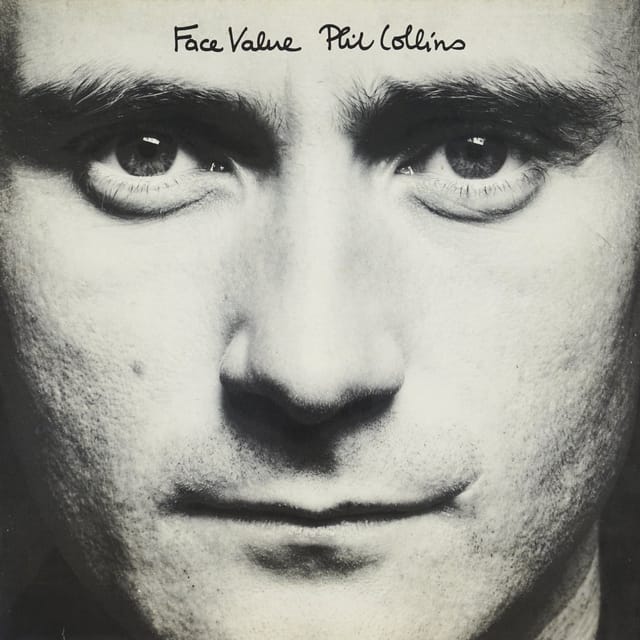

In November 1980, Phil Collins's marriage had just ended, and Genesis's future looked uncertain. He went into Town House Studios in London with producer Hugh Padgham to start his first solo album, Face Value.
He made it mostly alone, with piano, drum machine and his own voice, and wrote openly about his divorce. The album showed he was more than Genesis's drummer-turned-singer. It spent 274 weeks on the UK chart and included the song he's still best known for, “In the Air Tonight.”
“If my first album [Face Value] was 'I'm divorced and I'm miserable,' my next one was 'I'm going to kick this fucker to bits.'”
The Crucible of Personal Crisis
The genesis of Face Value lies in the convergence of professional uncertainty and personal devastation that defined Collins's life in 1979-1980. As documented in Chris Welch's authorized biography Phil Collins: The Definitive Biography, Collins's marriage to Andrea Bertorelli had been deteriorating for years, exacerbated by his increasing responsibilities as Genesis's frontman following Peter Gabriel's 1975 departure. The couple's separation in 1979 left Collins emotionally shattered and practically homeless, sleeping on friends' couches while contemplating his future in music.
Collins arrived at Town House Studios with producer Hugh Padgham carrying songs written on his own, at the piano, in the immediate aftermath of his separation—raw, painful sketches that would form the backbone of the album. That creative process—born from necessity rather than commercial calculation—would prove to be Collins's greatest artistic strength, transforming personal wreckage into the foundation for a solo career that would eventually outsell his work with Genesis.
The album's creation was further complicated by Collins's uncertainty about Genesis's future. With Tony Banks and Mike Rutherford pursuing solo projects and the band's direction unclear, Collins faced the possibility that his primary musical outlet might dissolve. As music journalist Armando Gallo noted in his contemporary Melody Maker coverage, this professional instability forced Collins to confront his identity as a musician independent of the progressive rock context that had defined his career since 1970. The result was an album that functioned simultaneously as artistic statement and survival mechanism.
Hugh Padgham and the Sonic Revolution
Producer Hugh Padgham's contribution to Face Value extended far beyond traditional production duties, essentially co-creating the album's revolutionary sonic landscape. Working primarily at Town House Studios in London's Shepherd's Bush, Padgham and Collins developed what would become known as the "gated reverb" drum sound—a technique that transformed Collins's already distinctive drumming into something entirely new. As detailed in Mark Cunningham's Good Vibrations: A History of Record Production, this effect was achieved by running Collins's drums through an SSL mixing console's built-in noise gate, creating the explosive, cut-off reverb that would define 1980s pop production.
The album's intimate scale belied its technical sophistication. Padgham's use of close-mic techniques on Collins's vocals created an almost uncomfortable intimacy, as if the listener was eavesdropping on private conversations. The Linn Drum machine, still relatively new technology in 1980, provided the rhythmic backbone for tracks like "I Missed Again" and "If Leaving Me Is Easy," its mechanical precision contrasting with Collins's raw emotionality. Music technology historian Peter Doyle notes in Echo and Reverb that this combination of human vulnerability with electronic precision would prove enormously influential on the decade's pop production.
“The sound Hugh and Phil created was completely new—this combination of intimacy and power, of electronic precision and human emotion. It changed how people thought about what a pop record could sound like.”
The Art of Musical Confession
The lyrical content of Face Value represented a radical departure from the fantasy narratives and literary allusions that characterized Progressive Rock songwriting. Collins's decision to write directly about his divorce, his feelings of abandonment, and his struggles with depression created what music critic Robert Christgau called "the first completely successful application of confessional songwriter techniques to arena-scale pop music." Songs like "Please Don't Ask" and "You Know What I Mean" functioned less as traditional pop compositions and more as transcribed therapy sessions, their circular structures mirroring the obsessive thought patterns of someone processing trauma.
The album's emotional honesty was matched by its musical sophistication. Despite their personal origins, the songs demonstrated Collins's understanding of pop craftsmanship learned through his years with Genesis. As analyzed by academic musicologist Walter Everett in The Foundations of Rock, tracks like "Behind the Lines" (a reworking of the Genesis song) showed how Collins could transform complex progressive compositions into emotionally direct statements without sacrificing their musical complexity. This synthesis of accessibility and sophistication would become the template for Collins's enormously successful solo career.
The album's thematic unity was reinforced by Collins's decision to use his own Polaroid self-portrait for the cover, literally showing his face to match the album's emotional transparency. Art historian Dick Hebdige's analysis in Subculture: The Meaning of Style noted how this visual choice—unusual for a major label release in 1981—communicated the album's central premise: that authenticity in popular music required complete vulnerability, even at the cost of commercial polish.
Essential Tracks
“In the Air Tonight”
The album's opening statement and career-defining moment, "In the Air Tonight" remains one of the most atmospheric and emotionally powerful pop songs ever recorded. Built around a hypnotic Linn Drum pattern and Collins's multi-tracked vocals, the track creates an almost unbearable tension that releases in its famous drum break—a moment that producer Hugh Padgham called "pure catharsis captured on tape." The song's sparse arrangement allows every element maximum impact, from the ominous synthesizer washes to Collins's increasingly desperate vocals.
Lyrically, the song functions as both specific confession and universal statement about betrayal and revenge. Collins's cryptic references to witnessing something he "can't forget" have spawned decades of interpretation, but the song's power lies in its emotional specificity rather than narrative clarity. The track's innovative use of the Prophet-5 synthesizer and its pioneering drum sound influenced everything from Prince's "Purple Rain" to modern electronic music, while its dramatic structure inspired countless power ballads.
That ambiguity eventually curdled into one of pop music's most elaborate urban legends — a drowning, a spotlight, a confession decades in the making. None of it happened, and Collins has said so directly. What actually did happen is stranger: “In the Air Tonight” and the Drowning Man: Pop's Favorite Urban Legend →
Watch: In the Air Tonight (Official Music Video)
“I Missed Again”
The album's most commercially successful track in America, "I Missed Again" demonstrated Collins's ability to transform personal failure into universal pop appeal. The song's bouncing Linn Drum rhythm and layered harmonies create an almost euphoric mood that contrasts sharply with its lyrics about romantic disappointment and self-doubt. This tension between musical optimism and lyrical pessimism would become a hallmark of Collins's solo work.
The track's sophisticated production showcases the collaborative chemistry between Collins and Hugh Padgham. The use of harmonized background vocals—all sung by Collins himself—creates a choir-like effect that anticipates his later hit "Against All Odds," while the gated reverb drums provide a rhythmic foundation that feels both mechanical and organic. Its success on American radio proved that Collins's confessional approach could translate across cultural boundaries.
Watch: I Missed Again (Official Music Video)
“If Leaving Me Is Easy”
Perhaps the album's most nakedly emotional track, "If Leaving Me Is Easy" strips away all musical artifice to focus on Collins's voice and piano, creating an intimacy that borders on uncomfortable. The song's simple structure—essentially a repeated verse-chorus pattern with minimal development—mirrors the obsessive thought patterns of someone unable to process rejection. Collins's vocal performance, recorded in a single take according to Hugh Padgham, captures the raw immediacy of someone speaking directly to their ex-partner.
The track's power lies in its complete lack of self-protection or artistic distance. Unlike contemporary confessional songwriters like James Taylor or Carole King, Collins offers no wisdom or resolution—only the immediate experience of abandonment and confusion. This unflinching honesty, combined with a melody of heartbreaking beauty, created what critic Jon Savage called "the template for every power ballad that followed," influencing artists from Lionel Richie to Adele.
Commercial Triumph and Critical Divide
The commercial success of Face Value exceeded all expectations, reaching #1 in the UK, Canada, and several European countries while peaking at #7 on the Billboard 200 in America—remarkable for a debut solo album by a progressive rock drummer. The album's 274-week run on the UK charts was unprecedented for the time, while its sales figures—over 5 million copies worldwide—established Collins as a major international artist independent of Genesis. Billboard's year-end analysis credited the album with helping to define the "adult contemporary" market that would dominate 1980s radio programming.
Critical reception, however, was more complex. While publications like Melody Maker and Record Mirror praised the album's emotional honesty and production innovation, others questioned its artistic merit. Village Voice critic Robert Christgau gave it a B+, noting that "Collins's willingness to make his private pain public isn't necessarily the same thing as making art," while acknowledging the album's "undeniable emotional impact." Sounds magazine's Geoff Barton was more enthusiastic, calling it "the most honest album by a major rock artist since John Lennon's Plastic Ono Band."
“Face Value works because Collins refuses to sentimentalize his pain. There's no self-pity here, just the brutal honesty of someone working through trauma in real time.”
Production Techniques That Defined a Decade
The technical innovations pioneered on Face Value would prove as influential as its emotional content. Hugh Padgham's use of SSL console compression and gating techniques created the "gated reverb" drum sound that would define 1980s pop production—a sound he and producer Steve Lillywhite had stumbled onto by accident during sessions for Peter Gabriel's third solo album in 1979, when a heavily compressed and gated talkback microphone picked up the drums in an unexpected way. Padgham brought the same SSL noise-gate-and-reverb combination to Face Value, sending Collins's drum tracks through the gate while applying heavy reverb to create the explosive, cut-off effect that made "In the Air Tonight" instantly recognizable.
The album's innovative use of the Linn Drum machine—still relatively new technology in 1981—demonstrated how electronic instruments could enhance rather than replace human performance. Collins's decision to layer his live drumming with the machine's samples created a hybrid sound that maintained human feel while achieving mechanical precision. This approach influenced the development of 1980s pop production and presaged the sampling techniques that would dominate hip-hop and electronic music.
Perhaps most importantly, the album's mixing philosophy—emphasizing space and dynamics over density—created a template for modern pop ballad production. The way Padgham used silence and restraint to build emotional tension influenced everything from Duran Duran's ballads to contemporary artists like Coldplay and The XX. Music technology journalist Dan Daley's analysis in Mix magazine noted that the album "proved that less could be more in an era increasingly obsessed with sonic maximalism."
Enduring Legacy and Contemporary Impact
Face Value established the template for confessional pop that continues to influence artists across genres four decades later. Its synthesis of personal vulnerability with commercial sophistication paved the way for everyone from Alanis Morissette's Jagged Little Pill to contemporary artists like Adele and Sam Smith. The album's production techniques—particularly its use of gated reverb and electronic/acoustic hybrid arrangements—remain staples of modern pop production, while its emotional directness helped establish the "singer-songwriter meets technology" approach that defines much contemporary music.
The album's influence extends beyond musical boundaries into broader cultural territory. Its exploration of masculinity and emotional vulnerability predated by decades the contemporary conversation about men's mental health, while its honest examination of divorce and family breakdown spoke to social changes that would accelerate throughout the 1980s. Academic studies by sociologist Simon Frith and cultural critic Greil Marcus have positioned the album as a key document in the evolution of masculine identity in popular culture.
Perhaps most significantly, Face Value proved that authenticity and commercial success need not be mutually exclusive. Its massive sales figures demonstrated that audiences were hungry for emotional honesty in popular music, establishing a market for confessional pop that would flourish throughout the 1980s and beyond. The album stands as Collins's masterpiece: a perfect fusion of personal crisis and artistic vision that transformed pain into art and established him as one of the decade's most important solo artists. As critic Dave Marsh noted in his retrospective analysis, it remains "proof that sometimes the most private statements become the most universal truths."
Four Decades of Critical Reassessment
Modern critical reassessment of Face Value has been overwhelmingly positive, with many contemporary critics acknowledging their initial underestimation of the album's artistic merit. Pitchfork's 2016 retrospective praised the album's "unflinching emotional honesty and production innovation," while Uncut's 40th anniversary review called it "a masterpiece of confessional pop that has only grown in stature." The album's inclusion in Rolling Stone's updated 500 Greatest Albums list reflects its growing recognition as a foundational work of 1980s pop.
Academic criticism has been particularly favorable, with scholars recognizing the album's sophisticated engagement with themes of masculinity, vulnerability, and technological modernity. Music historian John Covach's analysis in What's That Sound? highlighted how the album's production techniques influenced the development of 1980s pop, while feminist musicologist Susan McClary's work on gender and performance found in Collins's confessional approach a complex negotiation of masculine emotional expression that was decades ahead of its time.
The album's enduring popularity with both critics and audiences suggests its themes remain relevant. Streaming data shows consistent engagement across generational lines, while its songs continue to appear in films, television, and commercials. The 2021 documentary Phil Collins: Not Dead Yet featured extensive analysis of the album's creation and impact, introducing its story to new audiences while reinforcing its status as a classic of confessional pop.
---“What seemed like oversharing in 1981 now feels like necessary honesty. Collins showed that pop music could be a vehicle for genuine human emotion without sacrificing its commercial appeal.”
★★★★★
Essential Tracks: "In the Air Tonight," "I Missed Again," "If Leaving Me Is Easy"
For Fans Of: Peter Gabriel, Sting, James Taylor
MusicBrainz ID: 1cbc1a5a-5512-3f8e-997b-d9281b83722b
Album Artwork: https://coverartarchive.org/release-group/1cbc1a5a-5512-3f8e-997b-d9281b83722b/front