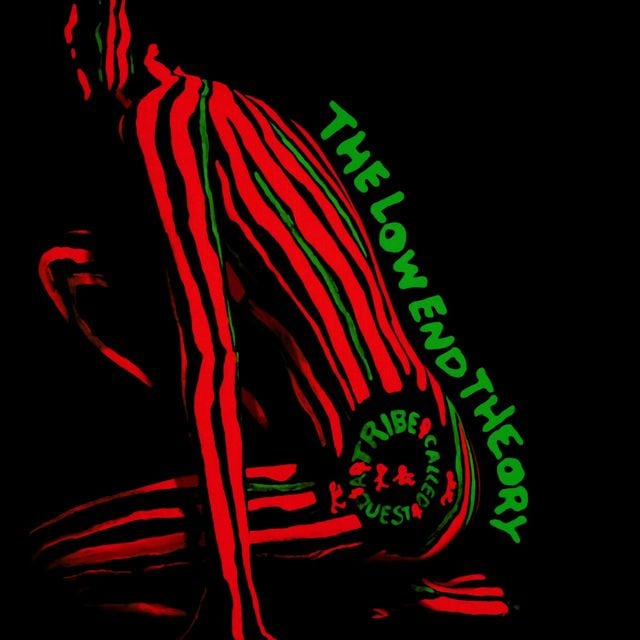

When Q-Tip called Ron Carter to ask him to play on a rap record, the jazz bassist had never heard of A Tribe Called Quest. He phoned his sons, who were into hip-hop, to ask about them. Then he set one condition: if the group started cursing, he would unplug and go home.
Q-Tip agreed, and one of jazz's most recorded bassists played upright bass on a rap song in 1991. That was one part of a much bigger project. Over about a year in New York studios, the group stripped their sound down to bass, drums and jazz samples. They recorded well over a dozen songs that didn't make the album, and lost a founding member to culinary school along the way.
They released The Low End Theory that September. It's the album most often credited with showing that hip-hop and jazz belonged together.
“With The Low End Theory, A Tribe Called Quest created one of the closest and most brilliant fusions of jazz atmosphere and hip-hop attitude ever recorded.”
Queens Kids and the Native Tongues
Q-Tip, Phife Dawg, Ali Shaheed Muhammad, and Jarobi White had grown up together in Queens, close enough that their 1990 debut, People's Instinctive Travels and the Paths of Rhythm, played like a home movie — loose, funny, a little scattered. That record had come out of the Native Tongues collective the group co-founded alongside De La Soul and the Jungle Brothers, a loose alliance built around Afrocentric themes and a shared distaste for hip-hop's more aggressive, materialist strains.
White had recorded verses for the follow-up before leaving the group during the sessions to study culinary arts — his parts did not make the final album, and A Tribe Called Quest continued as the trio of Q-Tip, Phife Dawg, and Ali Shaheed Muhammad that would define the group from that point forward. It left Q-Tip and Phife to carry the record's voice alone, a change that pushed Phife in particular toward a bigger, more assertive presence than he'd had on the debut.
Where the first album had reached in several directions at once, the sessions for what became The Low End Theory narrowed toward a single, deliberate idea: strip the music down until almost nothing was left but bass, drums, and a rapper's voice, and see how far that minimalism could carry a record built on jazz.
A Year in New York Studios
Recording stretched across 1990 and 1991, mostly at Battery Studios in Manhattan, with further sessions at Greene St. and Soundtrack. Q-Tip produced almost the entire album, with Ali Shaheed Muhammad on scratches and co-production. Skeff Anselm, who produced two of the tracks, described a process built on volume rather than a fixed plan. The group recorded “20-something or 30 songs,” he told Ambrosia for Heads, and only fourteen made the record. “Tip pretty much did most of the sampling on the spot,” Anselm recalled. “He did a few of them at home.”
Q-Tip's guiding principle gave the album its name before it had one. As Anselm remembered it, Tip told engineer Bob Power: “I want the bottom to be as heavy as you can make it.” Power, who mixed the album, built his approach around clearing space for exactly that. When a sample held a whole band but only one part mattered, he said, “I would do everything I could to take the band out of there so you could really hear the clarity of the musical constructions better.” He treated the sampled jazz and soul records the group pulled from — Art Blakey, Grant Green, Weather Report, Cannonball Adderley among them — less like source material to be buried in the mix and more like a band he was recording live.
Anselm credited all those unused songs with sharpening Phife Dawg, a rapper the group's debut had used sparingly, into a full creative partner for Q-Tip. By the time the sessions wrapped, the trade-off between quantity and focus — dozens of songs down to fourteen, a scattered debut narrowed into a single sonic idea — had produced something neither the group nor Jive Records fully anticipated.
The lead single, home of the ‘Industry rule number 4,080’ line that became one of hip-hop's most quoted.
Essential Tracks
“Excursions”
The album opens with Q-Tip recalling his father, who heard hip-hop and recognized bebop in it. The verse is autobiography, not theory: a son explaining his music to his dad and finding they were talking about the same thing. The bass and horns come from Art Blakey and the Jazz Messengers' “A Chant for Bu.”
Built around a loping bassline sample, the song frames hip-hop not as a break from jazz but as its direct continuation — bebop's improvisational freedom passed down a generation and given a drum break. It set the thesis for the entire record in its first ninety seconds.
As the album's opening statement, “Excursions” has become one of the most analyzed tracks in the group's catalog — not for a hook or a chart run, but for compressing an entire argument about lineage and legitimacy into a single verse.
“Verses From the Abstract”
Q-Tip called Ron Carter himself, telling him he was a Charles Mingus fan and wanted a live bassist rather than a sample. Carter had played on more recorded sessions than almost anyone in jazz. Carter got to the studio on time, went to the control room, plugged directly into the board, did three takes, and went home.
He'd called his sons beforehand to vet the group, and set one condition before agreeing to the date. “If you guys start cursing and talking like everyone else does on these records, I'm gonna unplug and go home,” he told them, as he recalled to the Observer. Q-Tip and the group obliged, and Carter's upright bass became the clearest evidence on the album that the jazz influence wasn't just sampled — it was, for four minutes, literally in the room.
The collaboration stands as one of the earliest instances of a jazz musician of Carter's stature recording directly for a hip-hop act, a pairing that looked improbable on paper and became, on record, one of the album's defining moments.
“Scenario”
The album's closing posse cut paired A Tribe Called Quest with Leaders of the New School, a Long Island quartet cosigned by Public Enemy, for a five-verse relay that stacked energy rather than competing egos — two connected groups, not five soloists jockeying for space.
The song is remembered almost entirely for what happens last: 19-year-old Busta Rhymes closing it out with a verse so explosive it turned a deep cut into hip-hop's reference point for how to steal a track from four other rappers on the same song. It is still routinely ranked as hip-hop's greatest posse cut.
Released as a single in March 1992, it became the launching point for Busta Rhymes' solo career — a rare case of a guest verse outgrowing the record that introduced it.
Busta Rhymes' closing verse, at age 19, is still cited as the moment a guest feature outgrew the song that introduced it.
Industry Rule #4080
“Check the Rhime,” the album's lead single, carried the line that would outlive the song itself: Q-Tip's “Industry rule number 4,080,” a one-couplet verdict on how record companies treat the artists they sign. It became one of the most quoted lines in hip-hop.
The phrase took on a life well beyond the record, becoming shorthand across hip-hop for industry distrust in general. It was a pointed thing to put on a lead single for a major-distributed label.
The song itself is a duet in the truest sense, Q-Tip and Phife trading lines like old friends from Queens, which is exactly what they were.
Five Mics and a Mixed Notice
The Source awarded the album five mics, the magazine's highest rating, and singled out Phife's leap forward from the debut. At AllMusic, John Bush later put the pair's chemistry plainly: their rapping “could be the smoothest of any rap record ever heard.”
Not every critic fell in line immediately. Robert Christgau, writing in The Village Voice, was reserved, pairing “dope jazzbeats” with “goofball rhymes from the well-meaning middle class” and giving the record a three-star honorable mention rather than a letter grade — though he still singled out “Check the Rhime” and “Buggin' Out” as highlights, a hedge that reads, in hindsight, like a critic underestimating a record everyone else would eventually treat as canon.
Commercially, the album entered modestly — debuting and peaking at No. 45 on the Billboard 200 and No. 13 on the Top R&B/Hip-Hop Albums chart — before building steadily on the strength of touring and singles. It was certified gold in February 1992 and platinum three years later, a slow climb that mirrored the record's reputation: unremarkable on arrival, essential in retrospect.
The “Sgt. Pepper's” of Hip-Hop
Bob Power, who died in March 2026, described the album's impact in blunt terms 25 years on: “I think that record, that era of records and Hip-Hop in general really changed the way everybody hears low frequency and its place on records.” The album has often been called the Sgt. Pepper's of hip-hop — a record that didn't just succeed but reset what the genre's productions were expected to sound like.
The thing is, when we was doing it, we didn't know that it was gonna be what it is today. We didn't, for real.
The verdict has only hardened with time. In 2022 the Library of Congress added it to the National Recording Registry. The jazz-rap lineage it opened runs directly through the Soulquarians collective a decade later — J Dilla, D'Angelo, Erykah Badu, and The Roots all working the same live-bass, minimal-drum territory the album staked out first, with Ali Shaheed Muhammad himself moving fluidly between both worlds in the years that followed.
Thirty-five years later, the record still sounds like an argument won rather than a trend followed — the sound of a trio in a New York studio deciding, with a departing member, a wary record label, and a jazz legend checking their lyrics for profanity, that hip-hop and jazz had been the same music all along.
“At the time, they seemed like the only ones who understood the relationship between the rhythm and the beat.”