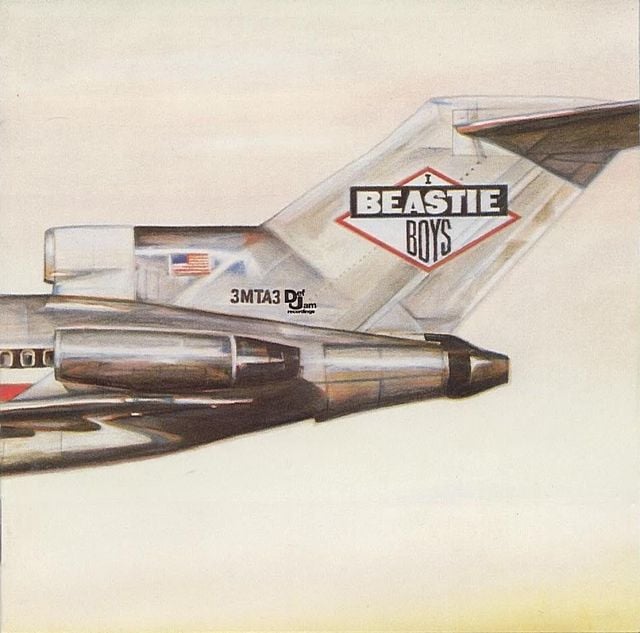

Rick Rubin produced most of the Beastie Boys' debut album while nursing an ear infection so severe that doctors told him he risked losing hearing in one ear if he got on a plane, so he stayed grounded in New York and worked the boards himself rather than handing the project off. What came out of those Chung King Studios sessions was a record built from arena-rock guitar samples, playground taunts and a joke song about frat parties that its own creators meant as satire — and it became, against nearly everyone's expectations, the first rap album ever to reach No. 1 on the Billboard 200. Three white Jewish kids from New York's downtown punk scene, backed by a Def Jam co-founder who was still a college student when the label started, had somehow made the biggest-selling rap record of the decade. Licensed to Ill went on to move more than ten million copies in the US alone, becoming the first hip-hop album ever certified Diamond by the RIAA — a legacy the band itself would spend years afterward trying to complicate.
“Three Idiots Make a Masterpiece.”
From Hardcore Punks to Def Jam's First Rap Group
Michael Diamond, Adam Horovitz and Adam Yauch started out playing hardcore punk in downtown New York before drifting toward hip-hop through their friendship with Rick Rubin, then a fellow NYU student running a fledgling label out of his dorm room that would become Def Jam Recordings. Def Jam's early roster — LL Cool J, Run-D.M.C. — had already begun folding rock guitars into rap production; the Beastie Boys, arriving from the opposite direction, brought a punk band's irreverence into a genre most of the industry still treated as a novelty.
The group's early singles for Def Jam, cut with Rubin's help, built a cult following on New York's club circuit and on tour opening for Madonna and Run-D.M.C., but nobody at the label, including Rubin himself, was predicting a Beastie Boys album would out-sell the rest of Def Jam's catalog combined.
Recording for what became Licensed to Ill stretched across 1985 and 1986, based mainly at Chung King Studios in Manhattan, with Rubin serving as producer and Def Jam co-founder Russell Simmons as executive producer. Midway through, an ear infection nearly took Rubin off the project entirely — doctors warned him that flying could cost him hearing in the affected ear, so he canceled tour dates and stayed rooted in New York, finishing the record from the studio rather than the road.
Sampling Zeppelin, Breaking the Rules Backward
Rubin's production approach treated rock guitar riffs, most famously Led Zeppelin's “When the Levee Breaks” drum break, as raw material for rap the same way earlier producers had used funk breaks, giving the album a bigger, more arena-scaled sound than anything else in hip-hop at the time. Mike D later credited Rubin plainly for turning the group's rougher ideas into something radio could actually carry: “What Rick did was pretty incredible. He took our weird rap songs, and he made them sound clean and big and polished — and ready for the radio.”
Some of the album's most distinctive sounds came from happy accidents rather than planning. Working on drum programming with an early digital sampler, Adam Yauch wondered aloud what a drum pattern would sound like reversed, bounced the beat to another tape, flipped it, and bounced it back — a manual, pre-digital version of a trick that would define an entire song. The reversed pattern became the backbone of “Paul Revere,” a beat so strange that Def Jam's own Russell Simmons initially assumed it was simply a mistake that had accidentally turned into a record.
That willingness to keep the mistake rather than fix it runs through the whole record — guitar solos bolted onto rap songs, drum patterns played backward, samples lifted wholesale from albums nobody expected a rap group to touch. It made Licensed to Ill sound less like a rap record trying to appeal to rock fans than a genuinely new hybrid neither genre had produced before.
Written as satire of frat culture, and almost universally misread as a straightforward party anthem.
A Joke Nobody Got
The album's biggest hit was conceived as a punchline. Adam Yauch had originally imagined a deliberately dumb, macho party-rock parody with a friend, Tom Cushman, as a side project mocking exactly the kind of frat-house anthems the finished song would become. He brought the idea into the Beastie Boys sessions, and “(You Gotta) Fight for Your Right (To Party)” was built as a caricature of the culture it seemed to celebrate.
The satire didn't survive contact with its audience. Frat parties across the country adopted it as an anthem in earnest, with none of the intended irony making it through. Mike D later summed up the disconnect with visible frustration: “There were tons of guys singing along… who were oblivious to the fact it was a total goof on them.”
That gap between intention and reception would eventually come to define how the band itself talked about the whole album — a record built partly on jokes the audience took at face value, performed by a group who spent the following decade trying to distance themselves from the persona the songs had accidentally cemented.
Essential Tracks
“(You Gotta) Fight for Your Right (To Party)”
Conceived by Adam Yauch as a parody of dumb, macho party-rock anthems — developed with his friend Tom Cushman as a joke side-project concept before the Beastie Boys ever recorded it — the song leans on a simple, sledgehammer riff and shouted, call-and-response verses that read as satire on paper and as an actual party anthem on a stereo, a gap the band never fully closed.
Its music video, ranked among MTV's funniest of all time, doubled down on the joke with exaggerated frat-party chaos, but the joke was lost on most of the audience, who simply heard a great party song and sang along accordingly, beer in hand, missing the target entirely.
It became the album's signature song and, eventually, its biggest source of band regret — a satire so successful at mimicking its target that it got mistaken for the real thing by nearly everyone who heard it, and stayed that way for decades regardless of how the band explained it afterward.
“No Sleep till Brooklyn”
A tour-exhaustion anthem built on a hard-rock guitar riff and capped by a genuine metal guitar solo courtesy of Slayer's Kerry King, the song is one of the clearest statements of the album's rock-rap fusion — a rap song that structurally behaves like an arena-metal track, right down to the guest shredding bolted directly onto the outro.
Its music video parodied 1980s glam-metal excess outright, with the group cycling through increasingly ridiculous rock-star costumes and wigs, extending the album's running gag of taking rock's biggest gestures completely seriously while winking at the audience the whole time.
The song became a permanent fixture of the band's live sets, traditionally closing their concerts for years afterward — a road anthem that outlived the touring cycle it was written to complain about, and one of the few tracks on the album the group never seemed embarrassed to keep playing.
“Paul Revere”
Built on a drum pattern Adam Yauch reversed almost on a whim — recording a beat, flipping the tape, and bouncing it back before digital sampling made that kind of manipulation trivial — the song tells a mock-Wild West origin story for the group in reverse chronological order, matching its backward-sounding beat to a backward-told narrative in a way few rap records had attempted before.
Russell Simmons has said he initially assumed the reversed beat was simply a technical mistake rather than a deliberate choice, which makes its survival onto the finished album a small triumph of the band's instinct for keeping happy accidents rather than smoothing them out into something more conventional.
It remains one of the most sonically distinctive tracks on the record precisely because it sounds like nothing else being made in hip-hop or rock at the time — a beat that shouldn't have worked, built from a mistake nobody bothered to correct, and a clear sign of the production ambition hiding under the album's frat-house surface, decades before reversed and manipulated drum samples became a routine studio trick rather than a happy accident.
Featuring a genuine guitar solo from Slayer's Kerry King, parodying glam-metal excess in the video.
Rap's First No. 1
Licensed to Ill reached No. 1 on the Billboard 200 in early 1987, the first rap album ever to top that chart, and held there for seven weeks — a genuinely unexpected result for a rap group whose core audience, on paper, looked nothing like the record-buying demographic that had made it happen. It went on to become the second rap album ever certified Platinum by the RIAA, then kept selling for decades afterward.
By 2015, nearly three decades after release, the RIAA certified the album Diamond for shipping more than ten million copies in the US — the first hip-hop album in history to reach that threshold, a distinction that had eluded every other rap record of the 1980s entirely.
That commercial arc — a slow-building cult act turned unlikely chart-topper turned decades-long steady seller — gave the record staying power most 1980s rap releases, treated by much of the industry as disposable singles product, never had a chance to develop.
Critics Caught Off Guard
Contemporary critics, expecting either a novelty record or a straightforward rap album, seemed genuinely surprised by what they heard. Rolling Stone's Michael Goldberg captured that surprise in his review's own headline, “Three Idiots Make a Masterpiece,” praising the record's production and rowdy energy in terms that took the group far more seriously than its frat-house image suggested it deserved.
Robert Christgau, reviewing it for The Village Voice, was similarly won over by the group's sheer nerve, praising the album's “wisecracking arrogance” as “the only rock and roll attitude that means diddley right now” and calling the music “radically original, childishly simple, hard to play” yet “accessible to anybody with two ears and an ass” — a review that took the joke seriously as craft even while acknowledging how dumb it was on the surface.
Radically original, childishly simple, hard to play… accessible to anybody with two ears and an ass.
Retrospective assessments have largely agreed on the record's significance while growing more clear-eyed about its flaws. AllMusic's later review located the album's importance in the space “where metal, punk, and rap meet,” crediting it as a genuine hybrid rather than a novelty crossover — a judgment the band itself has come to share, with reservations about some of what it took to get there.
The Apology
Some of the album's jokes have aged far worse than its production. Certain lyrics leaned on crude, homophobic and misogynistic material that the band itself came to regard as a genuine embarrassment rather than harmless provocation. In 1999, Adam Horovitz addressed it directly in an open letter to Time Out New York: “I would like to take this opportunity to formally apologise to the entire gay and lesbian community for the shitty and ignorant things we said on our first record,” he wrote. “There are no excuses. But time has healed our stupidity. We have learned and sincerely changed since the '80s.”
That public reckoning, unusual for a band still actively touring on the strength of the same record, reframed how the Beastie Boys wanted Licensed to Ill remembered: not disowned outright, but held at arm's length as the work of much younger men who'd go on to build a genuinely progressive reputation, especially under Adam Yauch's later Buddhist-influenced activism, that stood in direct tension with some of their own debut's content.
Few multi-platinum debut albums have had their creators publicly apologize for parts of their own content while the record was still selling briskly — a genuinely unusual afterlife for a record that made its label more money than anything else in its catalog.
Legacy: The Rap-Rock Blueprint
Licensed to Ill proved, commercially beyond any argument, that rap and rock guitar could share a record without either genre's audience treating it as a novelty — a template every rap-rock and nu-metal act of the following two decades would draw on, whether or not they acknowledged the debt. Its use of hard-rock samples as rap production material became standard practice well beyond hip-hop's original sampling vocabulary.
The band itself moved decisively away from the album's frat-house persona almost immediately, splitting acrimoniously from Def Jam and Rick Rubin shortly after its release and reinventing themselves within a few years as one of hip-hop's most inventive and critically respected acts — a trajectory that makes Licensed to Ill as much a starting point the group spent decades running from as a record they were ever fully comfortable owning.
Forty years on, the album occupies an unusual place in hip-hop history: commercially foundational, stylistically influential, and only partly endorsed by the very people who made it — a record whose creators kept growing up in public long after the joke had already gotten away from them.
“Operating from the axis of where metal, punk, and rap meet.”