
In 1985, Patrick Leonard wrote a piece of music for a film, and the studio turned it down. He asked Madonna to write words for it. She sat on the floor of his house with a notepad and wrote the lyrics. They recorded it on an eight-track machine, and that first vocal is the one on the record. The song was “Live to Tell.”
Madonna was 27 and newly married to the actor Sean Penn. Like a Virgin had made her famous. On her third album she co-wrote and co-produced every song for the first time, working with Leonard and her old friend Stephen Bray.
True Blue came out on June 30, 1986. It spent five weeks at No. 1 in America. In Britain it became the first album by an American artist to enter the chart at No. 1.
It produced five singles, and three of them went to No. 1 in the US. Estimates of its worldwide sales run from about 19 million to 25 million copies. It is still her best-selling studio album.
“With songs like ‘Papa Don’t Preach,’ Madonna made the transition from pop tart to consummate artist, joining the ranks of the decade’s icons like Michael Jackson and Prince.”
From the Virgin Tour to the Studio
In 1985 Madonna played arenas for the first time. Patrick Leonard was musical director of the Virgin Tour, and he was not a fan of the job. “Going out on a stage and playing ‘Like a Virgin’ wasn't my idea of a thrill,” he told Sound on Sound in 1991. “And it still isn't.”
What Leonard wanted was to score films. He had written music for a Paramount picture called Fire With Fire, but the studio passed on it and hired Howard Shore. Madonna had a suggestion. Her new husband had just made a film, At Close Range, directed by James Foley. Maybe the song could go in that.
“She sat on the floor with a pad, wrote the lyrics and we recorded it on an 8-track in my house,” Leonard told USA Today in 2021. In a later interview he put it more simply: “She wrote the lyrics in minutes, sang it once, got it down straight away.” Foley hired Leonard to score the film, and “Live to Tell” became its theme.
Stephen Bray went back much further. He had played with Madonna in the Breakfast Club, a New York band from her pre-fame years. Their demos helped get her signed to Sire Records, and he had co-written “Into the Groove.” With Leonard on one side and Bray on the other, Madonna had two writing partners she trusted.
A 10-by-12 Room in Los Angeles
The sessions began in December 1985 with “Open Your Heart” and ran for about five months. Much of the album was demoed at Leonard's home in Hollywood. It was finished at Channel Recording, a studio engineer Michael Verdick had built in his own house.
It was not a grand room. “The studio was probably only about 10-by-12,” Leonard recalled. One song, “Where's the Party,” was written after the rest were basically done. It was recorded almost entirely in Leonard's family room.
Leonard has described their usual routine. “I would put something together, usually just on piano, and then she would come in at about 11,” he told Music Business Worldwide. They didn't labor over takes. “It helped that neither she nor I are second guessers. Period,” he said.
The sound is clean and bright, built on synthesizers and drum machines, with real strings where a song needed weight. The title track and “Jimmy Jimmy” look back to early-1960s girl-group pop, a sound Madonna has always named as an influence.
Directed by James Foley, fresh from At Close Range, with Danny Aiello as the father. It tells the whole story without a line of dialogue.
The Song Written for Someone Else
The album's most famous song came from outside the team. Songwriter Brian Elliot wrote “Papa Don't Preach” for a singer named Christina Dent. Michael Ostin, an A&R executive at Warner, heard it and persuaded Elliot to give it to Madonna instead. She added a few lines and took a co-writing credit, then produced it with Bray.
The song is sung by a pregnant teenage girl telling her father she plans to keep the baby. Madonna knew what was coming. “‘Papa Don't Preach’ is a message song that everyone is going to take the wrong way,” she told The New York Times.
Everyone did. Anti-abortion groups adopted it. Tipper Gore, whose campaign against explicit lyrics had led to Senate hearings the year before, praised it as “an important song, and a good one.” The lawyer Gloria Allred said Madonna should “make a public statement noting that kids have other choices, including abortion.” Madonna stayed out of it.
Elliot was unbothered. “If Madonna has influenced young girls to keep their babies, I don't think that's such a bad deal,” he said. The song never uses the word “abortion.” It reached No. 1 on the Hot 100 on August 16, 1986, the same week True Blue went to No. 1 on the album chart.
The ambiguity is a cop-out rather than an open door (or heart), which is bad.
The Essential Tracks
“Live to Tell”
“Live to Tell” came out as a single before the album did. It was an odd choice for an artist known for dance hits. It is a slow, dark ballad about a woman who has kept a secret for years. Madonna told Rolling Stone it was “true, but it's not necessarily autobiographical.”
Leonard played the keyboards and programmed the drum machines, and he and Madonna produced it together. The track drifts between a hushed verse and a big, echoing chorus. Madonna had imagined singing it from a man's point of view. Leonard preferred her fragile demo vocal, and that is the one that was released. She sings low and almost without vibrato, and she sounds more exposed than on anything she had recorded before.
It reached No. 1 on the Hot 100 on June 7, 1986, and topped the Adult Contemporary chart too. Stereogum's Tom Breihan, looking back on it in 2020, wrote that it “cuts a little deeper” than the decade's usual power ballads. At Close Range flopped at the box office. Its theme song became the first single from her biggest album.
“Open Your Heart”
“Open Your Heart” was the first song recorded for the album, and it began as somebody else's. Gardner Cole and Peter Rafelson wrote it as “Follow Your Heart,” with Cyndi Lauper in mind, though they never pitched it to her. Madonna's managers picked up the demo for her.
Madonna and Leonard rebuilt it as a driving dance track, with Leonard sequencing the bass line. Madonna rewrote enough of the lyric to earn a writing credit. It became the fourth single, with a video by the French photographer Jean-Baptiste Mondino set in an old-fashioned peep show.
It reached No. 1 on February 7, 1987, the album's third US chart-topper. Robert Christgau was hard on the album as a whole, but he singled out “the inexhaustible ‘Open Your Heart’” as its high point. Cole's girlfriend at the time, Donna De Lory, had sung on his demo. Madonna hired her as a backing singer for her 1987 tour.
“La Isla Bonita”
Leonard first wrote this music for Michael Jackson. He had worked on the Jacksons' Victory Tour and stayed in touch with Quincy Jones. “Quincy called me and said, ‘I want to do something sort of Sade-like for Michael — would you write something?’” Leonard recalled to Boy Culture. His demo already had the phrase “la isla bonita” on it.
Jones passed. “He called up and said, ‘Ah, I just don't think it's for Michael,’” Leonard said. He played it to Madonna, who liked it, rewrote the lyrics and helped rebuild the arrangement. Guitarist Bruce Gaitsch shares the writing credit. The finished track has Spanish guitar, Latin percussion and a breathy, unhurried vocal. Nothing else on the album sounds like it.
Released as the fifth and last single in February 1987, it reached No. 4 in the US and No. 1 in Britain. It has outlived almost everything else from the record. According to the Official Charts Company, its video is Madonna's most-streamed by a wide margin.
Leonard wrote the music for Michael Jackson. Quincy Jones turned it down, and it became Madonna's most-watched video.
Number One in Two Countries at Once
True Blue went to No. 1 on the Billboard album chart in August 1986 and held the top spot for five weeks. The rest of that week's top five shows what it was up against: the Top Gun soundtrack, Peter Gabriel's So, Genesis's Invisible Touch and Janet Jackson's Control.
In Britain it entered the Official Albums Chart at No. 1. No album by an American artist had done that before. It spent six weeks at the top and sold just under two million copies in 1986 alone, more than any other album that year. It has since been certified seven times platinum in the UK, making it her best-selling album there.
The singles kept it on the charts into 1987. “Live to Tell,” “Papa Don't Preach” and “Open Your Heart” all reached No. 1 in America. The title track stopped at No. 3 and “La Isla Bonita” at No. 4. In Britain, “Papa Don't Preach,” “True Blue” and “La Isla Bonita” all went to No. 1. That is more UK chart-toppers than any other Madonna album.
Her film career went the other way. At Close Range had flopped, and Shanghai Surprise, which she made with Penn that year, did even worse. The records kept selling.
Sturdy, Dependable, or a Snow Job
Reviewers in 1986 were mostly kind. Rolling Stone called it “sturdy, dependable, lovable” and said it “remains faithful to her past while shamelessly rising above it.” Its review also predicted the album might sell less than Like a Virgin. It ended up selling more.
Robert Christgau gave it a B in the Village Voice, and his review was more a complaint about the critics. He wrote that they flocked to her “the way liberal arts magnas flock to investment banking.” He judged that she “doesn't speak for the ordinary teenaged stiff any more than Reagan speaks for union members.”
Later critics have been warmer about the hits and cooler about the rest. Sal Cinquemani of Slant called it “a supreme archetype of ’80s pop music.” He also said it was “home to some of her biggest clunkers,” naming “Jimmy Jimmy” and “Love Makes the World Go Round.” His verdict: “chock-full of hits,” and “undeniably of its time.”
The Coolest Guy in the Universe
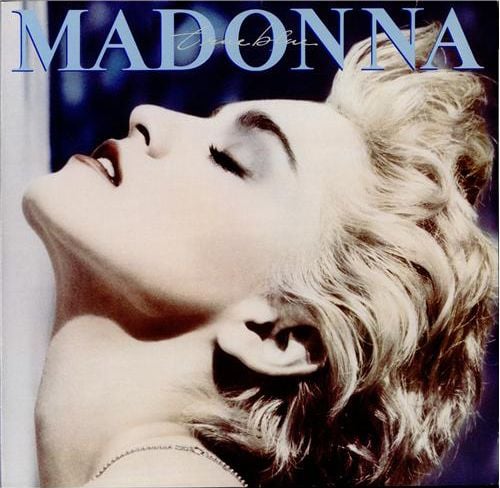
The album was dedicated to Penn: “This is dedicated to my husband, the coolest guy in the universe.” The title song is a cheerful, 1960s-style love song with him in mind. The cover photograph, taken by Herb Ritts in Hollywood, shows her with short platinum hair, head tilted back. That was a new look for her, softer than the crucifixes and lace of Like a Virgin.
The marriage did not last, but the partnership with Leonard did. “So we did True Blue, we did Like a Prayer, we did Breathless,” he said, “and from there she went in all kinds of directions.” Like a Prayer, three years later, took the seriousness of “Live to Tell” and “Papa Don't Preach” much further.
The songs kept their reach. Kelly Osbourne's cover of “Papa Don't Preach” reached the UK top three in 2002. Its string intro was later sampled by Mario Winans, among others. “La Isla Bonita,” the song Quincy Jones turned down, is still her most-watched video.
True Blue is where Madonna took charge of her own records. She co-wrote and co-produced every song, chose her collaborators, and took on a serious subject in a hit single. Forty years later, it is still her best-selling studio album.
“One of the best singles in a career full of great ones.”