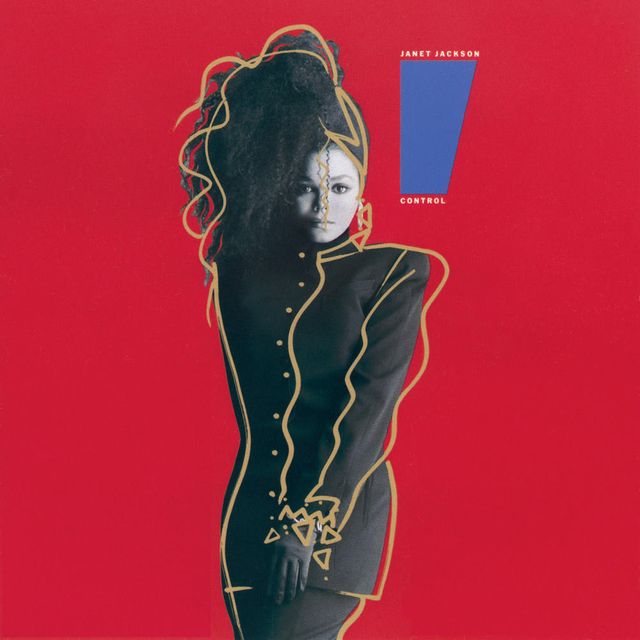

In the summer of 1985, Janet Jackson flew to Minneapolis expecting a limousine. Jimmy Jam picked her up in his own car instead. Her luggage, and her friend Melanie's, spilled out of the trunk into the back seat.
She was 19, newly out of a short marriage, and done with her father managing her career. Her first two albums had barely sold, and she had had almost no say in either. Jam and his partner Terry Lewis, two musicians Prince had fired from the Time, wanted to hear what she had to say.
Six weeks later they had Control. It was released on February 4, 1986, and entered the Billboard chart at No. 84. It climbed slowly as each single came out and reached No. 1 that summer.
It gave her a run of hits that lasted well into 1987, including her first No. 1 single. It has since sold more than 10 million copies worldwide.
“Janet was like a stick of dynamite. We lit the fuse.”
Michael's Little Sister
Janet Jackson was a television actor before she was a singer. She had regular roles on Good Times and Diff'rent Strokes and later joined the cast of Fame. Her father, Joe Jackson, steered her into a record deal with A&M, and she released her first album in 1982, while still a teenager.
Neither that album nor 1984's Dream Street made much impact. Both were made for her rather than with her, by producers including Giorgio Moroder. Meanwhile her brother Michael had released Thriller. When it took off, Janet told him, “You make me sick. I wish that were my album.”
In September 1984 she eloped with James DeBarge, a singer from another Motown family. She soon learned that he drank heavily and was addicted to painkillers. The marriage was annulled after eight months. Around the same time she ended her father's management. For the first time, she was making decisions for herself.
Fired by Prince, Hired by A&M
Jimmy Jam and Terry Lewis had been keyboardist and bassist in the Time, the Prince-backed funk band fronted by Morris Day. On the side, they began producing other acts. In 1983 a freak snowstorm stranded them in Atlanta while working with the S.O.S. Band, and they missed a Time show. Soon afterward they were out of the band.
The firing did them no harm. The S.O.S. Band's “Just Be Good to Me” became a hit, and they went on to make records for Cherrelle and Alexander O'Neal at their own Flyte Tyme studio. A&M executive John McClain lined them up to produce a different singer on the label. When she decided to go with other producers, McClain apologized and offered them their pick of the A&M roster. “Terry and I looked at the roster and we both said Janet Jackson,” Jam told Red Bull Music Academy. “We always felt like there was something there.” Jam always described their job as fitting the record to the artist, and Janet had more to say than their earlier clients. “Cherrelle had no particular statement to make, but she's a fun, energetic person, so we tried to capture that on her album,” he told Musician in 1986. “But Janet did have one to make, so we went for that.”
The first meeting nearly went wrong. The label played Janet their latest production, a lush, orchestral album for Patti Austin, and she worried her record would sound the same. Her father had a different worry. “He said, ‘Prince is from Minneapolis,’” Jam recalled. “He said, ‘Don't have my daughter sounding like Prince.’”
Janet wanted to record in Los Angeles. Jam and Lewis refused: they made their records at Flyte Tyme, in Minneapolis, away from Hollywood and away from her family's people. She agreed, and flew north with her friend Melanie Andrews and no bodyguards.
A Week at the Lakes
For the first week, nobody mentioned the album. “Minnesota is the land of 10,000 lakes,” Jam said. “So – we would literally go to the lakes and drive around and sit and talk.” They went to clubs and movies. Then Janet asked when they were going to start. “We replied, ‘Oh. We've already started,’” Jam remembered. They showed her lyric ideas for a song called “Control,” built from everything she had been telling them.
“It was like a light bulb that went off in her head,” Jam said. Nobody had asked her before what she wanted to sing about. She was now co-writing her own record. She also imposed some discipline: she fined the producers 25 cents every time they swore. “We probably blew half of the album budget just on that,” Jam joked.
One night at a club, some men harassed her while the producers watched from a distance, letting her handle it. She did, then asked why they hadn't helped. She told them the men had been saying nasty things to her. “We were like, ‘OK! So let's write about it,’” Jam said. “This was the spirit of the record.” The result was “Nasty.”
Lewis described the method plainly. “We got into her head,” he said. “We saw what she was capable of, what she wanted to say, where she wanted to be, what she wanted to be. We put together some songs to fit her as we saw her, as she revealed herself to us.”
Directed by Mary Lambert and choreographed by a young Paula Abdul, the 'Nasty' video gave Janet the tough image the song demanded.
Recording in the Red
The whole album took about six weeks in the summer of 1985: one week hanging out, three weeks recording, two weeks mixing. Days were for the lakes; work ran from late afternoon to midnight. Owning their studio meant no hourly rate. “If we had to be in a commercial studio, the record would've never been made the way it was made,” Jam said.
The first song they cut was the ballad “He Doesn't Know I'm Alive,” chosen to test her range. “She nailed the vocal on it,” Jam said. “That made us see that there weren't any boundaries with what we could do with her.” They also had her play some of the keyboard parts, to involve her as much as possible. Janet later credited them for letting her think of herself “as a musician, and not just as a singer.”
They deliberately changed their tools. Their recent records had used a DMX drum machine, so for Janet they switched to a Linn Drum fitted with custom sound cards. They also bought an Ensoniq Mirage, one of the first affordable sampling keyboards. The keyboard sounds on “Nasty” and the horn stabs on “When I Think of You” came from it.
Their inexperience as engineers became part of the sound. Following a trick they had learned from Prince, they recorded everything hot, with the meters in the red, and their tape machine setting pushed it further still. When engineer Steve Hodge arrived to mix, he played the first song and said, “Oh my God.” Then he asked who had engineered it. Hodge assured them he could save it, and the overload gave the album its aggressive, loud character.
Hodge added his own touch: delay and echo on the handclaps of “Control.” Years later, Babyface told Jam that the handclaps on his and L.A. Reid's productions, including Bobby Brown's “Don't Be Cruel,” came straight from that record.
The beats suspend your arms, poised to lash or defend, while locking the knees in an alert stance.
Essential Tracks
“Control”
The title track is the album's thesis. Its lyric came almost directly from Janet's own words to her producers: she had moved out, she was living on her own, and she wanted to be the one in charge. “It was the overarching theme of the record, which was a young woman asserting her independence and growing up,” Jam said. It opens with a spoken introduction that announces exactly that.
At nearly six minutes, it is built on the Linn Drum, with Jam playing extra snare fills by hand against the programmed pattern. They drift slightly out of time, on purpose. “When I was younger, I played the drums, and I thought I was a drummer,” Jam said. “I had really good rhythm.” He played the keyboard parts live too, rather than sequencing them. Hodge's echoing handclaps give the track its snap.
The label thought it too long and choppy to lead the album, and worried it sounded too aggressive for a lead single. Released later as a single, it reached the US top five.
“Nasty”
Born from the club incident, “Nasty” was the boldest thing on the record. “It was very aggressive for a female singer,” Jam said. “To me, the tracks we did for this record sounded like they could've been for a male artist or a rap artist. But we thought she would have the attitude to pull those kind of songs off.”
The track is all metal: anvil-like percussion, gated snares, and Mirage keyboard stabs, with gaps that make each hit land harder. Janet's vocal is full of asides and whoops, playful and confrontational at once. She is not afraid to sound rough, and she clearly enjoys it. Its mix of funk, pop, and hip-hop rhythm pointed straight at the new jack swing sound that would dominate the late 1980s.
It reached the US top five in 1986. Its video, choreographed by Paula Abdul, shows Janet facing down a gang of leering men and making them back off. Its spoken tag line became one of the most quoted lines in pop, the moment Michael's little sister introduced herself on her own terms.
“When I Think of You”
The album's sweetest song was not the one its makers expected to be the biggest. When the record was finished, Jam and Lewis played it for Janet's brothers. They passed over “Control,” “Nasty,” and “What Have You Done for Me Lately” and picked this one. “That is a #1 record,” they said. “I was like, ‘Huh. Really?’” Jam recalled.
The song builds layer by layer from a simple Mirage piano line, adding bass, drums, and brass before Janet sings. Lewis played the guitar part on an old green Telecaster that never stayed in tune. Jam took the beat's inspiration from KC and the Sunshine Band, and the bass came from a Yamaha DX7.
The brothers were right. Released as the third single, it gave Janet her first US No. 1, and she and Michael became the only siblings to have solo No. 1s on the Hot 100. Its video, directed by Julien Temple as a tribute to old Hollywood musicals, was choreographed by Paula Abdul.
Julien Temple directed the 'When I Think of You' video as a tribute to classic MGM musicals, with choreography by Paula Abdul.
“I Just Need One More”
When the album was done, McClain came to Minneapolis to hear it. He liked it, and then said what A&R men always say. “I just need one more,” he told them. He wanted a first single. Jam and Lewis protested that they had already given him “Control,” “Nasty,” and “When I Think of You.”
Later that day, riding around with McClain, they played a track they had been saving for their own album. McClain heard it and declared it the record he needed for Janet. The producers made a deal: they would play it for her, and if she reacted, she could have it.
Janet heard it from the lounge outside the control room. Jam watched her start to move, then make what they called “the ugly face,” the look that means something is really funky. “She said, ‘Ooooh, who is that for?’ I replied, ‘It can be for you, if you want it.’ She said, ‘Oh. I want it.’” It became “What Have You Done for Me Lately,” a pointed reply to her ex-husband, and her first top-ten hit.
McClain then sold the record inside A&M with total conviction, telling colleagues it would go at least double platinum. “He took the record when it was done and literally stood on people's desks,” Jam said. “You have to remember people weren't really expecting anything at this point.”
From No. 84 to No. 1
Control started slowly. It entered the Billboard 200 at No. 84 and climbed for about five months, rising each time a new single landed. It reached No. 1 that summer, pushed over the top by “When I Think of You.” The RIAA certified it gold in April and platinum two months later.
Critics were slower than buyers to credit Janet herself. Robert Christgau gave it a B and admitted he had “scoffed at Janet's claims of autonomy,” suspecting Jam and Lewis had simply written her in as a collaborator. Even so, he called the beats “their deepest ever.” Rolling Stone did not give it a review of its own, pairing it with Jermaine Jackson's new album in a single piece.
Rob Hoerburger's review still caught the point. “Janet's Control is already a hit, but she sounds more concerned with identity than with playlists,” he wrote. Jam and Lewis had aimed squarely at Black listeners first. “We wanted to do an album that would be in every Black home in America,” Jam told Rolling Stone. “We were going for the Black album of all time.”
The videos sealed the image. Paula Abdul, then a little-known choreographer, worked on several of them. Janet felt the first video, for “What Have You Done for Me Lately,” lacked attitude, so for “Nasty” she hired Mary Lambert instead. For “The Pleasure Principle,” written by the Time's Monte Moir, she danced alone in a warehouse, a performance she later admitted terrified her.
The album's quietest song carried its own message. “Let's Wait Awhile,” written with Melanie Andrews, grew out of her friend's uncertainty about sleeping with her boyfriend. “The theme of the song was Janet's idea,” Jam said later. “She's not a preachy person. She's not telling people how to live their lives. All she's doing is offering an opinion.” Arriving as AIDS cases were rising, it was praised well beyond the music press.
Not everyone was ready to treat her as an artist. A&M paid for only a three-week promotional tour of 13 American cities. On Dutch television, host Adam Curry quizzed her about Michael's oxygen chamber and her brothers' superstitions, as if she were the family spokesperson rather than the singer of the album climbing the charts.
The Road to Rhythm Nation
Control changed three careers at once. Janet became a star on her own terms. Jam and Lewis went from cult producers to one of the most sought-after teams in pop, and they produced her next several albums. Their sound, hard drum machines under pop melodies, set the template for the new jack swing records that followed.
The partnership went bigger on the next album. Three years later, Janet and the same team made Janet Jackson's Rhythm Nation 1814, trading personal independence for a social manifesto. Why she made that turn is its own story: 1814: How Janet Jackson Turned a Trivia Answer Into Her Generation's Anthem →
Janet was inducted into the Rock & Roll Hall of Fame in 2019. Her later albums often overshadow this one, but it is where the partnership and the persona began. Jam put the album's purpose simply: “Control was the first record where she told people how she was feeling.”
Forty years on, its opening statement still sets the terms. A 19-year-old who had spent her life being told what to do went to a cold city with two outsiders, talked for a week, and made a record about deciding for herself.
“Janet has a torn, raw, ‘wet’ voice, ideal for expressing the wariness of an outsider, as well as the sexual urgency of her later albums.”