
In 1971 the engineer Ken Scott agreed to co-produce David Bowie's next album. He wanted to learn production, and he thought Bowie was a safe place to do it. Bowie had one hit, “Space Oddity.” Scott assumed nobody would hear the mistakes.
The album was Hunky Dory, released by RCA on December 17, 1971. It had “Changes,” “Oh! You Pretty Things” and “Life on Mars?” It was also the first record by the band that became the Spiders from Mars.
At first it hardly sold. It did not enter the UK chart until September 1972, after Ziggy Stardust had made Bowie a star. It reached its peak of No. 3 in August 1973, twenty months after it came out.
“Hunky Dory gave me a fabulous groundswell. I guess it provided me, for the first time in my life, with an actual audience – I mean, people actually coming up to me and saying, ‘Good album, good songs.’ That hadn't happened to me before.”
A Hit Song for Peter Noone
By early 1971 Bowie's career had stalled. “Space Oddity” had been a hit in 1969, but his next album, The Man Who Sold the World, did not do well. Ken Scott, who engineered both of those records, later summed up his view of Bowie at the time. “David was a nice guy, he was very pleasant, obviously had a certain amount of talent,” he told the Red Bull Music Academy, “but superstar? Nah. No way.”
Two things changed that year. In January and February, Bowie made his first trip to America to promote the album. He crossed the country in under a month, from Washington and New York to Houston and Los Angeles. “America was an incredible adrenaline trip,” he told Beat Instrumental in 1972. “I got very sharp and very quick. Somehow or other I became very prolific. I wanted to write things that were more immediate.”
The second change was the piano. After signing a publishing deal with Chrysalis in late 1970, Bowie began writing songs on piano instead of guitar. One of his demos, “Oh! You Pretty Things,” reached the producer Mickie Most. Most gave it to Peter Noone, formerly the singer of Herman's Hermits, and Noone's version became a hit in 1971 with Bowie playing piano on it.
Bowie was amused by the result. “I don't know if Peter Noone knows what it means,” he told Melody Maker, “it's all about Homo Superior.” For a while he seemed content to write for other people. He made a single under the band name Arnold Corns, with his friend Freddie Burretti posing as the singer. Its two songs, “Moonage Daydream” and “Hang On to Yourself,” would turn up again on Ziggy Stardust.
He also got his guitarist back. Mick Ronson had played on The Man Who Sold the World and gone home to Hull. Bowie persuaded him to return to London. Ronson brought the drummer Mick “Woody” Woodmansey and a new bass player, Trevor Bolder, and all three moved into Haddon Hall, Bowie's home in Beckenham. Bowie's son Duncan was born on May 30, 1971. Soon afterwards Bowie wrote “Kooks” for him.
Ken Scott's First Production
Bowie needed a producer. Tony Visconti, who had produced his last two albums, had fallen out with him over his new manager, Tony Defries, whom Visconti distrusted. Ken Scott had engineered for the Beatles at Abbey Road and was now the house engineer at Trident Studios in Soho. He mentioned to Bowie that he wanted to move into production.
Bowie's reply surprised him. “Well, I've just signed a new management deal,” Scott remembered him saying. “They want to put me into the studio to record an album. I don't know that I'm capable of doing it all on my own. Will you co-produce it with me?” Scott accepted. His private reasoning, he admitted later, was that “no one's going to hear this record because he's never going to be a superstar.”
That changed a few weeks later. Bowie, his wife Angie and his publisher Bob Grace came to Scott's house one evening to go through the new songs. As they went through them, Scott realised what he was hearing. “There is every possibility,” he thought, “that a lot of people will hear every single mistake I make on the production of the album.”
In his memoir, Abbey Road to Ziggy Stardust, he put it more bluntly. Bowie “could be a lot bigger than I expected and this album might actually be something that a lot of people will listen to. Crap.” That evening was nearly all the pre-production they did. Some songs had been demoed and the band already knew them. The rest they worked out in the studio.
The credits on the back of the sleeve read “Produced by Ken Scott (assisted by the actor).” The actor was Bowie. He was just as modest about his playing, listing himself on guitar, saxophones and “the less complicated piano-parts (inability).”
Rick Wakeman at Haddon Hall
The pianist on most of the album was Rick Wakeman, then one of the busiest session players in London. He had first worked with Bowie in 1969, playing the Mellotron on “Space Oddity.” Now Bowie called him with a different brief. “David said, ‘I'm doing a new album, and I want a lot of it to come from the piano,’” Wakeman told Mojo.
Wakeman went to Haddon Hall to hear the songs. “I nicknamed it Beckenham Palace,” he told The Guardian, “because at the time I was living in a tiny little terraced house in West Harrow and his kitchen was bigger than my entire place.” Bowie played him the new material, and one song stood out. “‘Life On Mars?’ stuck out as being something very special,” Wakeman said. “He wanted a piano solo, he wanted the album to be very piano-orientated.”
Wakeman has always said Bowie played the songs to him on a battered 12-string guitar. In 2003 Bowie corrected him on his website. “Lovely fella, Rick, however his memory is as loopy as mine in some places,” he wrote. “Several songs on Hunky Dory were written on piano, e.g. ‘Life On Mars?’ and ‘Changes’ for starters, not guitar. I played my plodding version and Rick wrote the chords down then played them with his inimitable touch.”
Bowie gave his musicians a lot of room. Wakeman remembered what he was told about the album's key song:
When he played me Life On Mars?, he said, ‘Treat it as a piano piece… play it as you want to.’
Wakeman also recalled a scene in the studio. In his telling, Bowie scolded the band for not learning the songs and sent them away: “You can pack your stuff up, go and practice them, and we'll come back in the studio when you've learned them.” Trevor Bolder and Ken Scott both said it never happened. Bolder believed the band would not have survived a dressing-down like that, since Ronson and Woodmansey had already walked out on Bowie once.
Wakeman played Trident's house piano, a Bechstein grand built in 1898. It was already famous. The Beatles had used it on “Hey Jude,” and it was on Elton John's early records and Nilsson's “Without You.” Its bright tone opens both “Changes” and “Life on Mars?” “I have heard many pianos in my time,” Scott wrote, “but I have never heard a better ‘rock’ piano than that one.”
The album's opener, built on Rick Wakeman's piano and the first song Ken Scott mixed as a producer.
Eight Weeks at Trident
The sessions ran from June 8 to August 6, 1971, at Trident Studios on St Anne's Court in Soho. On the first day they recorded “Song for Bob Dylan.” Then there was a break of several weeks, and on June 23 Bowie played the first Glastonbury Fayre festival. He sang “Changes” there in public for the first time. Work resumed on July 9, with Wakeman now in the studio.
The band worked Monday to Saturday, from early afternoon until around midnight. According to Scott there were no drugs in the studio and very little drink, apart from Ronson's occasional beers. Most songs took two or three takes. Scott found that the band rarely needed telling what to do.
“There were often moments where David would say to Ronno, ‘OK, it's time to…’” Scott wrote, “and Ronno would cut him off and say, ‘I know. I'll do the guitar at the end of the song.’” Ronson also wrote the string arrangements. His future wife, Suzi Fussey, said he wrote them sitting in the studio toilet, by ear, without a keyboard, because it was quiet in there.
Bowie's vocals were nearly always first takes. Scott, who produced four Bowie albums, put the figure at 95 percent. “They're not perfect, they're sometimes slightly out of tune, sometimes slightly out of time, but they're real,” he said. Today, he added, they “would have to be auto-tuned.”
The mixing was a different story. Bowie rarely came to mix sessions, which left Scott and an assistant alone at Trident's Sound Techniques desk. There was no automation, and Scott heard far more changes in his head than two people could make with their hands. So he mixed each song a section at a time. He would “get one section right, then the next section, edit them together and listen to make sure that the edit worked.”
“Changes” was the first song he mixed that way, and he worked like that for years afterwards. On “Changes,” for example, he wanted Wakeman's piano brighter and thinner in the choruses than in the verses. “Over the years I have had it pointed out to me that if you listen on headphones you can hear some of those edits,” he wrote, “but thankfully they're few and far between.”
Warhol, Dylan and the Velvet Underground
The second side opens with Biff Rose's “Fill Your Heart,” the album's only cover. Then come three songs about Bowie's American heroes. The first is “Andy Warhol.” When Bowie met Warhol in New York in September 1971, he played it to him.
“Loathed it,” Bowie said of Warhol's reaction. “Somebody came over and said: ‘Gee, Andy hated it.’ I said: ‘Sorry, it was meant to be a compliment.’” He was told that Warhol was sensitive about his looks, and the song had mentioned them. What broke the ice in the end was Bowie's shoes, small yellow ones with a strap. Warhol had once designed shoes and adored them.
“Song for Bob Dylan” was more of a statement of intent. Bowie felt that Dylan had stepped back from leading rock music, and he offered to take the job. “It was at that period that I said, ‘Okay [Dylan], if you don't want to do it, I will,’” he told Melody Maker in 1976.
The third was “Queen Bitch,” which the sleeve credits with “Some V.U, White Light returned with thanks.” Bowie had heard the Velvet Underground's first album in late 1966, when his manager Kenneth Pitt brought home an early copy from Warhol's Factory. In the press adverts for Hunky Dory he called the song “A song on a Velvet Underground-Lou Reed framework s'about London sometimes.”
It is the loudest track on the album, just guitars, bass and drums, and it points straight at what came next. “If you take a track like ‘Queen Bitch,’” Scott told Uncut, “that would've fit in perfectly with Ziggy, so there wasn't much of a leap between Hunky Dory and Ziggy, in my estimation.”
Essential Tracks
“Changes”
The opening track is about reinvention, and about Bowie's own false starts in the 1960s. In his notes for the press adverts, Bowie wrote: “This album is full of my changes and those of some of my friends.” Woodmansey heard one line as being about “Space Oddity.” “He thought he'd made it with that song; then he found out that he hadn't made it after all,” the drummer wrote in his memoir. “He was almost admitting it had been a false start.”
The chorus has a stutter borrowed from Roger Daltrey on the Who's “My Generation,” and it tells older rock stars that they are getting old. “I guess it was me being sort of arrogant,” Bowie said in 2000. “It's sort of baiting an audience, isn't it? It's saying, ‘Look, I'm going to be so fast you're not going to be able to keep up with me.’” Woodmansey was proud of his drumming on it, because he left a lot of space so the vocal could breathe.
RCA released it as a single in Britain on January 7, 1972, the day before Bowie turned 25. It flopped. In America it reached No. 66, his first single to chart there. It became a concert favourite anyway. “It turned into this monster that nobody would stop asking for at concerts,” Bowie said. It finally entered the UK chart in January 2016, after his death, at No. 49.
“Life on Mars?”
The song began with a grudge. In 1968 Bowie wrote English words for a French song, “Comme d'habitude,” but the publisher turned his version down. Paul Anka then wrote new lyrics, and the song became “My Way,” Frank Sinatra's signature. “There was a sense of revenge in that, because I was so angry that Paul Anka had done ‘My Way,’” Bowie told the NME. “I thought I'd do my own version.” The sleeve says the song was “inspired by Frankie.”
“This song was so easy,” Bowie wrote in 2008. The idea came on a sunny day in the park. On a bus to Lewisham to buy shoes, he could not get the riff out of his head, so he got off and went home to the piano. He “had the whole lyric and melody finished by late afternoon.” He described it as “a sensitive young girls reaction to the media.” It was recorded on August 6, the last day of the sessions. Ronson ran the session from the studio floor, cueing Wakeman, and wrote one of his first string arrangements for it.
One take was spoiled when a pay phone in the studio bathroom rang. “No one ever knew the number, so it never rang,” Scott wrote. They taped over that take, but the end of it survived. During the string overdubs it suddenly played back, and it sounded good, so it stayed. You can still hear the phone, and Ronson swearing, as the song fades. Woodmansey remembers the playback: “all of us had our jaws dropped.” Released as a single in June 1973, it reached No. 3 in Britain.
“Quicksand”
Bowie wrote “Quicksand” on the American trip, and one of its demos was recorded in a San Francisco hotel. In his press notes he called it the result of “the bliss and then the calamity of America,” which “produced this epic of confusion.” He added that he could just as well have written it in Dulwich.
It is a song about self-doubt. The 24-year-old Bowie worries that his ideas are built on sand. The lyrics are full of the reading he was doing at the time: the occultist Aleister Crowley, the philosopher Friedrich Nietzsche, Buddhism, and the Second World War, with Himmler and Churchill both mentioned by name. Musically it is one of the album's biggest productions, with acoustic guitars, Wakeman's piano and a Ronson string arrangement.
Bowie later admitted that a lot of this reading was for show. He said he never really got into Crowley and had carried a biography of him on the Tube with the title showing. Trevor Bolder did not mind. “It's my favourite track on the album,” the bass player told the author Ken Sharp. “I think it's Bowie at his best.”
The 1973 promo shot by Mick Rock, made when RCA released the song as a single. It reached No. 3 in Britain.
An Album Without a Record Label
Bowie made Hunky Dory without a record deal. By July 26, seven songs had been recorded and mixed. They were pressed with songs by Bowie's friend Dana Gillespie onto a promotional LP, about 500 copies, known as BOWPROMO. In August Tony Defries took it to New York to find a label.
Five companies were interested. United Artists nearly signed him, but RCA, the home of Elvis Presley, made a late offer. Bowie signed with RCA in New York on September 9, 1971. The deal was for three albums in two years, with an advance of $37,500 for each one. On the same trip he met Lou Reed, Iggy Pop and Andy Warhol.
The last two songs recorded show how fast Bowie was moving. “The Bewlay Brothers,” taped on July 30, was the only song on the album without a demo. Scott remembered Bowie bringing it in with a warning. “I've just written this new song, we've got to record it but don't listen to the lyrics,” Bowie said. Why not? “Because they don't mean anything. I wrote it specifically for the American market to read things into it.”
Bowie did not perform it live until September 18, 2002, at a small BBC show in London. He read the words from lyric sheets. One of the reasons he had never played it, he joked to the audience, was that “there are more words in this than there are in Tolstoy's War And Peace.”
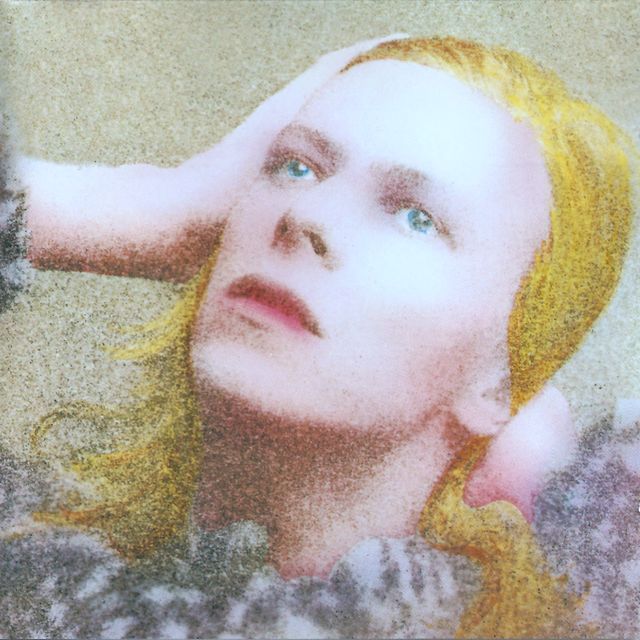
The cover photo was taken by Brian Ward at his studio on Heddon Street in London, where the Ziggy Stardust cover would be shot the next year. Bowie had tried an Egyptian theme, dressing as a pharaoh, but chose a simple close-up of himself looking skyward, holding his long hair flat against his head. Ward shot it in black and white. The illustrator Terry Pastor then tinted it, giving it the look of an old Hollywood glamour shot.
Twenty Months to No. 3
RCA did not know what to do with the record. Bowie had already told the label that he was about to change his image and his sound. By the time Hunky Dory came out, he was halfway through recording Ziggy Stardust. Staff argued over how much to spend on promoting an album its maker had already moved past.
The British music papers liked it. The NME called it “a breath of fresh air compared to the usual mainstream rock LP of today.” Melody Maker said it was “not only the best album Bowie has ever done, it's also the most inventive piece of song writing to have appeared on record for a considerable period of time.” Rolling Stone called it his “most readily enjoyable work” since 1969 and ended its review with a pun: “Hunky Dory will suffice hunky-dorily.”
The public did not buy it. In Britain, Hunky Dory failed to chart at all for its first nine months. It finally entered the Official Albums Chart at No. 44 on September 23, 1972, after “Starman” and the Ziggy Stardust album had made Bowie famous. It dropped out again after a week.
The real turn came in 1973. RCA released “Life on Mars?” as a single in June, and it spent three weeks at No. 3. The album followed it up the chart. On August 18, 1973, Hunky Dory reached No. 3, and it was back there again on September 1. One run that year lasted 42 weeks without a break.
Rick Wakeman says he knew all along. “I remember telling people I'd just played on what was going to be a very iconic album,” he told The Guardian, “which Hunky Dory of course was.” By then he had turned down Bowie's offer to join the Spiders from Mars. He was asked on the same day that Yes asked him to join. “It was like being asked to join Manchester United or Chelsea,” he said. “I took Yes, because within the Spiders David was always going to be the leader.”
The Songwriter Before Ziggy
Ziggy Stardust made Bowie a star, and Hunky Dory is the album that showed what he could write. It has no character to hide behind. Rick Quinn of PopMatters, writing for the 50th anniversary, argued that its “musical versatility and genius rivals any of the Beatles' late ’60s catalog.”
Its songs kept finding new audiences. John Hughes quoted “Changes” in The Breakfast Club in 1985. A version by Butterfly Boucher, with Bowie singing harmony, appeared on the Shrek 2 soundtrack in 2004. “Changes” was also part of Bowie's final live appearance, a duet with Alicia Keys at a charity concert in New York in November 2006.
The album kept changing hands as the format changed. Rykodisc reissued it on CD in 1990 with four bonus tracks, and it was remastered again for the Five Years 1969–1973 box set. In 2022 the box set Divine Symmetry collected the demos, outtakes and 1971 radio sessions. It includes Bowie's solo piano demo of “Life on Mars?” and the San Francisco hotel demo of “Quicksand.”
The album was also the start of a partnership. Ken Scott went on to co-produce Ziggy Stardust, Aladdin Sane and Pin Ups with Bowie, working in much the same way. Later in the decade Bowie went back to Tony Visconti, and their Berlin-era albums are covered in our review of Low.
Scott thinks part of the reason people still listen is those first-take vocals, flaws and all. He never fixed them, and fifty-five years later nobody has needed to.
“I think that's one of the reasons that we're still talking about these albums after all this time. They're real, they're human, and they reach you here [points to his gut] more than they do up here [points to his head].”