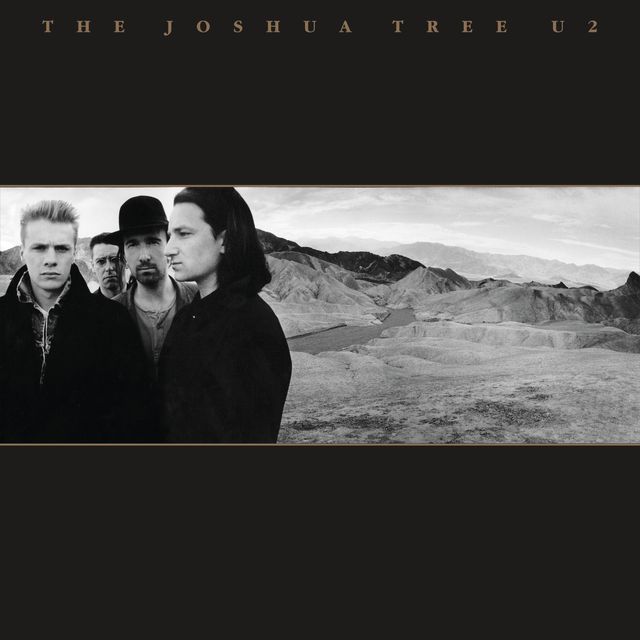

During the sessions for U2's fifth album, Brian Eno had the tape machine ready to record over “Where the Streets Have No Name.” He had spent weeks trying to fix it. A junior tape operator, Pat McCarthy, dropped his cup of tea and physically held him back.
The song survived and opened The Joshua Tree, released on March 9, 1987. It spent nine weeks at No. 1 in America and gave U2 their only two Hot 100 No. 1 singles, “With or Without You” and “I Still Haven't Found What I'm Looking For.”
It won the Grammy for Album of the Year and has sold more than 10 million copies in the US. It turns 40 on March 9, 2027.
“The Joshua Tree rescues rock from its decay, bravely and unashamedly basing itself in the mainstream before very cleverly lifting off into several higher dimensions.”
The Two Americas
By 1986 U2 were already one of the biggest live bands in the world, helped by their set at Live Aid the year before. What they did not have was a classic album. War and The Unforgettable Fire had both gone platinum in America, but neither had reached the top 10, and their biggest US single, “Pride (In the Name of Love),” had stalled at No. 33.
The new songs were about America. Bono had travelled to Nicaragua and El Salvador in 1986 after the band's Conspiracy of Hope tour for Amnesty International. He saw poverty and government planes over the hills. Those trips became “Bullet the Blue Sky” and “Mothers of the Disappeared.”
At the same time the band were falling for American music: blues, gospel, country and soul. The album's working titles were The Desert Songs and The Two Americas. The second referred to the gap between the America of myth and the real one.
There was grief at home too. In early July 1986, Greg Carroll, a 26-year-old New Zealander who had become one of U2's closest crew members, was killed on a motorbike in Dublin. A driver did a U-turn in front of him near Donnybrook. Bono heard the news in Texas, an hour after landing for Farm Aid, and flew straight home.
A group from U2 took Carroll's body back to his family in Whanganui, New Zealand, for a traditional Māori tangi. Bono spoke and sang at the marae. Afterwards he wrote “One Tree Hill” for his friend.
Danesmoate and the Lyric Room
U2 brought back Eno and Daniel Lanois, the producers of The Unforgettable Fire, with Mark “Flood” Ellis as engineer. Bono disliked the sterile feel of studios, so instead of returning to Windmill Lane they rented Danesmoate, a Georgian house in Rathfarnham, at the foot of the Dublin Mountains. Adam Clayton liked it so much that he later bought it.
Lanois loved the main room. “It was loud, but it was really good loud, real dense, very musical,” he told Hot Press. “In my opinion it was the most rock and roll room of the lot.” What he valued most was its warmth in the lower middle frequencies. “The low mid-range is where the music lives,” he said.
The control room was the next room along, with its doors replaced by glass. Everyone called it the “lyric room,” because that was where they sat down with Bono's notebooks. Lanois, Eno and the Edge screened the words and suggested changes. Lines often changed once Bono sang them over a backing track.
Eno and Lanois took turns rather than working together, a week or two each. “We did that on purpose,” Lanois said. “It's a nice thing I like to do with Brian, which is to do something impressive for the other man.” On his first day, he carried in the band's tea tray himself, to show he was still “in the trenches.”
The aim was to capture performances, not build them from overdubs. “We had it in mind right from the beginning to record as much performance live off the floor as possible,” Lanois told Sound On Sound in 1987. The band played without headphones, using stage monitors on the floor. Clayton would rest his foot on his wedge to feel the drums. The cost was spill between microphones, so every take had to be kept or thrown away whole.
Work later moved to Melbeach, the Edge's new house on the sea at Monkstown. “Probably the bulk of the record was done at Edge's house,” Lanois said, though Danesmoate gave the album its tone and most of its drums. In August 1986 Robbie Robertson of the Band dropped in during Hurricane Charlie, which flooded Dublin. U2 played on two songs for his solo album.
The song that took up about half the album's sessions, filmed on a Los Angeles liquor-store rooftop.
The Science Project Song
“Where the Streets Have No Name” was the hardest song to get right. It changes chords and time signatures in unusual places. “That was the science project song,” Lanois said. He took the band through it on a big school blackboard with a pointer. “Like a college professor, walking the band through the chord changes like a fucking nerd,” he said. “It was ridiculous.”
Flood told the erasing story on the TV series Classic Albums. McCarthy had gone to make tea and came back to find Eno with the machine ready to record. “Pat had to drop the tea, run up and grab Brian physically and hold him back from doing this,” Flood said.
Eno has given his side. The recorded version had a lot of problems, he said, and “probably half the time that the whole album took was spent on that song, trying to fix up this version on tape. It was a nightmare of screwdriver work.” He thought starting again would be quicker. “My idea was to stage an accident to erase the tape so that we would have to start again,” he said. “But I never did.”
The finished song opens the album with a long build of organ and the Edge's echoing guitar before the band crashes in. Released as the third single that autumn, it reached No. 4 in Britain and No. 13 in America. Its video was filmed on the roof of a liquor store in downtown Los Angeles.
Essential Tracks
“With or Without You”
It began badly. “It started out with this Yamaha beat box we had at the time,” Lanois said. Clayton added a simple eight-note bass line on a short-scale Ibanez, which Eno always wanted for himself. Then the Edge plugged in a new instrument, the Infinite Guitar, built by Lanois's Canadian friend Michael Brook. It holds a note for as long as you like.
The Edge was just testing it in the lyric room. “Suddenly it went whoooooo,” Lanois said. “I said, ‘That sounded pretty cool,’ so we listened back and I said, ‘Jesus it's better than I thought’. It was like, ‘Okay, let's go’ and it was two takes right away.” The result left a clear gap in the middle frequencies for Bono's voice. “It's kind of hymnal,” Lanois said.
Like most U2 songs it has no real chorus, just a long build. The manager, Paul McGuinness, thought it was too unusual to be a single. Gavin Friday, Bono's friend, insisted it was a certain No. 1. He was right. It was the first single from the album and U2's first US No. 1, and reached No. 4 in Britain.
“I Still Haven't Found What I'm Looking For”
Its working title was “Under the Weather,” because the drum part came from an abandoned song called “The Weather Girls.” Lanois rescued Larry Mullen Jr.'s beat. “It had this tom-tom thing that he does and nobody ever understands,” he said. “And we just didn't want to let go of that beat, it was so unique.”
The early version was “light and cheerful,” Lanois said, until he and Eno suggested a new melodic approach. It turned into a gospel song, shaped by records by the Staple Singers and the Swan Silvertones. The backing choir is just the Edge, Lanois and Eno, multitracked. “If we sing it'll sound more real,” Lanois said.
Lanois also played the muted guitar you hear at the start. The song followed “With or Without You” to No. 1 in America, and the two singles spent five weeks at the top between them. It was nominated for Record and Song of the Year. Lanois later joked that at that tempo, in 2006, “we would be doing hip-hop.”
“Bullet the Blue Sky”
The angriest song on the album started as a 20-minute jam at the Edge's house. “It was one of those songs that was born partially by surgery,” Lanois said. “The editing of the structure was a really big part of it.” Bono wrote the words afterwards, about American power in Central America.
To make the drums bigger, Flood took them to a warehouse next to Windmill Lane, built a PA system there, and played Mullen's drums back through it to record the sound of the room. The Edge's guitar dives bomb in and out over the top.
Steve Lillywhite, who was brought in to mix it, said there were two versions, and the Edge wanted to jump from one to the other. With no samplers, they copied one onto another tape and matched the tempos by hand. “‘Bullet The Blue Sky’ was never all played at the same time,” Lillywhite said. “It was a real mish-mash of two things.”
The first single, built on a drum machine, an eight-note bass line and the Edge's Infinite Guitar. It became U2's first US No. 1.
Blasters, Junk Guitars and a Deadline
Some of the album's sounds came by accident. On “Running to Stand Still,” a song about heroin in Dublin and the Ballymun tower blocks near where Bono grew up, the Edge was practising slide guitar through a cheap portable stereo in a lounge at Windmill Lane. Lanois walked in. “I said that's a great part and a great sound – don't move!” he told Sound On Sound. They recorded it there.
On another day the road crew had cleared all the gear out of the Edge's house. All that was left was a small Roland amp and a reject guitar with a plastic, fretless neck, given to the Edge as a promotional item. They found a filthy sound in it and used it on “Exit,” a murder ballad Bono wrote after reading Norman Mailer's The Executioner's Song.
The album had to be delivered by January 15, 1987, and it ran late. Flood had to leave for other work and Eno could not stay for all the mixes. Steve Lillywhite came in for the last three weeks. He mixed four songs at Windmill Lane while Lanois mixed seven at the Edge's house.
There was no automation at Melbeach, so mixing needed three people at the desk at once. By the end, Lanois said, the Edge was the only one still standing. “Everyone else is sick, overwhelmed, being carried out on stretchers and people have quit,” he said. The Edge sequenced the album himself and sent it off for mastering.
I hate comparisons but like The Beatles at their height, in terms of unusual production techniques, we wanted to do what was right for the song.
A Tree Off Route 190
The photographer Anton Corbijn took the band into the California desert in late 1986. The brief was to find a place, as designer Steve Averill told RTÉ, “where civilization and the desert met.” The front cover was shot at Zabriskie Point in Death Valley.
On the way to Joshua Tree National Park, Corbijn saw a single Joshua tree standing on its own off Route 190 near Darwin, rare for a plant that usually grows in groups. “Anton suddenly said, ‘Stop the coach!’” Averill recalled. “It looked magnificent and was an emblem for what was going on.” They never got to the park.
The band had already settled on the title. Mormon settlers are said to have named the tree after the prophet Joshua, because its branches looked like raised arms in prayer. Without realising it, the crew had walked onto military land. As they set up, three jets flew overhead. “It was a very eerie experience,” Averill said.
The tree photo on the inner sleeve was taken with a panoramic camera Corbijn had never used, which is why the band are slightly out of focus. The tree itself fell years ago. Fans still hike out to its trunk and leave guitars, notes and stones spelling “U2.”
Rock's Hottest Ticket
Some British and Irish shops opened at midnight on March 9, 1987, and fans queued in the cold. The album went straight in at No. 1 in Britain and stayed there for two weeks. In America it reached No. 1 that spring and held it for nine weeks, the second-longest run of 1987 after Whitney Houston's Whitney. Within months, Time put U2 on its cover as “Rock's Hottest Ticket.”
In the US it was certified gold, platinum and double platinum all at once, as soon as it became eligible in May 1987. It went diamond in September 1995. On March 2, 1988, it won Album of the Year at the Grammys, beating Whitney, Michael Jackson's Bad, Prince's Sign o' the Times and Trio. U2 also won Best Rock Performance by a Duo or Group.
Not every critic was convinced. Robert Christgau gave it a B in the Village Voice. He liked the sound: “Let it build and ebb and wash and thunder in the background and you'll hear something special.” Bono's singing was another matter. It was, he wrote, “one of the worst cases of significance ever to afflict a deserving candidate for superstardom.”
Lillywhite had a simpler explanation for the sales. “I think what made The Joshua Tree the big seller that it was,” he said, “was the fact that they had the radio songs, the hits, and it was all stuff that they could play live.”
The Album U2 Ran Away From
The Joshua Tree made U2 the biggest band in the world, and it also gave them a reputation for solemnity that they spent the next decade trying to shake. Their next studio album, Achtung Baby, recorded again with Eno, Lanois and Flood, was a deliberate break, louder and more ironic. FLOOD Magazine described the years from Achtung Baby to Pop as an era “that found U2 fleeing from the self-importance of The Joshua Tree.”
Still, the songs never left the set, and in 2017 U2 took the album on a 30th-anniversary tour. Reviewing that year's reissue, the same FLOOD writer called it “a record so universal, so full of modern pop hymns,” and “the sound of a band trying, and succeeding, to throw its arms around the world.” It was inducted into the Grammy Hall of Fame in 2014.
The leftovers had long lives too. “Sweetest Thing,” unfinished at the time, became a B-side and later a hit single. Lanois says pieces left over from these sessions turned up on Achtung Baby. In Britain the album has now spent 201 weeks in the top 100.
As it reaches 40, what stands out is how much of it was made by hand: songs cut live in a Georgian drawing room, drums replayed through a warehouse PA, a guitar sound found in an empty house. Lanois called it simply “a great rock and roll record.”
“You see, the thing that U2 have is total commitment and that's what I look for in music. … It should lift somebody a little in their listening life.”