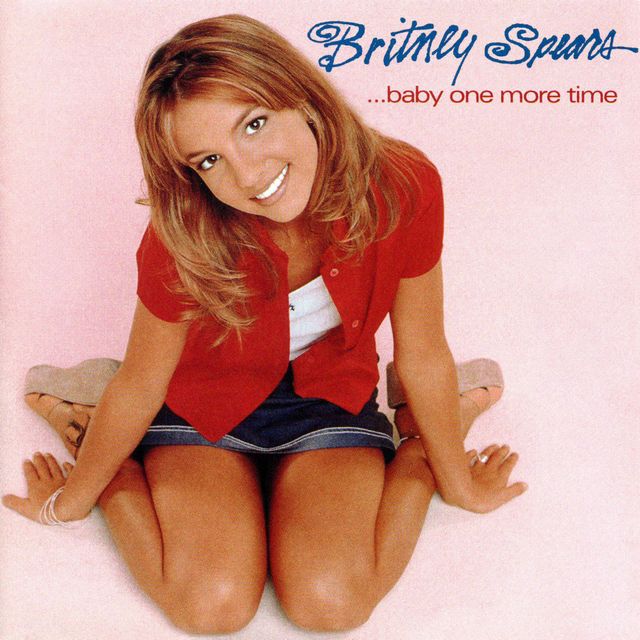

In 1998 the Swedish songwriter Max Martin offered a song called “Hit Me Baby One More Time” to TLC. They turned it down. Jive Records gave it to Britney Spears, a 16-year-old former Mouseketeer from Louisiana, and sent her to Stockholm to sing it.
The single, with “Hit Me” cut from the title, came out that autumn. The album, …Baby One More Time, followed on January 12, 1999. It went straight to No. 1 in America, and a few weeks later so did the single.
The album has sold about 14 million copies in the US alone. It made Spears the most famous teenager in the world. It also gave Max Martin his first American No. 1. He has written more than two dozen since.
“It's kind of a perfect marriage of song and artist and songwriter. If Max Martin is John Hughes, he found his Molly Ringwald. … You can't picture it being sung by anybody else.”
A Photo Card and a Development Deal
By her mid-teens Spears had already been in show business for years. She had lost on Star Search at 10. At 11 she joined the Disney Channel's Mickey Mouse Club, in a cast that included Justin Timberlake and Christina Aguilera. When the show was cancelled in 1994 she went home to Kentwood, Louisiana, and played high-school basketball for a while.
The family's lawyer, Larry Rudolph, kept pushing. In 1995 he sent Jeff Fenster, an A&R executive at Jive Records, a demo cassette with Spears singing on it. “There was something about her voice that caught my attention,” Fenster told SongwriterUniverse. Rudolph also sent a promotional photo of her sitting on a picnic basket.
Barry Weiss, then Jive's president, remembered the picture too. “Almost like Dorothy from Kansas,” he told Entertainment Weekly. Spears flew to New York with her mother and auditioned in Jive's conference room in a black cocktail dress and high heels. “She sang live for us: Whitney Houston ballads, Mariah Carey, Toni Braxton,” Weiss said. “She really was a good singer.”
Jive was mostly a rap and R&B label, but it also had the Backstreet Boys. Its founder, Clive Calder, saw a gap. “If the Backstreet Boys are the New Kids On The Block,” he said in one meeting, “then this is Debbie Gibson.” Spears had no songs yet, so Jive signed her to a development deal and sent her to work with the producer Eric Foster White in New Jersey.
Spears had a different record in mind. She told Rolling Stone she had pictured “Sheryl Crow music, but younger – more adult contemporary.” Once the music turned toward pop, she was happy with the change. “It made more sense to go pop,” she said, “because I can dance to it – it's more me.”
The Song Written for TLC
Jive's link to Sweden was Cheiron Studios in Stockholm, where Max Martin and his mentor Denniz Pop had made the Backstreet Boys' hits. Martin came to New York to meet Spears. “She thought I was a 50-year-old producer from the old school,” he remembered. “I had really long hair at the time – I looked like Ozzy Osbourne.” Spears told Time she was scared of him: “I thought he was someone from, like, Mötley Crüe or something.”
Back in Sweden, Martin already had a song on the shelf. He had written “Hit Me Baby One More Time” thinking it was an R&B song for TLC. They passed. “I like the song, but do I think it's a hit? Do I think it's TLC?” T-Boz later told MTV. “Was I going to say, ‘Hit me baby one more time’? Hell no!” Martin also offered it to the Swedish singer Robyn, who did not record it.
According to Weiss, Clive Davis at Arista wanted it for Deborah Cox, but Martin was not keen. Jive's A&R man in the Netherlands, Martin Dodd, sent the demo to New York instead. “When the song came into us, we thought, let's cut this with Britney,” Weiss said. “Let's send her to Stockholm.”
Martin builds songs from melody first. “I write on the Dictaphone,” he said. “I came up with the melody first. I wrote the chorus; you just hum it in.” He gave much of the credit for the sound to his co-producer, Rami Yacoub. “He is much more urban and R&B than me,” Martin said. “I'm more of a melody man.”
The words were a problem. Martin's English was not perfect, and to him “hit me” meant something like “call me.” To American ears it sounded like a reference to violence. Martin refused to change it, so Weiss changed the title. “I was concerned about going to U.S. radio with a song called ‘Hit Me Baby One More Time,’” he said. “I don't know if I'm proud of this or not: I came up with the ‘…Baby One More Time.’”
Six Songs, One Week in Stockholm
The trip to Sweden was Spears's first time abroad. “I didn't know what to expect,” she said. “They had six songs, [and] I had a week.” The title track was the first one they recorded, and nobody was sure how to approach it. “We just kept on recording,” Martin said. “We tried a couple of different styles.”
Eight hours in, Martin heard her stomach growl through the microphone. She said she was fine. He called a break anyway, and she ate three burgers. “She was very well prepared,” Martin said. When they first met in New York he had noticed the same thing everyone did: “It was pretty obvious that she had something, even though she was very quiet and very shy.”
Spears had a plan for the vocal. The night before, she stayed up late listening to Soft Cell's “Tainted Love” over and over. “I wanted my voice to be kind of rusty,” she told Rolling Stone. “So the night before, I stayed up really, really late, so when I went into the studio, I wasn't rested.” She sang it low, in the deep part of her voice.
She also added something of her own. Martin's demo had him singing every part, and the author John Seabrook, who heard it, says Spears ended up sounding a lot like Martin. But the opening ad-lib, the drawled “oh baby, baby,” was hers. “We thought it was really weird at first,” Weiss said. “It was not the way Max wrote it. But it worked!”
Yacoub remembered a hard-working teenager. “She was so young, but she was very professional and never complained,” he told Music Week. “We would record for hours and hours, and she never so much as asked for anything.” He thought her voice's character mattered more than its power. “It's fragile and she sounds human,” he said.
Cheiron was in mourning. Denniz Pop had stepped back from work with stomach cancer, and he died in August 1998, aged 35. He is credited on the album, but Spears never met him. Martin took over running the studio's music, with Yacoub as his new partner.
Nigel Dick's video. The school setting, the uniform and the knotted shirt were all Spears's own ideas.
The Video Was Her Idea
Weiss hired Nigel Dick, the British director who had made the Backstreet Boys' videos. Everyone remembers the rejected idea differently. Weiss says it had Spears landing on Mars in a spaceship. Dick says his first treatment was set in a boxing ring. Spears called it “this animated Power Ranger-y thing.” All agree that she said no.
She rang Dick with her own idea. “She said, ‘I want to be in a school with a bunch of cute boys and do some dancing,’” he recalled. He was 40, and she was 16. “Your initial reaction to this is, I'm being told by a 16-year-old girl what I should do,” Dick said. “Perhaps she has a better perspective on her audience than I do. So I swallowed my pride.”
The schoolgirl thing was hers, and it's good it came from her. At the time I made that video, I was a 40-year-old British guy – I had no idea what was going through the mind of a 16-year-old American girl!
The costumes came from Kmart, and every item cost less than $17. Dick had suggested jeans, T-shirts and backpacks. Spears asked whether she should be wearing a schoolgirl outfit, and she was the one who tied up her shirt. “I said, ‘Why don't we have knee-highs and tie the shirts up to give it a little attitude?’” she told Rolling Stone, “so it wouldn't be boring and cheesy.”
Dick had doubts, and so did others. He knew some people would find it exploitative, and he got “a huge amount of grief” once it came out. Tom Breihan of Stereogum has called the video “a strange and uncomfortable artifact,” made by a 16-year-old who chose the look herself but was surrounded by adults who profited from it.
The timing was perfect. MTV launched Total Request Live that September, a daily countdown voted for by viewers, and almost all of them were teenagers. “…Baby One More Time” dominated its early weeks, and viewers voted it the No. 1 video of 1998. Meanwhile Jive sent Spears on a tour of shopping malls, singing in food courts and handing out cassette singles, and booked her to open for ’N Sync.
Essential Tracks
“…Baby One More Time”
The song opens with three hammered piano notes and a drum machine, then Spears's low “oh baby, baby.” The guitars and bass hint at funk without ever loosening the beat. It is a song about a girl hoping to hear from a former boyfriend, and the chorus is a crowd of voices, some of them Spears harmonizing with Martin.
Yacoub thought the secret was restraint. “The melodies were on point, the production was raw, simple and different, but it didn't take over,” he told Music Week. “It was just holding the song's hand.” Nobody knew it would be a hit, he said. “We work on each song almost surgically.”
The single sold a million copies in America, and sales more than radio pushed it to No. 1 on the Hot 100. It went to No. 1 in more than a dozen countries. Over the years it has been covered by Travis, Fountains of Wayne and many others, usually half as a joke and half because it is so well made.
“(You Drive Me) Crazy”
The second Cheiron hit was written by Jörgen Elofsson, Per Magnusson, David Kreuger and Max Martin, and produced by Magnusson, Kreuger and Martin. It is bouncier than the title track, with the same chunky guitars and a chorus built for shouting along.
Spears went back to it within months. In May 1999 she re-recorded her vocals for a remix used in the teen film Drive Me Crazy, starring Melissa Joan Hart and Adrian Grenier. Annie Zaleski of Stereogum hears a different singer on it. Only months after the album, she writes, Spears's delivery exudes “far more confidence and bite.”
Zaleski prefers that version, which became known as “The Stop Remix!” As a single, “(You Drive Me) Crazy” reached No. 10 in America. It put Spears back in the top 10 after the ballad “Sometimes” had stalled at No. 21.
“Born to Make You Happy”
Kristian Lundin and Andreas Carlsson, two more Cheiron writers, wrote this mid-tempo song, and Lundin produced it. It is one of the album's smoothest tracks, with a soft R&B groove under the Cheiron gloss.
It is also where Spears drew a line. “I asked them to change the words to ‘Born To Make You Happy.’ It was a sexual song,” she told Rolling Stone. “I said, ‘This may be a little old for me.’ Because of the image thing, I don't want to go over the top. If I come out being Miss Prima Donna, that wouldn't be smart. I want to have a place to grow.”
Zaleski calls that quote “remarkably prescient.” Spears was 17 and already thinking about how her image would age, and about saving the more adult songs for later. She got there quickly: within five years she had made “Toxic.”
The video for 'The Stop Remix!', made for the 1999 film Drive Me Crazy, with Spears's re-recorded vocal.
The New Jersey Half of the Album
Only five of the album's eleven songs came out of Cheiron. The other six were produced by Eric Foster White, the New Jersey producer Jive had paired Spears with first. His songs pull the record toward the adult contemporary pop she had originally imagined.
Zaleski describes the album as Spears “trying on different sonic personas to see what she likes.” “Thinkin' About You” is sunny soul. “Soda Pop,” with the singer Mikey Bassie, has a reggae lilt. “From the Bottom of My Broken Heart” is a slow, sweet ballad.
“E-Mail My Heart” is the most dated thing here, a song about waiting for a message to arrive from a boyfriend. It came out in the early days of home internet, when that was still new. Zaleski finds it charming, and notes that the feeling it describes has not changed.
The album closes with a cover of Sonny & Cher's “The Beat Goes On,” built on a 1998 remake by the British group the All Seeing I. Zaleski thinks it is the most interesting song on the record. She also reads it as a label playing safe with a familiar tune, unsure whether a new artist could carry an album alone. After it, the CD ends with an advert for the Backstreet Boys.
No. 1 in Its First Week
The album came out on January 12, 1999, and entered the Billboard 200 at No. 1, selling more than 100,000 copies in its first week. A few weeks later the single reached No. 1 on the Hot 100. The album went double platinum within a month and diamond, for ten million US sales, within a year.
Britain took longer. The album entered the UK chart in March 1999 and kept selling well into the next year. It reached its peak of No. 2 in February 2000, and spent 103 weeks in the top 100.
The attention was not all about the music. In a 1999 interview, Spears was asked whether she minded being treated as a sex symbol. She was polite but annoyed. She pointed out that the Backstreet Boys and ’N Sync did pelvic thrusts on stage without comment. “But when I'm just showing the little belly,” she said, “everyone's like, ‘Ooh!’ You know what I mean?”
The success changed the people around her too. Weiss called it “worldwide domination” and “the re-emergence of pop music.” Seabrook argues it put Cheiron and Sweden on the map, persuading Swedish writers that they could write for Americans. Breihan notes that Jive's owner, Clive Calder, became the richest man in the history of the music business, and that this record is a big part of the reason.
She Wasn't Manufactured
The old view of this album is that Max Martin and Jive built Britney Spears out of spare parts. The people who were there tell a different story. Weiss, the man who changed the title, is blunt. “Max Martin is a genius, okay? He's brilliant. He tailor-made those records for her,” he said. “But she would never have had the career without her vision.”
Joe Levy of Rolling Stone went further. “If the record company could have created more than one Britney Spears, they would have done it, and they tried!” he told EW. He argued that Spears deserves “the same sort of respect that Justin Timberlake gets. Otherwise, I'm sorry, but you're engaging in a double standard.”
Her later years make the album harder to hear innocently. Breihan points out that the world treated Spears as an adult while she was still a child, and then, under a long conservatorship, denied her control of her own life as an adult. The schoolgirl video sits at the start of that story.
The music itself has lasted. By 2022, Breihan counted 25 Hot 100 No. 1 hits written or co-written by Max Martin, more than anyone except Lennon and McCartney. Much of modern pop follows the method he and Yacoub used here: melody first, every line built to stick, production that stays out of the singer's way.
And the title track still works. Martin wrote it, Yacoub shaped the beat, and Weiss changed the name. But the low, sleep-deprived voice and the “oh baby, baby” that opens it were Spears's choices. So was the video that made it famous. For a debut album by a 17-year-old, that is a lot of her on the record.
“A lot of artists contribute to pop, but a few with such impact. If pop was a big old oak tree, she is definitely part of those roots.”