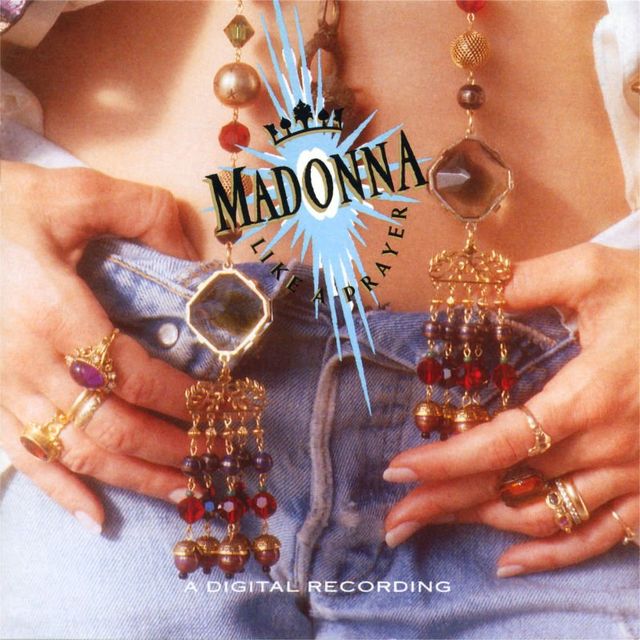

In early 1989 Pepsi paid Madonna $5 million to launch her new song, “Like a Prayer,” in a television commercial. Then the song's video reached MTV, with burning crosses and Madonna kissing a Black saint in a church. Religious groups called for a boycott, and Pepsi pulled the ad.
Madonna kept the money. The album Like a Prayer came out on March 21, 1989. It spent six weeks at No. 1 in America, her longest run at the top with any album, and also went to No. 1 in Britain.
It was her most personal record so far. She made it at 30, as her marriage to Sean Penn ended, and she wrote about her Catholic childhood, her father and her mother, who died when Madonna was five.
“I came in with the music, the gospel influence, and Madonna added the words. The protest against the church came later in the video. But it's a testament to the weight of the song that this vessel could hold it. When we wrote it, it felt like being on fire.”
Thirty, Divorced and Writing Again
By 1988 Madonna had sold millions of records. Her last studio album, True Blue, had been a huge hit two years earlier. But critics still tended to treat her as a savvy pop star rather than a serious artist, as Nick Levine argued in Vice on the album's 30th anniversary.
Her private life was falling apart. Her marriage to the actor Sean Penn was ending, and she filed for divorce in January 1989. She had also just turned 30, the age her mother had been when she died. “It was like a part of my heart was ripped out,” Madonna told People about losing her mother.
In September 1988 she went back to work with the two producers from True Blue, Patrick Leonard and Stephen Bray. Bray saw the change in her straight away. “True Blue was about feeling romantic and wanting to be unabashed about love,” he told The Guardian. “Then she changed chapters. ‘Things didn't work out the way I thought.’”
Leonard wrote most of the album with her. He co-wrote eight of its eleven songs, and Bray co-wrote two, “Express Yourself” and “Keep It Together.” Leonard thought the partnership worked because they were opposites. “I started playing the piano when I was three-years old, and studied music my whole life,” he told Billboard in 2014. “And for her, it's much more just about creativity, and a natural gift, what the impulse says is right.”
They also shared a background. “We're both from Michigan,” Leonard said, where it is “30 below zero a good part of the year and blue collar work ethics apply to everything.” His summary of how they worked: “So we shut up and we did the work.”
One Song a Day
The writing was fast. Leonard was working on another album at the time, so Madonna came to his studio on Saturdays and days off. He would arrive at 7 or 8 a.m., work out in the gym he had there, and build a basic track: chords, a drum beat, a bass line. Madonna arrived about 11.
She would listen, sometimes tell him to swap the verse and the chorus, and then write. “She would write the lyrics in an hour, the same amount of time it took me to write the music,” Leonard said. “And then she'd sing it.” By three or four in the afternoon she was gone.
“That's how ‘Like a Prayer’ was written, and then the next day we wrote ‘Cherish,’ and then the next day we wrote ‘Dear Jessie,’” he said. “We wrote the album in less than two weeks.” Nothing, he said, took more than four hours.
Often the vocal she sang that first afternoon was the one on the record. “She didn't sing the songs on Like a Prayer more than once, ever,” Leonard told Music Business Worldwide. “There were no re-takes, there was the demo vocal and that was the record.” They had learned the trick on True Blue, where the vocal for “Live to Tell” was the demo.
The demos Leonard made alone were then turned into band recordings. Real drummers, percussionists, guitarists and backing singers replaced the drum machines. “I was always on my soap box saying ‘let's get real musicians in,’” he said. Most of the bass is Leonard on synthesizer, but Guy Pratt plays on the title track and Randy Jackson, Leonard believes, on “Express Yourself.”
Leonard is still proud of how it sounds. “It was my studio, I hired all the musicians and the engineers, and pretty much made the record,” he told The Telegraph in 2026. “If you have a really good stereo, and you sit in front of those speakers and you put Like a Prayer on – try to find something better. Good luck!”
Mary Lambert's video, with its burning crosses and a Black saint who comes to life. It cost Madonna her Pepsi campaign.
A Choir, a Door Slam and Prince
“Like a Prayer” was the first song written for the album. Leonard brought in an organ chord sequence. “Pat had the chord changes for the verse and the chorus. We hadn't written the bridge yet,” Madonna told SongTalk. “I really wanted to do something really gospel-oriented and acapella, with virtually no instrumentation, just my voice and an organ.” Together they added the bridge and the idea of a choir.
The choir was led by Andraé Crouch, the gospel singer and arranger. “Madonna wanted something very churchy,” Crouch told The Guardian, “so I tried to blow up what she did and make it as powerful as I could.” Leonard later marvelled that the song held together, “with its stopping and starting, and a minimalistic rhythmic thing, and the verses, and these bombastic choruses, and this giant choir comes in.”
Leonard was uneasy about one line in the chorus, which he felt was too sexual for a song about faith. Madonna explained that blurring the two was the point, and he gave way. Guy Pratt's bass, meanwhile, was meant to be a throwaway take. “As I was playing Madonna was going: ‘Guy, more! More!’” Pratt told The Guardian. “By the fade I had run out of licks and had to go back to the beginning again.”
There is also a hidden guest. Madonna co-wrote the duet “Love Song” with Prince, and she sent him the title track to play on too. The band did not use most of what he sent back. But the distorted guitar at the very start, before a door slams, is his. “We just thought it was crazy and really cool,” Leonard said. Prince also played guitar on “Keep It Together” and “Act of Contrition.”
The Pepsi Deal and the Vatican
Pepsi's deal was unusual. It paid Madonna a reported $5 million to premiere the new song in a commercial and to sponsor her next world tour. According to Entertainment Tonight, an estimated 250 million people saw it worldwide.
The video, directed by Mary Lambert, told a different story. Madonna sees a white woman murdered and a Black man arrested for it. She hides in a church, where a statue of a Black saint comes to life and kisses her. She dances in front of burning crosses and shows wounds like stigmata on her hands. “I wanted to explore the correlation between sexual ecstasy and religious ecstasy,” Lambert told The Hollywood Reporter.
It was meant to premiere on Entertainment Tonight, but the tape arrived so late that the show only ran safer parts of it over the end credits. “We popped in the video and started watching it, and then we looked at each other and I went, ‘Uh oh. I don't know if we're going to be able to air this,’” the show's producer, Lu Murray, recalled. MTV showed it in full.
The reaction was immediate. Pope John Paul II spoke out against it, and religious groups called for a boycott of Pepsi and its other businesses, including KFC, Taco Bell and Pizza Hut. Within days Pepsi dropped the ad and its deal with Madonna. ET's John Tesh called it one of “the most expensive advertising blunders ever.”
The commercial was immediately canceled when I refused to change any scenes in the video where I was kissing a Black saint or burning crosses. So began my illustrious career as an artist refusing to compromise my artistic integrity.
The critic Greil Marcus, in a 1990 documentary, called the video “blasphemy on about ten levels at once.” Madonna did not apologise. “Art should be controversial,” she told the New York Times, “and that's all there is to it.” That September, at an MTV Video Music Awards show sponsored by Pepsi, the video won the Viewers' Choice award. “I would really like to thank Pepsi for causing so much controversy,” she said.
Essential Tracks
“Express Yourself”
Madonna wrote this one with Stephen Bray. It is a funk song in the style of Sly and the Family Stone, and Levine calls it “a feminist rallying cry that would inspire generations to come.”
It reached No. 2 in America and opened the Blond Ambition tour that followed. Ian Cottrell, who saw the tour at Wembley Stadium at 17, told NME he remembered “the pure excitement of her coming on stage and opening with ‘Express Yourself,’” with Madonna at the top of the stairs in the suit from the song's video.
Christina Aguilera and the Spice Girls have both named it as an influence. When Lady Gaga released “Born This Way” in 2011, many critics noted the resemblance. Madonna called Gaga's song “reductive.” Gaga said the only similarity was a chord progression that had been “in disco music for the last 50 years.”
“Oh Father”
This slow, heavy ballad is about Madonna's father and about God at the same time. It is Leonard's favourite of all their work. “That to me is the best thing we ever did,” he told Billboard. “We knew when we did it, that there was something about this that was in a way kind of the most real thing.”
It was recorded almost entirely live. Madonna sang while two or three guitarists, Leonard and Jai Winding on keyboards, a percussionist and a drummer all played together. “The ‘record’ button was only pressed three times,” Leonard said: once for the band and vocal, once for the orchestra, and once to double her vocal in the mix.
Even the doubling was a compromise. The mixer, Bill Bottrell, suggested it, and Leonard was annoyed. Bottrell's reply: “three isn't exactly shameful.” Released as a single, it was a bold choice, and it peaked at No. 20. It is still the song Leonard points to.
“Dear Jessie”
The album's lightest moment is a psychedelic lullaby written for Leonard's daughter, Jessie, then a toddler. Vice's Nick Levine called it “treacle-sweet, Beatles-y psychedelia” and one of Madonna's most charming singles.
Madonna and the little girl were friends. “It wasn't arbitrary – it was like they were kind of buddies,” Leonard said. Jessie had been on tour with them as a baby, and there are photos of the two of them together in the studio. It was written the day after “Cherish.”
In Britain it was released as a single with an animated video based on a photo of Jessie. “It doesn't look anything like Jessie to me,” Leonard said. Twenty-five years later Jessie was working for her father as a writer. People still ask her, “You're the Jessie?” “She thinks it's funny,” he said.
The Stephen Bray co-write that reached No. 2 in America and later opened the Blond Ambition tour.
Sean Penn, a Mother and an AIDS Leaflet
Several songs come straight from Madonna's life. “Till Death Do Us Part” sets a portrait of a failing, angry marriage to a bright keyboard riff. It arrived just as she was divorcing Penn, though she later denied claims that she had been physically abused. “Promise to Try” is a ballad about the memory of her mother.
“Pray for Spanish Eyes” was, in Levine's reading, a lament for lives lost to AIDS. Madonna's close friend Martin Burgoyne had died of the disease in 1986. Every copy of the album came with a card titled “The Facts About AIDS.” “People with AIDS – regardless of their sexual orientation – deserve compassion and support, not violence and bigotry,” it said.
Catholicism runs through all of it. “In Catholicism you are a born sinner and you're a sinner all your life,” she told Interview in 1989. “No matter how you try to get away from it, the sin is within you all the time.” The album closes with “Act of Contrition,” a prayer recited over screaming guitar that collapses into a joke about a lost restaurant reservation.
Not every experiment lands. Levine calls “Love Song,” the Prince duet, the album's most throwaway track, “a vaguely experimental extended flirtation.” Its main legacy is a line from its bridge that Madonna reused 16 years later on “Hung Up.”
Five Hits and a Stadium Tour
The controversy did not hurt sales. “Like a Prayer” went to No. 1 on the Hot 100. The album entered the UK chart at No. 1 on April 1, 1989, and stayed there for two weeks. In America it held No. 1 for six weeks. It produced five top 20 hits on the Hot 100: the title track, “Express Yourself” and “Cherish,” both No. 2, “Keep It Together” at No. 8 and “Oh Father” at No. 20.
It has sold four million copies in the US, according to the RIAA figures Billboard cited in 2014, and more than 15 million worldwide, according to Entertainment Tonight. The tour Pepsi had meant to sponsor became the Blond Ambition tour of 1990. The Vatican tried to keep people away from its Italian dates, and Toronto police threatened Madonna with arrest under obscenity laws.
“I am aware that the Vatican and certain communities are accusing my show of being sinful and blasphemous,” she said at the time. “I think I'm offending certain groups, but I think that people who really understand what I'm doing aren't offended by it.” She also used the tour to push safer sex, and her New Jersey show raised $300,000 for AIDS research.
Pepsi Comes Back 34 Years Later
The quarrel ended in 2023. To mark its 125th anniversary, Pepsi showed the lost commercial during that September's MTV Video Music Awards. “Thank you [Pepsi] for finally realizing the genius of our collaboration,” Madonna wrote. “Artists are here to disturb the peace.”
Critics have come round too. Levine called Like a Prayer “Madonna's first undisputed masterpiece,” the album that “proved once and for all that she was a meaningful artist, not just an uncommonly savvy and driven pop star.” NME's El Hunt, at 30, called it an “unparalleled totem of pop music.”
Its influence runs through the confessional pop albums that followed. Levine argued that it laid the foundation for the deeply personal pop blockbuster, decades before Beyoncé's Lemonade and Ariana Grande's Thank U, Next. The title song is still in Madonna's shows. In 2026 she sang it with Sabrina Carpenter at Coachella.
It is also, as Leonard says, a well-made record. The songs were written in an afternoon each, the vocals are first takes, and real musicians replaced the drum machines. The result still sounds warm and human 37 years later.
“She bared her navel on the album's cover, and her soul in its songs.”