
On September 18, 1976, Queen played a free concert in London's Hyde Park to well over 100,000 people. They ran half an hour past the curfew. When Freddie Mercury tried to go back on for an encore, the police threatened to arrest him.
Queen were in the middle of making A Day at the Races, their follow-up to A Night at the Opera and “Bohemian Rhapsody.” It was the first album they produced themselves. It came out in Britain on December 10, 1976.
Advance orders made it a gold record in Britain before anyone had heard it. It went to No. 1 in the UK and No. 5 in America, where it became Queen's first gold album. It gave them “Somebody to Love” and “Tie Your Mother Down.” A 50th-anniversary vinyl reissue arrives on December 11, 2026.
“We just felt that, for this one, we needed a bit of a change. We were quite confident in doing it ourselves. … We simply felt that it was now or never.”
Life After Roy Thomas Baker
Roy Thomas Baker had co-produced all four of Queen's albums so far. He had co-produced A Night at the Opera and “Bohemian Rhapsody,” the records that made Queen one of the biggest bands in the world. In 1976 the band and Baker decided they had gone far enough together.
Queen chose to produce the next record themselves. Mercury told Circus that they had always taken a close interest in production anyway. “Roy's been great,” he said, “but it's a progression, really – another step in our career.” Gary Langan, who engineered on the sessions, put it differently. “Roy's ego was exploding,” he later recalled, laughing.
In Baker's place they promoted Mike Stone, the engineer who had done so much of the overdubbing on “Bohemian Rhapsody.” Stone was close to Mercury and knew how the band worked. You can even hear him on the album: he sings one of the voices on “Good Old-Fashioned Lover Boy.”
Doing it themselves was slower. Mick Wall, writing for Louder, reports that progress was so slow that Mercury sometimes flew into rages. A UK tour planned to promote the album had to be postponed.
The band's lives were changing too. Brian May had just married Christine Mullen. John Deacon had bought a house in Putney for his wife and young son. Mercury had split from his long-term girlfriend, Mary Austin, and moved into a flat in Holland Park.
A Hot Summer at The Manor
The band rehearsed at Ridge Farm, then in July 1976 moved to The Manor, a residential studio in Oxfordshire, to lay down the backing tracks. It was the summer of Britain's great heatwave, the hottest on record in central England until 2018.
It was the first Queen album since Queen II to be made entirely in England. They still recorded on 24-track tape, and the backing tracks were mostly played live. Deacon and Roger Taylor each played rhythm guitar on their own songs. May played keyboards on one track, using piano, harmonium and electric piano.
From The Manor the tapes went to London for overdubs at Sarm East and Wessex Studios. The work went on, with breaks for concerts, until November. Taylor later said that A Day at the Races cost about as much as A Night at the Opera, which had been one of the most expensive albums ever made.
The money went on the same things: stacks of vocal harmonies, May's layered guitar parts, and days of overdubs. On “The Millionaire Waltz,” May spent weeks building an orchestra of guitars at Mercury's request. On “Somebody to Love,” Mercury, May and Taylor sang part after part until three voices sounded like a choir.
Hyde Park and the Police Curfew
To make up for the postponed tour, the band booked two big outdoor shows that September, at Cardiff Castle and Hyde Park, with warm-ups at the Edinburgh Playhouse. They tried out new songs. “Tie Your Mother Down” got its first airing, and so did “You Take My Breath Away,” a ballad for voice and piano.
Hyde Park, on September 18, was free. The support acts were Kiki Dee, Steve Hillage and a Liverpool band called Supercharge. Mercury played “You Take My Breath Away” alone at the piano and got the crowd singing along. Footage from the day was later used in the TV adverts for the album, the first time Queen had advertised a record on television.
The show had overrun its permitted time by 30 minutes, and the police would not let the band back on for an encore. Mercury lost his temper and stopped only when officers threatened to arrest him. “The thought of being in jail in tights didn't appeal to Freddie at all,” said Gerry Stickells, Queen's tour manager.
Taylor saw the temper as part of the ambition. “We always said we wanted to be the biggest band in the world,” he said. “What else are you going to say? ‘We'd like to be the fourth-biggest!’” Hyde Park was also one of the last shows at which Mercury wore his long hair and black nail polish.
The album's opener, built on a riff Brian May first played on a volcano in Tenerife. Queen premiered it on the September 1976 dates.
The Sequel Question
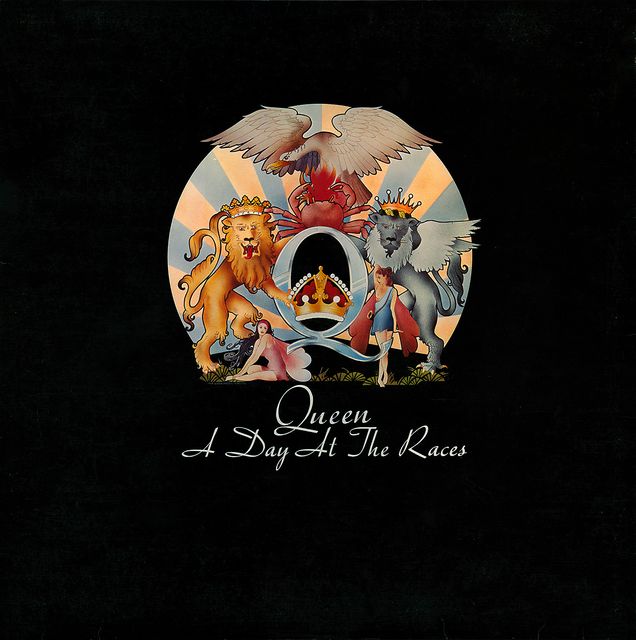
Everything about the packaging said “part two.” The title came from another Marx Brothers film, the one that followed A Night at the Opera in 1937. The sleeve used the same Queen crest and lettering, now on a black background instead of white. Taylor joked on Saturday morning TV that the next one would not be called Room Service or Duck Soup.
Baker was unimpressed. “I thought it reeked of sequel,” he said when the album came out. Years later May half agreed. “I wish in some ways we'd put A Night At The Opera and A Day At The Races out at the same time,” he said. “The material for both of them was written at the same time, so I regard the two albums as completely parallel.”
The paperwork tells a different story. QueenSongs.info, which tracks the band's session dates, notes that nearly eight months passed between the final mixes of Opera and the first rehearsals for Races. The two albums were not made side by side. They simply sound like a pair, because the same four people were doing the same things a year apart.
The new record also avoided the most obvious trap. It has no six-minute single and nothing like the eight-minute “The Prophet's Song.” The two longest tracks, “You Take My Breath Away” and May's “Teo Torriatte,” each run only a little over five minutes. Our A Night at the Opera review covers how the first record was made.
Essential Tracks
“Somebody to Love”
Where “Bohemian Rhapsody” borrowed from opera, Mercury built “Somebody to Love” on gospel. The model was Aretha Franklin. “It was all about Aretha Franklin for Freddie,” May told Astronomy magazine in 2012. “She was a huge influence.” The song is a lonely man asking God for someone to love, answered line by line by a choir.
That choir is just three people. Mercury, May and Taylor multitracked their voices until they sounded like a hundred-voice gospel group. Near the end the instruments drop away, leaving only voices and handclaps as the song builds. Mercury occasionally named it as one of his own favourite songs. “Freddie certainly loved that song at the time,” May said.
Released as the first single three weeks before the album, it reached No. 2 in Britain in December 1976 and No. 13 in America. It had a second life after Mercury's death. The surviving members performed it with George Michael at the Freddie Mercury Tribute Concert in 1992, and that recording was released the following year.
I said to some people that I think sometimes Freddie wants to be Aretha in pretty clothes. So it was very much gospel construction and allowed him to sing in the way which he loved.
“Tie Your Mother Down”
May wrote the riff years earlier, on the volcanic ridge in Tenerife where he was observing for his astronomy PhD. “I woke up one morning and started playing this riff,” he told the radio show Ultimate Classic Rock Nights. “It's sort of inspired by Rory Gallagher, this business of sort of snapping on and off the strings.” All he had for words was the title, and he assumed it was unusable.
Back with the band, he played it to Mercury. “I said, ‘I don't have any words; all I have is that ‘tie your mother down,’ which obviously we can't use,’” May recalled. “He went, ‘Yeah you can!’” May then realised the line was a teenager complaining about a girlfriend's parents. Mercury had his own theory. “Maybe he was in one of his vicious moods,” he said. “I think he's trying to outdo me after ‘Death On Two Legs’ actually.”
May added a rising harmonium effect, a Shepard tone, that returns in the finale of “Teo Torriatte,” tying the album's first and last songs together. As a single in March 1977 it only reached No. 31 in Britain. On stage it did much better. It became a fixture of Queen's live shows from 1976 onward.
“The Millionaire Waltz”
Mercury wrote “The Millionaire Waltz” about John Reid, who was then managing both Queen and Elton John. It starts as a piano waltz, swerves through several changes of time signature, and turns into a hard-rock section before waltzing out again. It is the closest thing on the album to “Bohemian Rhapsody.”
The orchestra you hear is mostly May. At Mercury's request, he spent weeks layering guitar parts to play the roles of strings and woodwind. The harmonies pile up behind Mercury's lead, and all four members had to work on it together.
It was never a single and rarely gets played on the radio, which May understands. “It's so incredibly complex that it doesn't program on radio, I suppose,” he told Cuepoint in 2014. “But, boy, there's some stuff in there. It's a favorite of mine – it's so extreme!” He also said it “actually would sum up most of what we were about.”
The promo was filmed in the studio, giving a rare look at the room where Queen layered the song's three voices into a choir.
Japan, Ragtime and Two Quiet Songs
The rest of the album shows each writer going his own way. May wrote “Teo Torriatte (Let Us Cling Together)” as a thank-you to Queen's fans in Japan, where Queen now enjoyed Beatles-like fame. Parts of it are sung in Japanese, over May's harmonium and a toy piano. It was released there as a single in March 1977.
Mercury's “Good Old-Fashioned Lover Boy” is a ragtime piano number in the music-hall style he had used on Opera. It became the lead track on Queen's First EP in May 1977. His “You Take My Breath Away” goes the other way, a slow ballad built from stacked layers of his own voice.
May has two more songs. “Long Away,” sung by May himself, is built on a jangling electric 12-string. It was a single in America. “White Man” is the heaviest thing on the record, a protest about the treatment of Native Americans by European settlers.
Taylor and Deacon contributed one song each. Taylor's “Drowse” is a sleepy Sunday-afternoon song, with Taylor playing rhythm guitar and timpani and May adding slide. Deacon's “You and I” is a light acoustic pop song. It later became the B-side of “Tie Your Mother Down.”
Gold Before It Came Out
On October 16, 1976, the record company took the band to the races at Kempton Park in Surrey to promote the title.
British fans did not need persuading. By December 1, advance orders had passed the thresholds for both silver and gold certification. Reports put the pre-orders at over half a million copies. The album was released on December 10, 1976, and in America a week later.
It entered the UK chart at No. 8 on Christmas Day. On January 8, 1977, it reached No. 1, overtaking Glen Campbell's 20 Golden Greats. A week later ABBA's Arrival took over. In America it reached No. 5 on the Billboard chart and became Queen's first album to go gold there, and later platinum.
The critics were less sure. Punk was arriving in Britain that winter, and Queen's excess was an easy target. The American critic Jeff Burger split the album into two kinds of song: “the Led Zeppelin–like hard rockers and the layered, frequently a cappella vocal extravaganzas.” He liked the second kind and found rockers like “Tie Your Mother Down” “perfunctory.”
The band went on a long tour of North America in early 1977. They played Madison Square Garden in February, and after a show at the Forum in Los Angeles they hosted a party with Thin Lizzy. Guests included an 18-year-old Michael Jackson and the Beach Boys.
An Afternoon With Groucho Marx
One fan of the title was Groucho Marx himself, by then in his eighties. He sent the band his congratulations and wondered whether their success might be down to their “sage choice of album titles.” Then he invited them to visit him in Los Angeles.
May described the visit to Astronomy. “He was very much like he was in the films,” he said. “He was ancient by that time and they wheeled him out, but he was sharp as a razor. He sang this curious little song and then we all clapped and then he said, ‘Now you sing!’”
Nobody had come prepared. “It was that terrible moment when you think, ‘Oh, what are we going to do?’” May said. “I remember saying that we couldn't sing without a guitar, and he had one brought out! And so I settled down to strum away ‘’39,’ I think it was. He enjoyed it, told us a few jokes, and went off to have his nap!” The song came from A Night at the Opera. Groucho also asked them not to call the next album Duck Soup.
The Album in Opera's Shadow
A Day at the Races has always been compared with the record before it, and it usually comes second. Adam Gold of American Songwriter called it Opera's sequel, “and like all sequels, it's no Godfather II. But it's still a ‘classic rock’ classic.” Drowned in Sound found it “a slickly produced work but a slight disappointment to modern ears.”
The Australian critic Bernard Zuel was harsher. “By A Day At The Races, the slickness was heading towards smugness,” he wrote in 2022, “and while the brains are still active there's less heart at work.” Still, he called “Tie Your Mother Down” “a hoot” and “You Take My Breath Away” “moving in its way.” He concluded that “something needed to change.”
Something did. Within a year Queen made News of the World, a leaner record built around “We Will Rock You” and “We Are the Champions.” Mercury cut his hair. In that sense A Day at the Races was the last album of Queen's first phase, the band of crests, harmonies and guitar orchestras.
Its two big songs never left. “Tie Your Mother Down” became a mainstay of Queen concerts, and “Somebody to Love” is one of their most loved songs. On December 11, 2026, Sony Music is reissuing the album on blue marbled vinyl, with a picture-disc edition sold only through the official Queen Store. It keeps the original ten tracks.
The reissue is a chance to hear the album on its own terms rather than as Opera's sequel. It is Queen at their most self-confident, producing themselves for the first time and deciding that every idea could stay. Sometimes that is too much. On “Somebody to Love” and “The Millionaire Waltz,” it is exactly right.
“Queen is going downhill even as it improves, but this fifth LP showcases sufficient strength to keep me cheering.”