
On the first day of recording at the Château d'Hérouville in September 1976, Tony Visconti patched a new gadget into the snare drum. Only the drummer, Dennis Davis, could hear it in his headphones. David Bowie and Brian Eno asked for it to be muted on playback. A few days later, nobody wanted it turned off.
The gadget was an Eventide Harmonizer, and the drum sound it made became one of the most copied of the next decade. The album it appeared on was Low, released on January 14, 1977.
Bowie made it while trying to quit cocaine, fighting a lawsuit, and watching his marriage end. Side one holds seven short, broken songs. Side two is almost entirely instrumental. His record company was so dismayed that it held the album back from the Christmas market.
It reached No. 2 in Britain anyway. Decades later, Pitchfork ranked it the best album of the 1970s.
“Remarkably, alluringly beautiful… one of the finest discs of his career.”
Getting Out of Los Angeles
By 1976 Bowie was a superstar on both sides of the Atlantic and in poor shape. He had spent the previous year in Los Angeles, heavily dependent on cocaine. He had fired his manager, Michael Lippman, and was suing him over money he claimed was owed. His royalties were frozen while the case went on.
He described the period plainly to Q in 1989. “You're up and down all the time, vacillating constantly,” he said. The music on Low, he explained, “was literally expressing my physical and emotional state… I just made this album… in a rehab state. A dreadful state really.”
After his 1976 tour ended in Paris that May, he and his wife Angie stayed for a few days at the Château d'Hérouville, a residential studio outside the city. That summer Bowie booked it to produce Iggy Pop's album The Idiot, co-writing much of it. He later said The Idiot gave him ideas that only “reached their fruition” when he started working with Eno.
Bowie and Eno had become friends after a backstage meeting at Wembley in May 1976. Bowie told him he had been playing Eno's ambient album Discreet Music nonstop on tour. “Naturally flattery always endears you to someone,” Eno told Uncut in 1999. “I thought, ‘God, he must be smart!’”
Then they phoned Visconti, Bowie's longtime producer. The plan was one side of conventional songs and one side of instrumentals based on Eno's ambient work. They asked what he could bring to the table. Visconti had a new Eventide Harmonizer and tried to explain it technically, then gave up. “It f—s with the fabric of time,” he told them. He heard them whoop on the other end of the line.
Six Days at the Château
Bowie warned Visconti that the album might never be released, and asked if he minded wasting a month. Visconti did not. Sessions began on September 1, 1976, with the band from Station to Station: guitarist Carlos Alomar, bassist George Murray, and Davis on drums. Scottish guitarist Ricky Gardiner and pianist Roy Young joined them.
Bowie had wanted a German guitarist. He later said his first choice was Michael Rother of Neu!, the krautrock band he admired, and that Rother politely turned him down. Rother remembered it differently. He said someone from Bowie's team called to tell him Bowie had changed his mind, and he only learned decades later that Bowie believed he had said no. Rother also placed the invitation a year later, during the making of “Heroes”.
Bowie wanted the American funk players and the German sound together. “If I took what I'd found in America, brought it back to Europe and combined it with what was happening in a sonic way in Germany, I'd just see what would happen,” he told Mojo in 2002. The rhythm section, he stressed, was “not a metronome, electronic sound like the Germans were doing.”
The basic tracks were done almost immediately. “The tracking went down so fast it was over in six days!” Visconti wrote in his notes for the 2017 box set. Davis loved the Harmonizer and learned to play it. Hit hard, it spluttered; hit softly, it made a diving boom. Gardiner's first job on arrival was the solo for “Always Crashing in the Same Car.” Bowie hummed the first few notes and Gardiner took it from there.
The words came last. Visconti watched Bowie sit on the studio couch with a blank pad, listening to a finished track with no melody. He recorded about one vocal a day. Bowie kept having to go into Paris for depositions in the Lippman case. “He would come back so pissed off and angry and depressed,” Visconti said. “And that's exactly why he called the album Low.”
A visit from Angie and her new boyfriend ended in a furious row, and it fed into “Breaking Glass” and “Be My Wife.” The building did not help either. Bowie refused to sleep in the master bedroom, which was rumored to be haunted. Visconti took it instead. According to Visconti, Eno claimed he was woken every morning by someone shaking his shoulder, with no one there when he opened his eyes.
Filmed in Paris in June 1977, 'Be My Wife' was Bowie's first promotional film since 'Life on Mars?' in 1973.
Side Two: Music Without Words
In the second week, with the backing tracks done, work began on the instrumentals. There were no standard bars or time signatures. The pieces were built over a click track, and Visconti was the designated “counter of clicks.” “Art Decade” came first, built on a Latin rhythm from Bowie's drum machine, with Bowie's Chamberlin and Eno's briefcase synthesizer.
Bowie described the method for “Warszawa” to Melody Maker. Eno laid down 430 clicks on a clean tape, and they numbered them on paper. Each man picked sections at random and changed chords as his numbers came up. “We then took the clicks out, heard the piece of music as was, and then wrote over the top of that.”
Bowie had a subject in mind that he did not share with Eno: the countryside of Poland, which he had seen from a train earlier that year. He later explained side two as a set of places. “Warszawa” was Warsaw's bleakness, “Art Decade” was West Berlin, and “Weeping Wall” was the Berlin Wall.
Side Two was more an observation in musical terms: my reaction to seeing the East bloc, how West Berlin survives in the midst of it all, which was something I couldn't express in words. Rather it required textures.
When Bowie was called to Paris for four days of court hearings, Eno and Visconti kept working on “Warszawa.” He had all his parts done by the end of the second week and left. At the end of September the team moved to West Berlin, where the album was finished and mixed at Hansa. Still one track short, Bowie wrote and played all of “Weeping Wall” himself in a single day.
Essential Tracks
“Sound and Vision”
It started as an instrumental. Mary Hopkin, Visconti's wife at the time, sang the “doo doo” backing line with Eno before there was a lyric, title, or melody. She meant it as a distant echo. “When David heard it, he pushed up the fader until it became a prominent vocal – much to my embarrassment, as I thought it very twee,” she said.
The intro runs for well over a minute before Bowie sings, driven by Davis's Harmonizer drums and Alomar's bright guitar. The lyric is about sitting in a blue room waiting for inspiration that does not come. “It was wanting to be put in a little cold room with omnipotent blue on the walls and blinds on the windows,” Bowie told Melody Maker.
Released as the first single on February 11, 1977, it reached No. 3 in the UK with almost no promotion. Bowie later called it “a very sad song” about trying to get clean. “It was the first time I knew I was killing myself and time to do something about my physical condition,” he told Q in 2003.
“Be My Wife”
The château row with Angie fed straight into this song. It is one of the album's plainest lyrics, a lonely man asking someone to share his life. “It was genuinely anguished, I think,” Bowie said in 1978. “It could've been anybody, though.”
Roy Young's piano leads it, and Bowie sings in a flat, weary voice. Bowie also played guitar and a pump bass on the track himself, alongside Alomar and Gardiner. The rhythm section plays it straight, which makes the strangeness of the sound around them stand out more. It is the closest thing on Low to a conventional rock song.
It was the second single and Bowie's first new single since 1971 to miss the UK chart. He still made a promotional film for it, his first in four years, shot in Paris in June 1977. In 2017, its 40th-anniversary picture disc became one of the UK's biggest-selling vinyl singles of the year.
“Warszawa”
The opening of side two took longer to make than anything else on the album. Its main theme began with Visconti's son Morgan, nearly four, playing three low notes over and over on the château's piano. “When Brian heard this, he brushed Morgan to the side of the piano bench and finished those notes with the main melodic theme of the composition,” Visconti wrote.
For long stretches it is slow chords and drones. When Bowie finally enters, he sings in no real language, apparently inspired by a record of Polish folk singing he had bought in Warsaw. Visconti slowed the tape about three semitones so that, played back at speed, Bowie sounded like a boy. “I can't tell you how much fun the three of us had recording side two,” Visconti said. “It was more fun than side one.”
Within months a Manchester band named themselves Warsaw after it, before becoming Joy Division. Philip Glass used it as the basis of the third movement of his 1992 Symphony No. 1, subtitled Low. It is the clearest proof that the album's quiet side was also its most influential.
'Warszawa' opens side two: Eno's chords, a three-note motif from a four-year-old, and Bowie singing in no known language.
RCA Wanted Young Americans II
At the end of the château sessions, Visconti made a rough mix and a cassette copy. Bowie waved it over his head and said, “We have an album!” In Berlin he moved into a seven-room flat on Hauptstraße in Schöneberg with Iggy Pop and his assistant Coco Schwab. “Berlin was the first time in years that I had felt a joy of life and a great feeling of release and healing,” he told Uncut in 2001.
He went out on foot and by bicycle, grew a moustache, and let his hair return to its natural color. “Berlin was my clinic,” he told Musician in 1983. “It brought me back in touch with people.” The recovery was not smooth. In November 1976 he was rushed to hospital in Berlin with an irregular heartbeat brought on by heavy drinking.
His record company did not share the joy. RCA had expected another album of smooth soul like Young Americans. Visconti recalled one appalled executive saying, “I'm gonna buy Bowie a house in Philly and make him write Young Americans II.”
RCA at first refused to release it and told Bowie he could keep the tapes. He took legal advice and learned his contract obliged them to put it out. The label dropped it from the Christmas schedule and released it quietly on January 14, 1977, with no lead single. Bowie did almost no promotion.
Review copies seem to have gone out late, and many British listeners first heard the album when John Peel played it in full on his Radio 1 show after release. It was a strange way to launch the follow-up to Station to Station, and it suited the record.
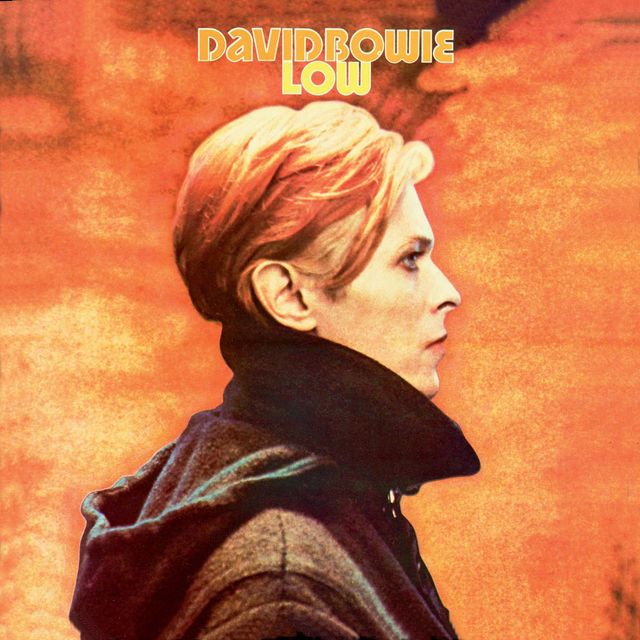
The cover used a Steve Schapiro photograph taken on the set of The Man Who Fell to Earth, Bowie in profile against an orange haze. He had hoped people would get the joke in the title. “The album cover has a profile of me on it, and on the album itself I keep a very ‘low profile’,” he said. “I was very disappointed no one picked up on that.”
Homage to Catatonia
The reviews split sharply. The NME gave the album a page and a half and two reviews. One was by Charles Shaar Murray, one of Bowie's most devoted critics, who hated it. His proposed headline was “Homage to Catatonia.” A proofreader “corrected” it to Homage to Catalonia, which, as Murray later complained, made no sense at all.
In America, Robert Christgau gave it a B-plus. He admired side one's “fragments” but found most of side two “so far from hypnotic” that Bowie, not Eno, must deserve the credit for it. John Rockwell in The New York Times was far warmer. Bowie had expected the caution. “I certainly didn't expect people to embrace it with open arms as the long lost ‘new language of music’,” he said that December.
Buyers were less troubled. Low peaked at No. 2 in the UK and No. 11 on the Billboard 200. “Sound and Vision” became a top-three single in Britain and also went top ten in Belgium, Germany, and the Netherlands.
Murray revisited his review for Bowie's official site in 2017. Part of his reaction, he explained, was personal. He and his wife had just escaped amphetamine addiction, and the album seemed to glamorize what they had fought. “Low is an album I can admire, for any number of reasons, and freely and happily acknowledge for its innovation and influence,” he wrote. “Unfortunately, it's one which I can never enjoy.”
The Drum Sound That Shaped the ’80s
The first sign of the album's influence was the phone calls. Producers rang Visconti asking how he had made the drum sound. He would not tell them. “I felt that the magic of this rebellious album would be reduced to a technical trick if I had explained,” he wrote. Murray, for all his dislike, put it bluntly: “without Low, Gary Numan would never have had a career.”
The album pointed straight at post-punk. Joy Division took their first name from “Warszawa” in 1977. Bowie, Eno, and Visconti went on to make “Heroes” in Berlin later that year and Lodger in 1979, completing what became known as the Berlin Trilogy.
The classical world took notice too. In 1992 Philip Glass built his Symphony No. 1 on themes from Low, using “Subterraneans,” the outtake “Some Are,” and “Warszawa.” The original album, he wrote, “used techniques which were similar to procedures used by composers working in new and experimental music.”
When Pitchfork ranked the best albums of the 1970s, it put Low at No. 1. Its write-up, by Stephen Thomas Erlewine, ends: “Low is an album about rebirth, which is why it still possesses the power to startle.” Fifty years on, it still sounds like what Bowie said it was: a record made by someone trying to get well.
“Overall, I get a sense of real optimism through the veils of despair from Low. I can hear myself really struggling to get well.”