
In April 1971, The Who set up their gear on the stone floor of the entrance hall at Mick Jagger's country house, with a mobile studio idling in the driveway. Pete Townshend played over a pre-recorded synthesizer track. Keith Moon waited eight and a half minutes for the scream.
Engineer Glyn Johns captured “Won't Get Fooled Again” live in that hallway. It became the closing track of Who's Next, an album The Who never meant to make. It existed only because something much bigger had just collapsed: Lifehouse, Townshend's sprawling science-fiction opera and planned follow-up to Tommy, which pushed him to the edge of a breakdown.
Stripped of its story and cut to nine songs, what was left became the only Who album ever to top the UK chart. Rock's future arrived by accident.
“There have been a few tracks during my life where the hairs stand up on the back of your neck and you think, 'Jesus Christ!' That was one of them.”
The Opera That Fell Apart
After Tommy made The Who the most ambitious band in rock, Pete Townshend decided to go further. Lifehouse was to be a film, an album, and a series of concerts all at once, set in a poisoned future where music is banned and life is piped to housebound citizens through a government network called the Grid. Rock and roll survives as samizdat. The story would climax at a concert where audience and band dissolve into a single perfect note.
Townshend meant parts of it literally. In early 1971 The Who took up residency at London's Young Vic theatre, playing experimental concerts intended to blur into the film's plot. The audiences wanted “My Generation”; the band got nowhere near a universal chord. Worse, almost no one around Townshend understood the concept — and his attempts to explain it, he later admitted, brought him closer to a nervous breakdown than he had ever been.
The project's collapse was also a collapse of partnership. Kit Lambert, the band's manager and longtime creative foil, had drafted a Lifehouse script of his own and booked sessions at New York's Record Plant in March 1971. Those recordings — with guests including Mountain's Leslie West on guitar and Al Kooper on organ — ran aground along with the relationship. When the band flew home, the opera was dead. The songs, stubbornly, were not.
The empty theatre, the hotel window in New York, and the pub conversation that ended the opera are their own story: The Rock Opera Nobody Understood: How Pete Townshend's Lifehouse Collapsed Into Who's Next →
A Mobile Studio in Mick Jagger's Driveway
Enter Glyn Johns, the engineer who had already worked with the Beatles, the Stones, and Led Zeppelin. Brought in to salvage the New York tapes, Johns listened and made a bolder call: scrap them and re-record everything. The first session convened in April 1971 at Stargroves, Mick Jagger's Victorian mansion in Hampshire, with the Rolling Stones Mobile Studio parked outside and the band playing in the entrance hall.
The Stargroves take of “Won't Get Fooled Again” convinced everyone that the songs could stand without the story. Work then moved to Olympic Studios in Barnes, where Johns — credited, at his own modest insistence, as associate producer — recorded the band through June with a clarity no Who record had ever had. Nicky Hopkins, rock's ubiquitous session pianist, added keys to “The Song Is Over” and “Getting in Tune.”
Johns's great insight was subtraction. Lifehouse had been conceived as a double album wired to a screenplay; Johns argued for a single LP of the strongest material, sequenced for impact rather than plot. Eight Townshend songs survived the cut, joined by John Entwistle's comically vengeful “My Wife” — the only track with no Lifehouse pedigree at all. The concept was gone. What remained was the tightest 43 minutes the band ever put on record.
The Who performing 'Baba O'Riley' at Shepperton Studios in 1978, filmed for The Kids Are Alright — the Lowrey organ loop intact.
The Synthesizer Joins the Rhythm Section
What made Who's Next sound like the future was Townshend's home experiments with organ and synthesizer. In his Twickenham studio he fed a Lowrey organ through primitive electronics, and for the album's opening he built a burbling, minimalist pulse inspired by composer Terry Riley — honored, along with spiritual teacher Meher Baba, in the title “Baba O'Riley.” On “Won't Get Fooled Again,” an ARP synthesizer processed the organ into a stuttering electronic backbone that ran the full length of the track.
The radical part was not the technology but the role it played. Synthesizers in 1971 rock were garnish — sci-fi squeals and studio novelty. Townshend made them structural: the loops keep time, and the band plays against them, Moon crashing around a grid that never flinches. It is the architecture of electronic dance music, three decades early, executed by the loudest rock band in the world.
It uses the synthesizer to vary the power trio format, not to art things up.
Christgau graded the album an A, and his point was the one that stuck: the machines serve the band, never the reverse. Daltrey never sounded more commanding, Entwistle's bass never more melodic, and Moon — playing to a fixed pulse for the first time in his life — delivered the most disciplined performances of his career without losing an ounce of mania.
Essential Tracks
“Baba O'Riley”
In the Lifehouse script, this was the overture: a Scottish farmer named Ray gathers his family and heads toward London and the concert that will free everyone. Cut loose from the plot, the song became something bigger — a hymn for every stranded kid in what its chorus calls a teenage wasteland. The title fuses the song's two guiding spirits, Meher Baba and Terry Riley: devotion and repetition, joined at the hip.
The Lowrey organ pattern runs alone for a full 30 seconds before Nicky Hopkins's piano chords land like hammer blows, and Moon enters as a force of weather. Daltrey sings the verses with gale force; Townshend takes the fragile middle section himself. Then, in the final minute, Dave Arbus of the band East of Eden — invited by Moon — saws out a violin reel that accelerates the song over a cliff.
Never released as a UK or US single, it became one of the most recognizable rock recordings ever made anyway — a stadium fixture, the theme to CSI: NY, and the proof that a synthesizer loop could carry an anthem. Half a century of imitators have borrowed the blueprint; none have improved on the original's five minutes of controlled acceleration.
“Behind Blue Eyes”
Written as the theme for Jumbo, the Lifehouse villain, “Behind Blue Eyes” is the bad man's soliloquy — a plea to understand what it costs to be the one everyone fears. Townshend wrote it after resisting a temptation on tour, turning private guilt into his most naked lyric.
The arrangement is a two-act play. Acoustic guitar and three-part harmony — Daltrey, Townshend, Entwistle — hold the first half in near silence; then Moon detonates the second half before the song folds back into its opening prayer. Daltrey, handed the gentlest melody on the record, sings it with a restraint he was rarely credited for. Few Who tracks show the band's dynamic range so nakedly.
Released as the album's second US single, it reached the Top 40 and never left rock radio. Limp Bizkit's 2003 cover introduced it to a generation that had never heard of Lifehouse — villain's monologue turned standard.
“Won't Get Fooled Again”
The finale — in the opera, the moment the crowd rejects every revolution that ends with a new boss. Townshend's lyric is not apathy but hard-won suspicion of anyone selling utopia, compressed into the most quoted closing line in rock: meet the new boss, same as the old boss.
For eight and a half minutes the band rides the ARP-processed organ, until everything drops out but the machine. The pulse runs alone — and then Moon's drums come thundering back in what may be the most famous re-entry in rock, capped by Daltrey's scream, recorded live in the hall at Stargroves.
Edited down for the single, it reached the UK Top 10 in the summer of 1971. The full-length version closed nearly every Who concert for the next five decades, and the Shepperton performance filmed for The Kids Are Alright in May 1978 turned out to be Keith Moon's last stand in front of cameras — he died four months later.
The Shepperton performance of 'Won't Get Fooled Again' from May 1978 — Keith Moon's final filmed performance with the band.
Nine Tracks, One Number One
Released in August 1971 on Track in the UK and Decca in America, Who's Next did what none of the band's grander statements had done: it went to No. 1 in Britain — the only Who album that ever has. In the US it peaked at No. 4 and simply never stopped selling, eventually certified triple platinum by the RIAA. “Won't Get Fooled Again,” cut down to single length, reached the UK Top 10 that summer.
The critical verdict hardened quickly from approval into canon. Christgau's A-grade notice called the record a triumph of hard rock that was never merely hard rock. Within a few years, Who's Next had become the consensus pick as the band's finest studio album — the one placed on greatest-albums lists ever since, from Rolling Stone's 500 to the Grammy Hall of Fame.
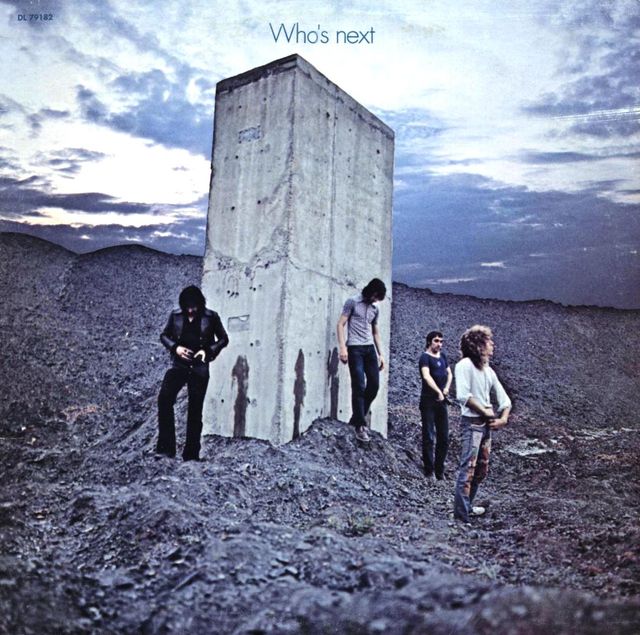
Even the sleeve became iconic by accident. Driving back from a gig, the band stopped at a concrete piling jutting from a slag heap at Easington Colliery, and photographer Ethan Russell shot them walking away from it, zippers ostensibly just closed — a deadpan inversion of the monolith from 2001: A Space Odyssey. Most of the streaks on the concrete, Russell later confessed, were rainwater tipped from an empty film canister; only one band member could actually deliver on cue.
The Wasteland Never Emptied
The influence of Who's Next runs down two separate branches. The first is sonic: Townshend's sequencer-against-drums architecture became the default grammar of new wave and synth-rock — you can hear “Baba O'Riley” underneath everything from the Cars to U2's early loops to the arena-electronic hybrids of the past two decades. The second is professional: Glyn Johns's big, dry, close-miked drum sound became the reference point for how hard rock records are engineered.
Townshend never fully let Lifehouse go — he kept releasing chunks of it for 30 years, from demo collections to a radio play, and its central prophecy of life lived through a grid of home entertainment aged from science fiction into description. The opera about music holding a wired-in society together no longer needs explaining to anyone with a phone.
That is the great irony of Who's Next: the concept failed, and the failure is why it endures. Freed from the plot, nine songs had to survive on force alone — and 55 years on, they still open sports broadcasts, close encores, and teach each new generation of bands how big a rock record is allowed to sound. The new boss turned out to be the same as the old boss. The album outlasted them both.
“Every time we went back in we were just getting astounded at the sounds that [Glyn] was producing.”