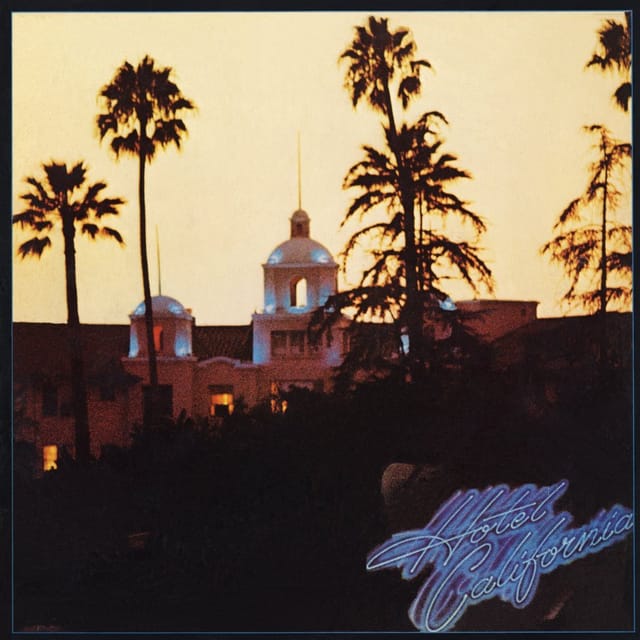

The Eagles released Hotel California on December 8, 1976. Fifty years later, they're still playing it. In December they return to the Sphere in Las Vegas for four more nights, on the 4th, 5th, 11th and 12th, right around the album's birthday.
The title song started as a demo with no words. Don Felder recorded it in a beach house he'd rented in Malibu: a falling 12-string pattern with a lilt so odd that Don Henley nicknamed it “Mexican Reggae.” From that sketch, a band in the middle of a lineup change built one of the biggest records of the decade.
The album spent eight weeks at No. 1 and produced two No. 1 singles. The title track won the Grammy for Record of the Year, and the band never showed up to collect it. In January 2026 the album was certified 28× Platinum, making it one of the best-selling records ever released in America.
It's a record about excess that was made with obsessive care. It's also a portrait of California that was partly recorded in Miami.
“It's a journey from innocence to experience. It's not really about California; it's about America. It's about the dark underbelly of the American dream. It's about excess, it's about narcissism. It's about the music business.”
A Demo Called “Mexican Reggae”
By the end of 1975 the Eagles were the biggest American band in the country and no longer quite the band that had made their name. One of These Nights had given them their first No. 1 album that summer, but founding guitarist Bernie Leadon, the group's strongest link to bluegrass and country, walked out in December. His replacement was Joe Walsh — a hard-rock guitarist with a solo career, a James Gang past, and a producer, Bill Szymczyk, whom the Eagles already shared.
The change pushed the band toward electric guitars just as Felder was stockpiling instrumental ideas. Working on the couch of the house he had rented on the beach in Malibu, he put a 12-string chord sequence onto tape, then layered a solo on top, switching guitars mid-demo and, as he later put it, “kind of duelled with myself between a Strat and a Les Paul.” Henley heard something that sounded Latin and Caribbean at once. The working title stuck for months.
The words came from Henley and Glenn Frey, who wanted to stretch past the cowboy romance of their early records. Frey later said the pair were trying to “expand our lyrical horizons and just take on something in the realm of the bizarre, as Steely Dan had done” — and he admired that Steely Dan “would say anything in their songs, and it didn't have to necessarily make sense.” Steely Dan had name-checked the Eagles earlier in 1976 on “Everything You Did”; the title track returns the favor with a sly nod to its “steely knives.”
What Henley and Frey built on Felder's chords was a mood rather than a plot: a traveler, a luxurious hotel that turns out to be a trap, and a guest list of people who have everything and cannot leave. The rest of the album filled in the picture — the hedonism of “Life in the Fast Lane,” the burnout of “Wasted Time,” the fickle fame of “New Kid in Town,” and the environmental lament of “The Last Resort.” It was 1976, America's bicentennial year, and the Eagles had decided to write about the hangover.
Criteria, Miami: Black Sabbath Through the Wall
The sessions ran from March to October 1976, split between the Record Plant in Los Angeles and Criteria Studios in Miami. The title track alone was cut three separate times. “Both of these sessions were done in L.A. at the Record Plant, and then the real version was done at Criteria,” Szymczyk told Mix. “It was cut on a beautiful afternoon in sunny Florida.” Felder played the 12-string through a pair of miked amps, Henley was on drums, Randy Meisner on bass, and Frey supplied what Szymczyk called “the reggae guitar chinks.”
Miami came with a neighbor. Black Sabbath were tracking Technical Ecstasy at Criteria at the same time, and the walls were not built for them. “We were too loud for them,” Tony Iommi admitted to Guitar Player. “It kept coming through the wall into their sessions.” The Eagles repeatedly had to stop recording while the heaviest band in Britain played on the other side of the wall.
The Eagles' own perfectionism did the rest. Szymczyk assembled the best version of each performance with a razor blade: “I think ‘Hotel California’ had 30-some edits in the basic, before we even started overdubbing,” he said — enough that the band nicknamed him “The Big Lopper.” Lead vocals got the same treatment, with four or five complete takes spread across his 24-track tape and stitched together line by line.
The pace was punishing enough that Szymczyk had to impose order. “I made a rule after it got a little unruly at first,” he recalled to the Record Plant Diaries. “I said, ‘All right, guys, we have to get in here at 2 o'clock in the afternoon.’” Walsh, the newcomer, remembered the whole project as “a kind of a painful birth.”
The title track live in 1977, on the tour that followed the album — Felder and Walsh trading the closing solo
The Solo Played Down a Phone Line
The song's most famous two minutes nearly came out differently. When the band reached the solo in Miami, Felder started improvising something new. Henley stopped him and told him to play it exactly the way it was on the demo — the demo Felder had made a year earlier, on a cassette that was sitting in his house in Malibu.
So Felder called home. His housekeeper found the cassette in his home studio, put it in a machine, and played it down the phone line to Florida, where the studio recorded it onto another cassette. Felder then sat down and relearned his own year-old solo, note for note, so that the master would match the sketch Henley had fallen for.
What he and Walsh built from it is the climax of the record: two lead guitars trading phrases and then locking into harmonized arpeggios over the descending chords, with nobody singing. Walsh described the partnership as rivalry that worked: “Don Felder and I were always very competitive, but it was good. We really respected each other and we pushed each other.”
This was probably one of the very, very highest points in my life — sitting in the studio with Walsh on one side, Felder on the other and the vocal's done.
Essential Tracks
“Hotel California”
Six and a half minutes long, with a long instrumental intro and an even longer instrumental coda, the title track had no business being a hit single — and it went to No. 1 anyway. Its architecture is Felder's: the 12-string figure walking down through its chords, Frey's off-beat guitar chops giving it the “reggae” sway Henley heard in the demo, and the guitar duel saved for the end like a reveal.
Henley sings it as a narrator who is slowly realizing where he is. The verses move from the open desert highway to the hotel's mirrored, champagne-soaked interior to the final discovery that checking out and leaving are not the same thing. The surreal imagery is deliberate — the Steely Dan-style “realm of the bizarre” Frey described — and the vagueness is the point.
That vagueness has cost Henley decades of explaining. Listeners have read the lyrics as devil worship, a hidden addiction confession, and a secret map of a real Mexican inn. Henley's own summary is simpler: a song about innocence curdling into experience, and one that “can have a million interpretations.” We trace every rumor to its source here: The Devil on the Balcony: What “Hotel California” Is Actually About →
“New Kid in Town”
The album's first single came from the Eagles' closest songwriting ally. J.D. Souther already had the chorus when he brought it to Frey and Henley. “I played it for them and they went, ‘Yeah, dummy, that's it. Let's write some verses,’” Souther told Songwriter Universe in 2017. The verses were finished under pressure: once the band had cut the track at Criteria, they phoned Souther to come to Florida and complete the lyrics.
Musically it is the gentlest thing on the record — a mid-tempo country-soul shuffle with an electric piano, Frey's lead vocal, and the band's stacked harmonies doing the heavy lifting. Those harmonies won the Eagles a Grammy for Best Arrangement for Voices.
Its subject is the album's theme in miniature: a hot newcomer arrives, everyone wants him, and the narrator knows exactly how quickly that attention moves on. Coming from a band that had just replaced a founding member and was watching punk gather on the horizon, it played as both a warning and a confession. It became the Eagles' third No. 1 single.
“The Last Resort”
The closing track is the album's thesis written out longhand: a seven-minute ballad tracing settlers moving west across America until there is nowhere left to go, then paving over paradise when they arrive. Frey gave the credit to his partner in the liner notes to The Very Best of the Eagles: “I called it Henley's opus. I helped describe what the song was going to be about and assisted with the arrangement, but it was Don's lyrics and basic chord progression.”
Musically it is the album's slowest burn — piano, voice and swelling harmonies, with none of the guitar fireworks of the title track — and it was the last song to fall into place. Frey called it “the final piece of the Hotel California puzzle.”
Not everyone was persuaded. Robert Christgau dismissed it as “pretentious and condescending.” But it pointed straight at where Henley was heading: his environmental activism, including the Walden Woods Project he founded in 1990, grew from the same concern. Ending a blockbuster on a slow lament about land and greed, rather than another hit, was the most quietly ambitious decision on the record.
The J.D. Souther co-write that went to No. 1 and won a Grammy for its vocal arrangement
Eight Weeks at No. 1, One Empty Seat
Hotel California first reached No. 1 on the Billboard 200 on January 15, 1977, and spent eight weeks on top across four separate stints — dislodged briefly by Wings' live album and by Stevie Wonder's Songs in the Key of Life, returning each time, until Fleetwood Mac's Rumours took over that May. It spent 37 weeks in the top ten and 108 weeks on the chart.
The singles kept it there. “New Kid in Town” and the title track both topped the Hot 100, and “Life in the Fast Lane” reached No. 11. That last one started as a warm-up riff Walsh played before shows and a phrase Frey picked up riding with a drug dealer known as the Count, who was doing 75 or 80 when he said it. “Oh, my God, what a title,” Frey told Cameron Crowe. “I didn't write it down. I didn't have to.”
Critics were more divided than buyers. Christgau, writing in the Village Voice, gave it a B and a backhanded compliment: “Speaking strictly as a nonfan, I'd grant that this is their most substantial if not their most enjoyable LP.” He added a barb that still stings, saying Henley was “incapable of conveying a mental state as complex as self-criticism.”
The music industry had no such reservations. At the Grammys in February 1978, “Hotel California” won Record of the Year and “New Kid in Town” won Best Arrangement for Voices. The Eagles did not attend the ceremony. Their biggest award went to an empty seat.
A Sinister Hotel on Sunset Boulevard
The cover had to look like a California hotel with something wrong with it. Art director John Kosh and photographer David Alexander scouted three hotels before settling on the Beverly Hills Hotel, then went up in a 60-foot cherry picker above Sunset Boulevard at sunset. Kosh said they were “shooting blindly into the sun” on high-speed Ektachrome, which produced the grainy, overheated glow of the finished image.
The band's name appeared nowhere on the front, and the neon sign in the corner was added afterward by airbrush artist Bob Hickson. The hotel itself was not consulted. Its lawyers threatened Kosh with a cease-and-desist — until, as he told the story, it was pointed out that booking requests had tripled since the album came out.
The image fixed the album in its moment. In 1976 America was celebrating its bicentennial and electing Jimmy Carter in the shadow of Watergate, and in New York the Ramones had just released a debut that sounded like a rebuke to everything Los Angeles rock stood for. The Eagles answered with a pink palace photographed so that you could not quite see inside.
After the Hotel: The Band Comes Apart
The tour behind the album exposed every crack in the band. Randy Meisner, whose falsetto on “Take It to the Limit” had become a nightly showstopper, grew anxious about hitting the high note night after night. In Knoxville in June 1977, ill and exhausted, he refused to come back out for the encore, which led to an angry backstage confrontation with Frey. He left when the tour ended that September; Timothy B. Schmit replaced him.
Following Hotel California took the Eagles three years. The Long Run arrived in 1979, and the band broke up in 1980. They did not record together again until the 1994 reunion that produced Hell Freezes Over. Felder was fired in 2001 and spent years in litigation with his former bandmates; Frey died on January 18, 2016, and Meisner in July 2023.
Meanwhile the album's sales never stopped. Together with the 1976 compilation Their Greatest Hits 1971–1975, now certified quadruple diamond, it gives a band that made six studio albums in its first decade two of the three best-selling albums in U.S. history.
Fifty Years Checking In
Half a century has not settled the argument about the Eagles. For PopMatters' Counterbalance series in 2012, Jason Mendelsohn and Eric Klinger called the band “the vanilla pudding of rock ’n’ roll,” and argued that Hotel California was “so clearly, so visibly their play for critical approval that it's really hard to imagine that it actually worked.” That skepticism is part of the album's legacy too: it remains the record critics reach for when they want to describe 1970s rock at its most polished.
The songs themselves have even ended up in court. In 2022, Manhattan prosecutors charged three collectibles dealers over roughly 100 pages of handwritten legal-pad drafts from the album's writing sessions. The defense said Henley had given the pages to Ed Sanders, a writer working on an Eagles biography that was never published. In March 2024 the case collapsed mid-trial after Henley waived attorney-client privilege, releasing some 6,000 pages of communications the defense had never seen.
On stage, the album has become a set piece. The Eagles performed Hotel California in its entirety for the first time at the MGM Grand in Las Vegas in September 2019. Their Sphere residency, which opened in September 2024, has since grown to 68 shows — the longest run in the venue's history — with Deacon Frey singing his father's parts. Rock historian Sean Egan's book Eagles and Hotel California: 50 Years arrived in September for the anniversary.
The reason it keeps selling is the reason it was made. A record about wanting everything and finding it empty, built from thirty-odd razor-blade edits and a solo relearned over a phone line, turned out to describe more than one Los Angeles scene in one year. Fifty years after it opened, nobody has managed to check out.
“It was a kind of a painful birth, ‘Hotel California.’ Not too bad, not too bad once we got going, but the funny thing is that everybody thinks we knew what we were doing.”