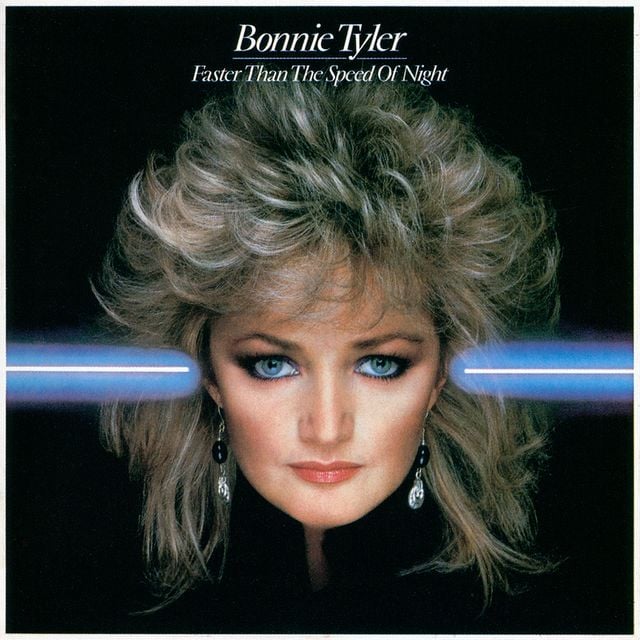

Bonnie Tyler died this week in a hospital in Portugal, at 75. Within hours, the world did what it does every time the moon crosses the sun: it reached for “Total Eclipse of the Heart.”
It's worth remembering how unlikely that song was. In 1982, Tyler was a Welsh singer five years past her last American hit, filed under soft country-pop and going nowhere. Then she saw Meat Loaf on television and asked for the man who wrote his songs. She ended up in a New York studio with Jim Steinman and half of the E Street Band.
The album they made, Faster Than the Speed of Night, entered the UK chart at No. 1. Its seven-minute gothic ballad went to the top of the charts on both sides of the Atlantic. Few singers who had been written off ever got a second act this loud.
“After it was a hit, Meat Loaf always used to say: ‘Dang. That song should have been mine!’”
From Gaynor Hopkins to Bonnie Tyler
She was born Gaynor Hopkins in 1951, a coal miner's daughter from the village of Skewen outside Swansea, and spent a decade singing covers in South Wales clubs before a talent scout heard her. Two things made her famous in the late 1970s. The first was “Lost in France” and then “It's a Heartache,” which reached the Top 3 in America in 1978 and sold millions worldwide.
The second was an accident. Surgery to remove nodules from her vocal cords in the mid-1970s — and her failure to rest her voice afterward, as ordered — left her with a permanent, dramatic rasp. The husk in her voice drew endless Rod Stewart comparisons and gave every note she sang the sound of something barely survived.
What she did not have was respect. Critics heard her as a jukebox voice attached to lightweight material; Robert Christgau, reviewing the It's a Heartache album in 1978, allowed that her songwriters had “a gift for the Nashvillian pain-of-love lyric” but warned that any other hit hidden on the record was “gonna bore us all stiff inside of two weeks.” He graded it a C. By 1982 the hits had dried up, and Tyler was determined that whatever came next would sound nothing like what had come before.
She Wanted the Man Behind Meat Loaf
The turn came from a television broadcast. Tyler saw Meat Loaf performing “Bat Out of Hell” on the BBC's Old Grey Whistle Test and decided on the spot that she wanted whoever wrote it. Newly signed to CBS and finally free to choose her own direction, she asked the label for Jim Steinman — the composer whose Wagnerian teenage melodramas had made Bat Out of Hell one of the best-selling albums on earth.
Steinman turned her down at first. Then he called back and invited her to New York, where he sat at a piano with his trusted session singer Rory Dodd and performed a long, dark ballad he had been carrying around for years — a song that had begun life, though Tyler didn't know it yet, as a vampire love song for an abandoned musical of Nosferatu. It was called “Total Eclipse of the Heart.”
“I just had shivers right up my spine,” Tyler told The Times of that first hearing. “I couldn't wait to actually get in and record it.” Steinman, for his part, heard in her ruined-and-rebuilt voice exactly the instrument his apocalyptic material needed — a singer who could stand in front of his walls of sound and not be flattened by them. The full, strange history of that song — from shelved vampire musical to global No. 1 and back again — is a story of its own: Vampires in Love: The Secret Life of “Total Eclipse of the Heart” →
Russell Mulcahy's fever-dream video, shot in a derelict Victorian asylum in Surrey, became an MTV fixture and one of the most parodied clips of the 1980s.
Wall of Sound at the Power Station
Steinman produced the album in New York across 1982, principally at the Power Station, with additional sessions at Greene Street and Right Track studios. He assembled a murderers' row: Roy Bittan on piano and Max Weinberg on drums — the engine room of Bruce Springsteen's E Street Band — plus guitar hero Rick Derringer, synthesist Larry Fast, bassist Steve Buslowe, and percussionist Jimmy Maelen. Rory Dodd handled the answering vocals that became the record's signature.
The blueprint was Phil Spector by way of Broadway: every song rebuilt as widescreen melodrama, with Bittan's piano cascades and Weinberg's cannon-fire fills pushing Tyler's voice to its ragged edges. Steinman contributed two originals — the title track and “Total Eclipse” — and dressed the rest of the album in radically reworked covers, on the theory that arrangement, not authorship, was where the drama lived.
The covers were audacious choices: Creedence Clearwater Revival's “Have You Ever Seen the Rain?” recast as arena rock on a classical piano riff, Bryan Adams's “Straight from the Heart” before Adams himself had made it a hit, and a duet with Scottish soul shouter Frankie Miller on “Tears.” A team of engineers that included Neil Dorfsman and Scott Litt captured it all at maximum scale. Nothing on the record is modest; that was the point.
Essential Tracks
“Total Eclipse of the Heart”
Steinman had been carrying the song for years before Tyler heard it — he later revealed it was drafted as “Vampires in Love” for his shelved Nosferatu musical, which explains its imagery of darkness, devotion, and eternal night. At nearly seven minutes on the album, it was commercial madness: a gothic duet structure in which Rory Dodd's “turn around” calls circle Tyler like a voice from another room.
The record is a masterclass in escalation. Bittan's solitary piano opens in near silence; each verse adds another layer — drums, choir, Derringer's guitar — until the bridge detonates and then strips everything away again for the final, exhausted refrain. Tyler's rasp does the emotional work no smooth voice could: she sounds genuinely wrecked, which is what the song is about.
Radio played it anyway — all of it. The single topped the UK chart in the spring of 1983 and spent four weeks at No. 1 in America that autumn, earning Tyler two Grammy nominations and becoming one of the defining power ballads of the decade. Four decades of karaoke nights, film syncs, and eclipse-day streaming spikes have never dimmed it.
“Have You Ever Seen the Rain?”
Opening the album with a Creedence cover was a statement of method: John Fogerty's two-and-a-half-minute swamp-rock lament stretched past four minutes and rebuilt from the ground up as a Steinman production number. It announces immediately that this record will treat other people's songs as raw material for spectacle.
Bittan opens it with a complex, classically styled piano figure that Fogerty never imagined, and the band behind Tyler swells the song into arena scale — Weinberg detonating the choruses while Dodd's harmonies push her upward. Tyler sings it not as nostalgia but as foreboding, her frayed top notes turning the title question into something ominous.
Released as the album's third single in June 1983, it kept the record on the radio through the summer and proved the formula travelled beyond one epic ballad. Among the album's six covers, it is the one that most completely stops belonging to its original owner.
“Faster Than the Speed of Night”
The second Steinman original is the title track and the album's engine room: nearly seven minutes of highway-mythology rock in the Bat Out of Hell mold, built on lightning piano runs and Derringer's metallic soloing. If “Total Eclipse” is the album's dark cathedral, this is its drag race.
It is also the track where the band shows off most freely — Bittan and Weinberg locking into the galloping momentum they perfected on Born to Run-era Springsteen records, while Tyler rides on top at full throttle for the duration. There is no restraint anywhere in the arrangement, and none intended.
Issued as a single in the UK weeks after the album's release, it never matched the ballad's chart run — but as the album's namesake it set the record's tone and title, and it gave Tyler the arena-rock identity she had asked Steinman for in the first place. She kept it in her live sets for the rest of her life, including on her final live album, recorded in Berlin.
The official video for Tyler's arena-scale reinvention of Creedence Clearwater Revival's classic, the album's third single.
Number One on Both Sides of the Atlantic
Released in Britain on April 8, 1983, Faster Than the Speed of Night entered the UK Albums Chart at No. 1 on April 16 and held the top for two weeks — a stunning debut for a singer the industry had written off. It topped the charts in New Zealand and Norway, reached the Top 3 in Australia, and climbed to No. 4 on the Billboard 200 after its American release that September, eventually going platinum in the US, double platinum in Canada, and selling roughly three million copies worldwide.
The single outran even the album. In the first week of October 1983, “Total Eclipse of the Heart” began a four-week run atop the Billboard Hot 100 — and for one of those weeks, the No. 2 song in America was Air Supply's “Making Love Out of Nothing at All,” also written by Jim Steinman. One songwriter, two acts, the top two positions on the chart: Steinman's melodrama had briefly conquered American radio outright, with Tyler's voice as its flagship.
The industry that had graded her a C now handed her its ballots: Tyler received two Grammy nominations on the strength of the single and the album. The Russell Mulcahy video — billowing curtains, glowing-eyed choirboys, a derelict asylum standing in for the haunted house of the heart — became inescapable on MTV, introducing an American audience that had last seen her as a country-pop singer to a full-blown gothic diva.
An extinction-level event rendered in musical form.
Retrospective critics have been kinder to the record than 1983's tastemakers were. Breihan's Number Ones column awarded “Total Eclipse of the Heart” a perfect 10, and the album's reputation has settled where its audience always placed it: as the moment the power ballad became an art form of excess, and the proof that Steinman's theatrical maximalism worked even better with a voice rougher than Meat Loaf's.
The Eclipse That Never Ended
Tyler never stopped benefiting from the association — or escaping it. Steinman gave her one more giant in 1984 with “Holding Out for a Hero” from the Footloose soundtrack; she represented the United Kingdom at Eurovision in 2013; and she kept recording into her seventies, releasing the studio album The Best Is Yet to Come in 2021 and a final live album, In Berlin, in 2024. The song, meanwhile, developed its own orbital mechanics: every actual solar eclipse sends it surging back up the streaming charts.
Tyler leaned into the joke with total good humor. During the August 2017 American eclipse she performed the song aboard a cruise ship in the path of totality, timed to the moment the sky went dark. She was still singing it at full force four decades after Rory Dodd first sang “turn around” at her across Steinman's piano.
Her death on July 8, 2026 — announced by her family after weeks in a Portuguese hospital — closes the story of one of pop's great second acts. Steinman died in 2021, Meat Loaf in 2022; Tyler was the last principal voice of that strange, magnificent corner of the early 1980s where Broadway bombast and rock radio briefly became the same thing. Faster Than the Speed of Night is its high-water mark: the sound of a written-off Welsh club singer discovering that the biggest stage in pop was exactly her size.
“Bonnie's family and team are heartbroken to announce that Bonnie unexpectedly passed away last night in hospital in Portugal as a result of the illness that she was being treated for.”