Vampires in Love: The Secret Life of “Total Eclipse of the Heart”
Bonnie Tyler's signature song was written for a vampire musical that never opened — and the vampires eventually got it back
 Trevor Fortune•🎵 Bonnie Tyler - Faster Than the Speed of Night•9 min read•July 9, 2026
When Bonnie Tyler died in July 2026, the song that surged back up the streaming charts within hours was the same one that returns every time the moon slides across the sun: “Total Eclipse of the Heart,” four weeks a No. 1 in America, a No. 1 in Britain, and one of the most performed power ballads ever recorded. What most of the millions singing along have never known is what the song was actually about. It was not written for Bonnie Tyler, or for radio, or even — exactly — for humans. It was written for vampires.
A Song for Nosferatu
Long before he became the composer behind Meat Loaf's Bat Out of Hell, Jim Steinman was a theatre animal — a writer of overheated, operatic stage musicals who treated rock and roll as Wagner with guitars. Among his shelved projects was a musical adaptation of Nosferatu, F.W. Murnau's silent vampire classic. For it, he began a love duet between predator and prey: a song about surrender to something that will consume you. Its working title was “Vampires in Love.”
The musical never opened, and the song sat unfinished in Steinman's drawer. He said the quiet part out loud years later, when he recycled the song into his 1997 vampire musical and a Playbill interviewer asked about its origins.
"If anyone listens to the lyrics, they're really like vampire lines. It's all about the darkness, the power of darkness and love's place in the dark."
Heard that way, the song stops being mysterious. The endless night, the bright eyes that must turn around, the total eclipse itself — the imagery is not a metaphor gone florid. It is a vampire courting a victim, hiding in plain sight on adult-contemporary radio for four decades.
The Girl from Skewen Wants Steinman
The song might have stayed in the drawer forever without a Welsh singer's stubbornness. By 1982 Bonnie Tyler — born Gaynor Hopkins, a miner's daughter from the village of Skewen — was five years past “It's a Heartache” and thoroughly tired of being packaged as a country-pop act. Newly signed to CBS, she was watching the BBC's Old Grey Whistle Testwhen Meat Loaf performed “Bat Out of Hell,” and she made a decision that rerouted her life: she wanted whoever wrote that.
Steinman initially said no. Then he reconsidered, called Tyler, and invited her to New York. In his apartment he sat at the piano with Rory Dodd — the session singer whose keening tenor haunted Steinman's productions — and performed the resurrected, retitled vampire song at her. Dodd sang the “turn around” calls; Steinman hammered the chords.
"I just had shivers right up my spine. I couldn't wait to actually get in and record it."
Tyler said Steinman told her the song's history himself. “He told me he had started writing the song for a prospective musical version of Nosferatu years before, but never finished it,” she recalled in a 2023 Guardian interview. He finished it for her — a rasping, wounded voice that made the darkness sound survivable.
Recording an Impossible Single
The track Steinman produced at New York's Power Station in 1982 broke every rule of radio economics. It ran to nearly seven minutes on the album. It was a duet in disguise, Dodd circling Tyler's verses like a voice calling from another room. And it was built like theatre: Roy Bittan of the E Street Band opening at a whisper, Max Weinberg's drums arriving like scenery collapsing, a full choir at the climax, and then almost nothing again — two exhausted voices in the dark.
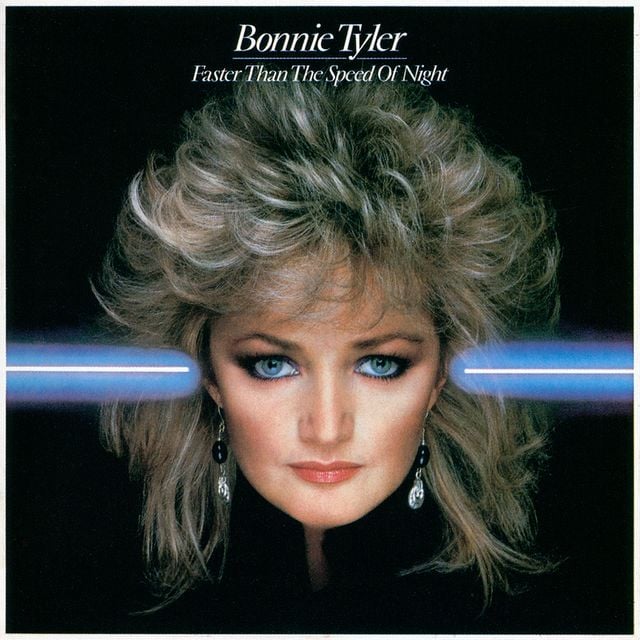
Even the woman who sang it doubted the world would ever hear it. In a letter to a friend written just after the session, Tyler reported: “I recorded an incredible song today. The trouble is, it's so long, I don't think anybody will ever play it.” Radio played all of it. The single topped the UK chart that spring, and the album it anchored, Faster Than the Speed of Night, entered the British chart at No. 1.
Turn Around: The Asylum Video
The song's gothic pedigree bled into its video. Director Russell Mulcahy — who would go on to make Highlander — shot it in a derelict Victorian asylum in Surrey, filling it with billowing curtains, doves, fencers, and choirboys with glowing eyes. Tyler wanders the corridors like the last living person in a haunted boarding school, forever turning around to find nobody there.
Tyler remembered the location as genuinely unnerving, telling The Guardian that the security dogs refused to enter the downstairs rooms where patients had once been given electric-shock treatment. The clip became an MTV fixture and, eventually, one of the most affectionately parodied videos of the 1980s — the rare promo whose fever-dream imagery actually matched the song's secret subject.
Steinman's October
In America the single climbed all summer and, on October 1, 1983, began four straight weeks at No. 1 on the Billboard Hot 100. For one of those weeks the No. 2 song in the country was Air Supply's “Making Love Out of Nothing at All” — also written by Jim Steinman. The failed vampire duet had made its author, for a moment, the most dominant songwriter in American pop.
One man took it personally. Meat Loaf had wanted the song, and his camp long maintained it was written for him; Steinman countered that he wrote it — or at least finished it — for Tyler. Tyler remembered the aftermath with a laugh, quoting Meat Loaf's own verdict once the record conquered the world: “Dang. That song should have been mine!”
The Vampires Get Their Song Back
The strangest turn came fourteen years later. When Steinman finally staged his vampire musical — Tanz der Vampire, premiered in Vienna in 1997 and later brought to Broadway as Dance of the Vampires — he reclaimed the song for its original purpose, rewritten as a duet between a vampire count and the young woman he is seducing. After a fourteen-year detour through the top of the world's pop charts, “Vampires in Love” finally got to be sung by vampires.
The pop world, meanwhile, kept finding new uses for it. Every real solar eclipse sends the song hurtling back up the charts, a ritual Tyler embraced completely: during the August 2017 American eclipse she performed it aboard a cruise ship in the path of totality, timing the chorus to the moment the sky went dark. Critic Tom Breihan, awarding the single a perfect score in his history of Hot 100 chart-toppers, called it “an extinction-level event rendered in musical form.”
Steinman died in 2021, Meat Loaf in 2022, and Tyler — the voice that gave the vampires their hit — in July 2026. The song shows no sign of joining them. It waits, like its subject, for the next darkness: another eclipse, another karaoke night, another generation discovering that the biggest, most ridiculous, most overwhelming love song of the 1980s was about the power of darkness all along.
Related Review
Read our comprehensive analysis of Bonnie Tyler's Faster Than the Speed of Night
Faster Than the Speed of Night Review →