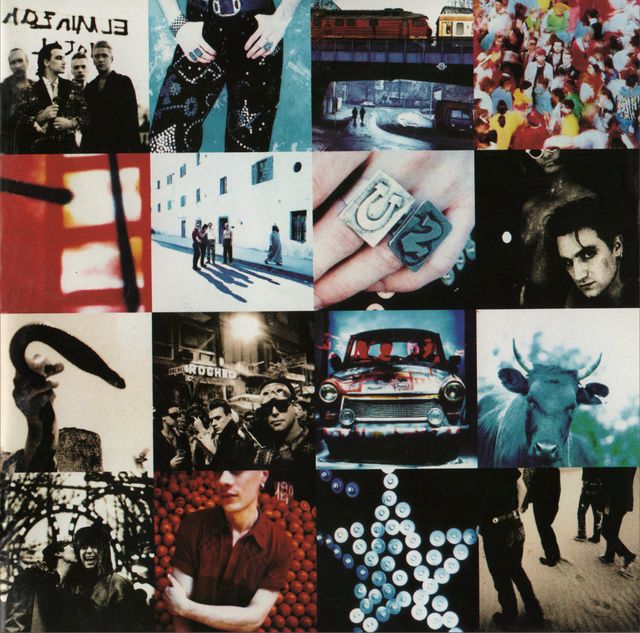

U2 landed in Berlin on October 3, 1990 — the exact day East and West Germany formally reunified — to record inside the Meistersaal, a former grand ballroom at Hansa Tonstudio that David Bowie had used for his own Berlin Trilogy a decade earlier. They had come chasing a piece of that mystique and, they hoped, a way out of their own success. The Joshua Tree and Rattle and Hum had made U2 one of the biggest bands on Earth by playing it straight — earnest, righteous, built for stadiums. Inside Hansa, that version of the band nearly came apart: Larry Mullen Jr. later described arriving already “on completely different pages,” and Adam Clayton remembered day after day of takes nobody liked, “a lot of friction, a lot of tension.” What emerged eleven months later, after the band decamped to a rented house outside Dublin and rebuilt the record almost from scratch, was Achtung Baby — an album so thoroughly reinvented that Bono would later sum up the whole gambit as the sound of “four men chopping down the Joshua Tree.”
“Few bands as far into their career as U2 have recorded an album as adventurous or fulfilled their ambitions quite as successfully as they do on Achtung Baby, and the result is arguably their best album.”
Arriving in a Reunified Berlin
The timing of U2's arrival in Berlin was not planned around the calendar of German history, but it landed there anyway: October 3, 1990, the day of formal reunification, was the day the band walked into Hansa Tonstudio's Studio 2 — a room built inside the Meistersaal, a grand ballroom roughly 150 meters from where the Berlin Wall had stood, nicknamed “Hansa by the Wall.” The Cold War framework that had shaped U2's entire career to that point — the earnest anti-authoritarian politics of War, the reverent Americana of The Joshua Tree — was visibly dissolving in the city where they'd chosen to remake themselves.
The Hansa sessions are often remembered as the whole story of Achtung Baby, but engineer Robbie Adams, who worked the sessions start to finish, has pushed back on that memory directly: “Many people are under the impression that most of the album was recorded in Hansa Ton Studios in Berlin. The truth is that the Hansa sessions lasted barely two months.” What happened in those two months, though, set the terms for everything after.
The band was fractured from the start. Larry Mullen Jr. later put it plainly: “Even before we got there, there was a sense that something was not quite right. And when we got there we were on completely different pages.” Adam Clayton described the daily grind of sessions that went nowhere: “We would go into the room and just bash it out hour after hour, listen back and not like anything that we were doing. We were going down a lot of blind alleys. There was a lot of friction, a lot of tension. Nobody was particularly happy.”
The Night “One” Saved the Album
The turning point came out of two unrelated chord progressions The Edge had been carrying separately. “I played these on an acoustic guitar and everyone was trying to decide whether they were any good,” he recalled. Producer Daniel Lanois suggested playing them back to back rather than treating them as competing ideas: “Danny said, ‘why don't you play those two ideas sequentially, just one after another.’ So I did and everyone was like ‘ooh that sounds really good.’”
What became “One” didn't arrive complete in that moment — Lanois later described a separate session overdubbing a guitar part with Bono alone in the room, “this little hammer-on kind of part on his Green Gretsch,” specifically to lift Bono's vocal performance — but the sequencing breakthrough was the visible turning point for a band that had spent weeks going nowhere. The Edge called it exactly that: “It was such a pivotal moment. We'd been going through this hard time and nothing seemed to be going right. Suddenly we were presented with this gift, it just kind of arrived. It steadied everyone's nerves hugely in the studio.”
Bono has since been careful to correct a common misreading of the song's title. “One is not about oneness,” he explained in U2 by U2. “It's about difference… We get to carry each other.” The lyric reads less like an anthem of unity than an argument for staying together despite everything pulling a group — a band, a marriage, a country — apart, which is precisely the tension the Berlin sessions had just lived through.
Built from two separate Edge chord progressions played sequentially — the session that steadied the band after weeks of dead ends.
Trashy, Dark, Sexy, Industrial
Once the Berlin stretch ended, the band regrouped at Elsinore, a rented house in Dalkey south of Dublin, working simultaneously with a second setup at The Edge's home studio to keep momentum alive. Adams credited the two-location approach directly with the album's late-stage energy: “It increased the level of activity and enthusiasm. There was always something different to listen to, always something exciting happening.” Sessions ran on for eleven months in total, far longer than any previous U2 record, with the band still reworking arrangements up to the last possible moment — the guitar overdub on “Mysterious Ways,” Adams noted, “went down after the mix was finished.”
Co-producer Brian Eno, writing about the sessions for Rolling Stone in November 1991, described the aesthetic the band settled on as a deliberate inversion of everything U2 had stood for a few years earlier: “Buzzwords on this record were trashy, throwaway, dark, sexy and industrial (all good) and earnest, polite, sweet, righteous, rockist and linear (all bad).” Eno and fellow producer Daniel Lanois, working alongside engineer-turned-co-producer Flood, pushed the band toward the industrial and electronic textures that dominated “Zoo Station” and “The Fly” — a sound so far from The Joshua Tree that it functioned as a rebuttal to the band's own back catalog.
Lanois later framed his own production instincts for the record in similar terms: he had “grown rather tired of polishing details on records,” he said, arguing that “musical recklessness goes a long way on records.” That looseness extended to the studio floor itself — Adams recalled nobody fussing over microphone bleed between instruments the way a more conventional U2 session might have: “Spill, what about it? They didn't worry about it and neither did I.”
Essential Tracks
“Even Better Than the Real Thing”
The album's opening single announces the reinvention immediately: a wah-drenched Edge riff, a sly, strutting Bono vocal, and lyrics built around seduction and artifice rather than the band's usual moral clarity — a total inversion of the earnest register U2 had built its reputation on.
It performed modestly in the US (No. 32 on the Hot 100) but topped Billboard's Album Rock Tracks chart, a split that captures the album's whole commercial story — rock radio and the band's core audience embraced the new sound instantly, while pop radio needed more convincing.
A later Perfecto Mix remix gave the song a second life on UK dance charts, underlining how deliberately the track was built to survive outside the context of a conventional rock single — exactly the kind of genre-crossing flexibility the earnest, guitar-forward Joshua Tree era had never attempted.
“Mysterious Ways”
Built on a sinuous Adam Clayton bassline and a groove closer to funk than anything on U2's previous six albums, “Mysterious Ways” was the sound of a stadium-rock band deliberately learning to move rather than march.
Its music video, shot in Morocco and built around distorted images of Bono and belly dancer Morleigh Steinberg, pushed the reinvention into the band's visual identity just as forcefully as the track pushed it into their sound — a clean break from the earnest concert-film aesthetic of the Rattle and Hum years.
The song reached No. 9 on the Billboard Hot 100, the album's second-biggest US hit, and remains one of the clearest examples on the record of the band finding genuine groove rather than simply borrowing electronic textures for atmosphere.
“The Fly”
Released as the lead single weeks ahead of the album, “The Fly” was the first evidence the public got of the reinvention, and it was designed to unsettle: a distorted, falsetto Bono vocal delivered in character as a sleazy, self-aware rock star, over a grinding, industrial-leaning riff.
It topped the UK Singles Chart — U2's second UK No. 1 — while barely denting the US Hot 100 at No. 61, instead ruling Billboard's Alternative chart. That split reception previewed the album's reception almost exactly: audiences already inclined toward U2's new direction embraced it immediately, while the mainstream American pop audience took longer to follow.
The Fly persona Bono built around the song — sunglasses, leather, a character explicitly designed as everything earnest U2 wasn't — became the visual shorthand for the entire album cycle, deployed deliberately to make it impossible for audiences to mistake this for another Joshua Tree.
Shot in Morocco, built around distorted, sensual imagery — a deliberate break from U2's earnest 1980s visual language.
A Reinvention the Charts Rewarded
Achtung Baby arrived on November 18, 1991, into a rock landscape that was itself in the middle of a violent reinvention — Nirvana's Nevermind had landed barely two months earlier and was actively rewriting what mainstream rock was allowed to sound like. U2 debuted at No. 1 on the Billboard 200 the week of December 7, 1991, and peaked at No. 2 in the UK, a rare instance of the band's home audience taking slightly longer to embrace a record than America did.
The album went on to sell more than 18 million copies worldwide and won U2 the Grammy for Best Rock Performance by a Duo or Group with Vocal at the 1993 ceremony, with Lanois and Eno also earning a Producer of the Year nomination for their work on it. Every one of its five singles reached the Top 40 somewhere in the world, a spread of commercial success across a record that, on paper, was a serious commercial gamble for a band walking away from the exact sound that had made them famous.
Not Everyone Was Convinced
Contemporary reaction in the band's home market was immediate and enthusiastic. Ireland's Hot Press called it “a long way from the palpable innocence of Boy, this seething odyssey into the dark underbelly of inter-personal exchange,” and praised the record as “trashy, ambitious, subversive and profound” while noting it “sounds less like the U2 that we know than anything they have done before and yet it is unmistakably them.” Rolling Stone's Elysa Gardner was similarly won over, writing that the band was “once again trying to broaden its musical palette, but this time its ambitions are realized.”
It is trashy, ambitious, subversive and profound. It sounds less like the U2 that we know than anything they have done before and yet it is unmistakably them.
Not every critic came along for the reinvention. Robert Christgau graded the album a “Dud” in his Village Voice Consumer Guide — his lowest tier, reserved for records he considered unworthy of a fuller review — a reminder that the reinvention that thrilled Dublin and impressed Rolling Stone didn't land with every corner of the critical establishment at the time.
Retrospective opinion has settled far more decisively in the album's favor. AllMusic's Stephen Thomas Erlewine called it a reinvention “as thorough and effective” as any in rock history and named it arguably U2's best record outright, while PopMatters' 30th-anniversary reassessment framed it as “a timestamp of a band at the height of their powers and popularity, daring to risk it all and reboot.”
The Template for Reinventing a Legacy Band
Achtung Baby became the model other long-running rock bands would point to whenever they attempted their own sonic pivot — proof that a band could abandon the exact sound that made it famous and come out the other side bigger rather than diminished. The Zoo TV tour that followed pushed the reinvention even further into performance art and media satire, cementing the album not as a stylistic detour but as U2's actual second identity.
Adam Clayton, reflecting later on what the whole ordeal in Berlin and Dublin had actually taught the band, put it in terms that apply well beyond music: “It was something we had to go through to realize what we were trying to get to was not something you could find physically, outside of ourselves, in some other city. There was not magic to it… we actually had to put the work in and figure out the ideas and hone those ideas down.”
Thirty-five years on, Achtung Baby still reads as the rare career-reinvention album that actually delivered on its own premise — not a band chasing a trend, but four musicians who nearly broke apart in a Berlin ballroom and rebuilt themselves into something stranger, sexier, and considerably more durable than the earnest arena band that walked in.
“Achtung Baby is not U2's Blood On The Tracks but at the very least it is a distant cousin of that epic saga, full of pain, hurt and resentment.”