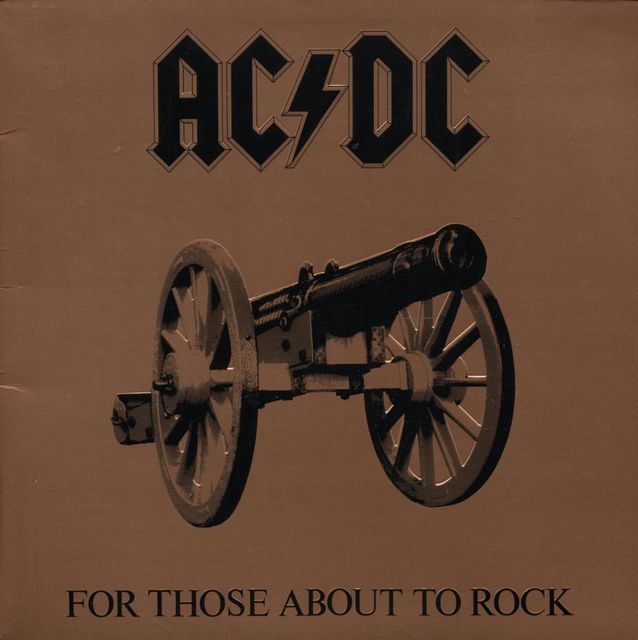

On July 29, 1981, Angus Young was in Paris making AC/DC's next album when he caught the royal wedding on a studio TV. Guns fired a salute as Prince Charles married Lady Diana Spencer. Young wanted that sound on his new song. It became the cannon fire at the end of “For Those About to Rock (We Salute You).”
The song gave AC/DC's eighth album its title and its best moment. For Those About to Rock We Salute You came out on November 23, 1981. It was the follow-up to Back in Black, the album that had brought the band back after the death of singer Bon Scott.
Back in Black had stalled at No. 4 in America. This one went to No. 1 on the Billboard 200 and stayed for three weeks. It was AC/DC's first American chart-topper, and they would not get another until 2008.
The band was less happy than the numbers suggest. The sessions dragged on for months under producer Robert John “Mutt” Lange. By the end, AC/DC had fired their manager and would never work with Lange again.
“On For Those About to Rock We Salute You, AC/DC's best album, the case for the band's talents is finally made with undeniable force and clarity.”
Following Back in Black
Bon Scott died on February 19, 1980, after a night of drinking. AC/DC had just broken through in America with Highway to Hell, Lange's first album with them. Instead of quitting, brothers Angus and Malcolm Young hired Brian Johnson, the singer from the English band Geordie.
Johnson later described his audition to Rolling Stone. Malcolm, “the smallest guy in the room,” handed him a bottle of Newcastle Brown Ale. A month later Malcolm phoned to ask if he would like to come down. Johnson asked if that meant he was in the band. “Oh, fuck yeah,” Malcolm said.
Back in Black, recorded in the Bahamas with Lange, made AC/DC one of the biggest rock bands in the world. Atlantic Records then tried to cash in. In the spring of 1981 it released Dirty Deeds Done Dirt Cheap, a 1976 album with Scott singing that had never come out in the US.
The old record reached No. 3, higher than Back in Black. According to Mick Wall's biography Hell Ain't a Bad Place to Be, the band were “apoplectic with rage” at the release. Wall writes that Malcolm was still furious when he arrived in Paris that summer to start the next album.
Waiting on Mutt Lange in Paris
The band spent a week rehearsing in Montmartre, in apartments tour manager Ian Jeffery says they all hated. Recording began on Monday, July 6, 1981, at EMI's Pathé-Marconi Studios in Paris. Lange was now the most sought-after hard-rock producer around. Since Back in Black he had made Foreigner's 4 and Def Leppard's High 'n' Dry. He was also famously slow.
Lange always started with the drum sound. “Mutt has a picture of the way he wants to hear it in his head, and will keep on bashing away until we hit that particular note that he has,” Dearnley told Classic Rock in 2011. “They spent the first three days in Paris just on the snare drum sound.” After nearly ten days, Lange gave up on Pathé-Marconi.
The next problem was finding another room. “There was lots of moving about from studio to studio,” engineer Mark Dearnley told the Billboard Book of Number One Albums. “In one, Mutt was happy with the guitar sound but wasn't happy with the way the drums were working, and vice versa in the other.”
After two weeks of trying studios for a day or two each, the fix was the rehearsal room the band had been using, a cold stone space at Quai de Bercy known as H.I.S. Studio. “It was a huge stone building,” Dearnley said. They brought in the Mobile One truck from London and recorded there, with the guitars in one room and the drums in another. “We also had a P.A. feeding drums as well, so it was quite an unusual set up,” Dearnley said. Vocals were cut at Family Sound Studio.
This was not how AC/DC were used to working. Graham “Buzz” Bidstrup, drummer with the Angels, remembered their earlier sessions with Angus and Malcolm's brother George Young producing: “when they recorded back then they just did it like playing a gig.”
The band grew restless. “We go in the studio with completed songs and we know what we want,” Angus said in Wall's book. Lange, he added, “has always been slow. Real slow.” Asked to describe a typical day in Paris, Johnson answered: “Angus, Malcolm and myself on a big sofa – waiting!”
Some of them believe I was a merciless tyrant in the studio and obsessed with absolute perfection with each song.
Malcolm later explained the clash to Mojo. Lange “was trying to outdo Back in Black for sound, and it was the sound he was looking for whereas we were thinking of the music – and the performances were starting to suffer.”
Dearnley remembered it differently. In his account, much of the time went on sitting around and chatting. “When the mood was right, they would get up and fire off a couple of takes,” he said. “They are not a band that can just keep plugging at a take until it's right.” Sometimes they jammed for hours just to pass the time. “I've got out-takes of Angus singing ‘Feelings’ and stuff like that,” he said.
The cost started to grate. “It really soured when they started to look at the figures Mutt was being paid,” Jeffery said. The band's view, as he put it, was that they wrote the songs and no longer needed him.
The title track, with the cannon fire Angus Young borrowed from the royal wedding. It became the band's traditional show-closer.
Donington, a Firing and a Concorde Flight
By mid-August the album should have been done. It wasn't, and AC/DC had to stop to headline the Monsters of Rock festival at Donington in England, their first show in nearly a year. “We were shitting ourselves,” Johnson recalled. “‘Fuck, we haven't played this! We haven't rehearsed anything!’”
It rained, and the live sound was poor. Jeffery blamed something the BBC did with the sound. About 65,000 fans seemed happy, but the band knew they had played below their best, using the same set as the previous year's tour.
Five days later they fired their manager, Peter Mensch. He has never given his side in full. “I was never told why I was fired,” he wrote to Classic Rock. “They called their lawyer, who called David Krebs, who called me.” Then it was back to Paris for several more weeks of work.
Recording finally wrapped up late in September. Even then Lange was not finished. Ultimate Classic Rock reports that a quick Concorde trip to New York was needed to cut a test acetate, so Lange could check sound problems that still bothered him.
Malcolm summed it up in a 1992 interview with Mark Blake: “By the time we'd completed the album, I don't think anyone, neither the band nor the producer, could tell whether it sounded right or wrong.” He was blunter with Metal CD the same year: “Christ! It took us forever to make that record and it sounds like it.”
Essential Tracks
“For Those About to Rock (We Salute You)”
The music came first. Angus told Apple Music's Zane Lowe in 2021 that he wrote “a little guitar thing” for the intro, and Malcolm “had this little guitar chordal progression.” Together they built the verse. “And the funny thing is, when we got to the chorus, we were going, ‘OK, what are we going to sing on this?’”
Angus remembered a book about Roman gladiators and the salute they gave the emperor before fighting. He thought it was by Robert Graves, though Graves wrote no book by that name. “I think at first Malcolm thought, ‘Wait. What is he on?’” Angus said. As he told Classic Rock: “We thought: ‘For those about to rock’… I mean, it sounds a bit better than ‘for those about to die’.”
Musically it is built to rise. It starts at a steady mid-tempo and gathers weight until the guns come in about three and a half minutes in, then keeps firing to the end. “I just wanted something strong,” Angus said of the cannons. “What's more masculine than a cannon, you know? I mean, it gets loaded, it fires, and it destroys.”
The sound effect was hard to get right. “We had a lot of fun trying to find the right cannon sounds for it,” Dearnley said. “But in the end it was sorted out in London on the remix.” Released as a single on March 22, 1982, it reached No. 15 in the UK and No. 4 on Billboard's Mainstream Rock chart. Even AllMusic's harsh review singles it out as “a concert staple.”
“Let's Get It Up”
The first single is a slow-burning boogie with a joke for a title. It is the kind of single-meaning innuendo that critics held against the album. Robert Christgau called it “a limited sentiment in any case.” Mick Wall later dismissed it as “the pedestrian first single.”
Kurt Loder heard something better in the guitar. He pointed readers to Angus Young's “serpentine solo” on the track, where “you'll hear his unabashed blues roots shining through.”
It was the album's biggest hit. It reached No. 13 in the UK in early 1982. In America it got to No. 44 on the Hot 100 and spent 12 weeks on the chart.
“Inject the Venom”
The fourth track on side one is one of the darkest songs on the record, a heavy, slow-burning threat. Ultimate Classic Rock describes it as anti-drug. It is a good example of the slower tempos that run through the album. Steve Huey of AllMusic thought that “the band itself slowed down the tempo frequently, sounding less aggressive and inspired.”
Loder liked Johnson's singing here. He called the track “nicely nasty” and said Johnson “manages, rather charmingly, to sound like Lou Rawls with a beer gut.”
Not everyone agreed. Mick Wall, writing for Classic Rock, put “Inject the Venom” and “Night of the Long Knives” on his list of the album's weak spots and called them “parodic.” Fans have argued about side two ever since.
The album's first single, which reached No. 13 in the UK and No. 44 on the Billboard Hot 100.
Number One in America at Last
Atlantic rushed the album out for Christmas. It entered the Billboard chart in the top 10 in December 1981, and two weeks later it was No. 1. It topped the chart for three weeks.
Britain was a different story. Back in Black had been a UK No. 1, but the new album peaked at No. 3, behind the Human League's Dare and Queen's Greatest Hits. In the US it went platinum on January 20, 1982, two months after release, and quadruple platinum by 2001.
The success did not match Back in Black. Mick Wall notes that sales of the new album were “a fraction” of its predecessor's. By 2011, Classic Rock reported, it had sold four million copies in the US, roughly 18 million fewer than Back in Black. Still, it kept AC/DC at the top while they toured America on the strength of both records.
Loder Loved It, Christgau Gave It a C
Kurt Loder's Rolling Stone review was the strongest praise AC/DC had ever had from a major critic. He called them “perhaps the purest major practitioners of hot and snotty rock since Led Zeppelin lumbered off the boards.” Other bands sounded “cleaned up,” he wrote, but AC/DC “have always left the rough edges in.”
Loder gave Johnson some of the credit. His lyrics, Loder thought, gave the band a “marginally broader lyrical outlook.” He praised the rhythm section of bassist Cliff Williams and drummer Phil Rudd as the band's “backbone.”
Robert Christgau, in the Village Voice, gave the album a C. He thought Johnson had taken the band toward “an anthemic grandiosity more suitable to their precious-metal status than Bon Scott's old-fashioned raunch. Also dumber.”
Later critics have mostly sided with Christgau. Steve Huey of AllMusic wrote that “AC/DC's hot streak began to draw to a close” with this album. He found Johnson's lyrics “more calculated and a bit clichéd, lacking Scott's devil-may-care sense of humor.”
Side One Versus Side Two
Unlike Back in Black, almost all the songs had been written before the sessions began. Mick Wall argues that the long studio process wore them down. On songs like “Put the Finger on You,” “Let's Get It Up” and “Snowballed,” he writes, “the lyrics had descended from double- to single-entendre.”
Ultimate Classic Rock splits the record in two. It says side one, with “Put the Finger on You,” “Let's Get It Up,” “Inject the Venom” and “Snowballed,” “gave fans little cause for complaint.” Side two, with “Evil Walks,” “Night of the Long Knives” and “Spellbound,” produced “some love/hate results among the AC/DC faithful.”
Loder heard more in the guitar playing than later critics did. He compared the “dark-toned guitar filigree” on “Snowballed” to John Lee Hooker. He thought the final leads on “Breaking the Rules” recalled Jeff Beck on the Yardbirds' “Over Under Sideways Down.” Even Wall singled out “the swaggering C.O.D.” and “the groovacious Evil Walks” as better tracks.
The Cannons Go on Tour
The royal-wedding idea did not stop at the record. A Napoleonic cannon went on the album sleeve. When the tour opened in America that winter, the giant bell from the Back in Black shows was upstaged by two banks of artillery “fired” during the finale.
The first version did not work well. “There were twelve black boxes each side, in two rows of six, that looked nothing like cannons,” tour manager Ian Jeffery told Louder. “Until they were lifted up from the ground behind the PA, and barrels popped out – when they worked.”
They had been built by a Birmingham company, Light & Sound Design. “The original concept was based on flaps opening in PA stacks, and the cannons then emerging and firing as they would have done on a pirate ship,” co-founder Terry Lee told Louder. “But the problems were both mechanical and pyrotechnic.”
Before the tour reached the UK, that first batch had been scrapped. “There were sparks flying out everywhere,” Angus admitted in 2004. “So we got rid of them pretty quick and got the two giant cannons that we put either side.” The cannons have been part of AC/DC shows ever since.
The American tour opened in Detroit on November 14, 1981, and ran into protests. Christian groups read “C.O.D.” as “Care Of the Devil” and pointed to “Evil Walks” as proof of the band's intentions. Johnson later shrugged it off: “That was the best promotion we could get.” Angus added that the protesters “got paid by the hour.”
By the end of the tour, in December 1982, AC/DC were big enough to turn down $1 million to open a US stadium show for the Rolling Stones. “Malcolm had decided they weren't ever going to open for anybody any more,” Jeffery said.
Malcolm, for one, missed the smaller shows. In 1982 he told Dave Lewis of Sounds that he wanted to go back to the Red Cow, the pub where AC/DC had made their UK debut, “and just pay with eight lights an two speaker columns.”
Johnson has paid for the cannons. “I could write a book about standing under the cannon for thirty years,” he said in 2013. “These horrible sparks come out of them. And at the end of the show I have burn marks all over my shoulders.”
The Last Album With Mutt Lange
AC/DC never worked with Lange again. The producer has said almost nothing about it. In a rare online exchange he offered only that “Angus has a certain vision for his music, which works for him.”
The band produced the next album, Flick of the Switch (1983), themselves, aiming to strip away the studio polish. None of their next three albums got near the US top 10. Ultimate Classic Rock argues the band only fully recovered when they went back to outside producers for The Razor's Edge in 1990.
Jeffery, who managed them day to day after Mensch left, thinks dropping Lange was “a huge mistake – the biggest mistake.” “With Mutt Lange they were crafted records,” he said, “without taking away the spontaneity of it sounding like a band playing.”
The record's reputation has slipped over the years. Classic Rock's retrospective review says that “these days a lot of negativity surrounds” the album. It argues that only the title track truly matched the best songs from Lange's two earlier AC/DC albums.
That one song has done a lot of work. It closed shows on tour after tour. It also lent its name to the video of the band's huge 1991 Moscow concert, For Those About to Rock: Monsters in Moscow, which included no other song from the album. AC/DC did not top the US album chart again until Black Ice in 2008.
Malcolm Young died on November 18, 2017, aged 64. Johnson remembered him to Rolling Stone as “the most precise guitarist.” Forty-five years on, the album he complained about still ends with his band's most famous goodbye. For anyone coming to AC/DC after Back in Black, it is the natural next record, flaws and all. Angus, asked in 2011 when he last listened to it, said he never plays any of the band's albums: “I've written and recorded them. Why would I listen to them?”
For more hard rock from the same era, see our reviews of Paranoid and Led Zeppelin IV.
“By the time we'd completed the album, I don't think anyone, neither the band nor the producer, could tell whether it sounded right or wrong. Everyone was fed up with the whole album.”