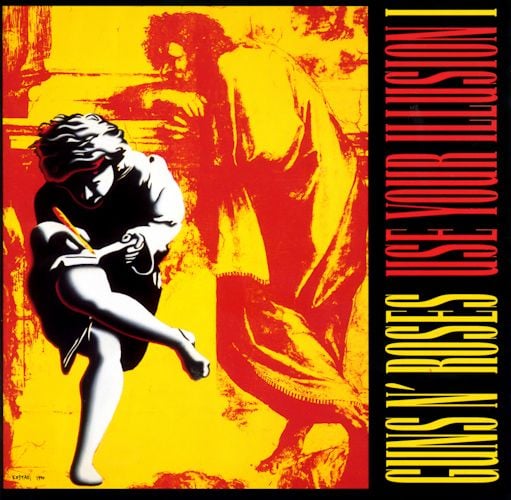

In 1991, Guns N' Roses had far more songs than one album could hold, and Axl Rose wanted to release all of them. But Rose had worked at Tower Records. He knew that double albums got stuck behind the cash register.
So the band put out two separate albums instead, Use Your Illusion I and Use Your Illusion II. Both went on sale at midnight on September 17, 1991. Fans lined up outside record stores across the country. Geffen shipped 4.2 million copies, the largest album shipment in history at the time.
“[Axl] wanted those records to be separated on Volume I and Volume II, based on somebody being able to purchase them at the record store and then being able to go buy it without having to ask for the box set or whatever.”
A Cash-Register Rule Becomes a Marketing Plan
By the time Guns N' Roses went in to follow up 1987's Appetite for Destruction, drummer Matt Sorum assumed they'd do what bands usually did: record twenty songs and keep the best twelve or thirteen for one album. Axl Rose rejected that. “I want to put out all the songs,” Sorum recalls him announcing — and he had a specific, oddly practical reason rooted in his own retail history working at Tower Records on Sunset Boulevard.
Double albums, Rose had noticed as a clerk, cost over twenty dollars and got kept behind the cash register rather than out in the bins where browsing fans could grab them. “He wanted the records to be in the bin where you could actually hold them, pick them up,” Sorum said. So rather than package the overflow as a conventional double LP, Rose split it into two separate, individually purchasable albums with the same name and the same Mark Kostabi artwork in different colors — Use Your Illusion I in yellow and red, Use Your Illusion II in blue and purple.
The gambit required a level of coordination the record industry hadn't attempted before: two albums, one release date, one advertising campaign, and a shared mythology that made buying only one feel incomplete. Geffen leaned into the spectacle rather than downplaying it, positioning the twin release as an event rather than a compromise.
Thirty-Six Tracks in Thirty-Six Days, Then a Year of Overdubs
Recording began in early 1990 and didn't wrap until August 1991 — a stretch of a year and a half that spanned a lineup change, a firing, and a mixing process the band scrapped and restarted. Basic tracking with producer Mike Clink moved fast. “Before you know it, we were doing the basic tracks,” Slash said. “We did 36 songs in 36 days.” The band played live in one room at A&M Studios, then moved on to the slower, more exhausting work of overdubs.
The lineup that finished the album wasn't the one that started it. Original drummer Steven Adler, unable to manage his heroin addiction, was fired in July 1990. “Civil War” was the song that exposed it: Slash called it “the first song where we went in the studio with Steven and realised that he wasn't really playing up to par.” Adler was replaced by Matt Sorum, and keyboardist Dizzy Reed joined as a full member — the first time either appeared on a Guns N' Roses studio record.
Even after tracking wrapped, the album wasn't finished. Bob Clearmountain mixed about twenty songs, then was let go and the band started over with Bill Price, the veteran Sex Pistols engineer. Price later described a band still fighting itself in the mix room: “If Axl liked the mix, Slash didn't, and if Slash liked the mix, Axl didn't.” The record still wasn't finished when the band's marathon world tour began in May 1991.
Watch: Don't Cry — Official Music Video
One Song, Two Different Lyrics
Nothing captured the twin-album concept more literally than “Don't Cry.” The song appears on both records, but not as the identical track — Use Your Illusion I carries the original lyrics, while Use Your Illusion II carries an alternate version of the same music with different lyrics. It was less a bonus feature than proof of the underlying logic: these were genuinely two albums built from one overflowing well of material, not a single record arbitrarily cut in half.
“Civil War,” the album's most explicitly political track, had its own unusual path to the record. “That was actually one of the first songs Axl and I wrote after Appetite,” Slash said. Rose heard him playing an acoustic figure before the tour had even ended, and the band started rehearsing it in Australia. The finished song first appeared not on Use Your Illusion II at all but on Nobody's Child: Romanian Angel Appeal, a 1990 benefit compilation supporting Romanian orphanages, a year before it resurfaced on the album proper. Its spoken-word intro sampled Strother Martin's “failure to communicate” line from Cool Hand Luke.
Across both records, the songwriting swung between that kind of message-driven ambition and pure excess — nine-minute epics next to two-minute blasts, orchestral balladry next to a Bob Dylan cover, “Knockin' on Heaven's Door,” that would itself become a radio staple. Critics at the time struggled to describe an album this sprawling as a single artistic statement, because in the strictest sense it wasn't one.
Essential Tracks
“November Rain”
At nearly nine minutes, “November Rain” was Axl Rose's clearest bid for a rock opera scale nobody expected from the band that made Appetite for Destruction. Built around a piano ballad structure Rose had been developing since the mid-1980s, the song layers a full orchestra under Slash's guitar work, building from restrained verses to one of the most recognizable extended solos of the era.
The accompanying video, directed by Andy Morahan and inspired by a Del James short story, was conceived on the scale of a short film. In July 2018, “November Rain” became the first music video from the 1990s to pass one billion views on YouTube, a strange vindication of a scale that seemed indulgent even by the band's own standards in 1992.
The video's narrative — a wedding, a storm, a funeral, all cut against the band performing with an orchestra — gave MTV something it hadn't seen from a hard rock band before: a genuine mini-film with production values closer to a studio feature than a promotional clip. That ambition became the song's legacy as much as the music itself. Where most of the era's power ballads leaned on formula, “November Rain” treated its runtime and its visuals as essential to the statement, not padding around a single.
“You Could Be Mine”
Where “November Rain” represented the album's orchestral ambitions, “You Could Be Mine” was pure velocity — a leftover from the Appetite-era writing sessions, reworked and sharpened into one of Use Your Illusion II's hardest-hitting tracks. Its music video paired the band with a genuine cultural crossover moment, intercutting the band with footage from Terminator 2: Judgment Day, released the same summer.
The pairing wasn't incidental promotion — Arnold Schwarzenegger himself appears in the video as the Terminator, tying the album's summer 1991 lead single directly to the era's biggest action-movie franchise. The track became a template for the leaner, riff-driven side of the two records, a counterweight to the six- and nine-minute epics elsewhere on the set.
Musically, the song leaned on Izzy Stradlin's rhythm guitar to keep the verses tight while Slash's lead lines carried the hooks, giving the track a swagger closer to the band's 1987 debut than to the orchestral reach of “November Rain” a few tracks earlier on the same release. That contrast was the point: Use Your Illusion II needed a song that could remind listeners the band that made Appetite for Destruction hadn't disappeared inside its own ambition, and “You Could Be Mine” did exactly that.
“Civil War”
“Civil War” found Guns N' Roses working in explicitly political territory, framing all war as fundamentally the same conflict — one that, as the lyric puts it, feeds the rich while it buries the poor. Musically, it moves between a delicate acoustic passage and a full-band charge, giving Slash room for one of the record's more melodic solos.
Released as a single in 1993, it reached No. 4 on Billboard's Mainstream Rock chart. Even Robert Christgau, who had little use for the rest of the set, singled it out as the one track on Use Your Illusion II worth hearing.
Its road to the album was unusual on its own terms: the song existed and had already been released, on a charity compilation, a full year before most listeners heard it in its familiar album context. That detour through a Romanian orphan-relief benefit rather than a standard rollout gave “Civil War” a credibility other tracks on the record didn't have to earn — it wasn't written for an album cycle, it was written because Rose, Slash, and McKagan had something specific to say.
Watch: November Rain — Official Music Video
A Music-Industry First
The midnight release turned into one of the most closely watched commercial experiments of the era. Stores in major cities opened their doors at midnight specifically to sell the two albums, and the band leaned into the theater of it — Slash slipped into the mobbed Tower Records on Sunset Boulevard and watched the rush from behind a two-way mirror, the same one through which he'd once been caught shoplifting cassettes as a teenager.
The fired mixer, the St. Louis riot, and the Wal-Mart ban that came before that midnight are their own story: 4.2 Million Copies at Midnight: How Guns N' Roses Released Two Albums at Once →
The numbers justified the stunt. Use Your Illusion II sold 770,000 copies in its first week and debuted at Number One on the Billboard 200; Use Your Illusion I sold 685,000 and debuted at Number Two, giving Guns N' Roses the top two positions on the chart simultaneously. Both albums were certified seven-times platinum in the United States in 1997.
Contemporary critics split along predictable lines. Reviewing Use Your Illusion I for Rolling Stone, David Fricke called it “a sixteen-song tour de spleen so physically assaultive, verbally incendiary and at times downright screwy that it's hard to believe there's a sister disc out there just like it.” If it were down to “riffs, hooks and body-slam sonics,” he wrote, loving the record would be no problem — the lyrics were the problem. Robert Christgau, in his Village Voice Consumer Guide, was unmoved by almost everything on Use Your Illusion II except “Civil War.”
The “difficult second album” is one of the perennial rock & roll clichés, but few second albums ever were as difficult as Use Your Illusion.
The Sound of a Band Coming Apart
The scale of Use Your Illusion mirrored the state of the band that made it. Manager Alan Niven later said he was grateful “none of the band members died on my watch.” The Adler firing was only the first of the lineup fractures that would eventually dissolve the band's classic configuration within a few years of the album's release.
Slash was blunt about why Adler had to go: “We were resigned to the fact that he wasn't going to be able to do it in the time frame that we needed to get going.” Izzy Stradlin quit in November 1991, two months after the albums came out. The marathon Use Your Illusion tour that followed, infamous for its chaos, delays, and the 1991 Riverport riot in St. Louis, only accelerated the tension the recording sessions had already exposed.
Even so, drummer Matt Sorum has since credited the decision to split the material as one of the more prescient calls in the band's history. “In retrospect, it was kind of a genius thing,” he said. “I would have never thought of that.”
Legacy: The Stunt Nobody Has Repeated
No band has attempted the exact Use Your Illusion release strategy since — two full-length albums, same day, same marketing push, positioned as companion pieces rather than a single sprawling work. Streaming has made the original commercial logic irrelevant; nobody worries about double albums getting stuck behind a cash register anymore. But the records themselves have outlasted the specific retail problem that shaped them.
Retrospective criticism has generally been kinder than the contemporary reviews, treating both albums less as a single unified statement and more as a time capsule of a band operating at maximum ambition and maximum dysfunction simultaneously. AllMusic's Stephen Thomas Erlewine called Use Your Illusion I “stronger than II, even though there's a fair amount of filler,” singling out “November Rain” and “Coma” as two ambitious set pieces “which find Rose fulfilling his ambitions.”
Thirty-five years on, “November Rain” remains one of the most-watched music videos ever uploaded, “Civil War” still gets pulled out at benefit shows, and the strange arithmetic of the release — two albums, one day, one former record-store clerk's stubborn insistence on how customers should be able to buy music — is remembered as a genuinely novel piece of music-industry history rather than just a footnote to the band's implosion that followed it.
“Imagine Exile on Main Street's epic grunge, the shotgun eclecticism of the Beatles' White Album and the lunatic pagan sport of Alice Cooper's Love It to Death and Killer albums … all whipped together with the junkyard grace of Rocks-era Aerosmith.”