
In the late summer of 1979, the head of CBS Records UK drove to Wessex Studios in north London to hurry The Clash along. Maurice Oberstein arrived by limousine and learned the new album would be a double. When he tried to leave, producer Guy Stevens lay down in the driveway in front of his car.
Stevens had to be carried back inside. The Clash got their double album anyway, and they got it in the shops for the price of a single LP.
The band had no manager, no rehearsal room, and very little money when they started. Joe Strummer later called it their last shot. What they made was London Calling: nineteen songs of rockabilly, ska, reggae, jazz, and R&B, released in Britain on December 14, 1979.
It entered the UK chart at No. 9. A song left off the sleeve gave the band their first American hit. Ten years later, Rolling Stone named it the best album of the 1980s.
“London Calling is the first of The Clash's albums that is truly equal in stature to their legend. Parts of it sound totally unlike anything they have ever recorded before, yet it is the most quintessentially Clash-like Clash record thus far.”
A Garage in Pimlico
By early 1979, punk had mostly burned out. The Sex Pistols were gone, and The Clash were among the few original bands still standing. Their second album, Give ’Em Enough Rope, had reached No. 2 in Britain, but its glossy American production by Sandy Pearlman had split their fans. It had not broken them in the United States either.
Then the band fired their manager, Bernie Rhodes, and lost their Camden rehearsal space with him. “Economically, we were really tight at the time,” Strummer told Melody Maker that December. “This album woulda been our last shot, never mind if we didn't have the spirit for it, which we did.”
Their road manager, Johnny Green, found them a new room. Vanilla Studios was a windowless space at the back of a garage in Pimlico, private enough that Green once caught Annie Lennox listening on the stairs and threw her out. The band worked there from May to August. Strummer wrote most of the words and Mick Jones most of the music.
The only break was football. The band played five-a-side every day, and visiting record company staff were made to join in. “The teams were normally us against them,” Jones said. “It was quite rough.”
Outside, Britain was changing fast. Margaret Thatcher had become prime minister that May. In the charts, the 2 Tone movement led by the Specials was bringing ska back, and Dexys Midnight Runners were reworking soul. Louder's Scott Rowley has described the album as partly a response to that new scene, and “a bit of one-upmanship from a band at the height of their powers.”
Don Letts filmed the title track's video on a dark, wet night on the Thames beside Albert Bridge, rain and all.
Guy Stevens and the Flying Chairs
CBS wanted a name producer. The band wanted Guy Stevens, who had made his name with Mott the Hoople, Jones's favorite band. By 1979 he was struggling with drink and drugs, and most of the industry had written him off. Strummer found him in a Soho pub.
Stevens wanted to hear the songs first, so the band taped a Vanilla rehearsal for him. Johnny Green was sent to deliver the cassette, celebrated with a few beers, fell asleep on the Victoria Line, and left it on the train. A roadie had labelled the tape “Val Doonican,” which probably kept it safe from bootleggers.
“There was nothing for it but to own up,” Green wrote in his memoir. “All I got for my confession was ‘wanker’ and the band made Guy another tape. He loved it.” Decades later Jones found a copy of the rehearsals in a cardboard box, and the Vanilla Tapes were released with the album's 25th-anniversary edition.
His methods were unlike anyone else's. “He'd pick up a ladder and swing that around and then he'd throw six or eight chairs against the back wall,” Jones recalled. Strummer described it to Melody Maker: “He comes in and grabs me by the throat and says, ‘I deal with emotions’, and that's it. He doesn't deal with knobs or whatever else producers deal with.”
The engineer, Bill Price, handled the knobs. He had run Wessex, a former church hall in Highbury, since the mid-1970s, and he understood exactly what Stevens was doing. “He believed that the record producer's job was to maximize the emotion and feeling that an artist revealed on mic in the studio,” Price told Mix. Stevens would challenge a singer verbally and physically, sometimes tackling him to the floor. “Funnily enough, this worked better on some people than others. It worked very well with Joe, actually.”
It also worked on Paul Simonon, who was still the least experienced musician in the band. “He made me feel really at ease,” Simonon said. “If I played wrong notes, he didn't care.”
Because the songs had been worked out in Pimlico, the recording took only five or six weeks. By the end the band were working 18-hour days, seven days a week, until about two hours before their flight to New York for a run of American shows. Price mixed the album largely on his own, phoning Strummer for instructions, then flew to New York and played the mixes to the band backstage at the Palladium. “They were happy with them,” he said.
Rockabilly, Ska, and a Drowning City
At Vanilla, each member had brought in the music he grew up on. Strummer leaned into rockabilly and rock ’n’ roll. Simonon, raised in Brixton, worked on reggae rhythms. Topper Headon, the band's most technically gifted player, brought jazz. “Punk was getting narrower and narrower, painting itself into a corner,” Jones explained. “We thought we could just do any kind of music.”
The result runs through four sides without settling. Vince Taylor's 1959 rockabilly B-side “Brand New Cadillac” follows the title track. “Jimmy Jazz” is a loose shuffle that Price mixed to sound like a live take in a smoky club. “Rudie Can't Fail” and “Wrong ’Em Boyo” are ska, and the album closes on Danny Ray's reggae song “Revolution Rock.” A four-piece horn section, known as the Irish Horns, played on several tracks.
“Brand New Cadillac” had started as the band's warm-up number before takes. When they cut it properly, Stevens was ecstatic and Headon was not. “We'll need to do it again,” the drummer said. “We speeded up.” Stevens cared about feel, not tempo, and the rushed energy is part of the track's charm.
Elsewhere the band aimed at everyday life rather than politics on a grand scale. “Clampdown” is about the pressure to conform at work and the slow surrender that follows. “Koka Kola” takes a satirical swipe at advertising and big business. Jones's “I'm Not Down” looks depression in the face and refuses to give in to it.
Strummer's guitar held it together. Price described an “unconscious way of damping the chord with his right hand, which used to produce this incredibly urgent, clanging and clashing sound, which I've never heard any other guitarist ever produce.” Strummer could not sing without strumming. He recorded his vocals holding an unplugged Fender, and if no guitar was handy, he beat his chest with his fist.
Warm, angry, and thoughtful, confident, melodic, and hard-rocking, this is the best double-LP since Exile on Main Street.
The lyrics moved as widely as the music. “Spanish Bombs” links tourist-hotel bombings on the Spanish coast to the International Brigades of the Spanish Civil War. “The Right Profile” came from a biography of the actor Montgomery Clift that Stevens passed around the band. “Lost in the Supermarket” was written by Strummer but sung by Jones. “I always thought he had me in mind and that he was writing about me,” Jones said.
Critics who heard the brass and piano as a softening missed the point. Christgau put it plainly in his A-plus review: “Complaints about ‘slick’ production are absurd—Guy Stevens slick?” The range, he argued, was “an expansion, not a compromise.”
Essential Tracks
“London Calling”
The title track began life as “Ice Age,” and its apocalypse is a list of 1979's headlines. The nuclear error in the chorus came from the partial meltdown at Three Mile Island that March. Strummer threw in flooding, famine, and police violence for good measure. “We felt that we were struggling, about to slip down a slope or something, grasping with our fingernails,” he said. “And there was no one there to help us.”
The song is built on Simonon's descending bass line, with Headon's drums close and huge. Price recorded them without Dolby noise reduction, which he found made drums sound wrong. Strummer wanted the mix to “sound like London,” with fog off the Thames and gulls overhead. Price ran Strummer's seagull cries through a slowed tape machine to make echoes. At the end, Jones's guitar pickups tap out SOS in Morse code.
Released as a single that December, it reached No. 11 in the UK in January 1980. It has long outlived the headlines that inspired it and became one of the band's signature songs.
“The Guns of Brixton”
Simonon wrote and sang it. He took the story from The Harder They Come, the Jamaican film starring Jimmy Cliff, and moved it to the streets of south London where he grew up. A man hears the police coming and decides to go down fighting.
The bass line carries the whole song, slow and heavy in the reggae style Simonon had been studying. He did not think of himself as a singer, and the vocal was angrier than planned. “The mic was right up against this glass panel of the control room and sitting in front of me, two feet behind the glass, was some American CBS bloke and it really annoyed me,” he said. “That's probably why the vocals came out the way they did.”
It is often heard as a song about the Brixton riots, which it predates by two years. That timing is part of its reputation: it described the tension before it broke. In 1990 its bass line was lifted for Beats International's hit “Dub Be Good to Me,” and the song lives on as a south London anthem.
“Train in Vain”
Jones wrote it in a single night near the end of the sessions, about his breakup with Viv Albertine of the Slits. It was meant to be a flexi-disc giveaway with the NME. When that deal fell through, the band added it to the end of the album. By then the sleeve had already been printed.
That is why it is missing from the track list on original copies. “If you look on a couple of the Web sites, it describes it as a hidden track, but it wasn't intended to be hidden,” Price said. Musically it is the album's most direct pop song, with a shuffling beat and a chorus that grooves like classic soul.
In the US it became the band's first hit, reaching No. 23 on the Billboard Hot 100 in 1980. A love song nobody listed turned out to be the track that opened America to The Clash.
'Train in Vain' arrived too late for the printed sleeve and became The Clash's first US Top 40 hit.
Two Records for the Price of One
The Clash had argued with CBS about record prices throughout 1979. They wanted London Calling to be a double album sold at the price of a single. CBS refused. The band then asked for a single album with a free bonus 7-inch, which the label accepted. Next they asked for the bonus disc to be a 12-inch, playing at 33rpm.
The “bonus” record ended up holding nine songs. The album was now a double, at the single price. “I'd say it was our first real victory over CBS,” Strummer told Melody Maker. Price, who watched Oberstein's visit end with Stevens in the driveway, came to think the protest helped. The sight of Stevens being carried back into the studio, he said, “made a big impression on Maurice.”
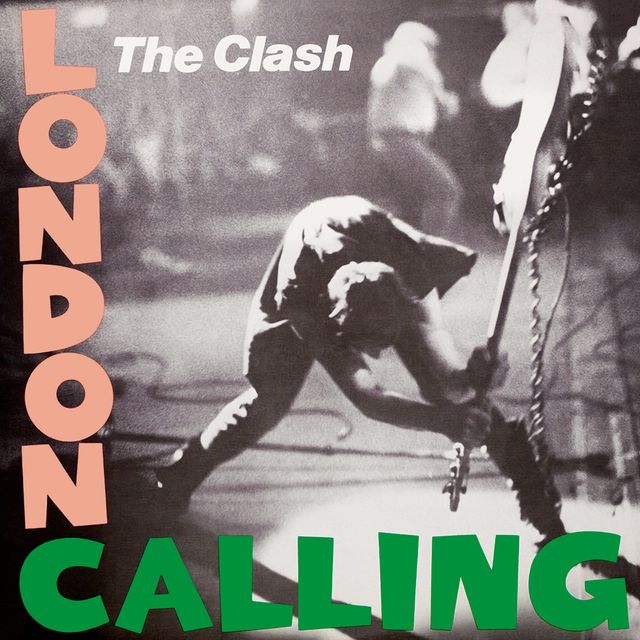
The cover made the same argument visually. Pennie Smith photographed Simonon smashing his bass on the stage of the Palladium in New York in September 1979. “Out of frustration, I just pulled the bass up and bashed it around,” Simonon said. Smith backed away as he swung, which is why the shot is blurred.
The designer Ray Lowry framed it in pink and green lettering copied from Elvis Presley's 1956 debut album. On that sleeve, Elvis holds his guitar up. On this one, the guitar is coming down. Jones had his own joke about the package: “It's our 20 ‘Greatest Hits’. We knew it was coming out at Christmas time.”
Number Nine in Britain, Exalted in America
The British reviews were mostly strong. Murray, who had once called The Clash a garage band that should be returned to their garage “preferably with the motor running,” gave in completely. “This is the one,” he wrote. Sounds disagreed. Garry Bushell gave it two stars: “There's no hunger here, no vision or coherence or charisma, no killer punches.”
The album entered the UK chart at No. 9. Epic released it in America in January 1980, and the reviews there were even warmer. In Rolling Stone, Tom Carson called it “so rich and far-reaching that it leaves you not just exhilarated but exalted and triumphantly alive.” Christgau noted that the double album was “selling for about $7.50.”
In the US it reached No. 27 on the Billboard 200, the band's best showing yet, and was eventually certified platinum. Mastering engineer Tim Young told Price it was the loudest vinyl he had ever cut. The success also gave the band leverage. Their next record, Sandinista!, was a triple album, again sold at a budget price.
The Best Album of the ’80s, Released in 1979
In 1989, Rolling Stone named London Calling the best album of the 1980s, counting from its January 1980 US release. In Britain, Q later ranked it the fourth greatest British album of all time. The reputation has only grown, partly because the record answered a question every punk band faced: what comes after the first explosion?
The Clash's answer did not last. Combat Rock in 1982 was their biggest seller, but Headon was fired over his drug addiction, and Jones left the following year. The band ended in 1986. Strummer died on December 22, 2002, five weeks after Jones joined him onstage at a benefit show for striking firefighters in Acton.
The band members agreed on where their peak was. “Many say that is our finest hour,” Strummer said. Simonon was more direct: “The best point of The Clash was probably London Calling. That was the most consistent period.”
Forty-seven years on, the album's range is what lasts. Punk had told its fans to forget the past. London Calling went back for all of it, from Elvis to Jamaica to New Orleans, and made it sound like one band from London. Jones put it simply: “You can hear all my life coming out in microcosm.”
“It just seemed to be like one huge body of work all done in one go… A real intensity of effort, and our only recreation was playing five-a-side football.”