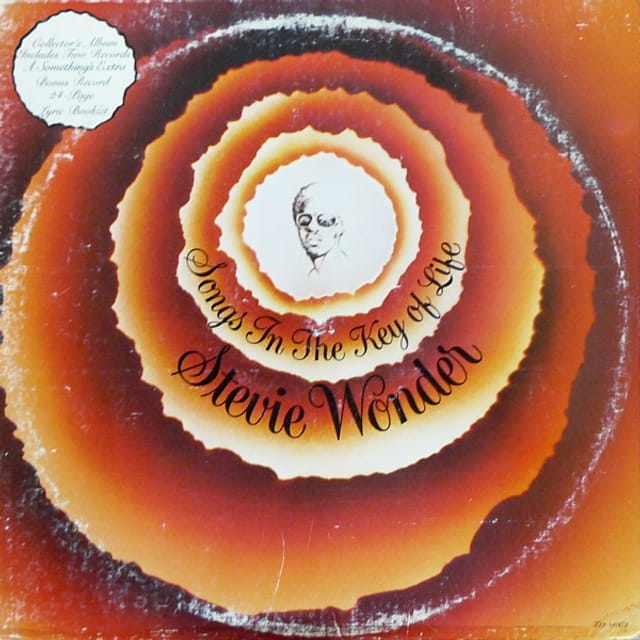

Stevie Wonder released Songs in the Key of Life in September 1976, after two years of obsessive work at Crystal Sound in Hollywood. It held 21 tracks and nearly two hours of music, spread across a double album and a bonus EP.
It debuted at No. 1 on the Billboard 200. Only two albums had done that before, and it was the first by an American artist. In his contemporary review for Rolling Stone, Vince Aletti wrote: “Wonder confronts us virtually single-handedly, grasps our expectations and wrestles them to the ground… It's his voice — also beyond mere words, into pure expression — that snatches you up. And won't let go.”
Fifty years on, it is still one of the most ambitious records in American music, and generations of artists have learned from it.
“Wonder's particular genius is that his carefully crafted perfection sounds so convincingly offhand. He confronts us virtually single-handedly, grasps our expectations and wrestles them to the ground.”
The Crystal Sound Sessions
By 1976, Stevie Wonder had achieved unprecedented artistic and commercial success with his groundbreaking trilogy of Talking Book (1972), Innervisions (1973), and Fulfillingness' First Finale (1974) — all Grammy Album of the Year winners. At the height of his powers, Wonder seriously considered leaving music to work with disabled children in Ghana, but ultimately signed the largest recording contract in history: a seven-year, $37 million deal with Motown that granted him complete creative control. This freedom would prove essential to creating his magnum opus.
The album's two-year gestation period at Crystal Sound Studios in Hollywood allowed Wonder to craft his most ambitious statement. Working primarily with engineers Gary Olazabal and John Fischbach, Wonder created a sonic laboratory where he could layer intricate arrangements while maintaining the spontaneous energy that made his music so compelling. As he explained to biographer John Swenson, "If my flow is goin', I keep on until I peak." This perfectionist approach resulted in marathon recording sessions where Wonder would work through the night, with bassist Nathan Watts remembering being called back to the studio at 3 AM to help with "I Wish" after already working exhausting hours.
Those sessions ran so long that Motown, unable to get the record it had paid a fortune for, resorted to printing thousands of “We're Almost Finished” T-shirts. The full story of the two years, the roughly 200 songs cut and the 130 musicians involved is here: The “We're Almost Finished” T-Shirt: How Stevie Wonder Kept Motown Waiting →
The sessions showcased Wonder's revolutionary approach to multi-instrumental recording and production. Wonder played virtually every instrument himself across most tracks, creating intricate sonic tapestries that blend soul, jazz, R&B, funk, Latin rhythms, and classical influences. His use of the TONTO (The Original New Timbral Orchestra) synthesizer system, developed by Malcolm Cecil and Robert Margouleff, allowed him to create orchestral textures that had never been heard in popular music. The album featured contributions from jazz legends like Herbie Hancock (Fender Rhodes on "As"), George Benson (guitar on "Another Star"), and vocalist Minnie Riperton, but Wonder's omnipresence remains the defining characteristic.
Orchestral Vision and Technical Mastery
Songs in the Key of Life represents the culmination of Wonder's evolution as both composer and producer. The album's 21 tracks flow seamlessly between intimate personal reflections and sweeping social commentaries, unified by Wonder's singular vision and his mastery of studio technology. Songs like "Love's in Need of Love Today" open with seven minutes of spiritual meditation, while "Sir Duke" pays jubilant tribute to Duke Ellington and jazz's greatest legends. The epic "Black Man" serves as an eight-minute Bicentennial history lesson celebrating America's multicultural heritage over complex rhythmic patterns that would influence hip-hop producers for decades.
Wonder's production technique was groundbreaking for its time. He used an Electro-Voice RE20 microphone for upbeat vocals like "I Wish," while employing different microphones for various sonic textures. The album's dynamic range — from the delicate orchestration of "Isn't She Lovely" to the funk powerhouse of "I Wish" — demonstrated Wonder's ability to think orchestrally while performing everything himself. Wonder's writing process was so spontaneous that engineers had to work around it: as Gary Olazabal, who served as first engineer on the sessions, recalled, "We'd always have to keep at least a 2-track recording going constantly to capture any of all of that stuff, in case he wanted to go back and remember something."
“For me, it's the best album ever made, and I'm always left in awe after I listen to it. It's a complete vision from a complete artist.”
Cultural Phenomenon and Commercial Triumph
Songs in the Key of Life achieved the rare feat of debuting at #1 on the Billboard 200, becoming only the third album in history to do so and the first by an American artist. It spent an unprecedented 13 consecutive weeks at #1, blocking major releases from artists like Led Zeppelin and Earth, Wind & Fire, and became the second-best-selling album of 1977 (behind only Fleetwood Mac's Rumours). The album spawned multiple hit singles: "I Wish" and "Sir Duke" both reached #1 on the Billboard Hot 100, while "Another Star" and "As" found success as well. Though never officially released as a single, "Isn't She Lovely" became one of Wonder's most beloved and recognizable songs through radio airplay.
Critics immediately recognized the album's scope and ambition, though not without reservations. In his contemporary Rolling Stone review, Vince Aletti praised Wonder's "carefully crafted perfection" that "sounds so convincingly offhand," but his verdict was genuinely mixed: Aletti also found the record's sprawl "haphazard," writing that its restless eclecticism risked turning "what might have been a stunning, exotic feast into a hastily organized potluck supper." That tension between abundance and discipline is part of what critics have argued about ever since. The album's critical standing has only grown over time, ranking #4 on Rolling Stone's 2020 "500 Greatest Albums of All Time" list and earning induction into both the Grammy Hall of Fame (2002) and the Library of Congress National Recording Registry (2005).
The album's influence on subsequent generations of artists cannot be overstated. From Prince's multi-instrumental approach to D'Angelo's neo-soul arrangements, from hip-hop's sampling culture to contemporary R&B's sonic sophistication, Songs in the Key of Life provided the blueprint for artists seeking to combine commercial appeal with artistic integrity. Wonder proved that a record could be deep and danceable, spiritual and funky, all at once — a balancing act that remains the standard ambitious soul and R&B artists measure themselves against.
Essential Tracks
“I Wish”
Perhaps the album's most perfect encapsulation of Wonder's genius, "I Wish" transforms childhood nostalgia into a funk masterpiece that became one of hip-hop's most sampled tracks. The song's irresistible groove, built around Wonder's clavinet work and layered with his multi-tracked vocals, creates a sonic time machine that captures the bittersweet nature of growing up. Wonder's production technique was revolutionary — he played virtually every instrument, from the driving clavinet rhythm to the punctuating harmonica flourishes, creating a seamless sonic environment where each element complements the others.
The song's lyrics walk the line between celebration and melancholy, as Wonder reflects on the innocence of childhood while acknowledging the responsibilities of adulthood. Lines like "I wish those days could come back once more" resonate with universal longing, while the music's exuberant energy suggests that the joy of those memories remains accessible. The track's influence on hip-hop culture is immeasurable — its drum break has been sampled countless times, making it one of the foundational grooves of the genre.
Watch: I Wish (Official Video)
“Another Star”
The album's closing statement, "Another Star," represents Wonder at his most musically adventurous, blending Latin rhythms with jazz harmonies and funk grooves to create a six-minute celebration of love and musical possibility. Featuring George Benson on guitar and showcasing Wonder's mastery of multiple synthesizers, the track demonstrates his ability to absorb and transform diverse musical influences into something uniquely his own. The song's complex arrangement shifts between sections with the fluidity of a jazz composition, yet maintains an irresistible dancefloor groove throughout.
Wonder's vocal performance on "Another Star" showcases his range and emotional depth, moving from tender verses to soaring choruses with effortless grace. The track's bilingual lyrics (including Portuguese phrases) reflect Wonder's growing interest in world music and his desire to create art that transcends cultural boundaries. As the album's final statement, "Another Star" suggests endless possibilities — both for Wonder's artistic future and for the transformative power of music itself.
Watch: Sir Duke (Official Video)
The Eternal Masterpiece
Fifty years after its release, Songs in the Key of Life remains a towering achievement that continues to influence artists across genres. The album's impact extends far beyond music — its themes of love, spirituality, social justice, and human connection resonate with new generations of listeners who find in Wonder's vision a roadmap for navigating contemporary challenges. Songs like "Love's in Need of Love Today" and "Have a Talk with God" address spiritual seeking with the same relevance they possessed in 1976, while "Village Ghetto Land" and "Black Man" tackle social issues with sophisticated musical arrangements that demonstrate how art can illuminate social realities.
The album's influence on hip-hop culture alone would secure its legacy. Tracks like "I Wish" provided foundational grooves for countless rap productions, while Wonder's multi-instrumental approach influenced producers from J Dilla to Kanye West. Contemporary artists from D'Angelo to Anderson .Paak continue to draw inspiration from Wonder's ability to blend commercial appeal with artistic integrity, proving that the album's innovations remain vital to popular music's evolution.
Most importantly, Songs in the Key of Life proved that pop music could be both deeply personal and universally significant. Wonder's achievement wasn't just creating great songs — it was demonstrating that an artist could address the full spectrum of human experience within the framework of popular music. The album stands as a testament to the transformative power of artistic vision, technical mastery, and spiritual depth. In an era of fragmented attention and abbreviated artistic statements, Wonder's sprawling masterpiece reminds us that some visions require space to breathe, time to develop, and the courage to follow inspiration wherever it leads.