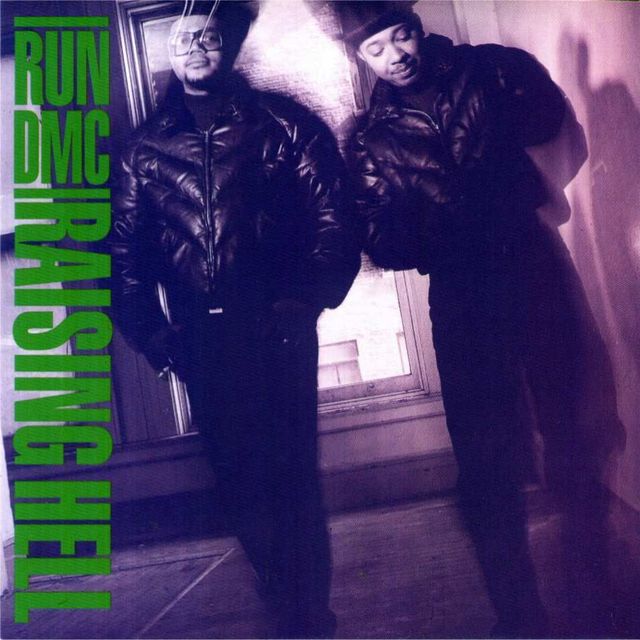

In 1986, Rick Rubin heard Jam Master Jay scratching the drum intro of Aerosmith's “Walk This Way” in the studio. Rubin suggested Run-D.M.C. record the whole song. Run and DMC hated the idea. Then Rubin brought in Aerosmith's Steven Tyler and Joe Perry to play on it.
Run-D.M.C. were three friends from Hollis, Queens: Joseph “Run” Simmons, Darryl “DMC” McDaniels and Jason “Jam Master Jay” Mizell. By 1986 they were already rap's best-known group. Their third album, Raising Hell, came out on Profile Records on May 15.
“Walk This Way” reached No. 4 on the Hot 100. No rap record had made the top five before. The album reached No. 3 and spent 71 weeks on the Billboard chart.
It was the first rap album to top Billboard's R&B albums chart. It was also the first to sell three million copies.
“This is their most uncompromising and compelling album, all hard beats and declaiming voices.”
Three Kids From Hollis
Run-D.M.C. did not sound like the rap acts before them. They wore black leather, black hats and unlaced Adidas sneakers. Over a hard drum machine and Jay's scratching, Run and DMC shouted their verses back and forth.
Their first two albums were produced by Larry Smith with Russell Simmons, Run's older brother and the group's manager. Smith pushed the group toward rock on tracks like “Rock Box” and “King of Rock,” with loud electric guitars over the beats. By 1985 the group knew they could do better. Jam Master Jay later said King of Rock “wasn't the best we could do.”
For the third album, Russell Simmons brought in Rick Rubin. Rubin was a young producer who had started Def Jam Recordings with Simmons, and he was making hard, stripped-down records with LL Cool J and the Beastie Boys. “I guess what I set out to do as a fan was to make records that sounded like what I liked about going to a hip-hop club,” he told the A.V. Club.
Three Months at Chung King
The group came off a US tour in late 1985 and booked Chung King Studios in Manhattan for three months. The studio was later dubbed “the Abbey Road of hip-hop.” “We did that album in, like, three months,” DMC said. “We definitely had a gameplan.”
Rubin and Russell Simmons got the production credit. The group has always said they did most of the work. “Rick and Russell got production credit, but we really did everything,” DMC has said. Jam Master Jay made a stronger claim. “I spent the most time in the studio,” he said. “I feel that I produced it more than anybody produced it.”
The biggest technical change was sampling. Larry Smith had built the earlier records around drum machines. Rubin preferred to take short pieces of existing records and loop them.
The finished album is twelve tracks and just under forty minutes. One track, “Perfection,” was recorded live in a single take.
Two bands in neighboring rehearsal rooms try to drown each other out until Steven Tyler smashes through the wall.
“You're Going to Ruin Us”
“Walk This Way” was a 1975 hit for Aerosmith. Its opening drum break was well known in hip-hop. “Before rap records were made, we used to have to find beats to rap over, and ‘Walk This Way’ was one of our favourites,” DMC told Classic Rock. Rubin wanted the group to record the whole song, not just the break. “If you listen to ‘Walk This Way’ by Aerosmith, it really is not that different from rap,” he said.
Run and DMC knew the beat, not the song. When they heard the rest of it, Run called the lyric “hillbilly gibberish.” “Me and Run were like, ‘You're taking this rock-rap shit too far – you're going to ruin us,’” DMC recalled.
Aerosmith needed the song more than Run-D.M.C. did. In 1986 they were in poor shape. Their 1985 album Done With Mirrors had sold poorly, and the members were struggling with drug problems. Rubin booked Magic Venture Studios in New York and invited Tyler and Perry, without telling Run-D.M.C. Aerosmith were paid $8,000. Only the two of them were asked to take part.
Perry had already heard the group through his son. “Their sound was like a freight train,” he said. In the studio he quickly saw Rubin's point. “I could see what Rick was talking about when he was talking about ‘Walk This Way’ being proto-rap,” he told Ultimate Classic Rock. Tyler sang the chorus and Perry played the riff. Run and DMC rapped the verses.
That was historic. We literally broke down walls with that.
The Essential Tracks
“Peter Piper”
The album opens with a tribute to the DJ. Run and DMC trade nursery-rhyme characters in rapid lines, all to praise Jam Master Jay. Jay supplies the music. He loops the chiming bells from Bob James's jazz-funk record “Take Me to the Mardi Gras,” a well-worn break in New York hip-hop.
It is close to the group's live show in its plainest form. Two voices trade lines, often finishing each other's sentences, over a beat one man is cutting by hand. There is no chorus to speak of and no guest star. The track works on the rhythm of the voices and the bounce of the loop.
It has been borrowed constantly ever since. According to the Library of Congress, which added Raising Hell to the National Recording Registry, “Peter Piper” had been sampled 229 times by 2018.
“My Adidas”
Run-D.M.C. already wore Adidas Superstars without laces on stage and in photos. “Let's do a record about our sneakers,” DMC remembered saying. DMC has credited Russell Simmons with the idea. The track uses a burst of horns and strings from John Davis and the Monster Orchestra's “I Can't Stop.”
The lyric is a love letter to a pair of shoes and to everywhere the group had worn them. It is one of the simplest songs on the album, a chant over a stomping beat, and it was meant to be shouted back by a crowd.
At Madison Square Garden in July 1986, the group asked the crowd to “show us your Adidas!” Fans held their sneakers in the air. Adidas executive Angelo Anastasio was there to see it. Within weeks the group signed an endorsement deal reported at $1.5 million. It was the first such deal Adidas had made with anyone outside sport.
“It's Tricky”
“It's Tricky” is about how hard fame is to handle: the fans, the hangers-on, the strangers who suddenly want something. It came out as a later single, after “Walk This Way” had made the group stars far beyond the rap audience.
The music borrows from two pop hits. The guitar stabs are cut up from the Knack's “My Sharona,” and the chant echoes Toni Basil's “Mickey.” The video has the group outwitting the magicians Penn & Teller.
It reached No. 16 in the UK, the group's first real hit there. In 2006, the songwriters of “My Sharona” sued over the sample. The case was settled out of court.
Penn & Teller try to con the group, and lose.
The Video That Broke the Wall
“Walk This Way” came out as a single on July 4, 1986. The video made the point of the record plain. Run-D.M.C. and Aerosmith rehearse in rooms next to each other, each trying to drown out the other. Then Tyler breaks a hole in the wall with his microphone stand, and the two bands end up on the same stage.
Perry thinks the video mattered most. “What it did for music, getting rap on MTV for the first time, it was big,” he said. The song was the first rap song to get heavy play on mainstream US radio, and it reached No. 4 on the Hot 100 and No. 8 in Britain.
The single pulled the album up the chart. Raising Hell peaked at No. 3 on the Billboard 200 in September 1986 and went to No. 1 on the R&B albums chart, a first for a rap record. It became the first rap album to sell three million copies.
It revived Aerosmith too. “I think a lot of people thought that was the thing that saved us,” Perry said. “Looking back at it, the numbers certainly tell that it was a boost.”
Middle-Class Lads, Hard Beats
Robert Christgau gave the album an A− in The Village Voice. He compared the group to the early Rolling Stones, “middle-class lads who are into music that's hard above all.” He wrote that they were “proud to be black because it means they can do this.”
The group was not trying to court a rock audience. “I only know how to make what I know how to make,” Run told Spin. “I'm not really trying to catch that Live Aid crowd or whatever.” Rubin, looking back, played down his own part. “It really was a wave,” he said. “We just happened to be in a good spot on the wave.”
Later critics have treated it as the peak of the group's career. In 2021, the writer Bill Adler called it “the pinnacle of their recorded achievements” in an essay for the Library of Congress.
The First Movie Stars of Rap
Raising Hell showed that a rap album could sell like a rock album. Later in 1986, Rubin's Def Jam released the Beastie Boys' Licensed to Ill, also made at Chung King. It became the first rap album to reach No. 1 on the Billboard 200.
Chuck D of Public Enemy has called Raising Hell “the greatest rap album of all time.” He has said it was the reason his group signed with Def Jam. When Run-D.M.C. entered the Rock and Roll Hall of Fame in 2009, Eminem gave the speech. “They were the first movie stars of rap,” he said.
The Adidas deal was the first of the brand deals that are now routine for rappers. “Walk This Way” showed that rap and rock could share a single, and plenty of acts followed. Jam Master Jay was shot dead in a Queens studio in 2002, at 37. Run and DMC retired the group name after his death.
In 2020, Run-D.M.C. and Aerosmith played “Walk This Way” together at the Grammy Awards. Forty years after Rubin heard Jay scratching that drum break, the album is still the clearest record of what the three of them could do.
“Breaking down the walls between the two of us, the symbolism was just really amazing.”