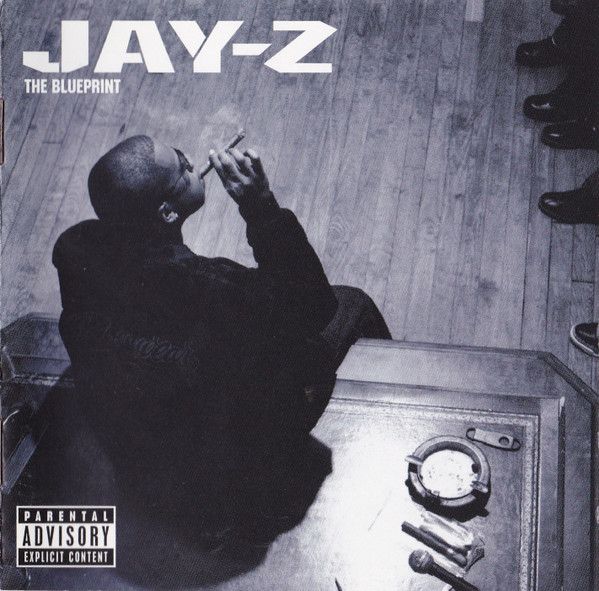

In the spring of 2001, Jay-Z walked into Baseline Studios in Manhattan facing two separate criminal cases. He had no finished songs and no plan for an album. He asked the room a simple question: anybody got some beats?
Within three days, by Just Blaze's count, he had recorded nine songs. Most were built on sped-up, chopped-up soul samples by two little-known producers, Kanye West and Just Blaze. The Blueprint came out on September 11, 2001, the day of the terrorist attacks.
It brought sample-based production back to the center of rap. It ended the argument over who was the best rapper alive, and it turned his feud with Nas into the most quoted battle in hip-hop history.
“A master of economy, Jay is able to say in one line what it takes some writers entire songs to get across.”
Two Trials and a Deadline
By early 2001, Jay-Z had four albums behind him, a platinum track record, and a growing sense among rap critics that he had settled into autopilot. He also had two criminal cases pending — a weapons charge and an assault charge stemming from a 1999 stabbing at a Manhattan nightclub — hanging over every session. Rather than retreat, he treated the pressure as fuel. He worked mostly out of Baseline Studios in Manhattan, Roc-A-Fella's home base, with no finished songs and no shortlist of collaborators locked in advance.
What followed became one of the most retold origin stories in hip-hop production. Producer Just Blaze, who had been holding the “Girls, Girls, Girls” beat for Ghostface Killah but never ran into him to hand it over, recalled the whole album crystallizing almost by accident. “For The Blueprint, Jay-Z literally just walked into the studio one day and was like, ‘Anybody got some beats?’” Just Blaze said. Kanye had about five beats ready and Just Blaze three or four, and Jay cut nine songs in three days. West, still unsigned as an artist, ended up producing four of the album's thirteen tracks.
Jay-Z's writing method added to the mythology: he composed in his head, no pen or paper. The whole album was recorded in about two weeks. The label pushed the release date up a full week, from September 18 to September 11, to get ahead of bootleggers who'd already leaked material off “Izzo (H.O.V.A.),” the lead single that had exploded on radio that summer.
Kanye, Just Blaze, and the Soul Revival
The Blueprint's defining move was sonic: it turned away from the synthesized, Timbaland-indebted sound that dominated turn-of-the-century rap and reached back into vintage soul. Kanye West sped up and pitched vintage records into tight, chipmunked vocal loops — a style he'd later expand into the backbone of his own The College Dropout. “Izzo (H.O.V.A.)” built its entire foundation on a loop from The Jackson 5's “I Want You Back,” sped up until Michael Jackson's voice turned bright and elastic, then wrapped around a booming drum pattern that made a 1969 soul record sound like a 2001 single.
Just Blaze worked the same soil from a different angle. “Song Cry” sampled Bobby Glenn's obscure “Sounds Like a Love Song”; Just Blaze had started the beat before the sessions but hadn't finished it when Jay arrived. “Girls, Girls, Girls” repurposed the beat he'd shelved for Ghostface into a horn-driven catalog of Jay's romantic entanglements across the country, treated more like comedy than confession.
The album's other credited producers filled out the palette without disrupting its center of gravity: Bink built “The Ruler's Back,” “All I Need,” and the title track “Blueprint (Momma Loves Me),” Timbaland supplied “Hola' Hovito,” the Trackmasters produced “Jigga That Nigga,” and Eminem — then riding the success of his own The Marshall Mathers LP — produced and appeared on “Renegade.” But it was the West and Just Blaze tracks that critics and other producers fixated on.
Watch: Izzo (H.O.V.A.) — Official Music Video
“Ask Nas — He Don't Want It”
No track on The Blueprint did more to define its reputation than “Takeover,” a Kanye West production built around a chopped loop of The Doors' “Five to One” and a Bowie “Fame” interpolation. Its first target was Mobb Deep's Prodigy, whom Jay-Z had already needled weeks earlier at Hot 97's Summer Jam on June 28, 2001, when he performed early verses of the song while a photo of a preteen Prodigy in dance class played on the arena screen behind him.
That same Summer Jam set ended with a line aimed at a bigger target: “Ask Nas — he don't want it with Hov.” The two rappers had circled each other for years — Nas had been a no-show for a planned feature on 1996's Reasonable Doubt — but the Summer Jam callout escalated things into open war. By the time The Blueprint reached stores, “Takeover” carried a third verse aimed squarely at Nas, dismantling his catalog line by line and dismissing 1999's Nastradamus as evidence he was finished.
Nas answered that December with “Ether,” on his album Stillmatic. The response was so vicious it added a verb to hip-hop's vocabulary — to “ether” someone became shorthand for a definitive verbal knockout. The two rappers traded further shots before settling their differences years later, but in the fall of 2001, “Takeover” did exactly what it was built to do: it made The Blueprint impossible to discuss without discussing who was the best rapper working, and it made Jay-Z the center of that argument.
Essential Tracks
“Izzo (H.O.V.A.)”
Kanye West built “Izzo” around a sped-up loop of The Jackson 5's “I Want You Back,” turning a 1969 bubblegum-soul single into a booming, radio-ready foundation. It was one of roughly five beats West brought to the sessions, and the brightest thing on the record.
Jay-Z used the track to retell his own rise — from Brooklyn street corners to Roc-A-Fella's boardroom — over a beat so buoyant it made the autobiography sound like a victory lap. Released as the lead single in July 2001, it became his first Top 10 pop hit as a lead artist and forced Def Jam to move the album's release date up to keep ahead of bootleg copies already circulating on the strength of the song alone.
The song's reach outlasted the album cycle. “Izzo” is still the track most casual listeners associate with The Blueprint — proof that a single loop, sped up and looped tight, could carry an entire era of rap production into the mainstream.
“Takeover”
Built on a chopped loop of The Doors' “Five to One” and a interpolation of David Bowie's “Fame,” “Takeover” is structured like a public execution in three parts — first Mobb Deep's Prodigy, then a general survey of pretenders to Jay's throne, then a verse dismantling Nas's catalog release by release.
Rolling Stone later called it “one of rap's most precise and unrelenting diss tracks.” Its rock samples were as pointed as its bars — pulling from The Doors and Bowie signaled a rapper reaching outside hip-hop's usual sample pool to make the takedown feel bigger than a beef, closer to a coronation.
The song's afterlife eclipsed even its original target. Nas's response, “Ether,” became so definitive an answer record that the word itself entered rap's working vocabulary as a verb for a decisive verbal defeat. But “Takeover” came first, and its structure — building from a lesser rival to the genre's reigning lyrical standard-bearer — set the template that diss tracks would follow for the next two decades, treating the feud less as a personal grudge than as a formal challenge to a title.
“Song Cry”
Just Blaze looped Bobby Glenn's “Sounds Like a Love Song” into a mournful, string-laced bed for the album's most emotionally exposed verse — Jay-Z narrating the collapse of a relationship without shifting blame entirely onto the other party, admitting his own pride and infidelity contributed to its end.
The title's joke — the song cries so he doesn't have to — became one of the album's most quoted lines precisely because it named a real convention of rap machismo even while indulging it. dream hampton singled the track out for the way it helped listeners “understand not just ‘the mind of a hustler,’ but his very heart.”
Released as a single in 2002, “Song Cry” became the record critics reached for whenever they needed to argue Jay-Z was more than a chest-thumping technician. It gave the rest of The Blueprint's bravado somewhere to land — proof the same rapper dismantling Nas on “Takeover” could sit with a failure and own his part in it, a balance later albums like The Black Album would lean on even more heavily.
Watch: Song Cry — Official Music Video
A Release Date No One Chose
The Blueprint hit stores on the morning of September 11, 2001. Record stores that opened before the attacks sold copies; most of the country spent the day watching television instead of shopping for new rap albums. The album's rollout carried on under circumstances nobody had planned for.
How a two-year fight with bootleggers put the album on shelves that particular Tuesday is its own story: Seven Days Early: How Bootleggers Put Jay-Z's The Blueprint Out on September 11 →
Despite — or perhaps because of — the surreal circumstances of its release, the album debuted at Number One on the Billboard 200, moving more than 427,000 copies in a week when much of American commerce had ground to a halt. It was his fourth consecutive No. 1 album. It went platinum within a month and double platinum by 2002, and the RIAA certified it triple platinum in 2023. The coincidence of the release date has followed the album ever since, cited in nearly every retrospective as one of the strangest pieces of timing in music history.
Contemporary critics recognized the album's quality independent of its release-day circumstances. Village Voice critic Robert Christgau awarded it an A-minus, comparing its appeal to a well-made commercial product: Jay-Z's music, he wrote, “unlocks the gate to a luxurious passivity that may not be good for you in the long run but does the trick at the time.” The Source gave the album five mics, its first perfect score since OutKast's Aquemini three years earlier.
His flow is fluent, sure. But his confidence reigns supreme.
The Producers It Made
If The Blueprint restored Jay-Z's standing as rap's dominant voice, it did something arguably larger for the two producers who defined its sound. Kanye West was still an unsigned staff producer at Roc-A-Fella when he built “Izzo,” “Takeover,” “Heart of the City (Ain't No Love),” and “Never Change” for the album; within a year he had a recording contract of his own, and within three he released The College Dropout, extending the chipmunk-soul style he'd premiered here into a full-blown career.
Just Blaze followed a similar trajectory, becoming one of the most in-demand producers of the decade off the strength of “Girls, Girls, Girls,” “Song Cry,” and “U Don't Know.” Together, the two producers didn't just make one good album — they reoriented an entire genre's sound away from the synthetic, Neptunes-and-Timbaland-driven production that had dominated rap radio, back toward crate-dug soul and funk records slowed, sped, and chopped into something new. Sample-based production, which had felt like a relic of rap's golden age just a year earlier, became the sound of the next half-decade.
Legacy: The First 21st-Century Classic
The Blueprint's standing has only grown with distance. In 2019, the Library of Congress added it to the National Recording Registry, alongside works spanning back to the birth of recorded sound. Rolling Stone ranked it Number 50 on its 2020 revision of the 500 Greatest Albums of All Time, praising Jay-Z's “unmatched air of calm control and a cavalier confidence,” while Pitchfork placed it fifth on its list of the best albums of the 2000s.
What separates The Blueprint from other albums that simply sold well is how directly its DNA runs through everything that followed — not just in Jay-Z's own catalog, where it set the template he'd chase for two more decades, but in the career of the producer he made a star. Every soul-sampled Kanye West beat, from “Through the Wire” to “Touch the Sky,” traces back to the beats he flipped for Jay in the spring of 2001.
Twenty-five years on, the album still gets discussed in two registers simultaneously: as a historical artifact permanently bound to a specific, terrible date, and as a self-contained artistic statement that would have mattered regardless of when it arrived. Both things are true, and neither cancels out the other — which is, in its way, the most Jay-Z outcome imaginable for a record about turning circumstance into leverage.
“Jay-Z elevates clever rhymes and innovations with an unmatched air of calm control and a cavalier confidence.”