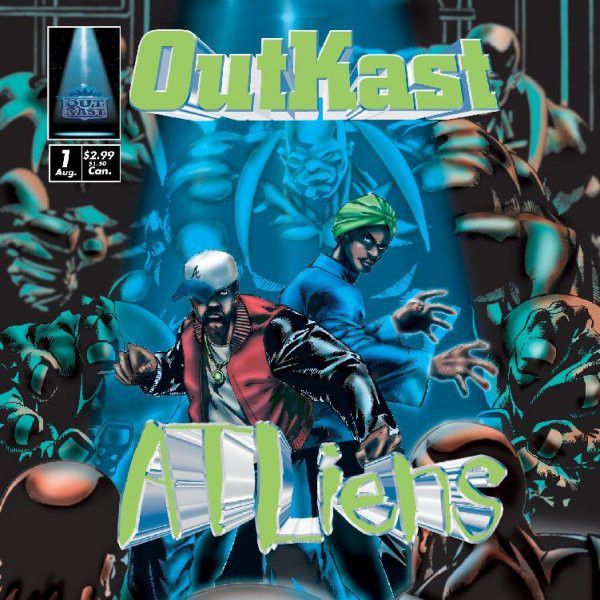

In 1995, OutKast won Best New Rap Group at the Source Awards in New York, and the crowd booed. When André Benjamin went up to accept it, he answered them directly: the South had something to say too.
OutKast's answer was their second album, ATLiens, released thirteen months later. It dropped the Cadillac-and-porch-funk sound of their debut, Southernplayalisticadillacmuzik, for something colder, slower and stranger. They made it largely without the production team behind their first record. The debut sounded like a block party. ATLiens sounds like two men who feel out of place on their own planet.
“I'm tired of closed-minded folks. It's like we got a demo tape and don't nobody want to hear it. But it's like this, the South got something to say, and that's all I got to say.”
Booed in New York, Answered in Atlanta
The Source Awards boo wasn't really about OutKast specifically — it was the New York rap establishment reacting to a Southern act winning a category it assumed belonged to the coasts. Regina N. Bradley, writing on the album's twentieth anniversary for the African American Intellectual History Society, frames what followed through Alondra Nelson's idea of “past-future visions”: OutKast responded not by chasing New York's or Los Angeles's sound, but by digging further into where they were from while imagining somewhere else entirely. “We stay closer to our roots here in the South,” André told Spin in 1996, citing “spirituals, the church, the struggle” as the record's real source material, even as its surface language was outer space and extraterrestrials.
The alien concept did double duty. It let André and Big Boi dramatize how the industry saw them — outsiders who didn't belong in hip-hop's existing map — while also giving voice to something more personal: both men were changing fast, and neither entirely recognized himself anymore. ATLiens turned that discomfort into a concept album without ever spelling out its own metaphor too literally, which is part of why it still plays as mood rather than gimmick three decades later.
It also marked a hard turn from the record that made them. Southernplayalisticadillacmuzik (1994) was cut entirely with Organized Noize — Rico Wade, Ray Murray, and Sleepy Brown, the production trio who discovered OutKast as teenagers and built their sound around live-band funk and Cadillac-trunk bass. On ATLiens, that arrangement changed, and the change is audible from the first track.
Earthtone III Takes the Wheel
André and Big Boi formed their own production unit for the album, credited as Earthtone III alongside DJ and programmer David “Mr. DJ” Sheats. Organized Noize still produced the bulk of the record — tracks like “Two Dope Boyz (In a Cadillac),” “Wailin',” and “Decatur Psalm” — but for the first time, OutKast built several key tracks themselves, including the title cut, “Elevators (Me & You),” and “E.T. (Extraterrestrial).” André had started buying his own gear — an SP-1200 drum machine, an MPC3000 sampler, a TASCAM mixing board — and building tracks from the ground up rather than rapping over someone else's finished beat.
Big Boi has described the shift as an apprenticeship paying off rather than a rejection of Organized Noize. “We learned from being under them for so long,” he said. “What better way to paint a picture than being able to create the soundscape for your words? We were maturing and coming of age then.”
LaFace Records didn't initially share the duo's confidence in the new direction. The label resisted releasing the self-produced “Elevators (Me & You)” as the lead single, favoring a sound closer to the debut's. OutKast pushed it to radio anyway. The song became their first Hot 100 entry to crack the top 15, and its success handed André and Big Boi leverage over single selection they wouldn't give back.
'Elevators (Me & You)' — the self-produced lead single LaFace didn't want to release, and the song that changed who got final say on OutKast's singles.
Two Men Becoming Aliens
André's personal transformation during this period is well documented and audible across the record. He gave up weed and alcohol, became vegetarian, took up celibacy, grew out his hair, and immersed himself in books and spirituality André also finished his GED through night classes squeezed between studio sessions, a detail that undercuts any read of the album's introspection as pure performance.
Big Boi's changes were quieter but just as real. He had become a father in March 1995, and has said the shift reordered his priorities going into the record: his daughter, he said, became his number-one priority. The two men were moving in different directions as people — André toward asceticism and abstraction, Big Boi toward domestic stability — and ATLiens is the first OutKast album where that gap between them becomes part of the material rather than something the music smooths over.
None of it reads as a concept forced onto the songs after the fact. The record's sci-fi imagery — spaceships, alien contact, characters who don't belong where they've landed — works because both rappers were, in different ways, genuinely trying to figure out who they were becoming.
Essential Tracks
“Elevators (Me & You)”
Built by Earthtone III rather than Organized Noize, “Elevators” announced the album's new sound in its first seconds: a spare, hovering beat with none of the debut's low-end swagger, replaced by something closer to weightlessness. The hook stayed catchy enough to work as a single even as the production around it got stranger, proof the duo could reinvent their sound without losing the pop instincts that got them signed in the first place.
Released as the lead single on July 5, 1996 over LaFace's own hesitation, it reached No. 12 on the Billboard Hot 100 — OutKast's highest pop chart placement until “Ms. Jackson” four years later — and topped the Hot Rap Songs chart. It was certified Gold within weeks of release, vindicating a single choice the label itself hadn't wanted to make.
The song's afterlife has been unusually long for a nine-figure catalog: it took until December 2024 — nearly three decades after release, well into the streaming era — for the RIAA to certify it Platinum, a slow-burn trajectory that mirrors the album's own reputation as a record that took listeners longer to fully catch up to than its predecessor did, but that has kept finding new audiences ever since.
“Jazzy Belle”
One of the Organized Noize productions retained for the album, “Jazzy Belle” pairs a smoky, understated groove with lyrics addressed to women caught up in the same trap-adjacent lifestyle the record elsewhere critiques in men. It's a rare moment where the album's gaze turns outward toward its community rather than inward toward its narrators, and one of the clearest examples of Organized Noize's continued imprint on the record even as Earthtone III took over elsewhere.
Musically, it splits the difference between the debut's live-band warmth and the newer, more atmospheric Earthtone III material — a reminder that the album's shift in sound wasn't a clean break from Organized Noize so much as a widening of who got to shape the record, with both production camps working side by side rather than in competition.
Released as the album's third single, it peaked at No. 52 on the Hot 100 — modest next to “Elevators,” but a track critics and fans have continued to single out for the interplay between André's and Big Boi's verses, each rapper answering rather than simply following the other, a call-and-response chemistry that would become the duo's defining trademark for the rest of their career.
'Jazzy Belle' — one of the Organized Noize productions OutKast kept, bridging the debut's warmth and the new album's colder atmosphere.
Space as Self-Determination
AllMusic's Steve Huey summed up the sound as “spacy sci-fi funk performed on live instruments” — a description that captures both the album's texture and its refusal to fully abandon the organic playing that defined the debut. Rather than leaning further into sampling, André and Big Boi built soundscapes from scratch, matching tempo and mood to lyrics that were themselves slower and more meditative than anything on Southernplayalisticadillacmuzik.
Bradley hears the record tying Southern Black oral tradition to “ticking clocks, outer space, and echoing synthesizers” — a hip-hop extension of the Afrofuturist vocabulary George Clinton had used decades earlier. On ATLiens, she writes, OutKast placed “one foot in the Southern past and the other foot in the future” — using science fiction not as escapism but as a way to describe a very real, very Southern kind of displacement.
A widely read Sputnikmusic user review by JonM, awarding the album a perfect “Classic” score, made a similar point about craft rather than concept: “there really is no variation in quality on ATLiens. None whatsoever.” The reviewer credited the interplay between the two rappers specifically — “Andre and Big Boi don't merely trade verses, they share them” — as the thing that keeps a slower, moodier record from ever sagging.
“Millennium”
Never released as a single, “Millennium” is the deep cut most frequently singled out by critics revisiting the album, built around a hovering, hymn-like keyboard figure that stretches the record's spiritual undercurrent to its most explicit point and gives the loosest possible frame to André and Big Boi's verses.
It has none of “Elevators” or “Jazzy Belle”'s hooks to fall back on, relying instead on atmosphere and the two rappers' chemistry to carry a track with almost no traditional chorus — a structural risk that only really works because the rest of the album has already built the mood it depends on.
The same Sputnikmusic review called it the track “some would say” is the album's best, with any listener “sent soaring into orbit” — a fitting endorsement for the song that most fully commits to the album's outer-space premise without ever needing to say the word “alien” out loud, and the clearest evidence of how far OutKast had moved from the sound that made them famous.
Critics Catch Up
Released August 27, 1996 on LaFace and Arista, ATLiens debuted at No. 2 on the Billboard 200 and topped the Top R&B/Hip-Hop Albums chart. Rolling Stone's Kevin Powell praised it on arrival as “a gritty document of what's happening here and now,” singling out “Decatur Psalm” as “a state-of-the-black-community address on poverty, education, crime and black-on-black violence” and crediting André and Big Boi with “a unique ability to describe ghetto life while offering up life-affirming possibilities.”
Powell made the regional point too, arguing that what set OutKast apart from both coasts was more than geography. It was the kind of line contemporary critics increasingly felt obligated to write about OutKast — acknowledgment that the group the industry had booed a year earlier was setting the pace rather than following it.
The album went platinum by the end of 1996 and has since been certified double platinum by the RIAA. Its commercial performance never matched the pop-chart dominance OutKast would reach with Stankonia four years later, but within hip-hop it did something arguably more important: it proved the duo could reinvent their sound entirely and still sell.
Despite a couple of overly sleepy moments during the second half, ATLiens is overall a smashing success thanks to its highly distinctive style, and stands as probably OutKast's most focused work.
The Bridge to Aquemini and Stankonia
ATLiens is most often discussed today as the hinge in OutKast's catalog — the record where the party-funk debut turned into the run of albums, Aquemini (1998) and Stankonia (2000), now regarded as the group's creative peak. The self-production experiment that started with a handful of Earthtone III tracks here expanded dramatically on Aquemini, where Organized Noize produced only a fraction of the record and André emerged as the group's de facto producer-in-chief.
Academically, the album has become a touchstone for scholars tracing hip-hop's relationship to Southern identity and Afrofuturism — Bradley's own book Chronicling Stankonia: The Rise of the Hip-Hop South treats it as a foundational text for understanding how OutKast repurposed science-fiction imagery to claim autonomy the music industry hadn't offered them. Thirty years on, that reading holds up better than a simpler one: that two rappers from Atlanta just liked spaceships.
What's clearest in hindsight is how deliberately unhurried the reinvention was. OutKast didn't chase the sound that had gotten them booed, and they didn't abandon Organized Noize outright either — they built a new sound alongside their old collaborators, at their own pace, and let the album's alienation feel earned rather than performed. That patience is why ATLiens still sounds less like a transitional record and more like the moment OutKast became the group everyone eventually caught up to.
“Being an alien is just being yourself when people don't understand you. We just trying to let everybody know there's a place for everybody in this world.”