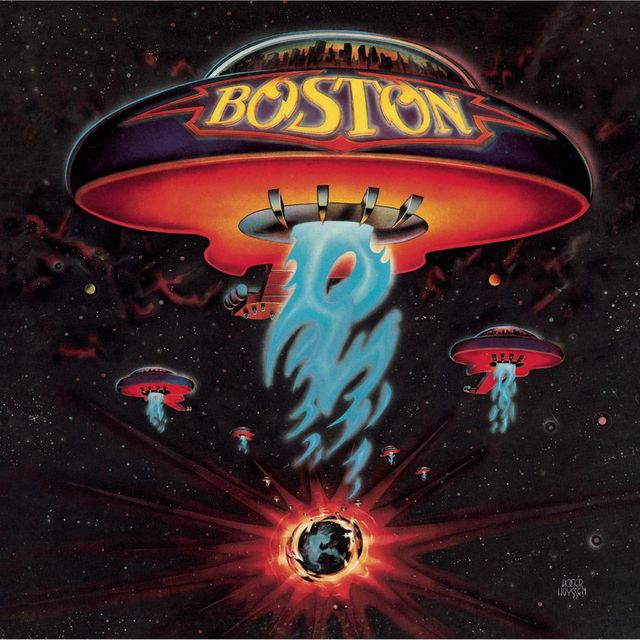

On winter nights in 1974, an MIT-trained engineer named Tom Scholz came home from his day job testing camera parts at Polaroid. He walked down into the basement of his rented house in Watertown, Massachusetts, and built a rock album by himself.
He had already spent six years and thousands of dollars on demo tapes that two dozen labels had rejected. When Epic Records finally signed him, the label needed the world to believe the record was being made in a real studio. So they struck a secret deal: Scholz would keep recording alone in the basement, and nobody outside the band would say otherwise.
The result, the self-titled debut Boston, became, for a time, the fastest-selling debut album in history. “More Than a Feeling” became the template every arena-rock record after it tried to match.
“What made the track so powerful in '76 was its uniqueness: Scholz's guitar sound was unlike anything else at the time.”
Six Years in a Watertown Basement
Tom Scholz was not a musician by trade. He held a master's degree in mechanical engineering from MIT and worked as a product design engineer at Polaroid, building the mechanisms inside instant cameras. Music was the thing he did after hours, funded by an engineer's salary and pursued with an engineer's obsessiveness. “I started around 1969,” Scholz recalled of his earliest demos. “From there it was a long, long string of doing everything from buying time in so-called professional recording studios… That whole process took until 1975… I'd been spending money for six years in pretty large quantities.”
The rejections piled up for most of that decade. Scholz sent his tapes to two dozen labels, and nearly all of them passed — Epic included, the first time. He still keeps a framed copy of that initial Epic rejection letter. Producer John Boylan, who eventually championed the demos inside the label, remembered the industry's blind spot bluntly: “Everybody and his dog had passed on it. Isn't that crazy? I was hearing ‘More Than a Feeling’ and ‘Peace of Mind.’”
What finally separated Scholz from every other bedroom hopeful was the equipment he built to make the demos sound finished. His basement rig centered on a Scully 12-track tape recorder, a Dan Flickinger mixing console, and a homemade attenuator he cobbled together from a theatrical lighting resistor — a device that let him drive a cranked Marshall amp at recording-friendly volume, which he later patented and sold commercially as the Power Soak. When Epic finally offered a deal, Scholz didn't quit Polaroid. “I took a leave of absence from my Polaroid job,” he said. “I was gone for several months.”
The Epic Deception
Epic's contract required union-approved engineers working in professional studios, which created a problem: the tracks that had gotten Boston signed were cut on a 12-track machine in a rented basement. Producer John Boylan solved it with a plan that doubled as a cover story. “John Boylan, the producer Epic chose, offered me a deal,” Scholz explained. “I would make the record in my basement and wouldn't tell anybody… Epic would think all the recording was done in LA.” Boylan — who also suggested renaming the group, previously called Mother's Milk, after its hometown — described his own role plainly: to “run interference with the label while he works out of his basement.” The full story of how that deception was built and kept is its own tale: The Basement Myth That Was True: How Boston Got Made →
The rest of the band flew to Los Angeles to make the ruse convincing. Brad Delp re-cut his lead vocals through a Neumann U87 at Capitol Studios' Studio C, and the sessions produced at least one genuine studio flourish: the hand-claps on “More Than a Feeling” were recorded in the Capitol men's room “because it had such a cool sound,” Boylan said. Scholz's guitar and bass tracks, already committed to tape at home, were transferred onto 24-track reels and blended in during final mixing at Westlake Studios on Wilshire Boulevard, on a manual board with no automation to smooth the seams.
The arrangement produced real friction. Boylan, an experienced session hand, found Scholz's command of live instruments shakier than his command of a guitar: “Tom was an obvious genius, but he didn't know how to record acoustic instruments. The drums and acoustic guitars were amateurish.” Mixing turned into a tug-of-war over the same guitars that made the album distinctive. “Tom is pushing the guitars up in the mix unceasingly,” Boylan said of the sessions. A handful of vocal overdubs never even survived the trip to Los Angeles — Delp's voice struggled in the smog, so the band drove back to Watertown and finished them in the basement that had started it all.
'More Than a Feeling' — cut largely on a 12-track recorder in a Watertown basement, then mixed in Los Angeles to complete the illusion of a proper studio album.
A Wall of Guitars, Built Alone
What listeners heard on the radio in 1976 was, in the truest sense, a solo record wearing a band's clothes. Scholz played nearly every guitar, bass, and keyboard part on the album himself, layering take after take until the tracks stacked into the dense, chiming “wall of guitars” that became his signature. Because one obsessive engineer controlled every overdub, the parts lock together with a precision that a live band playing in a room rarely achieves — and Delp's multi-tracked harmonies, stacked the same painstaking way, gave the vocals a similar sheen.
Epic wanted a road-ready band behind the record, which meant drummer Jim Masdea — who had played on Scholz's original demos — was replaced by Sib Hashian for most of the album, largely re-recording Masdea's own arrangements note for note. Masdea's original take survived intact on only one song, “Rock & Roll Band.” It is a small, telling detail: even the songs credited to a five-man band were, in most cases, one composer's blueprint executed by whoever the label decided should be standing on stage.
The remarkable part is how invisible the seams are. Despite being assembled from a home 12-track, a Providence remote truck, a Los Angeles studio, and a mixing room on Wilshire Boulevard, Boston sounds like a single, unified performance — arguably cleaner and more controlled than most big-budget rock records of the era. Scholz's basement engineering didn't just match professional studios of 1976. On this album, it beat them.
Everybody and his dog had passed on it. Isn't that crazy? I was hearing ‘More Than a Feeling’ and ‘Peace of Mind.’
Essential Tracks
“More Than a Feeling”
The song traces back to an early-1970s demo called “Ninety Days,” cut not long after Scholz and Brad Delp first started working together, and reworked across years of basement sessions before it became the album's opening single. Its ringing intro riff — among the most recognized in rock — announces the record's entire method in eight bars: layered, precise, and unmistakably one guitarist's design.
Delp's vocal, re-cut at Capitol Studios after months of Scholz's guide tracks, moves from a hushed verse into a soaring chorus with a control that gave the song a template other AOR bands spent years chasing. Released as the album's lead single in September 1976, it climbed to No. 5 on the Billboard Hot 100 that December and spent 19 weeks on the chart.
It has never left classic-rock radio rotation since, and its afterlife took a stranger turn in 1994 when a very different rock star acknowledged its shadow over his own biggest hit — a connection covered in the legacy section below. The chorus alone stacks Delp's doubled lead vocal against Scholz's layered guitar harmonies, the same overdub-by-overdub method used across the record, until the arrangement sounds like a full band even though most of it is one player working alone.
“Foreplay / Long Time”
The album's second single is really two pieces welded together: “Foreplay,” a churning organ-and-guitar instrumental that shows off Scholz's classical-leaning keyboard writing, followed by “Long Time,” a full-band anthem built on the same layered-guitar architecture as the opening track.
The pairing gave the band room to demonstrate range within a single seven-minute track — instrumental virtuosity giving way to hook-driven arena rock — without ever losing the sense that one engineer had planned every transition in advance. Released in early 1977, it reached No. 22 on the Hot 100.
Decades of classic-rock programming have kept the two halves inseparable; few stations play “Long Time” without its instrumental overture intact, a testament to how deliberately the sequence was built to be heard as one statement. The organ figure that opens “Foreplay” also doubles as a quiet showcase for how much of the album's texture came from keyboards rather than guitars alone, a detail that gets lost under the record's reputation as a purely six-string affair.
“Peace of Mind”
Of all the songs Boylan singled out as proof the labels had been asleep at the wheel, “Peace of Mind” was the one he named alongside “More Than a Feeling.” Its lyric, about walking away from the corporate ladder for something truer, carried an irony Scholz lived out literally — he wrote much of the album while still clocking in at Polaroid.
Musically, it leans on the same twin-guitar interplay that defines the record, with Barry Goudreau's rhythm work giving Scholz's leads a foundation to weave around. Released as the B-side to “Foreplay/Long Time” before charting on its own merits, it reached No. 38 on the Hot 100 in the spring of 1977.
It never became the cultural fixture “More Than a Feeling” did, but among the album's deep cuts it remains the one most frequently cited by musicians as evidence that Scholz could write a hook as easily as he could engineer one. Its message — trade the treadmill for something honest — is easy to hear differently once you know it was written by a man mixing tape reels in his basement after his shift at Polaroid.
'Foreplay / Long Time' — Scholz's keyboard writing and layered guitars, sequenced as a single seven-minute statement.
Fastest-Selling Debut in Rock History
Released on August 25, 1976, Boston became a commercial phenomenon almost immediately. It was certified gold within about three weeks of release and platinum by November 11 — a pace that made it, by most accounts, the fastest-selling debut album by an American act up to that point. On the Billboard 200, it climbed to No. 3 and stayed on the chart for 132 weeks, an unusually long run for a rock record without ever reaching No. 1.
The singles followed the album's momentum without quite matching its sales figures: “More Than a Feeling” reached No. 5 on the Hot 100, “Foreplay/Long Time” climbed to No. 22, and “Peace of Mind” peaked at No. 38. None of them topped the chart, which underlines how much of the album's success was driven by listeners buying the whole record rather than chasing a single hit.
That momentum never really stopped. The RIAA certified Boston 17× platinum on November 20, 2003, placing it among the best-selling debut albums in American recording history — a number built almost entirely from steady decades of catalog and classic-rock-radio sales rather than a single burst of hype.
Critics Caught Off Guard
Boston arrived during the commercial peak of what critics would later call corporate rock — only eleven albums reached No. 1 on the Billboard 200 in all of 1976, among them Wings' Wings at the Speed of Sound, Led Zeppelin's Presence, Earth, Wind & Fire's Spirit, Peter Frampton's Frampton Comes Alive!, and Fleetwood Mac's self-titled album. Boston never joined them at the top, but it outsold nearly all of them over time, arriving as arena rock's most polished, most engineered distillation just as punk was gathering to tear the format down.
The critical establishment was unmoved. Robert Christgau's Consumer Guide dismissed the record with a C grade and a memorably sour line: “When informed that someone has achieved an American synthesis of Led Zeppelin and Yes, all I can do is hold my ears and say gosh.” The gap between that verdict and the record's sales figures says as much about mid-70s rock criticism's taste for rawness as it does about the album itself.
Retrospective assessments have been kinder to the engineering, if not always the ambition. PopMatters' Adam Williams called Boston “an entirely (and expertly) guitar-driven record, no different than the heavier offerings of '70s hard rockers” — a backhanded compliment that nonetheless credits what critics in 1976 mostly missed: that a single self-taught engineer had built a sound that could stand next to any major-label production of its decade.
The Riff Nirvana Almost Stole
Boston's layered-guitar formula became a blueprint that arena rock spent the rest of the decade refining, and classic-rock radio has never let the record go quiet since; “More Than a Feeling” in particular has remained a programming staple for nearly fifty years, still identifiable within its first two notes.
Its strangest legacy moment came in 1992, when Nirvana opened its Reading Festival headline set by playing roughly 25 seconds of “More Than a Feeling” before launching into “Smells Like Teen Spirit.” Kurt Cobain later admitted the resemblance was more than a joke. “It was such a cliched riff,” he told Rolling Stone in 1994. “It was so close to a Boston riff or ‘Louie Louie.’” When he first played it, he added, bassist Krist Novoselic's verdict was “That is so ridiculous.” Scholz, asked about the resemblance that same year, took the comparison in stride: “I take it as a major compliment, even if it was completely accidental.”
There is a fitting symmetry in that exchange. A record built by a man escaping his day job at Polaroid one basement session at a time ended up inside the song that, sixteen years later, became grunge's escape from arena rock altogether. The basement secret that Epic once needed hidden is now the story every retelling of the album leads with — proof that the engineering, not the cover story, is what actually lasted.
“I've spent six months making a recording of a song that I've thrown out… It's just something that I have to do. I have to do it the best I can do it.”