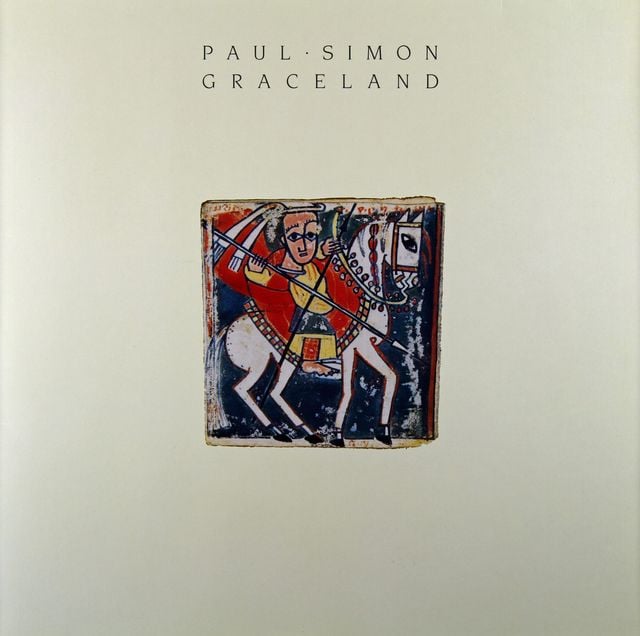

In 1984, Paul Simon was producing a shelved album for the singer Heidi Berg when she handed him a bootleg cassette: Gumboots: Accordion Jive Hits, Vol. II. Simon kept it playing on a loop in his car.
He was three years past the commercial failure of Hearts and Bones and had no plan beyond that tape. One track wouldn't let him go: a mbaqanga instrumental by a Soweto group called the Boyoyo Boys. Within months he flew to Johannesburg, in defiance of the United Nations' cultural boycott of apartheid South Africa, to record with musicians whose names he barely knew.
The album that came out of those sessions, Graceland, became the best-reviewed record of Simon's career and won the Grammy for Album of the Year. It is also one of the most argued-over albums in pop history, and Simon has never stopped having to defend it.
“Paul Simon's Graceland is a tremendously engaging and inspired piece of work… If you like him thorny it's his best record since Paul Simon in 1972.”
A Bootleg Tape Called Gumboots
By 1984, Simon had spent most of a decade trying to follow up the commercial peaks of his early solo career, and Hearts and Bones — his most personal record to date — had sold poorly and left him professionally adrift. It was the lowest-charting record of his career. When a borrowed cassette of South African street music went into his car stereo on the drive out to Montauk, what caught him wasn't lyrics or structure but the rhythm itself. “It sounded like very early rock & roll to me, black, urban, mid-Fifties rock and roll, like the great Atlantic tracks from that period,” he remembered.
Heidi Berg, the young songwriter who had lent Simon the tape, never received songwriting credit or public acknowledgment for pointing Simon toward the music that would define the next phase of his career — an erasure that set an uncomfortable template for the credit disputes that would follow the album for decades. Simon, meanwhile, decided he didn't want to imitate the sound from a distance. He wanted to record with the musicians who made it, in the country where they lived.
That country was South Africa, then under a UN-backed cultural boycott meant to isolate the apartheid government. In February 1985, Simon flew to Johannesburg with engineer Roy Halee and a stack of the Boyoyo Boys' records, planning to build songs from scratch with musicians he'd never met, in a genre he'd encountered only on a bootleg tape a few months earlier.
Two Weeks at Ovation Studios
Ovation Studios in Johannesburg surprised Halee, who had expected “a horror show” and found instead “the best-sounding control room I've ever been in” — “a Harrison console, 3M tape machines and modified James Lansing monitors that made it sound like you were in your living room.” Working with bassist Bakithi Kumalo, drummer Isaac Mtshali, and guitarist Ray Phiri of the band Stimela, Simon abandoned the usual order of pop songwriting entirely. There were no finished songs going in — only jam sessions, built live in the room, that Simon and Halee would shape into structures afterward.
“The musicians liked to work very close together, with eye contact to get the feel and the groove going,” Halee recalled. He recorded the band with almost no baffles separating the instruments, drums included, to preserve that physical closeness on tape — a choice that ran against standard studio practice but matched how the musicians actually played. The studio itself, Halee admitted, was “like a garage,” and the instruments still had to be isolated enough to edit later. Simon went in with nothing on paper. The words came later, written at his home in Montauk once the grooves already existed.
Assembling finished songs out of loose jam-session tape required editing on a scale Halee had rarely attempted. “The amount of editing that went into that album was unbelievable,” he said. “…without the facility to edit digital I don't think we could have done that project.” The Johannesburg sessions produced only raw material — the album took shape over the following year at New York's Hit Factory and studios in London, Los Angeles, and Louisiana, where Simon added Ladysmith Black Mambazo, Los Lobos, zydeco accordionist Rockin' Dopsie, and Senegalese percussionist Youssou N'Dour to the foundation built in South Africa.
Just listen to ‘The Boy in the Bubble.’ … The guitar, the drums and that incredible bass add up to a feel going on at the bottom end that is unlike anything I've heard before or since.
'Homeless' — built from a Zulu wedding melody Joseph Shabalala adapted for Ladysmith Black Mambazo, with English verses Simon added afterward.
Defying the UN Cultural Boycott
Simon had consulted Harry Belafonte before the trip, and Belafonte urged him to pause and speak with African National Congress contacts first. Simon went anyway, later comparing his own impatience to a teenager who'd been told not to borrow the family car but had a date he really wanted to keep. Instead of ANC clearance, Simon secured a resolution from South Africa's Black musicians' union formally inviting him to record — the procedural justification he leaned on when the backlash arrived. “What gives [governments] the right to wear the cloak of morality?” he railed at the time. “Their morality comes out of the barrel of a gun.”
The ANC placed Simon on the UN cultural blacklist, and Artists United Against Apartheid — the coalition behind the 1985 “Sun City” boycott anthem — treated the album as a direct violation of the movement they'd just built. The controversy deepened when Simon brought Linda Ronstadt onto “Under African Skies”: Ronstadt had performed at Sun City herself, and Christgau's Village Voice Consumer Guide called her cameo “a slap in the face to the ANC whether he admits it or not.” When the Graceland tour reached England in 1987, anti-apartheid protesters picketed the shows; it eventually closed with two concerts in Harare, Zimbabwe, filmed as Graceland: The African Concert.
Simon's defense rested on the argument that the music itself was the political act. Near the end of the tour he called it “the most powerful form of politics, more powerful than saying it right on the money, in which case you're usually preaching to the converted.” Audiences would hear the grooves first, he argued, and only afterward ask what was actually happening to the people who made them.
The distinction mattered less to critics abroad than it did to Simon. British musicians including Jerry Dammers of the Specials, an Artists Against Apartheid founder, argued the record legitimized cultural contact with South Africa that the boycott was specifically designed to prevent, regardless of who benefited financially. Whether Simon's argument justified going around the boycott, rather than through it, is a question the album has never fully settled — and one that resurfaces every time a Western artist proposes working with musicians under a regime the rest of the industry has agreed to isolate.
The UN register, the Royal Albert Hall pickets, and Simon's 1992 return with Nelson Mandela's blessing are their own story: The UN Blacklist: How Paul Simon's Graceland Broke the Apartheid Boycott →
Essential Tracks
“You Can Call Me Al”
The song's riff came out of Ray Phiri's guitar during a jam at Ovation Studios. Its famous bass break was Bakithi Kumalo's, recorded on his birthday: a one-measure descending run that Halee copied and synced backwards to create the ascending half. Phiri later said he never got the songwriting credit he felt he was owed, one of several disputes over who authored the album's most identifiable moments.
Released as the album's lead single in July 1986, it stalled at No. 44 on the Hot 100 and looked like a modest hit at best — until Simon and Chevy Chase's comic lip-sync video, built around the pair's absurd height difference, turned it into an MTV fixture. The song re-entered the chart the following spring and climbed to No. 23 as the album's momentum built behind it.
It remains the most recognizable song Graceland produced, still a wedding-reception and stadium staple four decades later — a song whose riff and bass break belong to Phiri and Kumalo as much as to Simon, even where the credits say otherwise.
“Diamonds on the Soles of Her Shoes”
Built around Ladysmith Black Mambazo's a cappella harmonies and Youssou N'Dour's percussion, the track opens with nearly a minute of unaccompanied Zulu-style vocal arrangement before Simon's verse enters — an unusual structure for a Western pop single that let the South African vocal tradition announce itself on its own terms rather than as backing.
Joseph Shabalala's group had spent two decades perfecting isicathamiya, the close-harmony style rooted in Zulu migrant-worker culture, largely unknown outside South Africa before this record. Released as a single in 1987, it introduced millions of Western listeners to a vocal tradition they'd never encountered, and to Ladysmith Black Mambazo by name.
The collaboration launched a partnership that outlasted the controversy around it: Ladysmith Black Mambazo continued working with Simon for years afterward and built an international career of their own, becoming Graceland's clearest case of a collaboration that left everyone involved better off than it found them.
“All Around the World or the Myth of Fingerprints”
The album's closing track became its ugliest footnote. Los Lobos guitarist David Hidalgo began playing a melody the band had been developing for its own record, By the Light of the Moon; Simon asked what it was, the band kept playing, and a jam session followed that Los Lobos assumed would be a co-write.
It wasn't. The finished credit reads “Words and Music by Paul Simon,” with no mention of the band. Saxophonist Steve Berlin later told Rock Cellar the group should have taken it to court: “We should have sued him, frankly. I would have loved to have seen what would have happened,” he said, recalling Simon's blunt response to the dispute: “Sue me. See what happens.”
The band never sued, and Berlin has stayed pointed about it for decades: “I mean he quite literally – and in no way do I exaggerate when I say – he stole the song from us.” Simon did share songwriting credit with several of the South African musicians on other tracks — making the Los Lobos song the clearest exception to a pattern he otherwise partly corrected.
'You Can Call Me Al' — Chevy Chase's deadpan lip-sync turned a stalled single into the album's breakout hit.
Five Million Sold, One Grammy Feud
Released on August 25, 1986, on Warner Bros., Graceland climbed to No. 3 on the Billboard 200 in the US and No. 1 in the UK, Canada, Australia, France, and several other markets. It has since been certified 5× Platinum by the RIAA and 9× Platinum in the UK, with worldwide sales estimated well beyond ten million copies — a staggering reversal for an artist whose previous album had barely sold.
At the 1987 Grammy Awards, Graceland won Album of the Year, and the title track won Record of the Year the following year — a rare case of the Recording Academy honoring the same project twice across consecutive ceremonies. The album also topped the Village Voice's Pazz & Jop critics' poll for 1986, cementing the album's status as the year's most respected record even as the boycott controversy played out in the same publications reviewing it.
Commercial success and critical acclaim arrived together and never really separated, which is part of what makes Graceland such an uncomfortable case study: the same qualities that made it a landmark record — the collaboration with musicians largely unknown outside South Africa, the textures no other pop album of 1986 had — are inseparable from the politics that made recording it controversial in the first place.
Inventing World Music by Accident
Graceland arrived in the same year as Peter Gabriel's So, another major Western pop record built partly on African and Brazilian rhythm, and less than a decade after Talking Heads' Remain in Light had drawn on Afrobeat. But no album of the period pushed a specific, previously obscure regional style — South African mbaqanga and isicathamiya — into mainstream Western listening the way Graceland did, largely because Simon built entire songs around the South African musicians' playing rather than layering their sound over songs already written.
The following June, a group of independent UK record label executives met at the Empress of Russia pub in Islington to solve a practical problem: record shops didn't know where to file the wave of African and international releases suddenly generating retail demand. They coined the term “world music” as a marketing category. The timing wasn't incidental — Graceland's crossover success is widely credited as the commercial event that created the shelving problem the term was invented to solve.
That legacy cuts both ways. Graceland introduced millions of listeners to musicians and traditions they would otherwise never have encountered, and it launched international careers for Ladysmith Black Mambazo and Ray Phiri's Stimela. It also helped establish “world music” as a single marketing bucket for enormously different traditions, sorted less by geography or genre than by not being sung in English — a category musicologists have criticized ever since as a Western convenience built for browsing bins, not listening.
Whose Story Is Graceland, Really?
The dominant narrative around Graceland, then and now, is one of redemption: an artist in career freefall who found his way back through an act of musical curiosity that happened to also be politically fraught. PopMatters critic Milo Burgner has argued that framing has calcified into something closer to an excuse, writing that “the redemption narrative driving Paul Simon's Graceland has expanded to excuse the morally questionable decisions he made” — and that “the social and political issues with Graceland have not been forgotten, but simply incorporated into the album's narrative” as color rather than critique.
Burgner's essay draws on bell hooks' concept of “eating the other” — the idea that ethnic and racial difference can be “continually commodified and offered up as new dishes to enhance the white palate” until it is, in hooks' words, “eaten, consumed, and forgotten” for the benefit of the audience doing the consuming. The uncredited Los Lobos song and Ray Phiri's complaints about credit and royalties aren't incidental to that critique; they're its clearest evidence, sitting inside an album that simultaneously did more than almost any other pop record of its decade to put South African musicians in front of a global audience.
Ray Phiri, whose guitar work and arrangements shaped much of the album's sound, never fully made peace with how the credits and money were divided. “There's bad blood with Paul Simon,” he told the Sunday Times years later. “He never gave me credit on the album for the songs I wrote, and financially we hardly got any royalties. But maybe I wouldn't have been able to handle all that wealth. I sleep at night, I have my sanity and I enjoy living. The big rock 'n' roll machine did not munch me.” It's a strikingly ambivalent statement — genuine grievance sitting next to genuine relief that fame never fully arrived — and it captures the album's legacy better than either the redemption narrative or the appropriation critique manages alone.
The songs themselves have outlasted the argument around them. The production carries obvious mid-'80s gloss, yet the grooves Halee spent months editing still sound fresh. Holding both of those things at once may be the most honest way to hold both truths about Graceland at once — a record that broke a boycott, shortchanged some of the people who made its best moments possible, and still sounds, forty years later, like almost nothing recorded before or since.
“I never said there were not strong political implications to what I did. I just said the music was not overtly political. But the implications of the music certainly are.”