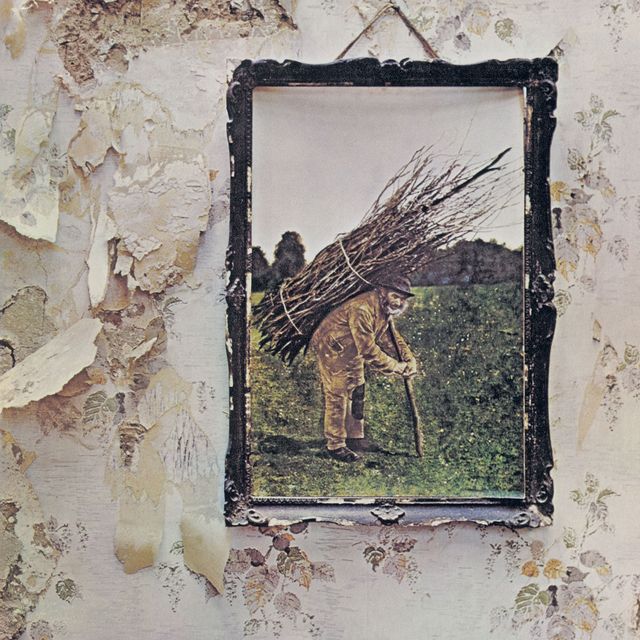

In November 2023, a British newspaper finally identified the elderly man photographed carrying a bundle of sticks on the cover of Led Zeppelin's fourth album: a Wiltshire thatcher named Lot Long, dead since 1893, whose portrait Robert Plant had come across in a Reading antiques shop nearly eighty years after it was taken. It took the internet half a century to answer a question the band itself never bothered to address — not who the man was, but whose record this even was. Led Zeppelin released their fourth album on November 8, 1971, with no title on the cover, no band name anywhere on the sleeve, and nothing to identify it beyond four cryptic symbols the members chose for themselves. Recorded largely inside an unheated, half-derelict Hampshire manor house with a recording truck borrowed from the Rolling Stones, it produced the band's most enduring single piece of music: an eight-minute song that has never been released as a single and remains, by most measures, the most-played track in the history of American FM radio. It has since sold more than 37 million copies worldwide — a genuinely strange outcome for a record that shipped with nothing on its cover to tell anyone who made it.
“It might seem incongruous to say that a hard rock band has produced an album which is remarkable for its low-keyed and tasteful subtlety, but that's just the case here.”
No Name, On Purpose
The decision to strip the album of a title traces directly back to how badly the music press had treated its predecessor. Led Zeppelin III had been dismissed by critics who heard its acoustic detour as a band running out of ideas, and Jimmy Page, who produced every Led Zeppelin record himself, wanted the follow-up judged on nothing but the music. “After all the crap that we'd had with the critics,” he later said, “I put it to everybody else that it'd be a good idea to put out something totally anonymous.”
Atlantic Records hated the idea and said so; the band responded by refusing to hand over the master tapes until the label agreed to release the album with no title, no artist name, and no text of any kind on the front or back cover. As a compromise of sorts, each of the four members picked a personal symbol from a reference book of historical and occult signs to stand in for a name: an alchemical glyph for Saturn for Page, a triquetra for John Paul Jones, three interlocking rings for John Bonham, and a feather that Robert Plant said represented the ancient Mu civilization for himself. Pressed for decades to explain his own choice, Page has mostly declined, saying only that it was “a way of stripping away the whole thing of a personality cult.”
The cover art carried the same instinct further. Plant found a colorized Victorian photograph of an old man with a bundle of sticks on his back in an antiques shop near Page's home in Pangbourne and suggested they build the sleeve around it, pasted onto a crumbling wall inside a demolished cottage. The back cover showed a modern tower block — Page's deliberate contrast between the rural past being torn down and the present rising in its place. Inside the gatefold, a hooded figure holding a lantern, painted by an artist credited only as “Barrington Colby MOM,” echoed the Hermit card from the Rider-Waite tarot deck. Nobody involved bothered to record who the old man on the front actually was; it took researchers until 2023 to identify him as Lot Long, a thatcher from Mere, Wiltshire, photographed in 1892, by which point the mystery had already outlived most of the people who could have solved it in an afternoon.
Headley Grange and the Rolling Stones' Truck
Recording began in December 1970 at Island Studios in London before the band relocated to Headley Grange, a decaying Hampshire poorhouse-turned-manor with no working heat and a reputation, among the musicians who'd used it before them, for being genuinely unpleasant to sleep in. They brought the Rolling Stones Mobile Studio — a state-of-the-art recording rig built into a truck at the suggestion of Stones pianist and road manager Ian Stewart — and parked it in the driveway, running cables into whatever room felt right that day.
Engineer Andy Johns, who ran the sessions alongside Page, has said the discomfort of the place was the point: without a proper control room separating the band from the recording gear, everyone worked in close quarters, which pushed the band toward looser, more spontaneous takes than a conventional studio would have allowed. Overdubs were finished afterward at Island Studios in London, and the whole record was mixed later at Sunset Sound in Los Angeles — a transatlantic hop that gave the album its odd shape: songs born from drafty-room improvisation, polished in two very different professional rooms months apart.
That informality produced the album's most famous piece of studio folklore. Working late one night on “Four Sticks” and getting nowhere, the band took a break; Bonham started drumming the intro to Little Richard's “Keep A-Knockin',” Page answered with a Chuck Berry-style riff, and the rest of the band joined in one by one. Stewart, still hanging around from setting up the mobile truck, sat down and played piano on what became “Rock and Roll” — the only outside musician who ever appeared on a Led Zeppelin studio recording.
Named after a stray Labrador that wandered the grounds at Headley Grange.
Eight Songs, No Filler
What Kaye meant by “low-keyed subtlety” is really a description of range. The album moves from the riff-driven strut of “Black Dog” and the borrowed-and-transformed rock and roll of its title-adjacent jam, through the English folk of “The Battle of Evermore” and “Going to California,” into the slow-building rock epic of “Stairway to Heaven” and the blues-soaked dread of “When the Levee Breaks,” without any single style dominating the sequence. Bassist John Paul Jones has said the riff for “Black Dog” came directly out of listening to Muddy Waters' Electric Mud and wanting to try “a riff that would be like a linear journey” against a rolling bass part — the finished version deliberately staggers the band's 4/4 groove against Plant's vocal phrasing, a syncopation so difficult that an early attempt in 3/16 time had to be abandoned because, in Jones's words, “no one could keep up with that.”
“The Battle of Evermore” is the outlier: the only Led Zeppelin studio recording with a guest vocalist, brought in because Plant felt his own two-part lyric, a Tolkien-inflected exchange between two voices, “didn't sound right in one voice, one pitch.” He asked his friend Sandy Denny, of the folk group Fairport Convention, to sing the second part. “Sandy and I were friends,” Plant said simply. “It was the most obvious thing to ask her to sing.” It remains the only Led Zeppelin song to feature another singer at all.
Even the album's handling of its blues source material was unusually honest for a band whose back catalog is full of uncredited borrowings. “When the Levee Breaks” reworks a 1929 Kansas Joe McCoy and Memphis Minnie recording about the Great Mississippi Flood of 1927, and the original 1971 pressing credited Memphis Minnie alongside all four band members as a co-writer — a level of acknowledgment several other Zeppelin tracks built on blues originals conspicuously lacked, and one that didn't need a lawsuit to happen.
Essential Tracks
“Black Dog”
Named, according to Page, after an old Labrador that hung around the kitchen at Headley Grange and vanished for a night before reappearing to sleep the whole next day — “we thought: ‘oh, black dog’ … he's been out on the razzle” — the song opens the album with a riff John Paul Jones built after immersing himself in Muddy Waters' electric blues records.
Its call-and-response structure, Plant's a cappella vocal lines answered by the full band slamming back in on a beat that doesn't land where the ear expects it, is deceptively difficult to play and even harder to dance to — the syncopation between the 4/4 riff and the vocal phrasing was so disorienting to the band itself that an early, stricter time-signature version had to be scrapped.
Released as the album's only American single, it became a hard-rock blueprint imitated for decades — proof that a riff could be rhythmically strange and still be one of the most immediately recognizable openings in rock history.
“Stairway to Heaven”
Written largely in one sitting beside an evening fire at Headley Grange, with Page working out chords on an acoustic guitar and Plant scribbling lyrics as they came to him, the song built from folk fingerpicking to full-band bombast over eight minutes — a structure nobody at the label expected to work on rock radio, let alone define it. “Robert started writing the lyrics,” Page recalled, “and much to his surprise, he wrote a huge percentage of it right there and then.”
Atlantic pushed hard for an edited single version; the band refused outright, arguing the song couldn't survive being cut down, and no single was ever issued anywhere in the world. That refusal didn't hurt it commercially in the slightest — American rock radio simply adopted the album track wholesale.
By 1991, twenty years after release, industry estimates put its American radio airplay at roughly 2.874 million spins — a figure that, played back to back, would run for over 44 years continuously. No other rock song has come to define an entire album's legacy quite so thoroughly.
“When the Levee Breaks”
The album's closer reworks a 1929 Memphis Minnie and Kansas Joe McCoy blues about the Great Mississippi Flood into something closer to doom rock, anchored by what is still one of the most sampled drum recordings ever made. Engineer Andy Johns has said the idea to move Bonham's kit into the stairwell at Headley Grange was his own: “One night Zeppelin were all going down the boozer and I said, ‘You guys bugger off but Bonzo, you stay behind because I've got an idea.’”
Two ribbon microphones hung two floors up captured the natural boom of the stairwell, run through a Helios console and a Binson Echorec echo unit to thicken the decay even further. The result is a drum sound with a cavernous, compressed weight that conventional studio miking of the era simply couldn't produce.
That single drum break has since been sampled by artists from the Beastie Boys to Dr. Dre, making a blues song about a 1927 flood, recorded in a stairwell in rural England, one of the most quietly influential rhythm tracks in hip-hop history.
Never released as a single, yet by most estimates the most-played song in American FM radio history.
A Record With No Singles, On Purpose
Despite arriving with no title and, in the UK, no singles at all, the album topped the British chart on release and eventually peaked at No. 2 on the Billboard 200 in America — its only real obstacle to the top being blocked out that winter, never quite dislodging whatever held the top spot at the time. What it lacked in chart-topping American singles it made up for in sheer staying power: it has spent a cumulative total of hundreds of weeks on the Billboard catalog charts in the decades since.
The RIAA certified the album 24× Platinum in the United States, and it has sold more than 37 million copies worldwide — multi-platinum or diamond-equivalent status in the UK, Canada, Australia and France among others. Virtually all of that was driven by album sales and radio play rather than singles marketing, since “Black Dog” was the only track from the record ever formally released as a single, and only in the US.
Won Over the Critics Who'd Panned Them
Rolling Stone had a well-documented history of hostility toward the band by 1971 — John Mendelsohn had savaged their 1969 debut, and Lester Bangs' review of Led Zeppelin III had been openly conflicted. Against that backdrop, Lenny Kaye's review of the untitled fourth album, praising “the sheer variety of the album: out of eight cuts, there isn't one that steps on another's toes,” and calling it the band's “most consistently good” release, marked a genuine turn in how the magazine covered them.
Retrospective critical opinion has settled somewhere between admiring and definitional. AllMusic's Stephen Thomas Erlewine called it “a monolithic record, defining not only Led Zeppelin but the sound and style of '70s hard rock,” one that “encompasses heavy metal, folk, pure rock & roll, and blues” without favoring any single mode. Of the closing track specifically, he wrote that it's “as forceful and frightening as Zeppelin ever got,” its “seismic rhythms and layered dynamics” illustrating why the band's many imitators could never quite reproduce the effect.
I put it to everybody else that it'd be a good idea to put out something totally anonymous.
The gamble of anonymity, in other words, worked in exactly the way Page had hoped: stripped of a name to react to, critics and listeners alike were left with nothing to judge but the music itself, and the music won.
Four Symbols, Fifty-Five Years of Interpretation
An album with no title and four occult symbols instead of a band name was always going to attract exactly the kind of mythology it did. Rumors of hidden messages and backward-masked lyrics on “Stairway to Heaven” circulated for decades, fueled almost entirely by the band's refusal to explain any of the artwork's symbolism in detail. Page has spent fifty years declining to fully decode his own ZoSo glyph; Plant has offered slightly more, framing his feather symbol as a reference to an ancient civilization most listeners had never heard of. The vagueness was, if anything, the point — a blank space fans could fill with whatever meaning they wanted.
That blank space extended even to the cover's literal subject matter. For fifty-two years, nobody involved in making the album, and nobody covering it, knew or apparently cared who the man with the sticks actually was. His identification in 2023 as Lot Long, a Wiltshire thatcher photographed by Ernest Howard Farmer in 1892, closed one of rock's longest-running trivia questions without changing a single thing about how the album sounds or what it means — a fittingly anticlimactic answer for a record built entirely around withholding information.
The album's influence has outlasted every mystery attached to it. “Stairway to Heaven” remains a fixture of classic rock radio and one of the most-covered songs in popular music; “When the Levee Breaks” became foundational sample material for hip-hop producers who never touched a Led Zeppelin record otherwise; and “Black Dog”'s asymmetric riff structure turned up, in one form or another, across four decades of hard rock and metal. Fifty-five years after a band deliberately hid its own name from the cover, virtually every rock fan alive can identify the album on sight anyway — by the old man, the sticks, and four symbols nobody has ever fully explained.
“A monolithic record, defining not only Led Zeppelin but the sound and style of '70s hard rock.”