Four Symbols, No Name
Led Zeppelin's fourth album shipped with no title and no band name, just four symbols the members chose for themselves. Fifty-five years later, one of them is still a secret.
 Trevor Fortune•🎵 Led Zeppelin - Led Zeppelin IV•5 min read•October 6, 2026
In the weeks before Led Zeppelin's fourth album came out in November 1971, strange adverts started appearing in the music papers. Some were blank except for four small symbols. Others showed the symbols beside the covers of the band's first three albums. There was no title and no explanation. Readers were left to work out for themselves that the symbols were the new record.
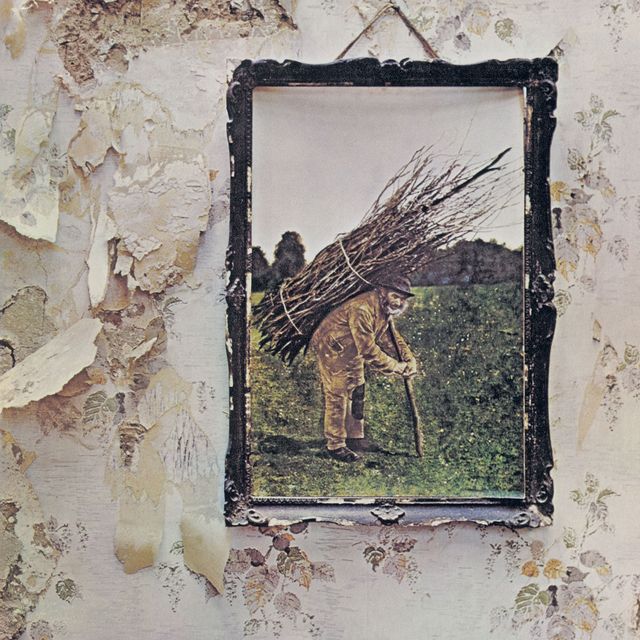
The album itself followed the same rule. Its cover had no band name and no title, front or back. Inside, the only credit was Jimmy Page's as producer. Each member was represented only by a symbol. The record people still call Led Zeppelin IV, Four Symbols, or Zoso went on to become the band's best-selling album.
“Totally Anonymous”
The idea started as a grudge. Led Zeppelin III, released in 1970, had leaned toward acoustic folk, and many critics dismissed it. Some suggested the band could sell anything as long as their name was on the cover. Page decided to test that.
“After all this crap that we'd had with the critics, I put it to everybody else that it'd be a good idea to put out something totally anonymous,” he told Trouser Press in 1977. “At first I wanted just one symbol on it, but then it was decided that since it was our fourth album and there were four of us, we could each choose our own symbol.”
Atlantic Records was against it. Selling a record with no name on it seemed like throwing away the most valuable thing the band had. The band held on to the master tapes until the label agreed. Page remembered the industry's verdict: “After a year's absence from both records and touring, I remember one agent telling us it was a professional suicide. We just happened to have a lot of faith in what we were doing.”
A Book of Signs and a Beer Logo
The two quieter members took the simplest route. John Paul Jones and John Bonham both picked their symbols from The Book of Signs, a collection of historic symbols by the German type designer Rudolf Koch. Jones chose a triquetra, three interlocking arcs inside a circle. It is said to stand for a person with both confidence and competence, because it is hard to draw accurately.
Bonham chose three interlocking rings, said to represent mother, father, and child. At the time he was a young father with his wife, Pat, and son, Jason. The rest of the band noticed something else, to their delight. Turned upside down, the rings looked like the logo of Ballantine beer.
A Feather From a Lost Continent
Robert Plant designed his own: a feather inside a circle. He traced it to a much stranger source. “My symbol was drawn from sacred symbols of the ancient Mu civilization, which existed 15,000 years ago as part of a lost continent,” he said.
Mu was a 19th-century invention, a supposed sunken continent with no basis in geology. Its symbols were popularized by Colonel James Churchward in books such as The Sacred Symbols of Mu. The feather in a circle is also linked to Ma'at, the Egyptian goddess of truth and justice. For a singer who wrote about Vikings and Tolkien, it fitted well.
The One Page Won't Explain
Page's symbol was the one everyone tried to read. It looked like a word, and fans started calling it “Zoso.” Page said that missed the point. “A lot of people mistook it for the word ZoSo, which is a pity because it wasn't supposed to be a word at all but something entirely different.”
What it was, he has never said publicly. Researchers have found nearly the same symbol in an 1844 French dictionary of occult signs, and others link it to astrological marks for Saturn, the ruling planet of Page's sign, Capricorn. Page has confirmed none of it. Plant was told once. “Page once took me aside and said, ‘I'm going to tell you the meaning of this once, and then I shan't ever mention it again,’” Plant recalled. Plant has since forgotten what he was told.
"My symbol was about invoking and being invocative. That's all I'm going to say about it."
There was also a fifth symbol. Sandy Denny of Fairport Convention sang on “The Battle of Evermore,” the only time Led Zeppelin brought in a guest vocalist. In the inner sleeve she was represented by three small triangles. It is not clear whether she chose them herself.
Names Anyway
The anonymity worked as a statement and failed as a disguise. Everyone knew who had made the record. It reached No. 2 in America and has been certified 24-times platinum there. “Stairway to Heaven,” never released as a single, became the most famous song on it. Critics who had dismissed III came around.
The symbols ended up working as names after all. Page's showed up on the inner sleeve of Plant's 1988 solo album Now and Zen, on which Page played, and on the cover of his live album with the Black Crowes. Jones used a version of his triquetra on the cover of his 1999 solo debut, Zooma. Plant put the feather on the back of his 2010 album Band of Joy. Bonham's rings appeared on his son Jason's drum kit.
Page has never regretted keeping his own symbol a mystery. “The cover was supposed to be something that was for other people to savour,” he told The Times in 2010, “rather than for me to actually spell everything out.” He had set out to make the band anonymous, and in the end only his own symbol stayed that way.
Related Review
Read our comprehensive analysis of Led Zeppelin's Led Zeppelin IV
Led Zeppelin IV Review →