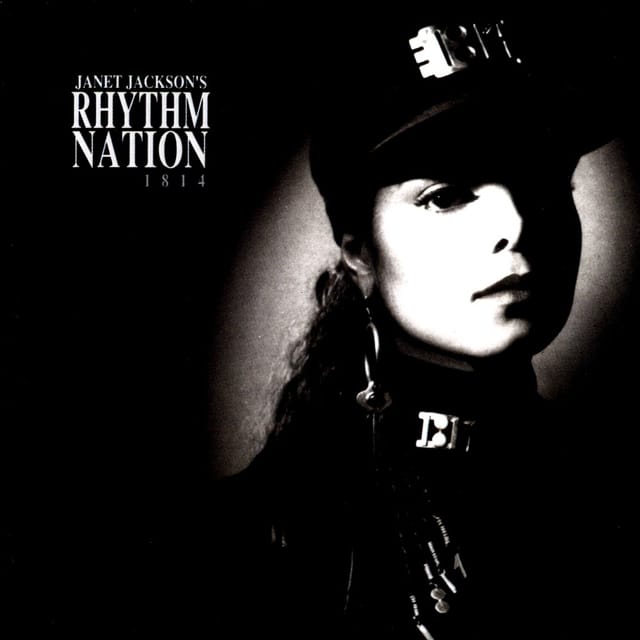
1814
Three years after Control declared her independence, Janet Jackson looked at a country full of school violence, poverty, and racism and decided the follow-up needed to be about everyone else, not just her.
 Trevor Fortune•🎵 Janet Jackson - Rhythm Nation 1814•9 min read•September 22, 2026
Jimmy Jam remembers the mood in the studio less as a plan than as an accident of what was playing in the room. “Watching music videos on one side and watching atrocities on the other,” he said of the sessions. “Somehow they all merged together.” Control, the 1986 album that turned Janet Jackson from a quiet A&M ingenue into a self-directed star, had taken six weeks to record and was built almost entirely around her own life — firing her father as manager, choosing her own producers, writing about her own independence. Rhythm Nation 1814, its follow-up, took six months and turned outward instead: militaristic uniforms, industrial percussion, and a title built from a number that meant nothing to anyone until Janet explained it herself.
Six Weeks, Then Six Months
Control was Janet's declaration that she was done being handed material. She replaced her father Joseph Jackson's management with A&M's John McClain and traveled to Minneapolis to work with Jimmy Jam and Terry Lewis, a production team then known mostly for club and R&B records rather than pop blockbusters. “Jimmy and I rode around Minneapolis and we talked about my life and what I had gone through,” Janet later said of the sessions. The album that resulted hit No. 1 on the Billboard 200, spun off four R&B chart-toppers, and had gone five-times platinum by the time its follow-up arrived.
Jam has been blunt that the team never intended Control to be the whole story. “Control was nice, but it was just the beginning of the story and not the end of it,” he said. What he and Terry Lewis felt Control had proven wasn't just that Janet could sing — it was that she had something more specific missing from her earlier records: “We felt that Janet had a great singing voice, but we knew that her attitude was what was missing.” Attitude alone, though, wasn't going to be the whole engine of a second album. Something else was filling the room by the time sessions for the follow-up began.
The News in the Background
The pivot from personal liberation to collective outrage wasn't plotted out on a whiteboard — by Jam's account, it leaked in from whatever was on television during the sessions. “You couldn't help but somehow be impacted by the things that were going on,” he said. “It was a crazy time. The Reagan years were ending. There were school shootings.” The sessions ran through a genuinely brutal stretch of American news — including, in January 1989, a racially motivated schoolyard shooting in Stockton, California, that killed five children, most of them refugees. Jam and Lewis have described watching coverage of youth violence directly alongside the music they were building in real time: “We were watching CNN and there had been a school shooting and all these kids had been getting killed, and we just thought, we gotta talk about that on a record.”
Terry Lewis has described the writing mindset in similarly direct terms — not a marketing pivot toward “serious” music, but a genuine sense of obligation. “At the time, we were trying to make some statements about worldly things,” he said. “You have to bring some awareness and have a voice in the times that you live in.” It was an unusual instinct for a 23-year-old pop star three years removed from an album about her own independence to indulge — and an even more unusual one for her label to greenlight.
"The album needed to sound angry, stark, and have wind blowing in the middle of nowhere."
A Trivia Answer Becomes a Title
The album's strangest and most enduring detail is its title, which sat unexplained on record store shelves for years before Janet finally spelled it out publicly: 1814 is the year Francis Scott Key wrote “The Star-Spangled Banner.” The team stumbled onto the connection almost as a joke. “I was kidding around, saying, ‘God, you guys, I feel like this could be the national anthem for the '90s,’” Janet recalled, after she and the producers realized the historical coincidence sitting inside the date. What started as a throwaway line became the album's organizing idea — a self-consciously patriotic, multiracial anthem built to answer a document written 175 years earlier by someone who never imagined its author.
The sound underneath that concept was built almost entirely from found and improvised noise rather than conventional studio instrumentation. “We used glass breaking, trashcan lids, and stomping feet to create the imagery for the record,” Jam said. The title track's central groove came from a sample of Sly and the Family Stone's “Thank You (Falettinme Be Mice Elf Agin),” looped through an AMS delay unit that held only six seconds of sample memory — a genuine technical constraint that Jam worked around by hand, triggering the loop manually rather than programming it. “I never sequenced any of the keyboards,” he said. “Everything was on analog tape and nothing was sequenced.” The industrial-sounding, mechanized percussion that defined the record's identity was, underneath the effect, almost entirely played and triggered live rather than automated.
Aiming Past the Already Convinced
Janet was explicit about wanting the record to reach an audience that protest music typically never touches — not the listeners already primed to agree with it. Comparing herself to artists already associated with political songwriting, she drew a sharp distinction: “I feel that most socially conscious artists — like Tracy Chapman, U2 — I love their music, but I feel their audience is already socially conscious.” The goal wasn't to preach to a converted crowd; it was to smuggle the same message into music built for Top 40 radio and MTV rotation, where an audience with no particular interest in activism would hear it whether or not they came looking for it.
She was careful, too, not to overstate what a pop record could actually accomplish. “I know a song or an album can't change the world,” she said. “But there's nothing wrong with doing what we're doing to help spread the message.” That modesty sat oddly alongside an album built with genuine maximalist ambition — a black-and-white short film, unisex military-style uniforms, and choreography by Janet herself alongside a then-largely-unknown Anthony Thomas, built to look less like a pop star's stage show than a movement with its own uniform.
A Record No Album Has Matched Since
Robert Christgau, reviewing the album at the time for The Village Voice, gave it an A− and captured the tension between Janet's voice and her subject matter directly: “Her voice is as unequal to her vaguely admonitory politics as it was to her declaration of sexual availability, but the music is the message,” he wrote, adding that “never before have Jam & Lewis rocked so hard for so long.” It was a fair description of an album that succeeded more on the strength of its production than any single vocal performance.
Commercially, nothing before or since has quite matched what Rhythm Nation 1814 did on the charts. It remains the only album in Billboard Hot 100 history to produce seven Top 5 singles — “Miss You Much,” “Rhythm Nation,” “Escapade,” “Alright,” “Come Back to Me,” “Black Cat,” and “Love Will Never Do (Without You)” — with four of them reaching No. 1 across three separate calendar years, 1989 through 1991. The accompanying short film won the Grammy for Best Long Form Music Video, Janet's first career Grammy, and the album earned her a nomination for Producer of the Year, Non-Classical, making her the first woman ever nominated in that category.
Looking back on the album decades later, Jam has expressed something closer to frustration than pride about how well its message has aged. “The fact that the lyrics remain relevant is a bit of a disappointment actually,” he said. “It means we haven't moved too far away from the prejudice, ignorance, hate and racial bias that we spoke about 30 years ago.” It is a strange kind of legacy for a record built specifically to feel urgent in its moment — still urgent, decades past the moment it was made for.
The two records, side by side, tell a story neither one tells alone. Control asked to be trusted with her own life. Rhythm Nation 1814 asked something much larger — to be trusted with everyone else's — and built a military uniform, a stolen national anthem, and six seconds of sampled Sly Stone into the vehicle for making that ask impossible to ignore.
Related Review
Read our comprehensive analysis of Janet Jackson's Rhythm Nation 1814
Rhythm Nation 1814 Review →