
On June 18, 1976, ABBA performed at the Royal Swedish Opera in mock-baroque costumes. They were playing for King Carl XVI Gustaf and his bride-to-be, Silvia Sommerlath, the night before their wedding. They premiered a song that wouldn't be released for another nine weeks: “Dancing Queen.”
The song had started as a demo called “Boogaloo.” It opened Arrival, ABBA's fourth album, released two years after Eurovision made them famous. Plenty of people had written them off as a novelty act. This album showed they could last.
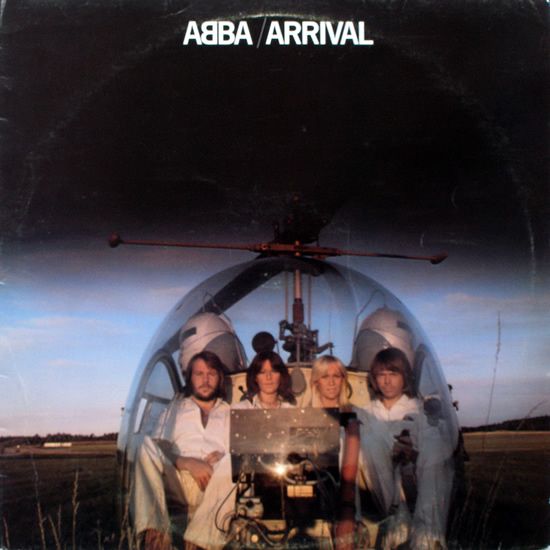
They made it over thirteen stop-start months at Metronome Studios in Stockholm. The cover shows the group inside a Bell 47 helicopter, and the album included three of the biggest singles of the decade. Fifty years on, the Library of Congress has added it to the National Recording Registry.
“Writer-producer-singers Benny Andersson and Bjorn Ulvaeus know enough about the value of pop sentimentality, strong melodic hooks and luring female voices to disarm even the toughest detractors.”
A Groove Borrowed from George McCrae
By the summer of 1975, ABBA had a Eurovision win, a US Top 10 hit in “Waterloo,” and a manager, Stig Anderson, who refused to believe a Swedish band couldn't sustain a global career. What they didn't have yet was a rhythmic idea that could carry a fourth album. Benny Andersson and Björn Ulvaeus were devoted Stevie Wonder fans, but as songwriters raised on tidy European hit music, neither could naturally write the kind of loose, syncopated groove that drove American radio. So they did what session musicians have always done: they studied a record that already worked. George McCrae's 1974 US number one “Rock Your Baby” became the reference point, not to copy outright but to reverse-engineer its shuffle into something they could call their own.
The song that resulted, first demoed under the working title “Boogaloo,” was the first track the group recorded for the album, in August 1975 — a full year before anyone outside the studio would hear it. ABBA's perfectionism kept the recording unfinished for months: sections were cut, verses were reordered, and the song that became “Dancing Queen” eventually ran with its original third and fourth verses moved to the front. Deliberately slowed to a swaying 100 beats per minute rather than a dancefloor-standard 120, it was built to feel unhurried even while describing a girl who “can dance, can jive, having the time of her life.”
How a backing track called “Boogaloo” made Frida cry, premiered at a royal wedding gala it wasn't written for, and ended up at every wedding reception since is its own story: A Song Called Boogaloo: How ABBA's ‘Dancing Queen’ Became the World's Wedding Song →
Then everything stopped. With “Mamma Mia” and “SOS” still climbing charts across Europe, ABBA spent late 1975 and early 1976 promoting singles instead of finishing an album, including a tour of Australia so overwhelming it earned its own name: Abbamania, a level of pandemonium the group hadn't previously encountered outside Sweden. The album sessions didn't resume until March 1976, seven months after they'd begun, forcing the group to return to a nearly finished “Dancing Queen” and build an entire record around it from a standing start.
Michael Tretow's Wall of Sound
If Andersson and Ulvaeus wrote the songs, engineer Michael B. Tretow built the sound they lived inside. Officially just the sound engineer at Metronome, Tretow functioned as ABBA's uncredited co-producer on every classic-era album, and Arrival is where his layering techniques became load-bearing rather than decorative. Recording synthesizer overdubs for the album's title track, Tretow physically relocated the amplifier around the studio floor for every new pass, chasing a different room reflection each time so that a single Polymoog part would sound, on playback, like a small ensemble of real instruments breathing together.
He described the method plainly in a 1980 interview with Sound International magazine: “To get a ‘natural’ sound, as if it were a bunch of real instruments playing out in the studio, I moved the amp in the room for every overdub we made, and recorded each harmony in stereo on two tracks.” Tretow also nudged the 24-track tape machine's speed by half a percent between certain takes, a deliberate pitch deviation too small to hear as an error but large enough to widen and thicken doubled vocal and instrumental lines — the same illusion-of-scale trick Phil Spector had chased a decade earlier with an actual wall of musicians, achieved here with two singers, a handful of Stockholm session players, and patience.
That session core — guitarists Janne Schaffer and Lasse Wellander, bassists Rutger Gunnarsson and Mike Watson, and drummers Ola Brunkert and Roger Palm — were Swedish players of genuinely international caliber, and their arrangement instincts shaped songs as much as the credited writers did. Brunkert and Gunnarsson would go on to appear on every ABBA album through the group's 1982 hiatus; Roger Palm's single credited contribution to Arrival was, fittingly, the drums on “Dancing Queen” itself.
Directed by Lasse Hallström, the video captures the song that took a year, three verses' worth of edits, and a stolen George McCrae groove to finish.
Ten Songs, No Filler
Modeling their album sequencing on the Beatles, Andersson and Ulvaeus built Arrival around contrast rather than a single mood. The record opens with “When I Kissed the Teacher,” a throwback to innocent 1960s girl-group pop sung by Agnetha, and closes its first side with “Knowing Me, Knowing You,” a soft-rock ballad about the end of a marriage sung by Frida. In between sit “My Love, My Life,” a stripped-down heartbreak ballad, and “Dum Dum Diddle,” a deliberately lightweight pop-rock trifle that biographer Carl Magnus Palm has called the “complete antithesis” of the tougher “Tiger” on side two.
The second side pushes further outward still: “Money, Money, Money” borrows its minor-key cabaret swagger from Weimar-era theater music, a jarring tonal left turn from anything ABBA had released before, while the instrumental title track closes the album on a folk-influenced, fiddle-heavy passage built almost entirely around Andersson's keyboard playing — a purely Scandinavian musical signature planted at the end of the group's most consciously international-sounding record. Virtually every track on the album, unusually for a 1976 pop LP, could plausibly have been issued as its own single.
That variety carried a quieter shift in who got to sing lead. Agnetha and Frida front almost every track on Arrival, a deliberate move away from the more male-forward arrangements of ABBA's earlier records. “Knowing Me, Knowing You” in particular struck a chord Andersson himself later ranked among the group's finest work, calling it one of their five best recordings — high praise from a songwriter not given to hyperbole about his own catalog.
Essential Tracks
“Dancing Queen”
No song on Arrival took longer to finish or traveled further. Started in August 1975 and not released until August 1976, “Dancing Queen” went through months of editing before Andersson and Ulvaeus considered it complete — re-sequencing its own verses so the third and fourth became the opening, trimming sections, and slowing its tempo below standard disco speed to give the song a glide rather than a stomp. The George McCrae-inspired groove underneath is played so lightly that most listeners never register it as a borrowed idea at all.
Its world premiere came nine weeks before release, performed for Swedish royalty in baroque costume at a televised gala — a strange, formal debut for a song built entirely around the pleasure of losing yourself on a dance floor. Nine weeks later it was a genuine single; eight months after that, in April 1977, it became ABBA's only US number one, the single achievement that finally made the group impossible to dismiss as a European novelty act.
Half a century later, it remains the song most casual listeners mean when they say “ABBA,” a rare instance of a band's most laboriously reworked track becoming its most effortless-sounding one — a year of edits and re-edits in service of four minutes that sound like they took no effort at all.
“Knowing Me, Knowing You”
The first song recorded once sessions resumed in March 1976, “Knowing Me, Knowing You” gave Frida the lead on a soft-rock ballad about a marriage ending — empty rooms, a house “where children used to play,” the quiet aftermath rather than the argument itself. Andersson later ranked it among the group's five best recordings, a rare instance of a songwriter singling out his own work without qualification.
The Who's Pete Townshend later singled the song out as a genuine departure for pop songwriting, noting that “ABBA was one of the first big, international bands to actually deal with sort of middle-aged problems in their songwriting” — domestic collapse rather than teenage heartbreak, sung by a woman rather than narrated around her.
Written years before any of the two ABBA couples actually separated, the song has since folded backward into the group's own biography, read now as an eerie preview of the divorces that would later shape “The Winner Takes It All” — a coincidence of timing that gives an already sad song a second, unintended layer of sadness.
“Money, Money, Money”
Built around a minor-key piano vamp closer to Weimar cabaret than Swedish pop radio, “Money, Money, Money” gave Frida a character to inhabit rather than a feeling to express: a working woman dreaming of marrying into money she can't earn on her own, singing the fantasy with just enough theatrical edge to keep it from curdling into bitterness.
Released as the album's second single on November 1, 1976, it topped the Eurochart for four weeks, proof that the group's audience would follow them somewhere tonally darker and more theatrical than “Dancing Queen” had suggested just months earlier.
Its theatrical sneer made it an outlier on the album and, decades later, one of its most sampled and covered tracks — a song built for a stage rather than a dancefloor, closer in spirit to a Kurt Weill number than anything else in the ABBA catalog, and proof the group had range well beyond the sunny pop the press pigeonholed them into.
The album's cabaret-tinged second single, a tonal departure the group's audience followed anyway.
A Helicopter, a Backwards B
The cover photograph — all four members sealed inside the bubble canopy of a Bell 47 helicopter, shot at Barkarby airfield northwest of Stockholm — was ABBA's own idea, and a deliberate one. The group had spent two years crossing continents to promote records, and the helicopter was meant to signal that they had arrived, literally and commercially, as major-league players rather than a Eurovision novelty. Designer Rune Söderqvist shot the cover and, in the same sitting, debuted the now-instantly-recognizable ABBA logo, its backwards second B a small piece of graphic design that would outlive most of the band's chart records.
Not everyone read the image as triumphant. One contemporary observer described it as unfortunate specifically because it showed the group “untouchable, behind glass and ready to take off back to their closely guarded private world” — a sharp break from the open, grinning group shots on ABBA's first three album covers. Whether it read as confident or standoffish depended entirely on whether the viewer already believed the band deserved to be taken seriously.
Critics in 1976 mostly didn't. Robert Christgau, reviewing the album for The Village Voice, gave it a flat “C” and built his review around a running joke about how to stop ABBA's advance now that they were, in his telling, already the best-selling group in the universe — half-serious plans for “heading them off at the airport.” Rolling Stone's Ken Tucker was blunter still, dismissing the record as “Muzak mesmerizing in its modality.” The dismissal wasn't universal — the Los Angeles Times's Robert Hilburn heard exactly what made the songs work — but it was loud enough that ABBA spent the rest of the decade a commercial phenomenon the Anglo-American rock press mostly refused to take seriously.
The Album Britain Finally Bought
Whatever the reviews said, the charts told a different story, and nowhere more clearly than in Britain, where ABBA had struggled after “Waterloo.” The UK singles that immediately followed the 1974 Eurovision win stalled outside the Top 30 or missed entirely, until “SOS” reached the Top 10 in 1975 and the group's Greatest Hits topped the albums chart in 1976. Arrival, released in Britain on November 5, 1976, took eight weeks to climb to number one — ABBA's first British chart-topping studio album — and went on to become the best-selling album of 1977 in the UK.
In the US, the album peaked at a comparatively modest No. 20 on the Billboard 200, certified Gold by the RIAA — real success, but nowhere close to the dominance ABBA enjoyed almost everywhere else. Australia and Germany both sent the album to number one, part of a wider pattern in which ABBA's commercial center of gravity sat firmly outside the English-speaking rock establishment that reviewed them.
At their best, as on Arrival, ABBA were as mysterious as Bowie, as rococo as Phil Spector, as unbearably sad as the Smiths.
That gap between reviews and sales has narrowed considerably with time. AllMusic's Bruce Eder gave the 2001 reissue 4.5 out of 5 stars, and The New Rolling Stone Album Guide — the same publication that dismissed the album on arrival — awarded it 4 out of 5 in its 2004 edition. Pitchfork's reassessment went further still, placing Arrival alongside Bowie and Phil Spector as reference points for a band still routinely underestimated on the strength of how easy its songs sound.
From Novelty Act to National Registry
The clearest sign of how far critical opinion has traveled arrived in 2024, when the Library of Congress selected Arrival for preservation in the National Recording Registry, its list of recordings deemed “culturally, historically, or aesthetically significant.” The accompanying essay, written by ABBA's own biographer Carl Magnus Palm, frames the album as the moment the group stopped finding out what they were good at and started building entire records around it — every track a plausible single, both women singing lead on almost everything, a full band operating at the peak of its arranging power.
That reassessment runs deeper than nostalgia. Michael Tretow's layered, pitch-shifted overdub techniques on Arrival anticipated production tricks that would become standard practice decades later, and the album's frank handling of divorce and adult disappointment — a full three years before any ABBA marriage actually ended — gave pop radio subject matter it rarely touched. Townshend's observation about “middle-aged problems” wasn't a backhanded compliment; it identified exactly what separated ABBA from the teen-pop competition the rock press lumped them in with.
Fifty years later, the helicopter on the cover reads less like distance from the audience and more like simple accuracy: by the time Arrival reached shelves, ABBA genuinely had left the rest of 1976's pop competition on the ground. Three of its songs are still inescapable; the fourth, the group's own name reduced to a logo with one backwards letter, is one of the most recognized pieces of graphic design in music history.
“Here, the focus is 100 percent on their strengths… virtually every track could have been a successful single A-side.”