
In May 1991, Nirvana went into Sound City, a no-frills studio in Van Nuys, California, to make their second album. They had a $65,000 budget and an indie producer from Madison, Wisconsin, named Butch Vig.
Eight months later, Nevermind knocked Michael Jackson off No. 1 on the Billboard 200. Nobody involved had planned for that, or quite believed it when it happened. The album cost less than many bands spent on a single music video.
It changed what a hit record could sound like. After a decade of polished rock on the radio, Nevermind was loud, rough and angry, and it sold millions anyway.
“Nevermind is a record for people who'd like to like Metallica, but can't stomach their lack of melody.”
From Sub Pop to a Major Label
Nirvana's 1989 debut, Bleach, had come out on Sub Pop, the Seattle indie that pressed 1,000 initial copies and treated a five-figure sales number as a triumph. By late 1990, with Dave Grohl joining on drums that September, the band was drawing major-label interest, and the move to DGC Records — a Geffen imprint — came with the kind of decision that terrified a group still uneasy about the idea of a career: who would produce the follow-up.
Several established names were floated, among them Scott Litt and Don Dixon, producers with hit records and, crucially, requests for royalty points on the finished album. Bassist Krist Novoselic later said the band was already anxious about signing to a major and didn't want to hand away a percentage of a record that might not even sell. They held out instead for Butch Vig, a Wisconsin engineer who had produced an early Nirvana session at his own Smart Studios and whose credits ran through the Midwest underground rather than the charts.
The week before the sessions, Cobain mailed Vig a cassette recorded on a boombox. “It was really terrible sounding,” Vig told Rolling Stone. “But I could hear the start to ‘Smells Like Teen Spirit,’ and I knew it was amazing.” The label set a budget of $65,000, modest even by 1991 indie-to-major standards.
A Month at Sound City
Recording began that May at Sound City Studios in Van Nuys, California, a room Vig described as “pretty much a no-frills studio” — a big, live tracking room built around an aging Neve board, 24-track analog tape, tube mics, and LA2A compressors, the same unglamorous setup that would later make the building famous for an entirely different reason. The band tracked largely live, drums set up in the middle of the room with the other instruments isolated around them, an approach that favored performance over polish before overdubs began.
Off the clock, the sessions were chaotic. The band was living together in a nearby apartment complex, and Vig remembered the scene bluntly: “They were living in this apartment complex, and it was chaos. There'd be graffiti on the walls, and the couches were upside down. They'd stay up every night and go down to Venice Beach until six in the morning.” In the studio, though, Cobain worked with a discipline that belied the reputation. Vig pushed him through extensive guitar overdubs — doubled rhythm parts, separate clean and distorted takes layered through Mesa Boogie, Fender Bassman, and Vox AC30 amplifiers, with Cobain's Rat distortion pedal doing much of the character work.
Drum recording was similarly deliberate for a record that would end up sounding so raw: an AKG D12 and FET 47 on the kick drum, an SM57 on snare, 421s on the toms, and a custom “drum tunnel” built from old shells and extended six feet from the bass drum to isolate room sound. Vocals were cut mostly in the studio's smaller Studio B, straight to tape through a Neumann U67 and an LA2A, with Vig applying heavy compression “so that I could control his dynamics” — a necessity given a voice that could, in his words, “scream and it would have this great rasp” one moment and “sound so world-weary and exhausted and intimate” the next.
The song built from a riff Krist Novoselic first dismissed as 'so ridiculous,' before the band slowed it down and Dave Grohl's drums turned it into the album's defining moment.
Essential Tracks
“Smells Like Teen Spirit”
Cobain wrote the song a few weeks before the Sound City sessions, later admitting the goal was blunt: “I was basically trying to rip off the Pixies.” He brought the band just a riff and a chorus. As Cobain told Rolling Stone in 1994, “Krist looked at me and said, ‘That is so ridiculous.’” Novoselic's fix was to slow the song down and play a verse under it, which gave Grohl room to build one of rock's most recognizable drum openings.
It's credited to all three band members rather than Cobain alone, a small but telling acknowledgment of how much the arrangement — not just the riff — made the song work. The loud-quiet-loud structure Cobain borrowed from the Pixies became the template not just for the song but for the album's entire dynamic vocabulary.
Released as the album's first single in September 1991, it became the unlikely centerpiece of MTV's rotation within weeks and the song that, more than any chart statistic, is credited with ending hair metal's decade-long grip on rock radio almost overnight.
“Come As You Are”
The song's watery, chorus-pedal guitar riff is a slowed-down cousin of Killing Joke's 1985 track “Eighties,” a similarity close enough that Cobain was reportedly nervous about releasing it as a single at all. Killing Joke never took Nirvana to court. The bands' later history took an odd turn: Grohl played drums on Killing Joke's self-titled 2003 album.
Where “Teen Spirit” explodes, “Come As You Are” stays coiled — a hypnotic, mid-tempo groove built to hold tension rather than release it, with a lyric (“come as you are, as you were”) that reads as an invitation and a warning at once.
Released as the album's second single in early 1992, it became Nirvana's second Top 40 hit and, despite the unresolved riff question hanging over it, one of the band's most enduring live staples.
“Something in the Way”
The album's closer imagines a life spent sleeping under Aberdeen's Young Street Bridge — a story that hardened into Nirvana mythology despite Novoselic and biographer Charles Cross both concluding it was never literally true; the muddy banks and fluctuating Wishkah River would have made the spot unlivable. Cobain turned the image into a song anyway, and the image outlasted the correction.
Vig recalled Cobain walking into the control room and insisting the take had to sound almost inaudible: “He was barely whispering, and playing the guitar so quietly you could barely hear it. It was mesmerizing.” It's the record's starkest departure from the loud-quiet-loud formula — a song that simply stays quiet, string section and all, all the way through.
Placed last on the tracklist, it left Nevermind ending not on a chorus built for arenas but on a whisper — a sequencing choice that previewed the more deliberately uncommercial instincts Cobain would chase further on In Utero two years later.
A riff close enough to Killing Joke's 'Eighties' that Cobain worried about releasing it. A decade later, Dave Grohl drummed on Killing Joke's 2003 album.
The Baby, the Hook, and the Dollar Bill
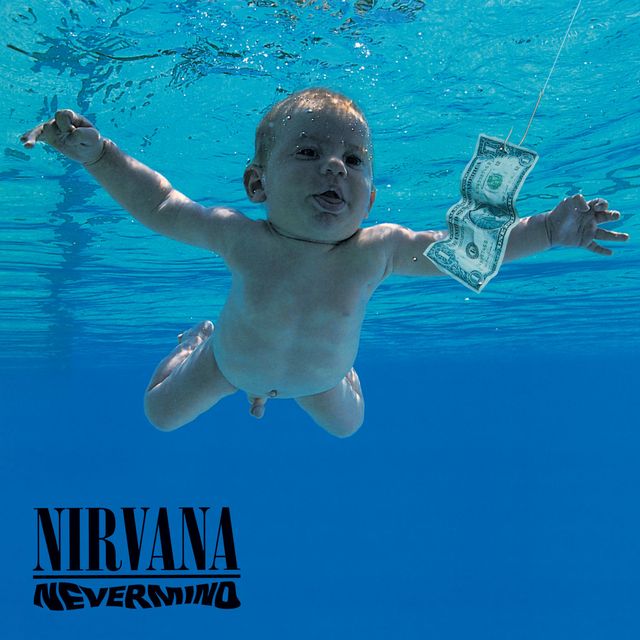
The label needed an arresting image, and photographer Kirk Weddle was handed a brief. “The concept was to create a visual statement by capturing an image of a baby going after a dollar bill on a fishhook underwater,” Weddle later wrote. He cast four-month-old Spencer Elden, the son of his friend Rick Elden, who was paid $200. Weddle shot with an underwater camera on a tripod at the bottom of a pool: seven frames on the first pass, four on the second, and then the baby started to cry.
The fishhook and dollar bill weren't in the water with him; both were stripped in afterward to complete the concept. Cobain, who had wanted the cover to carry an anti-consumerist jab from the start, signed off on the image immediately — it did in one frame what he might otherwise have needed a whole song to say.
It became one of the most recognizable album covers ever printed, reproduced on more dorm-room walls and T-shirts than almost any image in rock history — an odd fate for a photograph that took two passes at a swimming pool.
What happened when the baby grew up and sued is its own story: The $200 Baby: How Nirvana's Nevermind Cover Ended Up in Federal Court →
Nevermind vs. Michael Jackson
Nevermind was released September 24, 1991, and critics recognized something was different almost immediately. Steve Lamacq's NME review that September gave it 9 out of 10, praising a band “making the move from cult indie to major label with not as much as a hiccup” and predicting that “it'll stand up as a new reference point for the future post-hardcore generation.” Robert Christgau, writing in The Village Voice, graded it an A, calling it “proper postpunk” and “loud, slovenly, tuneful music” — hard rock, he argued, “as the term was understood before metal moved in.” Nevermind went on to top the 1991 Pazz & Jop critics' poll that Christgau helped compile.
Commercially, nobody at DGC expected what happened next. Fueled by MTV's heavy rotation of “Smells Like Teen Spirit” and word-of-mouth touring, the album climbed steadily through the fall. On the Billboard 200 chart dated January 11, 1992, Nevermind displaced Michael Jackson's Dangerous from No. 1. By then it was selling roughly 300,000 copies a week. It held the top spot only briefly, then returned for a second week at No. 1 in February — a back-and-forth that captured how unsettled the chart was in that moment.
The album has since sold more than 30 million copies worldwide and was certified Diamond by the RIAA in March 1999. None of it looked inevitable from inside the sessions — a band with one indie album, a producer with no major-label hits, and a label that had set expectations modest enough to hedge against exactly this kind of outcome not happening.
Cobain's Own Verdict
Vig and the band were unhappy with his initial mixes, so they brought in Andy Wallace, who had co-produced Slayer's Seasons in the Abyss. Wallace kept the treatment spare — what Vig described as “a little bit of tight slap echo” and light reverb rather than anything washed-out — but the result was still glossier than the band, and especially Cobain, ultimately wanted.
Cobain never made peace with that polish. Speaking to biographer Michael Azerrad for Come As You Are: The Story of Nirvana, he was unsparing: “Looking back on the production of Nevermind, I'm embarrassed by it now. It's closer to a Mötley Crüe record than it is a punk rock record.” Elsewhere he called it “such a perfect mixture of cleanliness and nice, candy-ass production,” adding, “I think it's kind of lame, myself.”
When I listen to Nevermind, I hate the production, but there's something about it that almost makes me cry at times.
The Album That Ended Hair Metal
Whatever Cobain thought of the mix, it did what almost no other underground rock record had managed: it made major labels rush to sign anything that sounded remotely like it, and it made the polished pop-metal that had dominated MTV since the mid-1980s look instantly, permanently out of date. AllMusic's Stephen Thomas Erlewine has argued the record's impact was never really about intention: “Nevermind was never meant to change the world, but you can never predict when the Zeitgeist will hit, and Nirvana's second album turned out to be the place where alternative rock crashed into the mainstream.”
Erlewine has also made the case that the album's reputation, thirty-plus years on, undersells how simple its actual achievement was: “In retrospect, Nevermind may seem a little too unassuming for its mythic status — it's simply a great modern punk record — but even though it may no longer seem life-changing, it is certainly life-affirming, which may just be better.”
Grohl went on to found Foo Fighters, Novoselic became a fixture of Pacific Northwest political and civic life, and Cobain died in April 1994, less than three years after the album that made him famous against his own instincts. What survives is the record itself — still the reference point every subsequent guitar band gets measured against when a scene claims it's about to change everything, because for one unlikely stretch in early 1992, this one actually did.
“Nevermind was never meant to change the world, but you can never predict when the Zeitgeist will hit.”