The $200 Baby
Spencer Elden was four months old when he was photographed in a Pasadena pool for Nirvana's second album. He spent his teens recreating the picture, and his thirties suing over it.
 Trevor Fortune•🎵 Nirvana - Nevermind•5 min read•October 6, 2026
Rick Elden remembers the pitch as casual. His friend Kirk Weddle, an underwater photographer, had a job for a record label and needed a baby. “Hey Rick, wanna make 200 bucks and throw your kid in the drink?” In 1991 Rick and his wife took their four-month-old son, Spencer, to a public pool in Pasadena. A few months later his photo was on the cover of Nevermind.
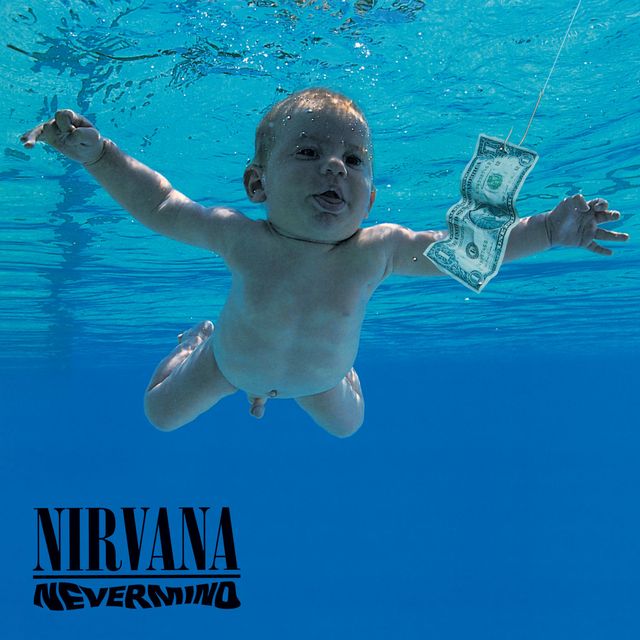
The picture became one of the most recognizable images in rock: a naked baby swimming toward a dollar bill on a fishhook. It has hung in the Museum of Modern Art and been parodied countless times. In 2021 the baby, now 30, filed a federal lawsuit claiming it was child pornography. The case is still in the courts.
Seven Frames, Then Four
The idea came from the band. Kurt Cobain and Dave Grohl had watched a television program about water births and wanted an underwater baby on the cover. The label's brief to Weddle added the satire: a baby “going after a dollar bill on a fishhook underwater.”
Weddle set up the shoot at the Rose Bowl Aquatics Center. He mounted an underwater camera on a tripod on the bottom of the pool and practiced framing with a doll. Spencer's parents and a lifeguard were in the water. Weddle shot seven frames on the first pass and four on the second. Then, he recalled, “the baby started to cry, this had been the babies first time underwater, and we wrapped the shoot.”
The dollar bill and fishhook were never in the pool. They were added afterward. Nevermind came out in September 1991 and reached No. 1 on the Billboard 200 within three months. It has since sold more than 30 million copies. The Eldens had been paid their $200.
The World's Most Famous Baby
Growing up, Elden treated the cover mostly as a curiosity. In 2008, at 17, he went back to the same pool and recreated the shot for the album's anniversary, this time wearing swim shorts. He talked about it with a mix of pride and unease. “It's kind of creepy [to think] that that many people have seen me naked,” he told MTV News. “I feel like I'm the world's biggest porn star.”
In 2016, for the 25th anniversary, he did it again with photographer John Chapple. Elden said he had suggested posing naked, but Chapple thought that would be weird, so he wore shorts. He was paid $200 for that shoot too.
Seventeen Defendants
On August 24, 2021, a month before Nevermind's 30th anniversary, Elden sued. He named Nirvana's business entity, Krist Novoselic, Dave Grohl, Courtney Love as executor of Kurt Cobain's estate, Kirk Weddle, and the record companies that had released and licensed the album: 17 defendants in all. He sought $150,000 from each of them, or damages to be set at trial.
The suit was brought under a federal law that lets victims of child pornography sue for damages. It alleged that the defendants had knowingly produced and profited from an explicit image of a minor. It also said that Elden's parents had never authorized the photo's use and that he had never been paid for it.
The defendants argued, among other things, that he had filed too late. The law set a ten-year limit, and Elden had turned 18 in 2009. In 2022 the district court agreed and dismissed the case as time-barred.
Every Copy a New Injury
Elden appealed, and on December 21, 2023, the Ninth Circuit Court of Appeals revived the case. The three-judge panel didn't rule on whether the cover was child pornography. It ruled only on the deadline. The album had kept selling, and the image had kept being licensed for merchandise, so the clock could restart each time.
"Each republication of child pornography may constitute a new personal injury."
That sent the case back to Judge Fernando M. Olguin to decide the real question: was the photograph pornographic at all?
“Not Child Pornography”
At the end of September 2025, Olguin granted summary judgment to Nirvana and the other defendants. The image, he ruled, did not come close to the legal definition. “Neither the pose, focal point, setting, nor overall context suggest the album cover features sexually explicit conduct,” he wrote. He also noted that Elden had made money from his connection to the image, including by selling memorabilia.
Elden's lawyers filed a new appeal to the Ninth Circuit within days. Bert Deixler, who represents Nirvana, Universal Music Group, and Weddle, answered in one line: “We will resist with vigor and will prevail.”
The courts will decide the legal question. The broader one is harder. A family agreed to a friend's $200 favor in 1991, long before anyone knew what the album would become. The image went on to sell tens of millions of records and decades of T-shirts. The baby in it grew up with no say in any of that, and has spent his adult life deciding what it means to him.