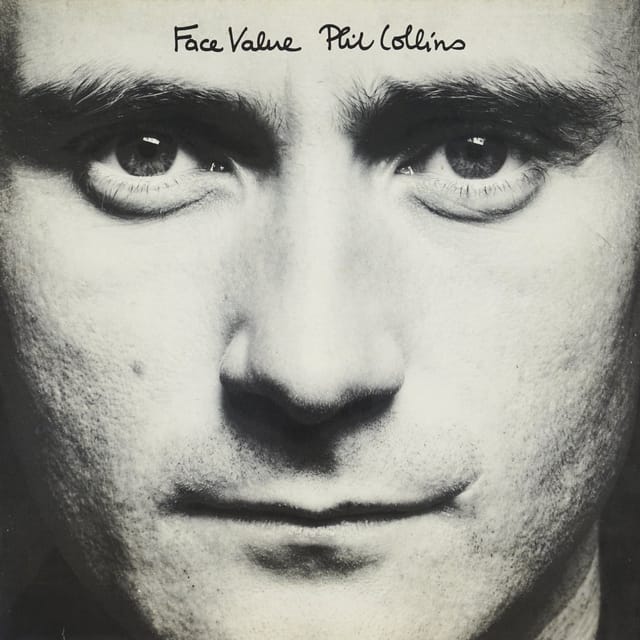
“In the Air Tonight” and the Drowning Man
Pop music's most persistent urban legend, and the true story it buried
 Trevor Fortune•🎵 Phil Collins - Face Value•9 min read•July 20, 2026
For four decades, a story circulated that Phil Collins watched a man drown while someone who could have saved him stood by and did nothing — and that Collins later lured the guilty bystander to a concert, shone a spotlight on him mid-song, and let the crowd know exactly who he was. It is, by Collins's own description, one of the best stories he has ever heard. It is also, he has said flatly, entirely false. The real story behind “In the Air Tonight” is a lot less cinematic and a lot more common: a thirty-year-old drummer, mid-divorce, alone with a drum machine.
A Legend With No Fixed Version
What makes the “In the Air Tonight” myth unusual, even among music urban legends, is how many mutually incompatible versions of it exist. Some tellings involve a drowning at a beach or a lake, with Collins too far away to help and someone closer choosing not to. Others recast it as a boating accident. Some versions swap drowning for a different crime entirely — assault, even murder — with Collins as an eyewitness rather than a participant. Nearly all of them end the same way: years later, Collins supposedly identifies the guilty party from a stage, either by hiring a private investigator to track the man down and buy him a front-row ticket, or by spotting him in the crowd by chance and refusing to let the moment pass.
None of it happened. There was no drowning, no boating accident, no investigator, no spotlight moment of public accusation. But the story didn't need to be internally consistent to spread — it needed only to be vivid, and the song's ominous atmosphere and that four-minute build toward the famous drum break did the rest of the work, giving millions of listeners a soundtrack that felt like it had to be about something.
What the Song Is Actually About
Collins wrote “In the Air Tonight” in 1980 while going through a divorce from his first wife, Andrea Bertorelli, following an affair on her part. He has been consistent about the song's origin for decades, describing it not as a narrative with named victims and villains but as a direct dump of whatever he was feeling at the time.
"When I was writing this I was going through a divorce, and the only thing I can say about it is that it's obviously in anger, the angry side, or the bitter side of a separation."
That reading lines up with the song's actual lyrics far better than the drowning story does — there is no drowning victim named in the song, no confrontation, no rescue withheld. What's there instead is a portrait of someone circling old resentment, aimed at a person who knows exactly what they did without the specifics ever being spelled out. That vagueness, ironically, is probably what let the legend take root in the first place: a song that clearly implies wrongdoing without naming it invites listeners to supply their own explanation.
The Myth Eminem Made Permanent
By 2000, the legend was widespread enough that Eminem could reference it in “Stan” without explaining the premise — a sign of just how deeply it had embedded itself in pop culture. In the song's final verse, the increasingly unstable title character plays “In the Air of the Night” in his car, invoking the drowning myth directly to accuse Eminem of the same failure to intervene, moments before driving off a bridge. The reference didn't explain the legend to listeners; it assumed they already knew it, which by that point, most did.
That kind of unexplained cultural shorthand is usually reserved for stories so widely circulated they've become common knowledge — and for nearly two more decades after “Stan,” Collins mostly let it circulate rather than mount a public campaign against it. It took a 2016 appearance on The Tonight Show Starring Jimmy Fallon, where Fallon read the legend aloud to the studio audience, for Collins to address it directly and conclusively on camera.
"That's the best story I've ever heard in my life. Unfortunately, none of it's true."
The Real Accident Was in the Drum Booth
The strangest part of the song's history is that it does have a genuine origin story worth telling — just not a lyrical one. The record's famous drum sound, the one that detonates midway through the track after four minutes of tension, wasn't designed. It was discovered by accident, and not even during the recording of “In the Air Tonight” itself.
While working on Peter Gabriel's third solo album at the Townhouse Studios, engineer Hugh Padgham was using a brand-new SSL 4000 mixing console fitted with a heavily compressed talkback microphone meant for quiet communication into the live room. During a take with Collins on drums, Padgham triggered the talkback microphone's compressor while a noise gate elsewhere in the signal chain was active. The combination crushed the drum sound's natural decay into something almost nobody in a studio had heard before — explosive, then cut off instantly, rather than trailing off naturally.
"The most unbelievable sound came out because of the heavy compressor. I said, ‘My God, this is the most amazing sound!’"
Rather than treat the accident as a mistake to fix, Gabriel built an entire song around it, having Collins repeat the pattern he happened to be playing until it became the foundation of “Intruder,” the opening track on Gabriel's 1980 album. Collins, who had just lived through the discovery firsthand, carried the same gated-reverb drum sound into his own material soon after, deploying it on “In the Air Tonight” forFace Value later that same year. The technique became one of the defining sonic signatures of 1980s pop and rock production, used on records by artists who had nothing to do with either Collins or Gabriel.
Two Legends, One Song
“In the Air Tonight” ends up carrying two origin stories at once, and the irony is that the false one is the story everyone tells, while the true one — an engineer's wiring mistake on someone else's album, repurposed by accident into the most recognizable drum break of the decade — rarely comes up at all. Collins spent thirty-six years watching a fabricated tragedy attach itself to a song about his own very real divorce, and when he finally corrected the record on national television, he did it with the same dry amusement of someone who'd simply gotten used to the story outliving the truth.