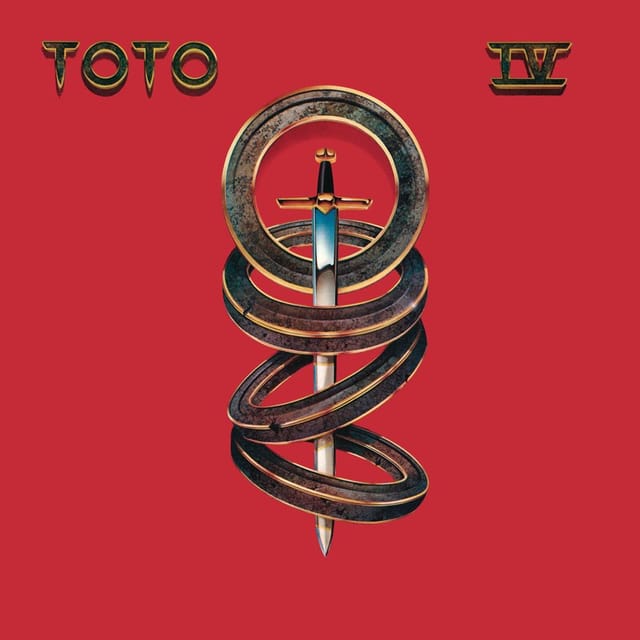

Toto released their fourth album, Toto IV, on April 1, 1982. Until then they were best known as some of the most respected session musicians in Los Angeles.
The album saved their career and made them global stars. Its studio craft set a standard that producers still work to today.
“Wish I could claim this millionaire Grammy-rock was totally pleasureless, but professionalism is rarely that neat. The fattest of all studio bands is almost as hooky as Shoes or the Ramones, and their production excesses at times betray verve, delight, even (though I must be mistaken) a sense of humor.”
Do or Die: The Pressure That Created Perfection
By 1981, Toto's career hung by a thread. Their self-titled debut had been a surprise success, powered by "Hold the Line" and establishing them as a force in the burgeoning AOR market. But follow-ups Hydra (1979) and Turn Back (1981) failed to capitalize on that initial momentum, leaving Columbia Records questioning their investment in the expensive-to-record band.
The pressure was immense. These weren't just any musicians facing potential career extinction—they were some of the most in-demand session players in Los Angeles, having collectively appeared on thousands of recordings. David Paich had co-written Boz Scaggs' massive hits "Lido Shuffle" and "Lowdown." Jeff Porcaro was already legendary behind the kit. Steve Lukather was becoming the go-to guitarist for major productions.
Rather than retreat to safer territory, Toto doubled down on their core strength: studio perfectionism. They convinced Columbia to give them an unprecedented recording budget, allowing them to become one of the first acts to regularly employ three synchronized 24-track tape machines—a setup that would become standard in the industry but was revolutionary in 1981.
“We were coming off the album Turn Back, which didn't do that well. And the record company said, 'If you don't have a hit record, you guys are done.' That pressure was put on us. So we said, 'Okay, we should go back to what we do best... Let's go back and make a classic Toto album and bring in the best songs.'”
The track that transformed Toto from respected session musicians into global superstars, “Africa” represents the perfect fusion of technical prowess and emotional resonance.
Revolutionary Recording: When Three Machines Became One
The technical innovation behind Toto IV cannot be overstated. At a time when most artists were limited to a single 24-track recorder, Toto pioneered the use of three machines linked via SMPTE timecode—a computerized synchronization system that allowed for an unprecedented 66 tracks of audio (22 tracks per machine, with one track reserved for sync on each).
This setup, recorded primarily at Sunset Sound in Los Angeles with additional work at Record One and Abbey Road Studios in London, allowed the band to layer vocals, harmonies, and instrumental parts with a precision that would have been impossible just a few years earlier. The result was a sonic density and clarity that jumped out of radio speakers and dominated the emerging compact disc format.
Engineer Al Schmitt, who worked on the sessions, remembered exactly when he knew the record was something special. After cutting the album's second track, "Africa," he called a friend who'd always wanted to attend the Grammys and told him, "Start getting your tickets." The band's session musician background gave them the discipline and expertise to maximize this technology, creating arrangements that were complex enough to reward repeated listening while remaining immediately accessible.
Masters of Their Craft: The Session Musician Advantage
What separated Toto from their contemporaries wasn't just technical skill—it was their unique perspective as session musicians who understood how to serve a song. By day, they were the invisible hands behind hits by Michael Jackson, Steely Dan, and Boz Scaggs. By night, they channeled that experience into their own compositions.
Steve Lukather, reflecting on the band's approach, noted: "We created our own parts and wrote our own parts on the spot. The solos were one or two takes. We did this every day for 25 years. People see that as, 'Oh, you guys are just studio musicians.' We're not the third viola player. We're creating our parts, and that's why we got hired."
This session work ethic permeates every moment of Toto IV. There's no wasted motion, no self-indulgent passages, no unnecessary complexity. Every element serves the song, from Lenny Castro's precisely placed percussion to Tom Scott's tasteful saxophone contributions. It's the sound of professionals at the peak of their powers, creating music that's both immediate and endlessly rewarding.
Jeff Porcaro's revolutionary drumming on “Rosanna” combined John Bonham's power with Bernard Purdie's finesse, creating a template that influenced an entire generation of musicians.
Essential Tracks
“Africa”
What started as David Paich's late-night keyboard exploration became one of the most recognizable songs in popular music. Built around a hypnotic 4/4 rhythm in A major and layered with Jeff Porcaro's legendary drum programming and live percussion overdubs, the track's unusual structure—beginning with a seemingly endless intro that builds layers of rhythm and melody—defied conventional radio wisdom but proved irresistible.
The song's production genius lies in its patient development. Paich's opening synthesizer sequence establishes the African-inspired rhythm before Bobby Kimball's vocals enter with the now-iconic melody. Steve Lukather's guitar work provides both rhythmic support and melodic counterpoint, while the layered background vocals create a sense of vast, open spaces that perfectly complements the song's geographical inspiration.
The track's recent renaissance, particularly among younger listeners discovering it through memes and covers, proves its enduring power. Weezer's 2018 cover version introduced Toto to a new generation, leading to billions of streams and confirming "Africa" as a truly generational anthem that now streams more heavily than it did at the height of its original 1982 chart run.
“Rosanna”
David Paich's tribute to actress Rosanna Arquette became the album's calling card, showcasing the band's rhythmic sophistication. Jeff Porcaro's legendary "shuffle" beat—a fusion of John Bonham's "Fool in the Rain" with Bernard Purdie's ghost notes—created a groove so infectious it influenced drummers for decades and became a template studied in music schools worldwide.
The song's harmonic complexity disguised as pure pop demonstrates Toto's mastery of accessible sophistication. Built in D major with jazz-influenced chord progressions, the track features intricate vocal arrangements and instrumental interplay that reward repeated listening. Steve Lukather's guitar solo, recorded in a single take, perfectly balances technical prowess with melodic sensibility.
Peaking at #2 on the Billboard Hot 100, "Rosanna" proved that technical mastery and pop sensibility weren't mutually exclusive. Porcaro's shuffle alone made the track a landmark, and the song went on to earn Grammy Awards for Record of the Year and Best Pop Vocal Performance by a Duo or Group. The track announced that Toto had learned to make their virtuosity serve the song, not overshadow it.
“I Won't Hold You Back”
Steve Lukather's most personal contribution to the album proved that Toto could handle tender emotions with the same skill they brought to rhythmic complexity. Written during a period of personal turmoil, the ballad's restrained arrangement and Lukather's vulnerable vocal performance added an emotional dimension that critics had long claimed was missing from the band's work.
The track's sophisticated production features the Martyn Ford Orchestra's string arrangement, recorded at Abbey Road Studios, which provides a lush backdrop that enhances rather than overwhelms the song's intimate core. David Paich's keyboard work and Bobby Kimball's backing vocals create a supportive framework that allows Lukather's emotion to shine through without sacrificing the band's trademark precision.
Reaching #10 on the Billboard Hot 100, the song became a template for how to add orchestral elements without sacrificing emotional authenticity. It proved that Toto's technical excellence could serve deeply personal expression as readily as arena-scale hooks, and it remains one of the band's most enduring and beloved compositions.
Recognition and Vindication: The Critical Response
While Toto had always faced skepticism from rock critics who viewed their polished, session-musician pedigree with suspicion, Toto IV forced a grudging respect rather than a rave. Even Robert Christgau's notoriously stingy Village Voice notice — a middling B−, not an endorsement — conceded that the band's "production excesses at times betray verve, delight, even... a sense of humor," proof the album had won over listeners inclined to dismiss it.
The Grammy Awards provided the ultimate vindication. Six wins, including Album of the Year, Producer of the Year, and Record of the Year for "Rosanna," represented an unprecedented sweep for what many had dismissed as "just another AOR band." The Recording Academy recognized not just the album's commercial success, but its technical innovation and musical craftsmanship.
More importantly, time has been kind to Toto IV. What critics once dismissed as "overproduced" is now recognized as pioneering. The album's influence can be heard in everyone from D'Angelo to Daft Punk, artists who understand that technical perfection and emotional authenticity aren't mutually exclusive.
The Thriller Connection: Perfection Meets Perfection
The success of Toto IV led directly to one of the most significant collaborations in pop history. Impressed by the album's production quality and the band's musical versatility, Quincy Jones recruited multiple Toto members for Michael Jackson's Thriller sessions. Steve Lukather's guitar work, Jeff Porcaro's drumming, and the band's collective arranging skills became integral to that album's unprecedented success.
David Paich recalled Jackson's perfectionism: "Michael was such a perfectionist. He really got under a microscope and fine-tuned things. Most artists leave thinking about that to the producer or musicians. Michael didn't." This attention to detail mirrored Toto's own approach and created a natural synergy between the artists.
The Thriller connection demonstrates how Toto IV's innovations influenced the broader music industry. The multi-tracking techniques, harmonic sophistication, and rhythmic complexity that defined the album became standard elements in 1980s pop production, helping shape the decade's distinctive sound.
It was the culmination of a reputation the band had been building since long before Toto existed as a band at all — and one critics spent years using against them. The full story is here: Two Thousand Records: How Toto's Session Players Ended Up on Thriller →
Four Decades Later: The Enduring Revolution
In 2022, forty years after its release, Toto IV stands as more than just a successful album—it's a watershed moment in the evolution of popular music. The album proved that audiences were hungry for musical sophistication wrapped in accessible packages, paving the way for artists from Steely Dan to Radiohead who refuse to choose between complexity and commerciality.
The recent resurgence of "Africa" demonstrates the album's timeless appeal. What began as a nostalgic meme became a genuine rediscovery, with streaming numbers that rival contemporary hits. The song's ability to connect with listeners born decades after its release proves that great songwriting transcends generational boundaries.
More broadly, Toto IV anticipated the digital age's emphasis on sonic perfection and detailed production. The album's layered arrangements and pristine recording quality translate beautifully to modern high-definition audio formats, sounding as fresh and immediate today as they did in 1982. In an era of compressed, digitally-processed music, Toto IV's analog warmth and three-dimensional soundscape offer a masterclass in how to create records that reward both casual listening and deep exploration.