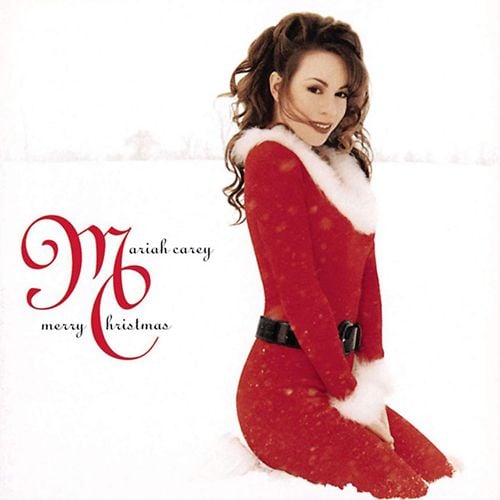

In the summer of 1994, Mariah Carey and producer Walter Afanasieff sat at a piano in a house in New York and wrote three Christmas songs. One of them was “All I Want for Christmas Is You.” Twenty-five years later, it became the first holiday song to top the Billboard Hot 100 since 1958.
The song came from Merry Christmas, Carey's first holiday album, released by Columbia in November 1994. It mixed seven holiday standards with three originals she wrote with Afanasieff.
The album reached No. 3 on the Billboard 200. It came out between two of her biggest records, Music Box and Daydream. Thirty-two years on, its lead song returns to the charts every December.
“Her early albums were often polished to a fault, but she cuts loose with unbridled soul on the new Christmas disc. Oddly enough, it may be her best album.”
The Christmas That Never Ended
Carey started recording the album almost a year before it came out. “I actually started recording right after last Christmas,” she told Billboard in October 1994. “The first song I did was ‘Silent Night.’ The decorations didn't seem too out of place in the room at that point.”
The decorations then stayed up as the sessions ran into spring and summer. “It was kind of like the Christmas that never ended,” she said. She told the Boston Globe that December that taking them down would feel strange: “We've had the decorations up in the studio all year.”
A holiday album was an unusual move for a star so early in her career. “Back in the early ‘90s, it wasn't as common for a newer artist to record a Christmas album,” Afanasieff told Songwriter Universe. “They would usually wait until much later in their career to do so.”
The Second Disc later wrote that at the time, the album “was seen a surprise and a departure for the singer.” Carey simply wanted to make one. “I'm a very festive person and I love the holidays,” she said. “I've sung Christmas songs since I was a little girl. I used to go Christmas caroling.”
She found the work different from her regular albums. “It comes from a totally different state of mind than when you are recording your own studio album,” she said. “The writing and the actual recording of the new Christmas songs was really an interesting experience, because you are coming from a totally different perspective.”
Her label treated it as a major release. Carey was married at the time to Tommy Mottola, the head of her record company and the executive Michael Jackson would later publicly attack over Invincible. Columbia sent three different songs to five different radio formats and made two videos before release. “I can't recall another Christmas album hitting such a wide variety of formats,” said Jay Krugman, Columbia's vice president of marketing. Stores received special display bins, stand-ups and posters.
The campaign started while Carey was already on the radio with a duet remake of “Endless Love” with Luther Vandross. She was also writing her next album; she told Billboard she already had seven songs. Her final wish for the season was simple: “I hope that it snows.”
The Pianist Behind Her Ballads
Afanasieff had been part of Carey's career almost from the start. He met her around 1989, when he was keyboard player and arranger for producer Narada Michael Walden, and Mottola asked Walden for help finishing her debut album. By 1994 Billboard was calling him her “frequent writing partner.”
Together they wrote three Billboard No. 1s: “Hero,” “One Sweet Day” with Boyz II Men, and later “My All.” Afanasieff went on to produce Celine Dion's “My Heart Will Go On,” which won him a Grammy for Record of the Year. He is a keyboard player and programmer who often plays every instrument on a track himself.
That summer he flew to New York to join Carey and Mottola at a house they had rented, to plan the album and pick its songs. “Normally, Christmas albums are recorded in the summer, and mixed by around the middle of September,” he said. They decided to write three originals: a classical-style hymn, “Jesus Born on This Day”; a sad ballad; and one fast, fun song.
Church Musicians and Tambourines
Carey wanted a balance of old and new. “So many songs have been done to death,” she said. “For the most part, people really want to hear the standards at Christmas, no matter how good a new song is.” She chose hymns like “O Holy Night” and “Hark! The Herald Angels Sing,” plus pop songs like “Santa Claus Is Comin' to Town” and Phil Spector's “Christmas (Baby Please Come Home).”
Her “Joy to the World” is credited both to the hymn's writers, Isaac Watts and Handel, and to Hoyt Axton, who wrote a different song of the same name. Columbia even prepared dance remixes of it for a 12-inch single aimed at clubs. One retail buyer told Billboard before release, “It wouldn't surprise me if it's the No. 1 Christmas album.”
For the gospel material she brought in organist Loris Holland, who co-arranged and co-produced several tracks. “That added a really great authentic gospel flavor to a lot of the stuff,” she said. Afanasieff recalled a strong session band as well, naming Dann Huff and Greg Phillinganes among the players.
The gospel sessions changed how she sang. “Why did I cut loose on this record? It was probably because of the whole gospel nature of it,” Carey told the Globe.
Afterward, she said, she recorded a new song in two takes and left it alone. “Usually, I would fix [a] lot of things and try to make it perfect. But something happened to me since I did the [Christmas] record which made it a lot easier.” She compared it to her 1992 MTV Unplugged set: “a whole new experience, like opening a whole new door.”
Filmed while the album was being made; Carey said everything in it was “really authentic Christmas stuff.”
Essential Tracks
“All I Want for Christmas Is You”
Carey and Afanasieff wanted one fast, happy song among the originals, in the style of the old Phil Spector Christmas records. Afanasieff started playing a boogie-woogie at the piano. Carey picked up the bass line under his left hand and turned it into a melody. “She goes, ‘Oh that's cute,’” he recalled.
Carey wrote the lyrics afterward, and Afanasieff built the track alone at his home studio in California. He programmed and played everything except the vocals. They tried it with the live band, he said, but “it just didn't sound as good. It needed to be brighter, more fun and more of what I thought a Christmas song should be on the radio.”
Afanasieff never expected a pop hit. Holiday music had its own radio outlets, he said, “and that really doesn't apply to top 40 radio. So I never expected it to.” He added a warning for pianists: “your hands are gonna fall off halfway through it.”
Columbia sent it to pop and adult-contemporary radio, but did not sell it as a commercial single. Under the rules at the time, that kept it off the Hot 100 entirely. It took a movie, a rule change and streaming into what Songwriter Universe called the most successful holiday song released in the past 50 years.
“Miss You Most (At Christmas Time)”
The second original went the other way. Afanasieff described it as “a slow, romantic and sad love song.” It sits closer to Carey's usual ballad hits than anything else on the album.
Columbia aimed it at R&B radio and sent its video to BET first, while “All I Want for Christmas Is You” went to MTV and VH1. The split shows how carefully the label tried to reach every part of her audience at once.
It never caught on the way its sister song did. Randy Fairman, reviewing the 25th-anniversary edition for The Second Disc, said it and “Jesus Born on This Day” “weren't instant classics,” but called them “fine yuletide treats.”
“Jesus Oh What a Wonderful Child”
The album closes with its loosest recording. Carey wanted it to sound like church, not a studio. “We cut the track live and had the guys that play it in church and the girls singing it,” she told Billboard.
The session turned into a family gathering. “It wasn't like a traditional recording session,” she said. “I had all my backup singers and their husbands and their babies playing tambourines, so we got to experience some real authentic church flavor.”
Loris Holland co-produced it, and it is the clearest example of what Morse meant when he wrote that she “cuts loose with unbridled soul” on the album. It is also the track that best explains why Carey said the record changed the way she worked.
The album's R&B single, whose video Columbia sent to BET first in 1994.
Who Wrote “All I Want for Christmas Is You”?
The official answer is both of them. The song is credited 50/50 to Carey and Afanasieff, as were all three originals on the album. But the two have told different stories about how it was written, and by 2019 they had not spoken in more than 20 years. Variety noted a complication: Carey had been married to the head of the label where Afanasieff was under contract, and loyalties divided when the marriage ended.
Carey has described writing it largely on her own. “I am proud of this song that I wrote basically as a kid on my little Casio keyboard,” she told Billboard in 2017. In a 2019 Cosmopolitan interview she recalled decorating a little tree, putting on It's a Wonderful Life and sitting down at a keyboard to work out melodies.
Afanasieff remembers the piano in the summer house. He says they wrote the melody and chords there together, and that she wrote the lyrics afterward. “My memory may be a little bit different than Mariah's,” he told Songwriter Universe in 2018, “but this is what I remember.” He spoke to Variety the week the song first hit No. 1. “I own 50% of the song, we're equal co-writers,” he said, adding that he had received death threats from fans who believed he was taking credit he hadn't earned.
“Mariah Carey is absolutely, one-million-percent an amazing, incredible, really accomplished and very competent songwriter.”
He was careful not to take anything from her. “She absolutely contributed to the melody,” he said. His complaint was that she would credit him for “Hero” or “One Sweet Day” but not for this one. Despite the dispute, he described the song's success as being “like being a parent that created something like a child.”
Twenty-Five Years to No. 1
Because Columbia never sold “All I Want for Christmas Is You” as a single, it could not chart on the Hot 100 in 1994. Album tracks became eligible in December 1998, and it spent a week at No. 83.
Two things changed its fortunes. In 2003, Carey licensed it to the film Love Actually, where a young actress performs it. “Oh for sure,” Afanasieff said when asked whether the film helped. Then, from 2012, chart rule changes let streaming count, and the song began re-entering the Hot 100 every December.
In 2018 it reached No. 3 and set a one-day streaming record on Spotify. On the chart dated December 21, 2019, it finally hit No. 1. It was Carey's 19th No. 1, one behind the Beatles, and the first holiday song at the top since “The Chipmunk Song” in 1958.
It also took her career total to 80 weeks at No. 1 and gave her the longest span of No. 1 hits of any artist, passing Cher. At the time, no song had ever taken longer to reach No. 1 after its release. Carey marked it with a two-word tweet: “We did it.”
It has kept coming back. “Every year it seems to be getting more popular,” Afanasieff said in 2018. “It's just crazy.” Billboard's chart history now credits it with 22 weeks at No. 1 in total.
By 2018 it had already spent 33 weeks at No. 1 on Billboard's separate Holiday 100 chart, and ASCAP had named it its No. 1 holiday song. Fifth Harmony, Michael Bublé, Idina Menzel and Cee Lo Green are among the many artists who have covered it. The album itself was No. 1 on Billboard's R&B albums chart the week the song first topped the Hot 100.
A Cathedral Concert and a Second Album
Carey first sang the songs live in December 1994, at a benefit at New York's Cathedral of St. John the Divine. The show raised money for the Fresh Air Fund, which runs summer camps for children from low-income city families and had named one of them “Camp Mariah.” One of her backup singers, Kelly Price, had gone to the charity's camps for seven years as a child.
The aim was to raise $1 million, with guests including Tony Bennett, Gloria Estefan and Julio Iglesias in the audience. Carey, then 24, had grown up poor and moved 13 times as a child. “It's something positive where you can really make a difference,” she said of the charity. “This is not just something I'm doing now and will blow off in the future.”
Of her visits to the children, she said: “I'm not like some magical genie that just appeared. I'm a singer. I'm a real person.”
Six songs from that concert finally came out in 2019, on the album's 25th-anniversary edition. The same set added “God Rest Ye Merry Gentlemen,” which had appeared only on international copies in 1994.
Carey returned to the season in 2010 with Merry Christmas II You, and has toured with the songs, wrapping an “All I Want for Christmas Is You” tour at Madison Square Garden in December 2019. The song alone has spun off a book, an animated film and an Amazon documentary, Mariah Carey Is Christmas. Her later holiday originals include “Oh Santa!,” a No. 1 on the adult-contemporary chart, and “The Star,” written for a 2017 animated film and nominated for a Golden Globe.
Fairman also liked the rest of the record more than its reputation suggests. He called the carols “treated in a reverent manner” and said the Spector and “Santa Claus” covers “proved to be spirited fun.” He summed up the original fairly: “‘All I Want For Christmas Is You’ tends to overshadow the rest of Merry Christmas but the rest of the album is enjoyable.”
“It's her song. It's her. It's her voice. It's her wall of sound.”