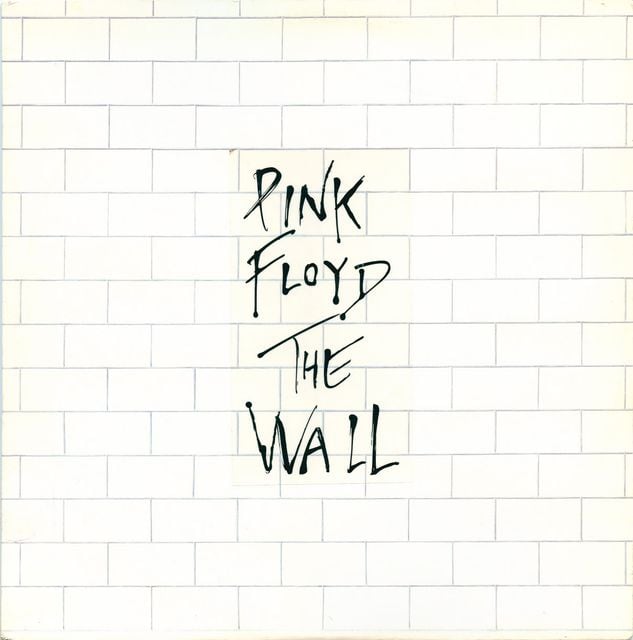

On July 6, 1977, at the end of Pink Floyd's tour behind Animals, a fan climbed toward the stage at Montreal's Olympic Stadium during the acoustic hush of “Pigs on the Wing.” Roger Waters, enraged that the crowd wasn't listening, spat directly in the man's face. That night became the seed of a concept Waters would spend the next two years building into The Wall — a double album about a rock star who bricks himself off from the world one grievance at a time. Producer Bob Ezrin took Waters' sprawling, ninety-minute demo tape and, by his own account, “wrote a screenplay for The Wall, where every scene was a song,” forcing a shapeless confession into a coherent rock opera. Released November 30, 1979, it became the best-selling album in America the following year and, decades later, is still the fault line critics use to argue about where Pink Floyd's ambition tipped into excess.
“The Wall is primarily a triumph of production: its seamless surface, blending melodic fragments and sound effects, makes the musical shortcomings and questionable lyrics easy to ignore.”
A Spit in Montreal, Two Years to a Record
The Montreal incident crystallized something Waters had been circling for years: a growing contempt for the distance between the band and the arena crowds who'd turned Pink Floyd into a stadium act rather than the band that made The Dark Side of the Moon. Out of that alienation came the character of “Pink,” a rock star who builds a literal wall, brick by brick, out of every trauma and betrayal in his life — an absent father lost in World War II, a suffocating mother, a failed marriage, an abusive education system — until he's isolated enough to become something monstrous.
Waters brought Bob Ezrin, already a trusted outside ear, a demo tape that ran on and on with no obvious shape. Ezrin didn't mince words about its state: “It started and just kept going. At that point, it didn't have any sort of commercial potential. In fact, it wasn't even organize-able in its form, but it was the genesis of a great idea.” His fix was structural rather than musical — treating Pink's collapse as a script rather than a concept album's usual loose thread of songs.
Ezrin also became the band's de facto mediator during a period when its four members were barely speaking as equals. Waters recruited him for exactly that reason: “The reason I need you is, you're going to deal with them. I can't deal with them any more.” It was a role Ezrin would need for the entire eleven months of recording that followed.
The Firing of Richard Wright
Recording ran from December 1978 through November 1979 across six studios on two continents — Britannia Row and Producers Workshop for the core sessions, Super Bear and Studio Miraval in the south of France, CBS 30th Street Studio in New York for orchestral overdubs with the New York Philharmonic under Michael Kamen, and Cherokee Studios in Los Angeles for the final push. It was, by any measure, an unusually fractured, geographically scattered way to make a record — and the band itself was just as fractured as the schedule.
Keyboardist Richard Wright bore the worst of it. Waters, increasingly frustrated with what he saw as Wright's disengagement from the sessions, considered suing him outright before settling on a more practical solution given the band's precarious finances at the time: Wright would finish the album and the following tour, but only as a salaried session musician rather than a full partner in the band. Ezrin later described the dynamic bluntly, saying Wright had become “a victim of Roger's almost Teutonic cruelty. No matter what Rick did, it didn't seem to be good enough for Roger.”
The arrangement produced an unexpected irony. Because Wright was salaried rather than a full partner on the enormously expensive tour that followed, he was the only member of Pink Floyd who didn't share in the tour's heavy financial losses — making the man who'd just been fired, by some accounts, the one member of the band who actually came out of The Wall era ahead financially.
Built from a school-hallway hook Roger Waters wrote as a solo-acoustic fragment, before Bob Ezrin insisted on a beat.
Turning a Fragment Into a No. 1 Single
Waters conceived “Another Brick in the Wall, Part 2” as a brief, solo-acoustic fragment — a transition, not a single. Ezrin heard something else in it and pushed to build the track outward, even sending David Gilmour out to research a sound the guitarist had no natural affinity for. “He told Gilmour to go out to clubs and to check out the sound of disco music,” critic Tom Breihan later recounted. “Gilmour hated what he heard, but he helped the band come up with some version of it anyway.” Ezrin was blunt about why he pushed so hard: “That's too short. We need it as a single. It's a smash, and we have to have it.”
The track's second signature element came from Ezrin's own back catalog of production tricks. Having already used children's voices to visceral effect on Alice Cooper's “School's Out” and Lou Reed's “The Kids,” he knew exactly what a real school choir, not adult voices imitating one, would do to a song about institutional cruelty: “We recorded these kids in the stairwells. Having done ‘School's Out,’ I knew the effect of kids, particularly in anything that has to do with school!” Twenty-three children from Islington Green School, a short walk from the band's own Britannia Row Studios, were brought in and overdubbed roughly a dozen times to swell into what sounds like a full playground's worth of voices.
The finished single became Pink Floyd's only Hot 100 No. 1 in America, topping the chart on March 22, 1980, and holding the position for four weeks before Blondie's “Call Me” took over — an improbable outcome for a track that started life as a fragment its own writer didn't think warranted a single release.
Essential Tracks
“Comfortably Numb”
The album's emotional and musical peak grew out of one of its sharpest creative standoffs. Waters wanted the song spare and unadorned; Gilmour pushed for the layered, orchestral arrangement and the extended guitar solo that ultimately defined the track — a genuine collision of the band's two remaining creative wills rather than a collaboration in the usual sense.
Ezrin sided with Gilmour's instincts and helped shape the orchestral scoring that gives the song its scale, while Waters' lyric — a doctor administering a sedative backstage before a show, the numbness read as both medical and existential — supplied the words that anchor the arrangement's ambition to something genuinely desolate.
Gilmour's guitar solo is routinely ranked among the greatest ever recorded, and the song has come to represent the album's best argument against its own reputation for bloat — proof that the record's enormous scope could still produce a single moment as tightly controlled as this one.
“Another Brick in the Wall, Part 2”
Built from Waters' hallway-chant fragment, Ezrin's insistence on a beat, and the Islington Green School choir's multiply-overdubbed voices, the track condenses the album's entire argument about institutional cruelty into three and a half radio-ready minutes.
Critic Tom Breihan, reassessing the song decades later for Stereogum, credited the children's presence directly for the track's emotional charge: “The kids really do add something to the song. It's one thing to hear a couple of rock stars in their mid-thirties singing that school is bullshit” — a different thing entirely, he argued, to hear it from an actual classroom.
It remains Pink Floyd's only U.S. No. 1 single, a genuinely strange outcome for a prog-rock band's most overtly danceable, disco-inflected track — built, ironically, by a guitarist who reportedly disliked the genre he was asked to draw from.
“Hey You”
Opening side three of the original vinyl, “Hey You” functions as Pink's first real attempt to reach back out from behind the wall he's spent two sides building — a reversal that gives the album's back half its emotional turn.
The arrangement builds from a spare acoustic figure into a full-band swell that mirrors the lyric's trajectory from isolation toward a doomed attempt at connection, one of several moments on the record where the production itself does as much storytelling as the words.
Though never released as a single, it's frequently singled out by musicians and critics as one of the album's most purely well-constructed songs — evidence, alongside “Comfortably Numb,” that the record's reputation for sprawl obscures just how disciplined its individual peaks actually are.
Grew out of a direct creative standoff between Roger Waters and David Gilmour over how spare the arrangement should be.
A Wall Built Nightly, Then Torn Down
The 1980–81 tour translated the album's central image into the most expensive and logistically extreme stage production rock had attempted to that point: a wall of cardboard bricks, built progressively across the first half of each show until it fully separated the band from the audience, then demolished at the climax. The show played only a handful of cities — Los Angeles, New York, London, and Dortmund — because the production was too enormous to tour conventionally.
The spectacle lost money even as the album sold in the millions. Waters later put it plainly: “It was incredibly difficult to stage back in 1980 and we lost a lot of money doing it.” The band had, in effect, built a stage show as uncompromising and financially reckless as the story it was telling — a rock opera about a man destroying himself for his art, performed by a band nearly destroying its own finances to stage it properly.
The album itself faced no such trouble commercially. It spent fifteen weeks at No. 1 on the Billboard 200, became the best-selling album in America for 1980, and has since been certified 23× Multi-Platinum by the RIAA under the industry's double-album counting convention — a commercial scale wildly out of proportion with a record built around a narrator's total psychological collapse.
A Prog Landmark, Arriving Amid a Punk Backlash
The Wall landed in a UK still absorbing punk's rejection of exactly the kind of wealthy, elaborate stadium-rock spectacle Pink Floyd represented — “I hate Pink Floyd,” read Johnny Rotten's famously worn T-shirt, a slogan aimed squarely at bands the punk movement considered bloated relics. The album also arrived six months into Margaret Thatcher's first term as prime minister, in the wake of the strike-crippled “Winter of Discontent” that had just brought her Conservative government to power — a backdrop of institutional breakdown and public alienation that the album's themes, whatever their personal origins in Waters' own history, ended up sitting remarkably close to.
Contemporary critical reaction split accordingly. Robert Christgau, reviewing it for The Village Voice, gave it a lukewarm B− and picked at its internal logic directly: “the story is confused, ‘mother’ and ‘modern life’ make unconvincing villains,” while still allowing the album was “kitschy minimal maximalism” rather than a total failure. That ambivalence — real craft undercut by a story some critics found self-indulgent — has defined the album's critical reception ever since.
Kitschy minimal maximalism with sound effects and speech fragments.
Retrospective critics remain similarly divided rather than uniformly reverent. PopMatters' Counterbalance dialogue called it “quite possibly the grandest statement on the Great List” while the same piece's co-writer admitted, “I'm fairly excited that I will never have to listen to this entire record ever again.” Writing for Rock and Roll Globe on the album's 40th anniversary, Katharine Coldiron placed it below The Dark Side of the Moon and Wish You Were Here in the band's catalog outright — a reminder that “landmark” and “best Pink Floyd album” are not, in the critical consensus, the same claim.
From Album to Film to Permanent Fixture
The album's story didn't end with the tour. Alan Parker's 1982 film adaptation, starring Bob Geldof as Pink, translated Waters' narrative into something closer to a feature-length music video with no live-performance footage of the band at all. The production was famously unhappy — Parker later admitted, “to be honest, I should never have made The Wall,” describing three creative egos, including his own, colliding constantly: “Three megalomaniacs in a room, it's amazing we achieved anything.”
Despite the friction behind it, the film cemented the album's narrative in a way the record alone hadn't fully managed. Coldiron argued the film actually clarifies the story better than the audio ever could on its own: “The film makes the album so much clearer: it progresses from one idea to the next, building the wall… you could hardly write a paper about it. The paper is the film.”
Forty-seven years on, The Wall remains the rare rock album whose central metaphor became genuinely useful shorthand far outside music — for isolation, institutional cruelty, and the walls people build around themselves one brick, one grievance, at a time. Whether that metaphor is delivered with discipline or indulgence is still, by design of the record's own reception, an argument nobody has fully settled.
The Last Great Statement of an Era
Whatever side of the bloat-versus-masterpiece argument a listener lands on, The Wall marked a genuine ending. It was the last Pink Floyd album to feature all four members in anything resembling a full band, and the last built on the kind of unlimited studio and touring budget that the classic-rock era had made possible before punk, new wave, and MTV reshaped what a rock album was supposed to cost and sound like.
PopMatters' Eric Klinger, revisiting the record after years of resisting it, landed on a verdict that captures how the album has aged for many listeners: “The Wall is a far more collaborative effort than many people, including many people named Roger Waters, would have you believe” — crediting Gilmour's guitar work and Ezrin's structural discipline for holding together a project that, left entirely to Waters' original ninety-minute demo, might never have become a record at all.
What began with one furious moment in Montreal ended as one of the best-selling and most divisive albums in rock history — proof that a genuinely personal grievance, handed to the right collaborators, can still find an audience large enough to make it universal.
“The Wall marks the culmination of Pink Floyd's career and end of the classic rock era.”