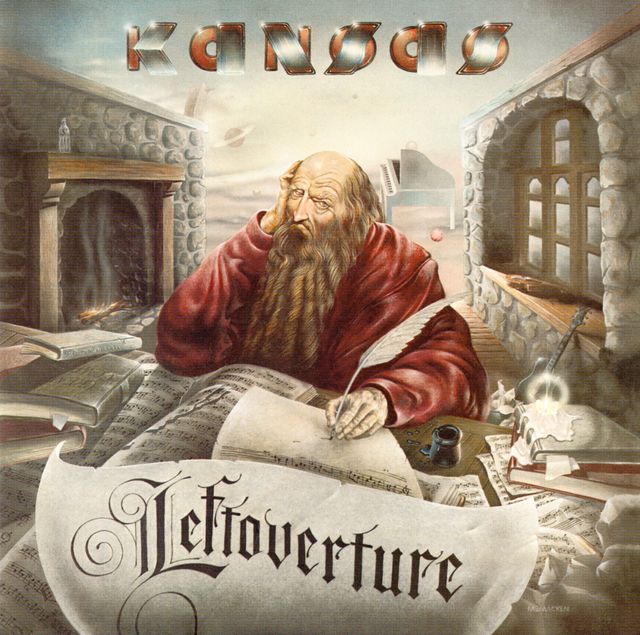

Look at the album cover for a moment before you play the record. Dave McMacken's painting shows a bearded composer slumped at a desk in a half-ruined stone room, quill in hand, chin propped on his fist, staring at a heap of manuscript that is going nowhere. A fire burns behind him. A grand piano sits abandoned out in the mist. It is a portrait of a man who cannot write, and it was commissioned by a band whose singer had just walked into rehearsals and announced that he had nothing — not one song — with a record label that had bankrolled three commercial failures and was not going to bankroll a fourth. What happened next is the most improbable rescue in American rock: one guitarist wrote almost an entire album by himself in a vacant Topeka storefront, and then, on the last day, as the van was being loaded for Louisiana, produced one more.
“For three albums, Don Kirshner poured a lot of money into us. If this new album failed to succeed, it was quite likely we would be dropped from the label.”
Three Albums and One Last Chance
Kansas had come out of Topeka in 1973 as a six-piece with an unhelpful set of ambitions. They wanted to play the long, sectional, classically-inflected music coming out of England — Yes, Genesis, King Crimson — while sounding like an American bar band with a violin in it. Don Kirshner, the publisher and television impresario who had assembled the Monkees and the Archies, signed them to his own label and, to his considerable credit, kept paying.
He paid through Kansas in 1974 and through Song for America and Masque in 1975. All three sold modestly. Kirshner covered recording costs, travel and tour support across the lot of them, and by the time the band assembled to write a fourth, everybody understood the arithmetic. Rich Williams has never dressed it up: another failure and they were gone.
They were not, at that point, a band with a sound problem. The playing on those first three records is formidable, and the ideas are there. What they lacked was any single moment a stranger could grab hold of — four or five minutes that would work on car radio without an explanation attached. Prog bands were not supposed to need that. American prog bands, on an American label, in 1976, absolutely did.
The Writer's Block on the Cover
Kansas normally split the writing. Kerry Livgren supplied around seventy per cent of a given album and Steve Walsh, the singer and keyboard player, supplied the rest. That arrangement collapsed on day one.
“On the very first day of rehearsals, Steve came to me and said that he had nothing — not a single song.”
Walsh was in the grip of a writer's block severe enough that he would end up with co-writing credits on only a handful of tracks. Which meant that the survival of a six-man band, and the money of a man who had already spent a great deal of it, now rested on one guitarist's ability to produce material to order in a rented empty shop.
Livgren's method was brute routine. The band rehearsed in a vacant Topeka storefront every morning; he wrote new material daily and brought it in. The album's title is his joke about the process — a portmanteau of “leftover” and “overture,” a record assembled from what was lying around, dressed up as something grand. McMacken's cover extends the gag: the frustrated composer, the scattered pages, the fire and the ruins. It is one of very few album sleeves that is a literal illustration of the album's own production problem.
I don't relish that kind of pressure, but with hindsight it really brought out the best in me.
Alligators in the Control Room
The sessions ran from December 1975 to August 1976 at Studio in the Country in Bogalusa, Louisiana, a facility the band already knew and which Livgren has described as sitting in the middle of a swamp — alligators outside, mosquitoes of unusual size, and armadillos that occasionally wandered into the control room. It is a comically un-progressive setting for a record with an eight-minute suite on it.
Producing was Jeff Glixman, who had been with them since the second album and who understood the band's central problem better than they did. His production on Leftoverture is bright, dry and unusually clean for 1976 prog — no cathedral reverb, no murk, everything separated. Robby Steinhardt's violin sits in the same frequency space a lead guitar would normally occupy and stays legible; the layered vocals are stacked but never smeared. It is a mix built for FM radio and for arenas rather than for headphones, and that decision is a good part of why the record broke when its predecessors did not.
Engineering was handled by Bill Evans, with George Marino mastering at Sterling Sound in New York. The band tracked as a unit — you can hear it in the ensemble passages, where six people execute unison lines that would defeat most groups — but the arrangements are dense enough that overdubs pile up quickly, particularly Livgren's Moog, Oberheim and ARP layers against Walsh's organ and piano.
The a cappella vocal opening, then the riff — the four minutes that saved a band's contract and became a permanent fixture of American classic-rock radio.
The Song That Almost Didn't Make It
By the end of rehearsals the album was, as far as everyone was concerned, written. The band were polishing arrangements and loading equipment for the drive to Bogalusa. Nobody wanted to learn anything else. And Livgren produced one more song.
“We were packing up our stuff when Kerry walked in with his last-minute addition. For such a very, very special song, it barely made the record.”
Livgren's own account of it is stranger. He has said the song arrived essentially complete, as though it had been beamed down to him — a claim that would be easy to dismiss if the finished thing were not so unusually well-built. He also insisted, then and since, that it was autobiographical: that running parallel to his musical career was a spiritual search that had taken him through most of the available options and left him unsatisfied, and that this song was a report from the middle of it. The weariness in the lyric is not a pose. He genuinely did not know the answer.
The band's reaction was immediate and, according to Livgren, visible: everybody's eyebrows went up. Their reservation was practical — at five and a half minutes it was too long for a single, which is why the version pushed to radio in November 1976 was edited down to three and a half, though a great many stations simply played the album cut anyway.
Prog With a Violin
What makes Leftoverture distinctive fifty years on is that it never resolves the contradiction it is built on. Side one front-loads the accessible material and then, from “Miracles Out of Nowhere” onwards, the record stops apologising and plays what the band actually wanted to play.
Robby Steinhardt is the reason it does not sound like anyone else. English prog used Mellotrons and synthesizers to imply an orchestra; Kansas had an actual string player who could improvise, and used him as a second lead instrument. On “Miracles Out of Nowhere” his electric violin runs so cleanly that listeners routinely mistake it for a synthesizer. He also sang — a rougher, bluesier voice than Walsh's, taking the lead on that track and on “Cheyenne Anthem” — which gave the band two front men and a genuinely unusual vocal palette.
The other distinguishing feature is the guitar writing. Livgren and Rich Williams built riffs with the muscle of American hard rock and the metre of European prog, and the combination is why Kansas could open for heavy bands and still play in seven. It is also, as more than one critic has noted, the element of this band that has gone most persistently uncredited.
Essential Tracks
“Carry On Wayward Son”
It opens with no instruments at all — a stacked a cappella vocal, four bars of harmony arriving from nowhere before the band crashes in. In 1976 that was a genuinely bold way to start a rock single, and it remains the reason the song is identifiable within two seconds on a car radio.
The riff that follows is the best thing Livgren ever wrote: a chugging, slightly off-kilter figure that sounds heavier than it is because of where the accents fall. The song then does something most hard-rock singles never attempt, dropping into a quiet middle section with Steinhardt's violin and Walsh's organ before rebuilding to the guitar break. Rich Williams put its appeal well — very easy to listen to, but still very different, with a lot of musically interesting parts.
Its chart life was a slow burn rather than an explosion. It entered the Hot 100 at No. 86 on Christmas Day 1976, climbed through secondary markets for weeks, and only reached its peak of No. 11 on April 2, 1977, once the major stations gave in. Livgren conceived it partly as a sequel to “The Pinnacle” from Masque. It ended up as the song that kept the band signed.
“Cheyenne Anthem”
Nearly seven minutes, and the most ambitious piece of writing on the record. It opens with folky acoustic guitar and Steinhardt singing lead, then moves through several distinct sections — enough of them that it could plausibly have been broken into three separate songs — before arriving at a massed choral passage with additional voices from Toye LaRocca and Cheryl Norman.
Its subject is the displacement of the Cheyenne, written from the perspective of a people watching land they understood as unownable get fenced, sold and taken. Coming from a band named after a Plains state, on a record otherwise concerned with private spiritual doubt, it lands as the album's one outward-facing political statement, and Livgren handles it without either sermon or costume drama.
Musically it is the clearest demonstration of what Kansas could do that their English models could not: the acoustic opening is unmistakably American folk, the choral climax is unmistakably English prog, and the transition between them is seamless. It has never been a radio song and it is the track most Kansas obsessives name first.
“Magnum Opus”
Eight and a half minutes, six named subsections, and a title that is either boastful or self-mocking depending on how generous you are feeling. The subsection names settle the question: “Father Padilla Meets the Perfect Gnat,” “Howling at the Moon,” “Release the Beavers.” This is a band that knew exactly how ridiculous the genre had become and did it anyway.
It is also, more than any other track here, a group composition — the one place on an album largely written by one man where all six get their fingerprints on the writing. Structurally it is a showcase: shifting metres, unison lines executed at speed by violin and two guitars, and a final section that builds without ever settling into a chorus, because there isn't one.
Placing it last was a statement. Having opened the record with the most radio-ready song they ever recorded, Kansas closed it by refusing entirely to repeat the trick. Within eighteen months the whimsical-suite style would be swept aside by punk; “Magnum Opus” is one of the last examples of it made by a band that was still, at that moment, on the way up.
The closing suite performed on the tour that followed — six musicians executing the unison passages live, which is the best argument for the band's reputation as players.
From No. 86 to No. 5
The gamble paid off completely. Leftoverture reached No. 5 on the Billboard 200 and No. 2 in Canada, finished seventeenth on the American year-end album chart for 1977, and became the first Kansas record the RIAA ever certified. It is now four-times platinum and remains the best-selling album of their career.
Contemporary critics were mostly warm and slightly puzzled. Rolling Stone called it the band's best album to date and reached for the comparisons available at the time — Boston, Styx — praising the way hard-driving ensemble playing was married to short, tight melodic lines. Playboy found it extremely strong and, in a phrase that has aged into unintentional comedy, commended Kansas for embodying the solid Midwestern values of the nation's vast musical heartland.
Robert Christgau was not having it, judging that the record lacked the intelligence and conviction of European progressive rock and noting that the self-deprecating humour in the titles never made it into the music. Later assessments split along the same line. AllMusic's Stephen Thomas Erlewine has argued that beyond “Carry On Wayward Son” the album offers neither the hooks nor the true grandiosity to hold interest, and that Kansas were undone by crippling ambition. Gary Graff, taking the other side, describes it as the breakthrough and a thorough representation of everything the band could do.
Both readings are defensible, and the disagreement is really about what you want a prog record to be. Judged as English progressive rock, Leftoverture is coarser and less strange than its models. Judged as the thing it actually is — the record that worked out how to get complicated music onto American radio without gutting it — it is close to a blueprint. Everything from Point of Know Return the following year through to the arena rock of the early eighties runs through this album.
The Song's Second Life
Most 1970s hits settle into classic-rock rotation and stay there. “Carry On Wayward Son” did something else: it found two entirely new audiences, three decades apart from the people who bought the album.
The first was Guitar Hero II in 2006, which placed it as an encore track and handed it to a generation of teenagers who learned its riff on a plastic controller before they had heard the record. The second was Supernatural, which used it in a montage near the end of the first season in 2006 and then adopted it as an unofficial anthem, opening almost every subsequent season finale with it. By the time the show ended, an entire fandom treated a Kansas album track from 1976 as its own theme song.
The result is a strange certification history. The album went four-times platinum on the strength of 1970s vinyl sales; the single went four-times platinum too, but in November 2019, on downloads and streams accumulated decades after the fact. Anthrax covered it in 2016. It is, by some distance, the most-streamed song any American progressive rock band has ever produced.
Why It Still Matters
Leftoverture is fifty years old and its central lesson has not dated: constraint is a compositional tool. A band with unlimited time and a comfortable contract does not write like this. The pressure that produced it — one writer, no safety net, a label about to walk — is audible in how economical the record is by prog standards. Forty-four minutes, eight tracks, one of them a hit single. Compare that to the sprawl its English contemporaries were producing in the same year.
It also settled a question about American prog that had been open since the start of the decade. English bands could afford to be forbidding because their audience had been trained to it. Kansas worked out that you could keep the odd metres, the violin, the eight-minute suite and the classical borrowings, provided you opened the record with something a stranger could sing. Nearly every American band that tried to be complicated and popular afterwards used some version of that formula.
And the story at the centre of it remains the best argument for keeping a band together one album longer than the accountants recommend. A singer with nothing, a guitarist writing under duress in an empty shop, a swamp in Louisiana, and a song produced on the final day that nobody wanted to learn. For a record named after leftovers, it has held up remarkably well.
“It's an autobiographical song. Parallel to my musical career I've always been on a spiritual sojourn.”