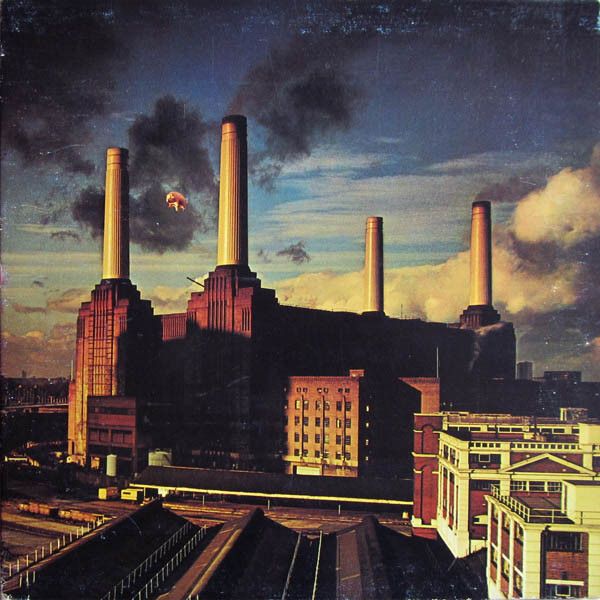

On December 3, 1976, a 40-foot inflatable pig broke loose from its moorings above Battersea Power Station. The marksman hired to shoot it down was not there that day. Within minutes it was gone, drifting into the flight paths over London. Airline pilots reported it at 30,000 feet.
It came down that night in a farmer's field in Kent. The pig, named Algie, was meant for the cover of Pink Floyd's tenth album, Animals, released in January 1977.
The record inside was the bleakest the band had made. It has five tracks, three of them over ten minutes long, and no single. Roger Waters borrowed from George Orwell's Animal Farm to divide people into pigs, dogs, and sheep.
It arrived in the middle of punk, from a band punk had made its enemy. It still reached No. 2 in Britain and No. 3 in America.
“An uncomfortable taste of reality in a medium that has become, in recent years, increasingly soporific.”
Two Songs Left Over From 1974
The roots of Animals go back to Pink Floyd's British winter tour of 1974. Alongside an early version of “Shine On You Crazy Diamond,” the band played two harsh new songs, “Raving and Drooling” and “You Gotta Be Crazy.” Waters wrote the first. He and David Gilmour wrote the second.
The mood of that tour was grim. Britain had unemployment, inflation, and IRA bombings, and the band were tired of the big halls. Arriving at a crumbling venue in Stoke-on-Trent, Waters asked what they were doing playing in such a building. “We really should stay in one place,” he said. “We'd do much better gigs.”
Sedgwick described London that winter in the same terms. “Everywhere was grey, sodden, and above all else, cold,” he wrote. “A kind of gloom set in: a languorous melancholy, which seemed exactly commensurate with the prevailing rhythm of the national psyche.”
Waters's friend Nick Sedgwick, who traveled with the band, captured the fatigue in his memoir In the Pink. Watching from the side of the stage, he noticed a crew member asleep on a pile of cables during “Money.” “But you can even grow used to magic when there is enough of it,” he wrote.
Both songs were considered for Wish You Were Here in 1975. Waters argued that album was about absence and they did not fit, and the band agreed. Two years later, he found a concept they did fit.
A Studio of Their Own in Islington
In 1975 the band bought a set of old church buildings on Britannia Row in Islington and turned them into a studio. Every earlier Pink Floyd album had been recorded at least partly at Abbey Road. Recording at Britannia Row began in April 1976 and ran to December, with engineer Brian Humphries. He had first worked with the band on the soundtrack to More, ran their live sound from 1974, and had engineered Wish You Were Here.
Humphries had doubts about the build. The architect was an old friend of Waters and Nick Mason. “I think he was bluffing his way through it because I don't think he knew anything about soundproofing,” Humphries said. Mason agreed the results were rough. “On the technical side of all the albums we've made, this was perhaps the roughest one,” he told Ultimate Classic Rock in 2022. “It was made at the same time that punk was kicking off, [but also] this was our own studio that had been built on a budget.”
Without Abbey Road's staff, the band ran the tape machines themselves, and mistakes followed. Mason remembered Waters and himself “supervising a guitar solo of David's and actually wiping it by mistake.” Humphries remembers the lost part as heavy drum fills Gilmour had overdubbed on “Dogs.” Either way, Gilmour had to play it again. “He wasn't a happy bunny,” Humphries said.
The work was not always shared evenly. “All four of them would lay down the basic tracks,” Humphries recalled. After that, he said, “it was basically more Roger, because upstairs they had a gaming room with a billiard table.”
Richard Wright contributed less than ever. “Animals was certainly mostly Roger's ideas, and Dave wrote the music for Dogs,” Wright told Melody Maker in 1978. “I, in fact, didn't contribute anything, and that was partly because there was enough material from Roger and also because I wasn't feeling very creative anyway.” Humphries points to the Fender Rhodes solo that opens “Sheep” as the exception. He dimmed the lights, told Wright to do his thing, and kept the first take.
Pigs, Dogs, and Sheep
Orwell's Animal Farm gave Waters his frame. “You Gotta Be Crazy” became “Dogs,” “Raving and Drooling” became “Sheep,” and he added two new songs, “Pigs (Three Different Ones)” and the short acoustic “Pigs on the Wing.” The pigs are the people at the top, the dogs the ruthless climbers who serve them, the sheep everyone else.
Writers have read the scheme as a portrait of late-1970s capitalism. “The pigs are the aloof elites; the dogs the servile, manipulative managerial class; and the sheep are the working masses from which the dogs extract value,” Erwin Montgomery and Rob Horning argued in The New Inquiry. Recording began the same month that Harold Wilson resigned as prime minister.
The country outside the studio fit the theme. 1976 brought industrial unrest, a long drought, and a stirring far right. It also brought the Sex Pistols. Johnny Rotten had been spotted in a Pink Floyd T-shirt with “I Hate” scrawled above the band's name. To the new punk audience, the Floyd stood for everything bloated about rock.
The critic Jon Savage, who chronicled punk in England's Dreaming, remembered how the previous album felt in that climate. “Wish You Were Here was everywhere in 1975 and early 1976: it's great but bloody hell, it's turgid. Funereal,” he said. He admitted he never even played Animals when a copy arrived. When he told Waters so in the mid-1980s, Waters replied that he could understand that.
The irony was that Waters was as angry as the punks. The album's sound is harder and sparer than Wish You Were Here: more guitar, fewer textures, and Waters's voice pushed to a sneer. Gilmour carries much of the music, but the vision is Waters's. The album is often seen as the start of the imbalance that would shape The Wall.
'Pigs (Three Different Ones)': Waters's three portraits of the powerful, with Gilmour's talk box making the pig noises.
Waters has always insisted the album is funnier than its reputation. “I don't think the humour of the work has ever really escaped in the way it might have,” he told Chris Salewicz in 1987. “I suppose I have always appeared as a rather melancholy person. But I'm not.” The barnyard sound effects, the mock-biblical vocoder in “Sheep,” and the grunting guitar in “Pigs” are jokes, if very dark ones.
A piece of well-constructed political program music… Lyrical, ugly, and rousing, all in the right places.
Essential Tracks
“Dogs”
“Dogs” fills almost all of side one, about 17 minutes. It is the only song on the album that Gilmour co-wrote, and he sings the first half. It began as “You Gotta Be Crazy,” played live on the 1974 winter tour, so audiences had heard an early version two years before the album came out. The lyric follows a ruthless businessman who claws his way up by betraying everyone around him, then dies alone and afraid.
Gilmour's guitar is the heart of it, moving through a run of solos and refrains. Halfway through, the band falls away into an eerie middle section of barking and baying dogs. Humphries supplied some of the sound himself. “I was doing the dog whistling,” he said, and he sometimes brought his golden retriever, Tina, to overdub sessions. Waters, at the mixing desk, ran the barking through a vocoder until it sounded like a machine.
Waters takes the second half, the dog looking back on a wasted life. The contrast between the two voices makes the song work: Gilmour's ambition, Waters's bitterness. Daryl Easlea of Prog calls it one of the group's greatest performances.
“Pigs (Three Different Ones)”
The three pigs are three kinds of power. The first is a businessman. The second was reportedly inspired by a woman Waters noticed at a bus stop near Britannia Row, though many listeners hear Margaret Thatcher, then leader of the Conservative Party. The third is named outright: Mary Whitehouse, the campaigner against sex and violence on British television. Her name carried a second meaning in the 1970s: the White House had housed Richard Nixon, who had resigned in disgrace two years before Waters wrote the song.
The music is a slow, queasy funk groove. Gilmour plays a talk box, the effect Peter Frampton had made famous a year earlier, but here it is used to make grunting, squealing pig noises.
On the 1977 tour, the inflatable pig floated over the crowd during this song. Decades later, Waters turned the album's imagery against Donald Trump on his Us + Them tour, proof of how easily its targets could be updated. “We don't rebel against Trump, we elect him,” Waters said in 2020, casting voters as the sheep.
“Sheep”
The old “Raving and Drooling,” renamed, closes the main body of the album. In 1974 it had been a song about violent social disorder; the farmyard concept gave that violence a cause and a target. It opens with Wright's Fender Rhodes solo, the single take Humphries coaxed out of him with the studio lights down. Then the band crashes in at a gallop.
The sheep start out grazing peacefully, unaware of what is coming. In the middle, Mason intones a twisted version of the 23rd Psalm through a vocoder, a shepherd who leads his flock to slaughter. Then the sheep turn on the dogs in a violent uprising.
The revolt does not end well, and Waters suggests the cycle will simply repeat. Gilmour's closing guitar solo is the album's one burst of release. As critic Daryl Easlea put it, it is “the only time you feel anywhere near becalmed during the album's three lengthy pieces.”
'Dogs' in James Guthrie's 2018 remix, the version held back for four years by a dispute over the sleeve notes.
A 40-Foot Pig Over Battersea
The design team Hipgnosis had designed every previous Pink Floyd cover, but this time the band disliked their ideas. According to Mark Blake's sleeve notes for the 2018 remix, Waters came up with the image himself. He drove past Battersea Power Station on his way to the studio and liked its four chimneys, one for each member of the band. Turned upside down, he noticed, the building looked like a table with four legs. He had a small model of a pig made, photographed the power station, and mocked up a sleeve. The rest of the band loved it.
Waters designed a pig, and the artist Jeffrey Shaw built it with Hipgnosis: a 40-foot helium balloon named Algie. A marksman stood by on the first day of the shoot, in case it broke free. The pig would not launch properly that day, and nobody booked the marksman again.
On December 3 the wind tore Algie loose. Flights at Heathrow were disrupted as the pig drifted east through the air lanes. That evening a farmer in Kent called in to report a giant pig in his field, frightening his cows.
The pig was recovered and flown again, but the final day's sky was clear and dull. The cover is a composite: the pig from a later day pasted into the dark, brooding sky from an earlier one. The escape earned the album acres of publicity before anyone had heard a note.
“Punk Floyd”
The album was launched at a party at Battersea Power Station on January 19, 1977. The reviews were divided. In Melody Maker, Karl Dallas welcomed it as a dose of reality, under a headline many still remember: “Punk Floyd.” Mick Farren in the NME was less grateful. “I know the dogs eat the sheep,” he wrote. “I can do without exquisitely crafted reminders.”
The Daily Mail's Bart Mills found it hopeless. “The nihilism of Animals is overpowering,” he wrote. Even the band's photographer for the pig shoot, Howard Bartrop, was let down. “I was disappointed it didn't sound like The Dark Side Of The Moon,” he said. In America, Christgau gave it a B-plus and dismissed the charge of repetitive cynicism. Humphries heard something else in it. “It showed the heavy metal in the band,” he said.
Fans bought it anyway. Animals reached No. 2 in the UK and No. 3 in the US, without a radio single. The band toured it through 1977 on the In the Flesh tour, with Algie flying over the stadiums.
Waters kept expanding the stage show. At American stadiums, Algie was joined by what he called Electric Theatre: an inflatable nuclear family of a mother, father, and two and a half children, surrounded by an inflatable Cadillac, a television, and a refrigerator. Saxophonist Dick Parry and guitarist Snowy White filled out the touring band.
That tour changed Pink Floyd. At Montreal's Olympic Stadium, a fan's behavior provoked Waters into spitting in his face. Afterward Waters began imagining a wall between himself and the audience, the idea behind The Wall. Waters would later describe stadium rock to Q as “genuinely awful.”
The Album That Keeps Coming Back
For years Animals sat in the shadow of the albums on either side of it, Wish You Were Here and The Wall. Its sleeve is far better known than its music. Over time, though, its reputation has risen, partly because its targets never went away. Even Mason came round to the punk comparison. “I suppose I always saw Animals as more of a punk album,” he said in 2019.
Mason had more than a passing interest in punk. Not long after the album came out, he produced the Damned at Britannia Row. Algie, meanwhile, became a fixture of Pink Floyd shows. When the band split in the 1980s, Waters kept the rights to the pig, and the others got around it by flying a pig with testicles instead. In 2011 a replica floated over Battersea again to mark the reissue of the band's catalogue.
The band's old divisions followed it into the 2020s. Engineer James Guthrie finished a new stereo and 5.1 remix in 2018, but it was held back for four years. In 2021 Waters said Gilmour had blocked it over Mark Blake's sleeve notes. “He does not dispute the veracity of the history described in Mark's notes, but he wants that history to remain secret,” Waters wrote. He posted the notes on his own website instead, and accused Gilmour of claiming “more credit for Dave on the work he did in Pink Floyd, 1967-1985, than is his due.”
The Animals 2018 Remix finally came out on September 16, 2022, without Blake's notes. Aubrey Powell of Hipgnosis re-photographed the cover, he said, “to reflect a changing world.”
The album still begins and ends with “Pigs on the Wing,” two short acoustic halves of a love song Waters wrote for his new wife, Carolyne. The title is a play on the saying “pigs might fly.” They frame the album's contempt with about two and a half minutes of tenderness. Fifty years on, that frame is what keeps Animals from being merely angry: its answer to a world of pigs, dogs, and sheep is two people looking after each other.
“I can't write a song that isn't connected with how I feel. I think that maybe if my songs have an enduring quality to them, it's that they're truthful, that they're very heartfelt.”