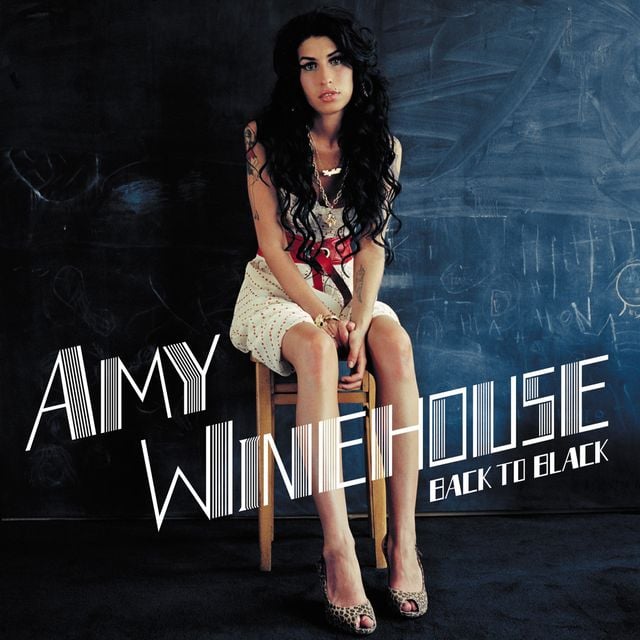

Amy Winehouse's management wanted her to go to rehab. She refused. She told the story to Mark Ronson, a producer she had just met, as they walked around New York. Ronson could hear a song in it straight away.
Six of the eleven tracks on Back to Black were made with Ronson and a Brooklyn soul band, the Dap-Kings, in five to seven days. The other five were recorded in Miami with another producer, Salaam Remi. Winehouse didn't meet the Dap-Kings in person until months after her vocals were done. You'd never guess any of that from listening.
The album spent six weeks at No. 1 in Britain, spread over five years. It won five Grammys. She accepted them by satellite from a London club, because US immigration wouldn't let her into the country in time. The Guardian has since ranked it the best album of the twenty-first century.
“One of the truest, most devastating pop albums of the 21st century.”
They Tried to Make Her Go to Rehab
The line that gave the album its most famous song was not invented for a record. Winehouse's management had pushed her toward alcohol treatment; her father Mitch, by his own later account, first backed the idea and then wavered, leaving her without the unified support that might have made rehab stick. She refused to go, and the phrase she used to describe the standoff — “no, no, no” — had apparently been sitting in one of her notebooks for some time before she said it out loud to Mark Ronson on a walk through New York in early 2006. Ronson suggested they turn it into a song. It took them very little time to do so.
The album's title track works the same way, describing the collapse of her relationship with Blake Fielder-Civil in the plainest possible terms — going back to what is familiar rather than what is good for you. Fielder-Civil and Winehouse were not together when most of the record was written, and were briefly reconciled and married the year after it came out, which gives Back to Black the strange distinction of being a breakup album published squarely inside a period when the breakup had not yet resolved either way.
None of this is unusual subject matter for a soul record. What is unusual is how little distance Winehouse put between the writing and the telling. There is no character, no narrator standing in for her; when she sings about refusing treatment or waiting up for a man who has already left, the album is not dramatizing a feeling, it is reporting one, close enough to real time that the record now reads less like a breakup album and more like a set of contemporaneous notes.
Built from a line she'd been carrying in a notebook and a conversation with Mark Ronson on a New York street corner.
Two Cities, Two Producers, No Shared Room
Back to Black was made in two separate camps that barely overlapped. Salaam Remi produced five tracks — including “Me & Mr Jones,” “Just Friends” and “Tears Dry on Their Own” — at Instrument Zoo Studios in Miami, largely in 2005, before Ronson was involved at all. Mark Ronson produced the other six, including “Rehab,” the title track and “You Know I'm No Good,” recording the instrumental beds with the Dap-Kings at their own studio in Brooklyn and finishing strings and brass at Metropolis Studios in London.
Ronson has said the two of them worked fast: “The six songs that we did on Back to Black together, we did in five to seven days,” he recalled, adding, “I always think, ‘Damn, I wish it did take longer’ because I would have more memories — it was just so quick.” The Dap-Kings cut their instrumental parts without Winehouse in the room; she recorded her vocals separately in London or New York, and the band and the singer traded tapes rather than takes.
The two never actually met until she came to New York for promotional work months later, when Ronson finally brought her to Daptone's studio to hear the band play the songs live. He has called it one of the last times he saw her able to move through the city unrecognized — a quiet afternoon, before the record turned her into someone who could not do that anymore. Salaam Remi, working the Miami side of the split with no knowledge of what Ronson was building in New York, has said he was less interested in chasing a signature Winehouse sound than in giving her room to write the way she already worked — retreating to a guitar or a Wurlitzer on her own for an hour and returning with a finished song, chords, melody and lyric all arriving together rather than assembled in stages.
The Trojan Horse
The Brooklyn sessions were deliberately old-fashioned. Daptone Records co-founder Gabriel Roth, who engineered alongside Ronson, has described the label's whole aesthetic in one line: “Show me a computer that sounds as good as a tape machine and I'll use it.” Mixer Tom Elmhirst has described the actual method: “They recorded drums, piano, guitar and bass all together in one room. The drums were recorded with one microphone, and there's lots of spill between the instruments, which was great.” Dap-Kings guitarist Binky Griptite remembered the pace as unfamiliar for a band used to cutting singles on their own schedule: “We weren't used to having another producer being in there, like, ‘Okay, we gotta knock this out by five.’”
The one real creative standoff of the sessions was over strings. Winehouse had told Ronson bluntly she did not want an orchestra anywhere near the record; arranger Chris Elliot recalled her exact words as “I don't want any fucking strings on the record.” Ronson commissioned the arrangement anyway, without telling her, reasoning that the girl-group and Phil Spector records she loved were built on exactly that kind of orchestration. When he finally played her the finished string part on “Love Is a Losing Game,” he expected a fight. “She had her head down on the desk, and I was kind of terrified,” he said. “When the song was done, she looked up, beaming, and said, ‘OK, you can leave it in.’”
Ronson has since described his own contribution to the album in terms that undersell it on purpose: “The production was really a Trojan Horse. It dressed the music up to get it through the wall, but that's not why the record is what it is. It's her.” It is a rare thing for a producer to argue against his own credit, and it happens to be accurate — the arrangements are immaculate, but nothing on Back to Black would matter without the voice singing over them.
Essential Tracks
“Rehab”
A horn-driven strut built around a real refusal, not a fictional one, made in a matter of days with the Dap-Kings supplying the kind of unhurried, tape-warm groove Daptone had spent years perfecting on Sharon Jones records. Winehouse's vocal sits just behind the beat throughout, giving the whole thing a wry, unbothered cool that undercuts how bleak the actual subject matter is.
It reached No. 7 in the UK and No. 9 on the US Hot 100, and went on to win three of the album's five Grammys — Record of the Year, Song of the Year, and Best Female Pop Vocal Performance — making it, structurally, the hinge the entire album turns on: the song that got Ronson and Winehouse into a studio together in the first place.
Its afterlife has been complicated by what came next in her life, but the song itself has aged as a genuinely sharp piece of songwriting — funny, specific, and entirely unsentimental about its own subject, which is part of why it still plays as more than a punchline. The horn chart, arranged and played by the Dap-Kings' own section, does most of the song's comic work, punctuating each refusal with a shot that lands like a laugh line rather than a lecture.
“Back to Black”
The title track is the album's bleakest arrangement — a minor-key dirge built on a Ronson production that leans directly on 1960s girl-group melodrama, the kind of record the Shangri-Las might have made if the boy really did die at the end of the song. The Dap-Kings play it almost funereally slow.
Lyrically, it is the most direct statement on the record about the Blake Fielder-Civil relationship: returning to old, familiar unhappiness — drinking, isolation — once a relationship ends, rather than moving toward anything better. There is no argument for hope anywhere in the song, which is unusual even by breakup-album standards.
It gave the album its name and its defining image, and became the song most closely associated with Winehouse's public persona — for better and, after her death in 2011, considerably worse, as its lyrics were read backward into her biography by people who had ignored them when the record first came out.
“Tears Dry on Their Own”
Produced by Salaam Remi in Miami rather than Ronson in Brooklyn, and built on an interpolation of Marvin Gaye and Tammi Terrell's “Ain't No Mountain High Enough” substantial enough that Nickolas Ashford and Valerie Simpson are credited as co-writers alongside Winehouse.
It is the album's most defiant track rather than its most devastated one — a song about choosing to be alone over being with the wrong person, delivered with a Motown horn chart that gives the resignation an unexpected lift. PopMatters singled it out, alongside “Love Is a Losing Game” and “Wake Up Alone,” as one of the songs that made the album “an artistic success worth keeping on repeat.”
It is also the clearest evidence that the Remi and Ronson halves of the record, cut an ocean apart with no shared personnel, belong on the same album at all — the tempo and horn language are different, but the emotional register never breaks continuity. That the interpolated Ashford & Simpson melody sits so naturally inside a song about walking away from the wrong man says something about how deliberately Winehouse and her producers were working within a Motown lineage rather than merely borrowing its surface sound.
The title track: a Ronson production built on 1960s girl-group melodrama, played almost funereally slow.
Five Grammys, Zero Trips to America
By the time the Grammys came around in February 2008, U.S. immigration officials were unwilling to grant Winehouse a visa on the original timeline, citing concerns tied to drug use after a British tabloid published video appearing to show her smoking crack cocaine weeks earlier. A visa eventually came through, but too late for travel. Grammy producer Ken Ehrlich made the unusual call to build a live satellite feed from a London club into the broadcast rather than lose the performance entirely: “There was no way we were going to do that show without her that year,” he said. Winehouse's manager told him she was ready — “She's so excited and she's really ready for this. She wants this to be great” — and Ehrlich recalled the results bearing that out: “The performance was electric. It was really something.”
She won five awards that night without setting foot in the country holding the ceremony: Record of the Year and Song of the Year for “Rehab,” Best Female Pop Vocal Performance, Best Pop Vocal Album, and Best New Artist — the first British woman to take home five Grammys in a single night. Ehrlich, watching from Los Angeles, remembered something more fragile underneath the triumph: “She seemed fragile to me,” he said of the broadcast, describing “a particular vulnerability” visible even through a satellite link and an ocean of distance.
The commercial arc the Grammys triggered was significant on its own: Back to Black had already reached UK No. 1 within three weeks of its late-October 2006 release and been the best-selling album in Britain for 2007, but the American sweep pushed it to a new US peak of No. 2 on the Billboard 200 the same month, more than a year after its original release — a rare case of an album's commercial ceiling arriving well after its cultural one.
Motown Rewritten, Reviewed Coolly at Home
Critical reaction on release was strong but not universally rapturous, which is worth remembering given how the album is discussed now. musicOMH's John Murphy called it “Motown rewritten for the 21st Century” and “a superb comeback, and one of the best albums of the year,” struck by a voice that sounded, in his words, like it belonged to “a woman two or three times her age” coming from a 23-year-old. PopMatters' Christian John Wikane praised its “stirring mélange of Muscle Shoals and Funk Brothers-driven Motown” while flagging a couple of weaker tracks toward the album's edges — a 7-out-of-10 rather than a rave.
Rolling Stone was more effusive, grading it an A- and later naming it one of the year's fifty best albums, calling it “a brassy, intensely personal sorrow that is true blues, not nouveau soul.” Robert Christgau, writing his Consumer Guide notice, was cooler and more circumspect — a two-star honorable mention with a wary aside about her recent marriage: “Pray her marriage lasts — she's observant, and it would broaden her perspective.” Read today, that line is less a critical judgment than an accidental piece of foreshadowing.
The gap between those contemporary notices and where the album sits now is instructive. The Guardian later placed Back to Black at number one on its list of the 100 best albums of the twenty-first century — not a runner-up slot, not a nostalgia pick, the top of the whole list, ahead of two decades of competition the 2006 reviewers could not have anticipated.
The Winehouse Effect
Back to Black is routinely credited with reopening British pop's door to girl-group and Motown-derived soul, a sound that had been treated as period pastiche until Winehouse and Ronson made it sound current. The artists who followed through that door over the next several years — Adele, Duffy, Estelle, Florence Welch — owe it a debt Adele herself has acknowledged in interviews crediting Winehouse and her 2003 debut Frank with making her want to pick up a guitar in the first place. The influence reached beyond the retro-soul lane it opened, too: after Winehouse's death, Lady Gaga tweeted that “Amy changed pop music forever,” adding, “She lived jazz, she lived the blues” — framing her less as a revivalist than as someone who had simply lived the genres she sang rather than imitating them.
Winehouse died in July 2011, at 27, and the album returned to UK No. 1 that summer for the first time since 2008 — grief translated, as it so often is, into chart position. The 2015 documentary Amy won the Academy Award for Best Documentary Feature and reframed the album's lyrics as something closer to a diary than anyone had treated them as at the time. A twentieth-anniversary reissue, due in late October 2026 with previously unreleased demos and a live set recorded in Amsterdam the year the album came out, arrives within weeks of this review — proof that this is not a record anyone has stopped listening to.
What holds the album together, twenty years on, is the thing Ronson kept insisting on when he described his own production as a Trojan Horse: the arrangements, however meticulously built from vintage soul and girl-group source material, were always in service of a voice specific enough that no amount of studio craft could disguise it as anyone else's. That specificity is why the songs still sound like reporting rather than performance, and why an album written about one bad year has outlasted nearly everything released around it.
“I really haven't met a person so immersed in their art… I have this sort of know-it-all reputation for music, but she knew way, way more stuff than I did.”