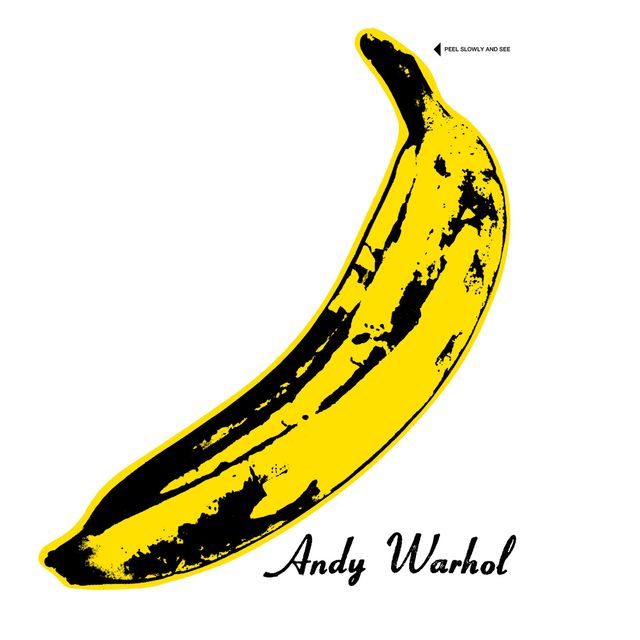

In April 1966 a Columbia Records sales executive named Norman Dolph paid for the Velvet Underground to record an album at Scepter Studios in New York. The sessions cost about $700. Andy Warhol paid him with a painting.
Columbia turned the tapes down within a day. The album finally came out on Verve on March 12, 1967, as The Velvet Underground & Nico, with Warhol's peelable banana on the cover. It had songs about heroin, waiting for a drug dealer and sadomasochism.
Radio stations and record shops banned it. It reached only No. 171 on the Billboard chart. Today it is in the Library of Congress's National Recording Registry, and it turns 60 in March 2027.
“I was talking to Lou Reed the other day, and he said that the first Velvet Underground record sold only 30,000 copies in its first five years. Yet, that was an enormously important record for so many people. I think everyone who bought one of those 30,000 copies started a band!”
A Songwriter and a Viola Player
The band began with two very different people. Lou Reed was a staff songwriter at Pickwick Records. John Cale was a classically trained Welsh viola player who had been playing drones in New York with the minimalist composer La Monte Young.
Cale wanted out of the avant-garde. “I woke up one day and said, ‘Wait a minute, there are people running around singing Beatles songs,’” he told Rolling Stone in 2017. “I wanted to cross-pollinate rock with the avant-garde, and then I met Lou Reed, and that was the solution.”
The first song Reed played him was “Heroin.” Pickwick would not let him record songs like that. “It kind of pissed me off,” Cale said. “I said, ‘Let's go and do it ourselves.’ … Let's put a band together and go out there and play them.” The guitarist Sterling Morrison joined, and then the drummer Maureen “Moe” Tucker, who played a very small kit.
In 1965 they started playing live to accompany underground films. Andy Warhol was looking for a band for a multimedia show of his own, the Exploding Plastic Inevitable. He became their manager, and he added a singer: Nico, a German-born actress and singer who had appeared in Fellini's La Dolce Vita and been given a Bob Dylan song to record in London.
Reed and Cale only accepted Nico because Warhol insisted. Reed still wrote her songs, including “Femme Fatale,” “All Tomorrow's Parties” and “I'll Be Your Mirror.” Warhol also gave Reed advice. “He told Lou, ‘Don't forget to put the swear words in the songs,’” Cale said. They never did. “We felt the intellectual strength in what we were trying to do came from not using swear words.”
The Exploding Plastic Inevitable
In March and April 1966 the show ran at the Dom, a rented hall on St. Mark's Place. Warhol's films were projected over the band, a light show filled the walls, and the poet Gerard Malanga danced with a whip. A roadie walked around with a 16mm projector on a long cable, aiming films at the walls and the performers.
Norman Dolph was the DJ between sets. He collected art and had already played four parties for Warhol, each time taking artwork instead of cash. He was not sure what to make of the band at first. “There was no yardstick to accurately measure what they were doing,” he told Sound On Sound, “but I did know we were dealing with something unprecedented.”
When Warhol said he wanted to make a record with them, Dolph offered to arrange it. “I'll do it in exchange for a picture,” he told Warhol. He took the job to John Licata, an engineer at Scepter Studios, which belonged to the label of the Shirelles and Dionne Warwick. Licata could book the studio for outside clients when it was empty. He quoted $600 to $800 for the whole album.
That May the show went to Los Angeles for a month at the Trip on Sunset Strip. The authorities closed it after a few nights. The band stayed in town to record, and there they signed a deal with MGM, which would put the album out on its Verve label.
One of three songs the band re-recorded in Hollywood in May 1966 with producer Tom Wilson.
Four Days at Scepter Studios
Scepter was falling apart. Cale later called it “post-apocalyptic.” “We had to walk carefully across the floor because the floorboards were up,” he told Rolling Stone. “We had no earphones. We just stood there and did it in a broken-down studio.” The control room held a four-track tape machine and room for about four people.
The whole thing took four days, two recording and two mixing. The band was playing five nights a week and wanted to sound as it did live. Most songs were done in one take. “Everything was done from the top,” Dolph said. “At the most, a song would be compiled from two half-takes.” Tape cost about $150 a reel, so false starts were stopped early.
Warhol was credited as producer, but he barely took part. Dolph says he was in the control room for about 30 minutes on two of the four days. “He'd stand behind me, listen to a playback and say, ‘Oh, yeah, yeah, that sounds great,’” Dolph said. “I don't think Warhol gave us the slightest instruction or command.”
Reed later saw that as the point. “The advantage of having Andy Warhol as a producer was that, because he was Andy Warhol, they left everything in its pure state,” he said in 1993. “They would say, ‘Is that OK, Mr Warhol?’ and he'd say, ‘Ohhh, yeah,’ and so they didn't change anything.”
The real decisions were made between Reed and Cale. “If they agreed on something, it was ‘next track’,” Dolph said. “And if they didn't, Cale normally won, although Reed had the final say over his own singing.” Nico was treated gently. Everyone went quiet when she was about to sing, and afterwards, Dolph remembered, she would lean against a wall “as if she wasn't in the room.”
Dolph could see the whole band through the control-room glass. Tucker sat in the middle with her back to the far wall, with no baffles around her small kit. Reed sang with his back to her, at a microphone in the centre of the room. Morrison stood in the far right corner. Cale stood on the left with his viola, facing Reed.
Cale looked like Paganini possessed by the devil when he played that viola; it was as if he might saw it in two with the bow.
Rejected by Columbia, Rescued by Verve
On April 25, 1966, an acetate disc of the Scepter recordings was cut to shop to record companies. Warhol wrote Columbia a cheque for $84 to make it. Dolph, who worked there, took it to the label and expected an instant yes. “Back then I got an inter-office memo within 24 hours, basically stating I must be out of my mind,” he said. “Columbia passed on it so fast, my head spun.”
Other labels said no too, until Tom Wilson, a former Columbia colleague of Dolph's who had moved to MGM/Verve, took it on. In May he recorded new versions of “Heroin,” “Venus in Furs” and “I'm Waiting for the Man” at TTG Studios in Hollywood, slower than before. Other Scepter tracks were remixed.
Verve still wanted a single. In November 1966 Wilson took the band into Mayfair Studios in New York to record “Sunday Morning,” meant for Nico but sung in the end by Reed. Reed and Cale had written it at a friend's place, on a harmonium in the corner, on a late Saturday night. “It was really Sunday morning by the time we finished,” Cale said.
Then the cover held things up. Warhol's design had a banana-shaped sticker that peeled off to reveal the fruit underneath, next to the words “Peel slowly and see.” A special machine had to be built to make it. The album reached the shops nearly a year after most of it was recorded, labelled “produced by Andy Warhol.”
Dolph never got a credit on the record. He got his painting, from Warhol's Silver Disaster series, and thought it was a fair trade for bringing the album in under budget. He also gives much of the credit to Licata, who got the band's live sound “on the first pass of every song without ever having seen their live performance.”
Essential Tracks
“Heroin”
It was the last song recorded at Scepter, and Dolph had never heard it before. The song speeds up and slows down with the rush of the drug, while Cale's amplified viola screeches over the top. “When Cale overdubbed his part, we were all holding our breath,” Dolph said. “No way would I even pick up a pencil and move it an inch while that was going on.”
Reed's vocal unsettled him. “I thought, ‘My God, this guy has first-hand experience, he's not just making it up,’” Dolph said. He also wondered who would pay for it. “Whereas you might enjoy the Rolling Stones' ‘Satisfaction’, you'd experience ‘Heroin’.”
The album uses Wilson's slower Hollywood remake. About six minutes in, Tucker's drums stop for a few seconds. “As soon as it got loud and fast, I couldn't hear anything,” she said in a 2006 documentary. “I stopped, assuming, well, they'll stop too and say, ‘What's the matter, Mo?’ But nobody stopped… so I came back in.”
“Venus in Furs”
Reed based the song on Leopold von Sacher-Masoch's 19th-century novel about sadomasochism. The sound is built on two drones. Cale strung his viola with guitar and mandolin strings and played sustained notes. Reed tuned every string of his guitar to the same note, a trick he called the “ostrich” tuning after “The Ostrich,” a 1964 dance record he and Cale had made as the Primitives.
Cale liked how harsh it was. “It was very abrasive,” he said of the viola. “And the pickups we had then were really not terrific. They had a lot of noise. It was a good racket.” Most of Reed's songs were in D or G, he noted, which suited the viola. Reed would bring in a finished song, and Cale would add a drone.
Cale still plays it. In 2012 he told Salon that the viola's role on these songs was “to create a kind of elegant backdrop for what we were singing about,” and that it still works live. Salon's Stephen Deusner described the effect as “an intensely narcotic buzz.”
“All Tomorrow's Parties”
This was Warhol's favourite song on the album. Reed wrote it about the people who drifted through the Factory, Warhol's studio, and gave it to Nico. It also uses the ostrich tuning.
Nico's low, flat voice makes the song. Marc Hirsh of the A.V. Club, reviewing the 2012 box set, heard a vocal-free mix and found it showed “how vital Nico was to that song's sense of panoramic perfection.” He called the finished song “a towering, untouchable fortress of solitude.”
It was one of the songs that most puzzled audiences. Cale said that when they played something strange like this or “The Black Angel's Death Song,” “people stand there with their mouths open.”
The album's opener, written on a harmonium late one Saturday night and recorded in November 1966 as a would-be single.
No. 171 on the Billboard Chart
The timing could hardly have been worse. 1967 was the year of the Summer of Love, and here was a record about addiction and street life. Many radio stations would not play it, some shops would not stock it, and magazines refused to review or advertise it. Verve's promotion was weak. The album peaked at No. 171.
The back cover caused trouble too. Its photo of the band on stage, taken at the Exploding Plastic Inevitable, showed the actor Eric Emerson projected upside down behind them. Emerson threatened to sue. Rather than pay him, the label recalled copies and sold the rest with a black sticker over his image until it could be removed from later pressings.
The band went back on the road and changed fast. “Everything on the Banana Album was rehearsed and rejiggered and rearranged,” Cale said. The next record, White Light/White Heat, was louder and made up mostly in the studio. Cale left in 1968.
The live shows were wilder than the record. Every set ended with “European Son,” the closing track, which is dedicated to the poet Delmore Schwartz. On the album, the crashes that sound like glass breaking came from little tin plates in the studio. On stage, Cale said, “everybody put down their instruments and thrashed around with the drums.” At one San Francisco show Cale knocked a cymbal off its stand, and it cut Reed's head.
Cale was not surprised by the poor reception. He had come from the avant-garde, where audiences were tiny. “We had a point to make,” he said. “We weren't there to fuck around. We're doing this song about this subject and that subject. Have you ever heard a song about this subject?”
A 75-Cent Flea Market Find
Dolph had handed the rejected acetate back to Warhol. It disappeared. In 2002 a Canadian collector, Warren Hill, bought it at a flea market in New York's Chelsea district for 75 cents. He rang Dolph to check its story, and Dolph confirmed the Columbia catalogue number.
Hill put it up on eBay. A winning bid of $155,401 was not honoured, and on December 16, 2006, it sold for $25,000. The acetate preserves the earlier Scepter versions, including faster takes of the three songs Wilson remade and a longer “European Son.” In 2012 it was finally released in the album's 45th-anniversary box set.
The banana itself ended up in court. In January 2012, Reed and Cale sued the Andy Warhol Foundation after it licensed the image for cases for Apple products. They argued Warhol had copied the banana from an advertisement and that the band had used it for merchandise for more than 25 years. “The banana design is a significant element of Velvet Underground's ongoing licensed merchandising activity,” the filing said.
Everyone Who Bought One
The famous line about the album comes from Brian Eno in 1982. He told the Los Angeles Times that Reed had said the album sold only 30,000 copies in its first five years, and that everyone who bought one started a band. Quote Investigator, which traced the saying, notes that it was later trimmed and that the sales figure was often changed.
The joke stuck because it was close to true. As the Washington Post put it in 1989, genres like glitter, punk and new wave “would eventually owe them a debt.” Robert Christgau graded it an A. Marc Hirsh called it “the anti-Revolver,” an album with “something for everyone,” from the speed-fuelled rush of “Run Run Run” to the pop of “There She Goes Again.”
Cale has mixed feelings about the reissues. “Every time I hear that record,” he told Salon in 2012, “I feel like I'm listening to it through gauze.” Yet the record keeps coming back. In 2006 it joined the National Recording Registry. In November 2025 it was one of the first four albums in UMe's Vinylphyle series of premium vinyl reissues.
Dolph, who later co-wrote the 1974 hit “Life Is a Rock (But the Radio Rolled Me)” and became a software developer, admits he did not hear its importance at the time. “What was there back then I helped put in the grooves,” he said, “but I didn't hear then what I hear in it now.”
“Even now, 45 years on, in a world where music has been irrevocably altered by The Velvet Underground & Nico, there's still nothing else that sounds like it.”