
On November 19, 1966, Paul McCartney was on an overnight flight home to London from Kenya. He could not sleep, so he worked on an idea for the Beatles. They would pretend to be a different band. Six months later that made-up band gave its name to Sgt. Pepper's Lonely Hearts Club Band.
The Beatles had stopped touring that August. They spent the winter and spring at EMI's studios on Abbey Road, working on one album for more than 400 hours. It came out in Britain on May 26, 1967.
Sgt. Pepper spent 27 weeks at No. 1 in Britain and 15 weeks at No. 1 in America. It won the Grammy for Album of the Year. It is still the best-selling studio album in British chart history, with more than five million copies sold there.
“My verdict: the most ambitious and most successful record album ever issued, and the most significant artistic event of 1967.”
A Band That Wasn't the Beatles
By late 1966 the Beatles were tired of being the Beatles. They had played their last concert that August. The crowds screamed so loudly that the band could barely hear themselves. That autumn the four of them went their separate ways for a while. Lennon acted in the film How I Won the War, Harrison went to India, and McCartney travelled through France and Spain with the band's assistant Mal Evans before flying on to Kenya.
On the flight home McCartney thought about how to make a fresh start. “Let's not be ourselves,” he remembered thinking, in Barry Miles's book Many Years From Now. “Let's develop alter egos so we're not having to project an image which we know. It would be much more free.” If the songs belonged to another band, he reasoned, each Beatle could sing them in a different way.
The name came from the in-flight meal. Evans asked what the “S” and “P” on the little packets meant. Salt and pepper, McCartney told him, and he turned it into “Sergeant Pepper.” He then added “Lonely Hearts Club,” after the dating clubs of the time. He liked that the full name made no sense. “People would have to say, ‘What?’” he said.
John Lennon saw it as McCartney picking up on the West Coast bands he had heard on the last American tour. “People were no longer The Beatles or The Crickets,” Lennon told the journalist David Sheff in 1980. “They were suddenly Fred and His Incredible Shrinking Grateful Airplanes, right?” Lennon never thought the idea went very deep. “Every other song could have been on any other album,” he said.
The Single That Got Away
Sessions began in late 1966, before there was any concept at all. The first three songs were “Strawberry Fields Forever,” “Penny Lane” and “When I'm Sixty-Four,” a tune McCartney had first written years earlier. The Beatles had a contract to fill. An early working title for the album was One Down, Six to Go, a joke about how many records they still owed EMI.
Their record company and management were nervous. The Beatles had released nothing new for months, so “Strawberry Fields Forever” and “Penny Lane” were taken off the album and released as a double A-side single in February 1967. It was a hit, but it missed No. 1 in Britain. It was the first Beatles single in four years that failed to get there.
George Martin, the band's producer, later called losing those two songs “a dreadful mistake.” The British music papers began to wonder in print whether the Beatles were finished. McCartney remembered them asking, “What are The Beatles up to? Drying up, I suppose.” Without those two songs, the band had to build the rest of the album from scratch.
The title song was recorded on February 1, 1967. Its framing idea came from Neil Aspinall, the Beatles' road manager. He suggested that Sgt. Pepper should open the album as a compère, introduce the band, and then close the show near the end. McCartney liked it. Lennon was less impressed with Aspinall. “Nobody likes a smart-arse, Neil,” he told him.
Four Tracks and 400 Hours
The album took more than 400 hours of studio time over 129 days. That was a huge amount for 1967, but EMI owned the studio, and the Beatles no longer had to plan around tours. They also knew they would never have to play these songs live, so they could put anything on tape.
The technology was basic. Abbey Road had four-track tape machines, so a song could hold only four separate parts at once. To add more, engineers mixed the four tracks down onto one track of a second tape, freeing up three more. Giles Martin, George Martin's son, compared it to copying a cassette. Each copy sounds a little duller. Some songs on Sgt. Pepper were copied this way three times.
The band also played with tape speed. “On this album, there's very few occurrences of a natural voice,” Giles Martin told NPR's Fresh Air in 2017. McCartney's voice was sped up on “When I'm Sixty-Four” and “Lovely Rita.” For “Being for the Benefit of Mr. Kite!” George Martin chopped up tapes of fairground steam organs and pieced them back together.
Not every Beatle enjoyed it. George Harrison had just come back from India and felt his heart was still there. “It became an assembly process – just little parts and then overdubbing,” he said in the Anthology. “For me it became a bit tiring and a bit boring.” Ringo Starr spent long hours waiting. “Sgt Pepper was great for me, because it's a fine album,” he said, “but I did learn to play chess while we were recording it.”
The beauty of it is it's just four human beings making noise in the studios. They just happened to make a very good noise with very good songs.
Harrison's main song was the Indian-influenced “Within You Without You.” McCartney, meanwhile, became the band's driving force. When George Martin was too busy to score the strings for “She's Leaving Home,” McCartney hired another arranger, Mike Leander, rather than wait. Martin was hurt. “He was so damned impatient and I was up to my eyes with other work and I just couldn't cope,” he said.
The title song introduces the made-up band. The crowd noise came from George Martin's 1961 recording of the comedy show Beyond the Fringe.
A Crowd of Cardboard Heroes
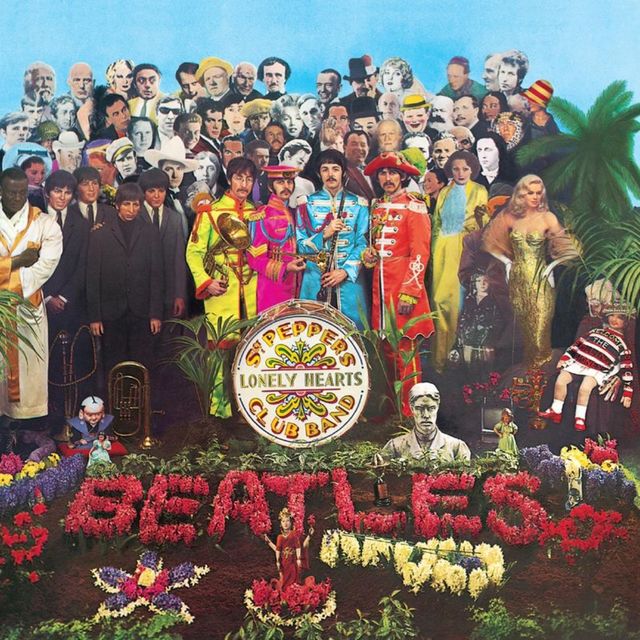
The cover nearly went a different way. The Beatles first liked an illustration by the design team The Fool. The art dealer Robert Fraser, who acted as art director, hated it. Jann Haworth recalled him telling the band, “You just cannot have this cover, it's not good enough. You should get Peter and Jann to do it.”
The pop artists Peter Blake and Jann Haworth, then married, built the cover as a real set. Each Beatle made a list of heroes to stand in the audience behind the band. Blake recalled that Lennon's list included Jesus, Gandhi and Hitler. Those three were left out. “George's list was all gurus,” Blake said. “Ringo said, ‘Whatever the others say is fine by me.’” Life-size cardboard cut-outs were made of everyone chosen, and Madame Tussaud's lent wax figures of the Beatles themselves.
Brian Epstein, the band's manager, worried about being sued, so his office wrote to everyone still alive for permission. Mae West at first refused. “What would I be doing in a lonely hearts club?” she asked. The Beatles wrote her a personal letter, and she changed her mind. Epstein was so uneasy about the whole package that before one flight he left a note asking for Sgt. Pepper to be released in “brown paper bags.”
Michael Cooper photographed the cover at his Chelsea studio on the evening of March 30, 1967. The band wore satin uniforms made by Berman's, a London theatrical costume company. The shoot took about three hours. Blake said he was paid about £200 and that Fraser signed away the copyright. The cover cost £2,868 in all, an immense sum for the time.
The package was new in other ways too. It was the first pop album to print all its lyrics, on the back cover, and it came with a sheet of cardboard cut-outs. On the back photo McCartney stands with his back to the camera. Fans later read that as a clue in the “Paul is dead” rumor, which our story Barefoot on Abbey Road tells in full.
Essential Tracks
“Lucy in the Sky with Diamonds”
The title came from a picture. Lennon's four-year-old son, Julian, brought home a drawing of a classmate, Lucy O'Donnell, and said it was “Lucy in the sky with diamonds.” Lennon wrote most of the song, with McCartney helping on the images. McCartney remembered adding “cellophane flowers” and “newspaper taxis.”
Listeners quickly noticed that the title's initials spelled LSD. Lennon always denied it was planned. He said the pictures in the song came from Lewis Carroll's Alice books. The verses float in a waltz-like 6/8 time, then the chorus switches to a heavy 4/4. Harrison added a tambura, an Indian drone instrument.
It was one of the fastest songs on the album to record. The band rehearsed it through the night of February 28, then cut the track in two days. Lennon later said he disliked the result. “It is a great track, a great song, but it isn't a great track because it wasn't made right,” he said in 1980.
“Being for the Benefit of Mr. Kite!”
On January 31, 1967, the Beatles were in Sevenoaks, Kent, filming a promotional clip for “Strawberry Fields Forever.” Lennon wandered into an antique shop and bought a framed circus poster from 1843. It advertised Pablo Fanque's Circus Royal in Rochdale, a show held “for the benefit of Mr. Kite.”
Lennon hung the poster on his wall and turned its wording into lyrics, changing a few details along the way. “Everything in the song is from that poster, except the horse wasn't called Henry,” he said. Some people decided that “Henry the Horse” meant heroin. Lennon denied it.
Lennon wanted it to sound like a fairground. A real steam organ could not be made to play a set part, so George Martin took recordings of steam organs, chopped the tape up and stuck the pieces back together. Giles Martin, who remixed the song in 2017, said the new mix could finally “swirl that around your head,” because the original tapes were clean enough to spread across the stereo field.
“A Day in the Life”
Lennon wrote the verses with a copy of the Daily Mail on his piano. The January 17, 1967 edition reported on the death of Tara Browne, a young Guinness heir and friend of the band, in a car crash. A short item in the same paper said there were 4,000 holes in the roads of Blackburn, Lancashire. McCartney supplied the middle section, about waking up and catching the bus to school.
The band left two 24-bar gaps in the song, with Mal Evans counting the bars and an alarm clock marking the end. On February 10, a 40-piece orchestra filled them. George Martin wrote only each instrument's lowest note, a few markers along the way and a final E major chord. “Whatever you do, don't listen to the fellow next to you,” he told them. The players wore evening dress plus fancy-dress items such as red noses and bald wigs. The violin leader played with a gorilla paw on his bow hand. Mick Jagger, Marianne Faithfull, Keith Richards and Donovan watched.
The ending took two tries. A hummed chord was tried first and dropped. On February 22, Lennon, McCartney, Starr and Evans hit an E major chord together on three pianos. Take nine lasted 53 seconds, with the volume raised as the sound died away. Before the album came out, the BBC banned the song over the line “I'd love to turn you on,” which it read as a drug reference.
The official film is built from footage shot at the February 10, 1967 orchestra session, with the players in evening dress and fancy dress.
Rush-Released, Then Banned
The last session was on April 21, 1967. The band recorded a few seconds of nonsense chatter for the run-out groove, the part of a record that keeps spinning after the music ends. Before it they added a high-pitched tone at 15 kilohertz, meant for dogs. EMI's disc cutter needed about eight attempts to get the groove right.
The Beatles spent most of their care on the mono mix, which was the main format in Britain then. They attended every mono mixing session. The stereo version was done in a few days afterward by George Martin, Emerick and engineer Richard Lush, without any Beatles present. “The only real version of Sgt Pepper is the mono version,” Lush said.
A week before release, the BBC told EMI it would not play “A Day in the Life” on radio or television. The corporation's head of sound broadcasting, Frank Gillard, wrote that “turned on” was “currently much in vogue in the jargon of the drug-addicts.” Lennon said the song came from newspaper headlines. “It's about a crash and its victim,” he said. “How can anyone read drugs into it is beyond me.”
EMI rushed the album into British shops on May 26, 1967, six days ahead of its official June 1 date. Capitol released it in America on June 2. In Britain it entered the chart at No. 8 on advance orders, then held No. 1 for 23 weeks in a row. In America it spent 15 weeks at No. 1. At the 1968 Grammy Awards it won four prizes, including Album of the Year.
“Dazzling but Ultimately Fraudulent”
Not every critic was won over. On June 18, 1967, The New York Times ran a review by Richard Goldstein. He called Sgt. Pepper “an album of special effects, dazzling but ultimately fraudulent.” “Like an over-attended child, Sgt. Pepper is spoiled,” he wrote. He made one exception. He called “A Day in the Life” one of the most important Lennon–McCartney songs and “a historic pop event.”
Four days later the Village Voice printed a reply from Tom Phillips, who worked on the Times' own broadcast desk. Phillips argued that the Beatles had “turned the record-album itself into an art form.” He heard the songs as a gallery of lonely hearts, from the runaway in “She's Leaving Home” to the circus acts in “Mr. Kite.” “A Day in the Life,” he wrote, turned the whole record “inside out.”
Goldstein stood his ground in the Voice that July. He predicted that once the studio tricks no longer seemed new, Sgt. Pepper would look like “Beatles baroque — an elaboration without improvement.” He still preferred Rubber Soul and Revolver. Robert Christgau partly defended him in Esquire that December. “Goldstein may have been wrong, but he wasn't that wrong,” Christgau wrote. “Sgt. Pepper is not the world's most perfect work of art.”
Decades later Goldstein revealed that he had reviewed the album on a stereo with a broken left speaker. He did not blame the speaker, though. “I didn't get it because the record wasn't really rock,” he told Rolling Stone in 2015. “It didn't belong in any genre that I could think of, so I didn't know how to receive it.”
Back at No. 1, Fifty Years Later
The Beatles moved on fast. They made Magical Mystery Tour in the same spirit later in 1967. But their next full album, the White Album in 1968, dropped the costumes, the psychedelic artwork and much of the group work. Lennon came to prefer it. “I don't care about the whole concept of Pepper,” he said in 1970. “But Pepper was a peak, all right.”
For the 50th anniversary in 2017, Giles Martin remixed the album from the original four-track tapes, before all the copying. He said the aim was to follow the band's own vision for the original mix and bring it into today's world. A box set added outtakes, including the abandoned hummed ending of “A Day in the Life.” “Even they had bad ideas,” Martin said. “Never be scared of a bad idea, just be scared of sticking with it.”
The reissue went back to No. 1 in Britain in June 2017, 50 years after the original first got there. No album had ever had a longer gap between its first week at No. 1 and its latest one. “Who would have thought that good old Sgt. Pepper would be back at number one 50 years on?” McCartney said. It brought the album's total to 28 weeks at No. 1 in Britain.
Giles Martin thinks the songs themselves are fairly ordinary on their own. “You take the songs in isolation, and they're not that weird,” he said. What made the record new was putting them side by side, so that a sitar raga sits next to a music-hall song about turning 64. The Official Charts Company sums up its influence this way: the Beatles are widely credited with the idea that an album is an artist's statement, “rather than a mere collection of songs.”
“Looking back on Pepper, you can see it was quite an icon. It was the record of that time, and it probably did change the face of recording, but we didn't do it consciously.”