
On May 13, 1966, Ginger Baker sat in with John Mayall's Bluesbreakers at Oxford Town Hall. Afterwards he drove Eric Clapton home to London and asked him to start a band. Clapton said yes, on one condition. Jack Bruce had to play bass. Baker and Bruce had been fighting for years.
Baker agreed anyway. Seven months later the three of them released Fresh Cream, on December 9, 1966. They recorded it on days off from touring, in a small studio in Mayfair. By Baker's count it took about ten days.
It reached No. 6 in Britain. It mixed old blues songs with new ones by Bruce, and it closed with “Toad,” a five-minute drum solo. Clapton was never happy with it. But it set the pattern for the rock power trio, and later hard rock bands built on it.
“Fresh Cream helped spur a bigger, louder and heavier way of playing rock 'n' roll. Even with three accomplished musicians, the amount of power the band manages to generate on this album is remarkable.”
A Ride Home in Ginger Baker's Rover
The idea of a trio came from Buddy Guy. Clapton had seen the Chicago guitarist play in London with just bass and drums behind him. “He was in total command and I thought, ‘This is it,’” Clapton told Uncut in 2004. “It seemed to me you could do anything with a trio.” At 21 he was the most talked-about guitarist in Britain. Fans had spray-painted “Clapton is God” on London walls.
Baker had his own plan. He was the drummer in the Graham Bond Organisation, a respected jazz and R&B band on the London club circuit. After the Oxford gig, he gave Clapton a lift. “He drove me back to London in his Rover,” Clapton remembered. “I was very impressed with his car and his driving. He was telling me that he wanted to start a band, and I had been thinking about it too.”
Clapton then asked for Jack Bruce. He had played with Bruce during Bruce's short spell in the Bluesbreakers, and he did not know the history. Bruce and Baker had both been in the Graham Bond Organisation, and they had argued constantly, sometimes violently. When Bond handed the leadership to Baker, Baker used it to fire Bruce. Bruce had since moved on to Manfred Mann.
Baker wanted Clapton badly enough to go and ask Bruce himself. “Forming Cream was absolutely Ginger's idea,” Bruce told Guitar World in 1997. “Ginger then had to come and ask me – which I thoroughly enjoyed!” The truce did not last long. At the first meeting, at Baker's house in Neasden, the two argued about an interview Bruce had given. “I thought, ‘Wait, there's something going back here that I'm not aware of,’” Clapton said.
Rehearsals, a Stolen Les Paul and Windsor
The rehearsals moved to a church hall in Kilburn. Baker remembered the first time they played as “total magic immediately.” Clapton came up with the name. He thought of the three of them as the cream of British musicians, so they became the Cream. Baker brought in Robert Stigwood, whom he knew from the Graham Bond days, as manager. Stigwood's suggestion was to drop the “the.”
Stigwood was not sure what he had. He asked Chris Welch of Melody Maker, who was watching a rehearsal, whether the band was any good. Welch said yes. Stigwood then announced the group with a riddle of a press release: “The first is last and the last is first, but the first, the second and the last are Cream.”
A few days into rehearsals, Clapton's guitar was stolen from the hall. It was the 1959 Gibson Les Paul he had bought with his Bluesbreakers wages, known to fans as the “Beano” guitar. It was never found. For Cream's first months he played a borrowed Les Paul, possibly Keith Richards's, before buying another one from Andy Summers.
The band played a warm-up show at the Twisted Wheel in Manchester on July 29, 1966. Two days later came the official debut, at the National Jazz and Blues Festival in Windsor. They played 40 minutes in pouring rain to a crowd of about 10,000. Baker's drum solo on “Toad” was one of the highlights. Club promoters had paid the Graham Bond Organisation £40 a night. Baker told the agent to ask £45 for Cream, and everyone paid it.
“Wrapping Paper” and Three Days in Chalk Farm
The band went into the studio almost at once. In August 1966 they spent three days at Rayrik Studios in Chalk Farm, north London, with Stigwood producing and John Timperley engineering. Rayrik was a basic room, better suited to demos. They cut four songs there: “Wrapping Paper,” “The Coffee Song,” “Beauty Queen” and “You Make Me Feel.”
“Wrapping Paper” became the first single, in October. Its music was by Bruce. Its words came from Pete Brown, a jazz poet Baker knew from London's poetry readings. Baker had called him because the band had a track and needed lyrics. Brown said he “proceeded to unload every cinematic image that I had ever stored into this song.”
It was a soft, old-fashioned tune with a music-hall feel and no blues in it. That was deliberate. “We wanted to surprise them,” Clapton told the BBC's Saturday Club. “We wanted to show them we were more than just a blues band.” He told Record Mirror the same thing: “People thought Cream was going to be a blues band, but it's not – it's a pop group, really.”
The fans were confused. “Wrapping Paper” spent six weeks on the UK chart and peaked at No. 34. Baker later called it “pretty pathetic.” Pete Brown said it was “bought into the charts.” None of the four songs from Rayrik made the British album.
Ten Days at Ryemuse
The album was made at Ryemuse Studios in Mayfair in the autumn of 1966. Timperley engineered again. The band was on the road most nights, often playing two shows, so sessions were fitted into rare days off. “We recorded the first album very quickly,” Baker said. “It took something like 10 days.”
Stigwood is credited as producer, but the band ran the sessions. Baker said Stigwood “was rarely there at the start” and only “turned up when the album was nearly finished.” The songs were mostly ones the band already played live. Baker said the blues numbers Clapton brought in, like “Cat's Squirrel” and “Rollin' and Tumblin',” “always got the public going.”
We were in complete control of our destiny.
Bruce came to the sessions with his own songs written out. He had a classical background and was used to working on paper. “I wrote all of ‘I Feel Free’ out on paper,” he said. Baker thought the song could be recorded better, and the band did try it again. After what Bruce called “a little – shall we say – ‘discussion,’” they kept the original.
Something else happened in the middle of the sessions. On October 1, 1966, Cream played Regent Street Polytechnic in London. Jimi Hendrix had arrived in England a week earlier, and his manager, Chas Chandler, asked if he could sit in. Clapton agreed. Hendrix played Howlin' Wolf's “Killing Floor,” a song Clapton said he had “never really had the complete technique to do.” “He just stole the show,” Clapton said.
The second single and the first Jack Bruce–Pete Brown song to reach the Top 20. It went to No. 11 in Britain and opened the American edition of the album.
Half Blues Covers, Half Jack Bruce
The British album has ten songs, and half of them are blues covers. There is Willie Dixon's “Spoonful,” Skip James's “I'm So Glad,” Robert Johnson's “Four Until Late,” the old Delta song “Rollin' and Tumblin',” and the instrumental “Cat's Squirrel.” Bruce wrote most of the originals. Janet Godfrey, who later married him, co-wrote two of them: “Sleepy Time Time” with Bruce and “Sweet Wine” with Baker. Baker also wrote “Toad.”
Bruce did not want to copy the blues records. Bands like the Bluesbreakers and Fleetwood Mac were trying to recreate Chicago blues, and Bruce saw no point. “Those original blues records had been done so well, which meant you could only ever be second best,” he said. “But, if you treated those songs with a great deal of love and respect, you could remake them into your own.”
The opener, “N.S.U.,” shows what he meant by an original. Bruce wrote it for the band's first rehearsal. It has long gaps between the verses and builds up in loud bursts. Bruce later called it “an early punk song.” The title, he said, stood for non-specific urethritis, a venereal infection, and he joked that one member of the band had it.
Bruce sings lead on almost everything. “Dreaming” is a short, gentle song sung in his high, almost falsetto voice. Clapton had once pictured himself as Cream's singer. “On the first day of rehearsal with Jack and Ginger it was obvious to me that I didn't have what it took,” he said. He sings lead only on “Four Until Late.” The rest of the time he is the lead instrument, with long, distorted solos on “Sweet Wine” and “Spoonful.”
The stereo mix is crude. Many tracks put the band on one side and the solos or harmonies on the other. John Robinson of Uncut called the original stereo mix “primitive, and occasionally bloody awful,” but he heard power in it too. On “Sleepy Time Time” and “Spoonful,” he wrote, “you can hear the roots of Sabbath and Zeppelin's hammer swing, the amps humming in the room.”
Essential Tracks
“I Feel Free”
“I Feel Free” was recorded at Ryemuse in September 1966 and released as a single in December, alongside the album. It was the second song by Jack Bruce and Pete Brown, after “Wrapping Paper.” The pair went on to write “Sunshine of Your Love” and “White Room” together. Bruce wrote the music first, and Brown then found words to fit it. Stigwood left it off the British album. It opened the American one instead.
It starts with the band singing a cappella over hand claps. Then Baker comes in with a hard, driving beat, and Bruce sings a long, smooth melody over the top. Brown thought that contrast was the point. He said the only person who had done anything similar before was Brian Wilson. Clapton's solo uses the soft, rounded “woman tone” he got by turning down his guitar's tone control. Sid Smith of BBC Music wrote that so much “musical information” is packed into its two minutes and fifty-five seconds that “it's a wonder the thing doesn't implode under the weight of its own inventiveness.”
The single went to No. 11 and spent 12 weeks on the UK chart. Brown called it “the first proper hit that we had,” unlike “Wrapping Paper.” The band rarely played it live, though. Brown said it “would have needed a number of other musicians to do it justice.”
“Spoonful”
Willie Dixon wrote “Spoonful,” and Howlin' Wolf made it famous on Chess Records in 1960. It was already part of Cream's live set. At six and a half minutes, it is the longest track on the album. Bruce said it was “something that we made our own.”
Bruce sings it and overdubs harmonica on the riff. Clapton's solo is loud and full of feedback, and Bruce and Baker push hard behind him instead of just keeping time. The band also knows when to drop the volume, which keeps the tension up. You can hear the start of Cream's long live jams here. Classic Rock called it the track where “Cream give a taste of their improvisational skills and Clapton shows flashes of real brilliance.”
In America the song was swapped out for “I Feel Free,” so the studio version did not come out there until Best of Cream in 1969. By then most American fans knew the live version from Wheels of Fire, which runs almost 17 minutes.
The six-and-a-half-minute studio version from the British edition. It was left off the American album until Best of Cream in 1969.
“Toad”
The album ends with Ginger Baker's instrumental “Toad.” Clapton and Bruce play a short blues riff at the start and the end. In between, for most of five minutes, Baker plays alone. Jazz records had long featured drum solos. Rock records had not, and “Toad” is usually counted as one of the first on a rock album.
Baker was a jazz drummer by training, and it shows. From 1966 he played a Ludwig kit with two bass drums. MusicRadar noted that his double-bass-drum patterns came from Sam Woodyard, Duke Ellington's drummer, and they became the standard for rock solos afterwards. The solo moves through quiet passages and loud ones, so it is easy to follow. American Songwriter wrote that Baker used “just about every tool at his disposal to keep interest over five minutes,” building the intensity until Clapton and Bruce return to finish the song.
Not everyone was impressed. Jon Landau, reviewing the album for Crawdaddy! in 1967, wrote that “regardless of how fine a drummer Ginger Baker is, ‘Toad’ is just another drum solo.” But the live version on Wheels of Fire ran more than 16 minutes, and drummers copied it. John Bonham's “Moby Dick” on Led Zeppelin II came three years later. Bruce had his own reason to like Baker's solos. He once said they let him “go off and have a smoke.”
“Not Quite as Fresh as It Should Have Been”
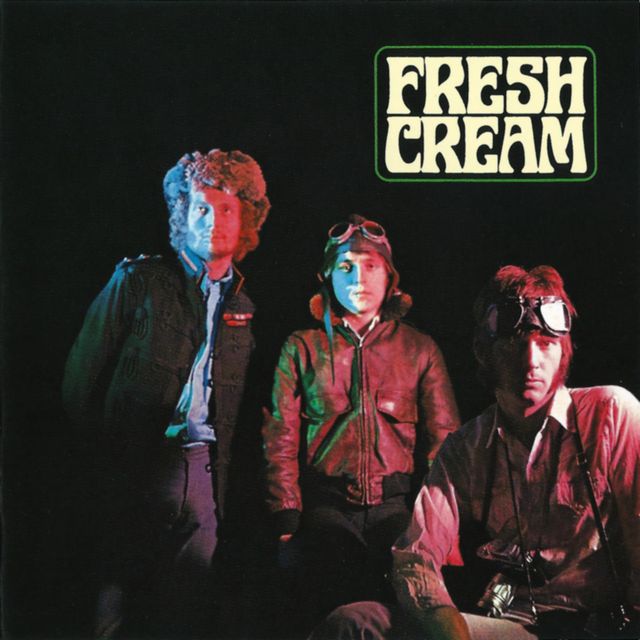
Fresh Cream came out on December 9, 1966. It was the first album on Reaction, Stigwood's own label, and it was sold in mono and stereo. The cover photo showed the three of them in old flying gear, with leather jackets and airmen's goggles.
Melody Maker reviewed it on December 24. The paper said it was “not quite as fresh as it should have been,” because the band were improving so fast that the record already sounded like “almost early material.” Still, the review called it “a great record,” with Clapton, Baker and Bruce “working like trojans to construct exciting, free, wild music of life, love, and soul.” It added: “Clapton bends, spits, and soars like a bird.”
Clapton agreed with the first part. “It could have been better,” he said not long after it came out. “We were working on it so long ago, and we have greatly improved since then. I'm also not completely happy with the production.” The public bought it anyway. Fresh Cream reached No. 6 on the UK albums chart and stayed on it for 19 weeks.
America was slower. Atco released the album there in January 1967, with “I Feel Free” in place of “Spoonful” and a different cover. It eventually peaked at No. 39. Baker felt Stigwood was more interested in his other new act, the Bee Gees. “He would be taking out huge ads in Melody Maker for them, while the Cream would get a two-line mention,” Baker said. He believed Stigwood only got behind Cream once the album entered the American chart.
American critics were mixed. Jon Landau's Crawdaddy! review in June 1967 found “too much chaff, too much unfulfilled experimentation, to make this a really first-rate album.” He thought the originals were the weak spots and picked “I'm So Glad” as the best track. But he still concluded that Fresh Cream had “enough good Cream on it to be well worth your attention.”
A Glorious Mistake
Cream lasted just over two years. Stigwood sent them to New York to record Disraeli Gears for Atlantic with producer Felix Pappalardi and engineer Tom Dowd. That album gave them “Sunshine of Your Love” and made them stars in America. Wheels of Fire followed in 1968. By the end of that year Bruce and Baker were fighting again, and the amplifiers had grown from one Marshall each to triple stacks. The band played its farewell shows at the Royal Albert Hall in November 1968.
Clapton has never warmed to the debut. Asked by Classic Rock in 2016 how it compared with the other big albums of 1966, he mimed being winded. “I thought the John Mayall album was better than the Cream stuff,” he said. “I thought we were really weak, to be honest, on record.” In 1994 he told Guitar World that Cream had been “a glorious mistake.” “It was meant to be a blues trio,” he said. “Jack and Ginger were the powerful, dominant personalities in the band; they sort of ran the show and I just played.”
Baker felt the opposite. “The first album was something I was completely pleased with, to be quite frank,” he said. Bruce put the band's sound down to its three people. “I think that band couldn't have happened if it had been any other drummer, another bass player, singer, guitarist,” he said. “I couldn't imagine anyone else being in Cream.”
From “Toad” to Heavy Metal
The year 1966 also gave us Pet Sounds, Blonde on Blonde and the Beatles' Revolver. Fresh Cream is rougher than any of them. What it added was volume and a new shape for a band. Three players, each soloing and pushing the others, filled the space a five-piece band used to fill. Within a few years Led Zeppelin, Black Sabbath and a long line of power trios were working the same way.
Critics now hear that line clearly. Gallucci of Ultimate Classic Rock wrote that groups like Led Zeppelin and the Who would probably never have gone in the same direction without Cream. Classic Rock ranks it fourth among the greatest British blues-rock albums, calling it “one of the most important albums in 60s blues rock.” The magazine singled out “Sweet Wine,” where Clapton builds “a dense, swirling psychedelic cloud of feedback and sustain.” Uncut's Robinson heard the roots of Sabbath in it, a link our review of Paranoid picks up.
The album has been reissued many times. A deluxe box set in 2017 gathered the mono and stereo mixes, the singles, outtakes such as “The Coffee Song” and “Beauty Queen,” and BBC radio sessions. In 2005 the three original members reunited for a run of shows at the Royal Albert Hall. They played “Toad” again, with Clapton and Bruce leaving Baker alone on stage for the solo.
Baker died in October 2019, five years after Bruce. Sixty years on, Fresh Cream is still the plainest record of what the three of them sounded like before the fame and the triple stacks.
“Their debut captures one of those elusive moments in music when blues, pop and rock magically starts to coalesce to create something brand new.”